Cardano Founder Calls For Simpler, Safer Crypto Across All Chains

bitcoinistОпубликовано 2026-05-08Обновлено 2026-05-08

Введение

Cardano founder Charles Hoskinson argued at Consensus 2026 that the crypto industry must overcome its complex and intimidating user experience to achieve mainstream adoption. He highlighted the burdens of managing seed phrases, navigating exchanges, and understanding DeFi risks as major barriers. Hoskinson's solution involves simplifying self-custody, identity, privacy, and multi-chain access without reverting to centralized control. He praised efforts like Ethereum's account abstraction but warned that abstraction must be paired with privacy to avoid recreating Web2's surveillance model. Hoskinson introduced Midnight Passport as a framework designed to offer secure, mobile-native management across multiple blockchains. He also discussed the future role of AI agents in handling transactions, emphasizing that privacy will be critical as these agents require deep personal context to operate effectively.

Cardano founder Charles Hoskinson used a Wednesday keynote at Consensus 2026 in Miami to argue that crypto’s next phase will not be won by another isolated chain, token or wallet. The Cardano founder said the industry must make self-custody, identity, privacy and multi-chain access simple enough for mainstream users without handing control back to centralized intermediaries.

Hoskinson framed the problem bluntly: crypto still asks users to manage seed phrases, navigate exchanges, wait for withdrawals, choose between networks, avoid fake apps and understand DeFi risk before they can do anything useful. That, he said, remains the core barrier to bringing “the next few billion people” into the industry.

“The number one problem that people say again and again and again when they think about cryptocurrencies, whether you’re an experienced user and you’ve been in the industry a long time or you’re a completely new person, you’ve heard about the industry is, I’m gonna fuck it up. The safety side,” Hoskinson said. “That is the user experience in 2026. That make any sense to you? Is this like a product you wanna use?”

Cardano Founder Targets Crypto’s UX Problem

His answer was not to abandon crypto’s original principles, but to make them usable. Hoskinson contrasted crypto’s current experience with Web2 products such as Google Wallet, which he said has around 1.5 billion users and trains consumers to expect one-click setup, recovery and seamless mobile access. Crypto, in his view, cannot keep insisting it is “different” if the product experience remains too punishing for ordinary users.

A central theme of the keynote was abstraction. Hoskinson credited Ethereum with advancing account abstraction and chain abstraction standards, arguing that these efforts became necessary as fragmented layer-2 environments created a poor user experience. He also pointed to Near Protocol as an example of embedding those ideas at the protocol level, citing $71 million in transaction fees in a year and billions of dollars traded through Near intents.

But Hoskinson warned that abstraction carries a tradeoff. When users delegate complexity to third parties, those parties often gain visibility into assets, transactions, preferences, identity and business data. For crypto to scale without repeating the surveillance model of Web2, he argued, abstraction must be paired with privacy.

“When you abstract things, you delegate to people. You trust people. You give them something to do that on your behalf somewhere else,” he said. “You don’t worry about the doing, but when they do the doing, they know you. They know what you’re buying. They know where you’re at.”

That argument led into Hoskinson’s pitch for Midnight Passport, a framework he described as combining mobile-native key management, recovery, self-sovereign identity, selective disclosure, wallet credentials, name services and multi-chain signatures. The idea, according to Hoskinson, is to let users scan a QR code, rely on trusted execution hardware already built into phones, encrypt off-chain data client-side and create wallets across networks such as Bitcoin, Ethereum, Solana and XRP.

“I don’t care what networks you want to use. I don’t care what assets you want to have,” Hoskinson said. “I want you to have control of those assets. I want you to custody those assets. I want you to be in control of your identity and your data.”

The keynote also expanded into AI agents, which Hoskinson described as an incoming force that could reshape internet commerce and crypto usage. He argued that agents may eventually handle most searches, transactions and online activity, while humans interact with a smaller “human internet.” For crypto, that raises a practical question: if users cannot safely evaluate DeFi protocols, counterparties or risks themselves, AI systems may become the layer that performs diligence and execution.

Hoskinson said this makes privacy even more important, because effective agents require deep personal context. Midnight Passport, he said, is being developed not only for people but also for agents, allowing rules to be set around identity, data access and execution.

At press time, Cardano traded at $0.2689.
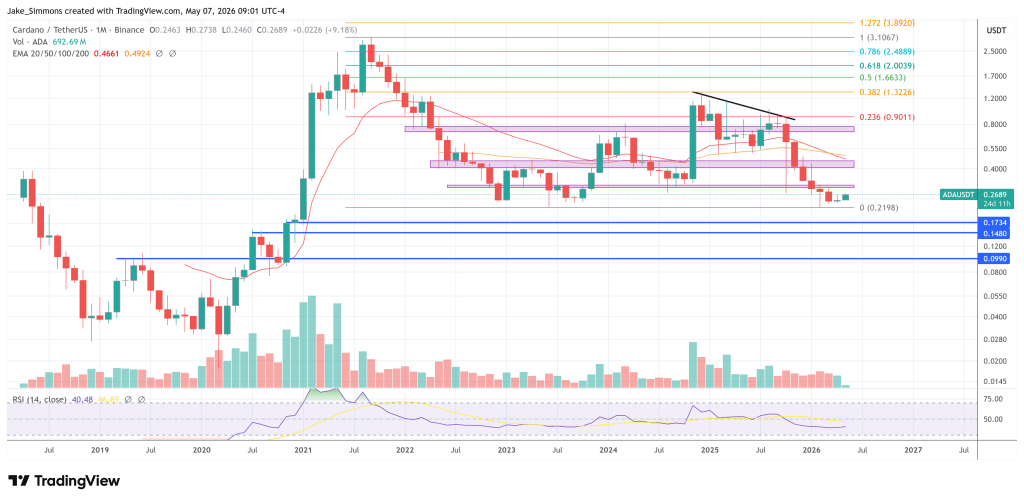
Cardano remains below key resistance, 1-monthly chart | Source: ADAUSDT on TradingView.com

Связанные с этим вопросы

QWhat is the main barrier to bringing mainstream users into crypto, according to Charles Hoskinson?

AAccording to Hoskinson, the main barrier is the poor user experience, which asks users to manage seed phrases, navigate exchanges, wait for withdrawals, choose between networks, avoid fake apps, and understand DeFi risks before they can do anything useful.

QWhat does Hoskinson identify as a necessary tradeoff that comes with simplifying crypto through abstraction?

AHoskinson identifies that the tradeoff with abstraction is often a loss of privacy. When users delegate complexity to third parties, those parties gain visibility into their assets, transactions, preferences, identity, and business data.

QWhat is the proposed solution, Midnight Passport, designed to combine?

AMidnight Passport is designed to combine mobile-native key management, recovery, self-sovereign identity, selective disclosure, wallet credentials, name services, and multi-chain signatures to simplify user experience across different blockchains.

QAccording to the keynote, why will privacy become even more critical with the rise of AI agents?

APrivacy will become more critical because effective AI agents require deep personal context to operate. Therefore, systems are needed to set rules around identity, data access, and execution for these agents, protecting user data.

QHow did Hoskinson contrast the current crypto user experience with that of successful Web2 products?

AHe contrasted it with products like Google Wallet, which trains consumers to expect one-click setup, recovery, and seamless mobile access. He argued crypto cannot insist it is 'different' if its product experience remains too punishing compared to these seamless mainstream options.

Похожее

a16z Crypto Partner: Cryptocurrency is Being Repackaged by Financial Institutions, Its Potential Far Exceeds Imagination

"Digital Assets" and the Real Digital Transformation of Finance The term "digital assets" puzzles many in crypto, as most assets today are already digital. Yet, the financial industry's core infrastructure has largely escaped the profound digital transformation seen in other sectors like media and retail. Beneath modern interfaces, finance still relies on fragmented systems, manual reconciliation, and paper-based processes. The true driver for blockchain adoption by large financial institutions is not ideology but a practical need to solve coordination problems. It provides a neutral system for multiple parties to collaborate without ceding control to a single entity. Asset ownership is encoded directly into the software, eliminating separate ledgers and disputes over records. The asset *is* the record. While crypto's adoption by Wall Street involves compromises and compliance, it inherits a key capability: *composability*. When financial assets exist on shared, programmable infrastructure, they can be combined, extended, and integrated seamlessly. The immediate benefits are faster settlement and lower costs, but the deeper, structural change is the newfound ease of building applications on top of this system. In essence, crypto technology is not disappearing into financial institutions but being repackaged as foundational infrastructure. As Wall Street adopts it, the industry may ultimately inherit more of crypto's transformative potential than it initially anticipated.

链捕手14 мин. назад

a16z Crypto Partner: Cryptocurrency is Being Repackaged by Financial Institutions, Its Potential Far Exceeds Imagination

链捕手14 мин. назад

Berkshire Hathaway and SoftBank: One Must Die

Berkshire and SoftBank: A Tale of Two Extremes The article presents a speculative future (set in 2026) contrasting the investment philosophies and potential fates of Berkshire Hathaway and SoftBank Group. Under new CEO Greg Abel, Berkshire sits on a massive cash pile of nearly $400 billion, built by selling assets like Apple stock over many quarters. Buffett and now Abel deem the market overvalued and refuse to invest, leading to significant underperformance. The "disease" of too much cash poses an existential threat to Berkshire's identity as a capital allocator, potentially forcing a future breakup or special dividend if the bull market persists. Its "death" would be a slow, dignified fading of its legendary investment narrative. In stark contrast, SoftBank's Masayoshi Son is all-in on a high-stakes gamble. To fund a colossal $64.6 billion (and growing) investment in OpenAI, SoftBank has aggressively leveraged itself. It has sold core holdings like Nvidia, T-Mobile, and Alibaba, taken on over $100 billion in parent-level debt, and secured a record $40 billion bridge loan. The survival strategy hinges on a successful OpenAI IPO and the high valuation of its Arm holdings. However, this creates multiple interconnected risks: an OpenAI IPO delay, a correction in Arm's lofty valuation, or a credit market freeze. Any of these could trigger a liquidity crisis. SoftBank's potential "death" would be swift and dramatic. The core thesis is that in this speculative market, one extreme strategy—Berkshire's paralyzing caution or SoftBank's all-or-nothing leverage—will likely prove unsustainable. One may lose its soul, the other may face financial rupture.

链捕手42 мин. назад

Berkshire Hathaway and SoftBank: One Must Die

链捕手42 мин. назад

The AI Economy I Saw at Stripe Sessions 2026

"At Stripe Sessions 2026, the AI economy's impact is undeniable, echoing the delayed productivity recognition seen with computers in the '90s. Stripe's data shows an AI boom: new business formation has surged vertically since early 2026, with companies generating revenue 5x faster than a year ago. AI firms like Lovable and Cursor scale to billions in months. Two key features define this economy: unprecedented speed and being 'global by default,' with companies reaching 55+ countries in their first year. Stripe's global financial infrastructure is critical for this instant international commerce. The conference's central theme was 'Agentic Commerce'—a future where AI agents become economic participants. Demos showed agents autonomously purchasing data, generating reports, and selling them. This shift introduces micro-payments and continuous 'strategic' spending, as agents lack human cognitive friction. New challenges like fraud targeting AI's real inference costs are met with systems like Stripe's Radar. The transition requires an ecosystem. Stripe is collaborating on protocols like the Machine Payments Protocol (MPP) and joining the Universal Commerce Protocol (UCP) to enable seamless agent-to-agent transactions. Underpinning this vision is Stripe's philosophy: 'money is data,' programmable and operable by agents. Thus, Stripe is not just powering the AI economy but acting as its 'heart-rate monitor,' capturing its rapid pulse through transactions equating to nearly 2% of global GDP."

marsbit58 мин. назад

The AI Economy I Saw at Stripe Sessions 2026

marsbit58 мин. назад

Three Months of Raising $6 Billion in Funding: What Are the Leading Crypto VCs Betting On?

While the crypto bear market persists, top-tier venture capital firms are making significant moves by raising massive new funds, signaling a strategic bet on the industry's future. Haun Ventures and a16z recently announced funds totaling $1 billion and $2.2 billion, respectively. This follows other major raises from firms like Dragonfly, Paradigm, ParaFi, and Blockchain Capital. In under three months, these six VCs have amassed over $6 billion in fresh capital, a clear example of counter-cyclical investing during a quiet market phase. The fundraising landscape highlights a sharp divergence between large and small VCs. Many mid-sized and smaller funds are struggling with poor returns, limited exit options, and difficulty raising new capital, leading some to scale back or exit. In contrast, leading firms are strengthening their dominance due to structural advantages: superior access to high-quality deals, the ability to invest across all stages, greater capacity for long-term bets and risk, and stronger negotiation power. These new funds are largely converging on key investment themes. The strongest consensus centers on next-generation on-chain financial infrastructure, including stablecoins, real-world asset (RWA) tokenization, prediction markets, and on-chain payments. VCs are focusing on projects with validated demand that can attract traditional finance flows. Another major focus is artificial intelligence (AI), particularly AI agents, as crypto seeks to position its open, composable networks as foundational infrastructure for the emerging AI economy. Ultimately, this wave of bear-market fundraising is a strategic wager on the next cycle. By deploying capital when valuations are lower and market noise is reduced, these top VCs aim to identify and back the foundational projects that will define the industry's future, betting on which companies will become the next generation of leaders.

marsbit1 ч. назад

Three Months of Raising $6 Billion in Funding: What Are the Leading Crypto VCs Betting On?

marsbit1 ч. назад

AI Agent Practical Guide: How to Power an Entire Company with Three Intelligent Agents?

AI Agent Implementation Guide: How to Use Three Intelligent Agents to Run an Entire Company? Every solopreneur faces the same bottleneck: too much work for one person, yet not enough revenue to hire three full-time employees at $60,000 each. These roles—market research, content creation, and daily operations—are essential and often consume the founder's time. The smartest entrepreneurs are now "building" AI agents for these jobs instead. Using Claude, MCP servers, and agentic workflows, you can build three specialized AI agents: 1. **Research Agent:** Acts as a full-time market intelligence analyst. It proactively monitors competitors, tracks industry trends, identifies opportunities, and delivers a concise weekly briefing. It requires a knowledge base of competitors and market data, tools like web search APIs and access to your files, and a workflow that runs automatically every Monday. 2. **Content Agent:** Manages your entire content production pipeline from ideation to publishing. It generates topics, drafts content, edits for your specific brand voice, repurposes content across platforms, and schedules posts. Key steps include feeding it your best writing samples to learn your style and implementing quality checks to ensure content meets your standards before you add your unique "soul" to it. 3. **Operations Agent:** Serves as your chief of staff, handling time-consuming administrative tasks like email triage, meeting preparation, and generating weekly reports. By connecting to your email, calendar, and project management tools, it can compress hours of daily work into a 15-minute review. The crucial step is enabling these agents to collaborate as a team. A shared knowledge base allows them to work together; for example, the research agent flags a competitor's new feature, the content agent creates a response, and the operations agent drafts a related email to clients. Financially, three human employees cost around $180,000 annually plus overhead, while three AI agents primarily cost your Claude subscription and setup time. While agents lack human judgment, creativity, and empathy, they can handle 70-80% of the workload for these core roles in a startup's first 12-18 months. The guide recommends building one agent per week: start with research, then content, then operations. In three weeks, you can have a 24/7 AI-powered team instead of working alone.

marsbit1 ч. назад

AI Agent Practical Guide: How to Power an Entire Company with Three Intelligent Agents?

marsbit1 ч. назад

Торговля

Спот
Фьючерсы

Популярные статьи

Как купить ADA

Добро пожаловать на HTX.com! Мы сделали приобретение Cardano (ADA) простым и удобным. Следуйте нашему пошаговому руководству и отправляйтесь в свое крипто-путешествие.Шаг 1: Создайте аккаунт на HTXИспользуйте свой адрес электронной почты или номер телефона, чтобы зарегистрироваться и бесплатно создать аккаунт на HTX. Пройдите удобную регистрацию и откройте для себя весь функционал.Создать аккаунтШаг 2: Перейдите в Купить криптовалюту и выберите свой способ оплатыКредитная/Дебетовая Карта: Используйте свою карту Visa или Mastercard для мгновенной покупки Cardano (ADA).Баланс: Используйте средства с баланса вашего аккаунта HTX для простой торговли.Третьи Лица: Мы добавили популярные способы оплаты, такие как Google Pay и Apple Pay, для повышения удобства.P2P: Торгуйте напрямую с другими пользователями на HTX.Внебиржевая Торговля (OTC): Мы предлагаем индивидуальные услуги и конкурентоспособные обменные курсы для трейдеров.Шаг 3: Хранение Cardano (ADA)После приобретения вами Cardano (ADA) храните их в своем аккаунте на HTX. В качестве альтернативы вы можете отправить их куда-либо с помощью перевода в блокчейне или использовать для торговли с другими криптовалютами.Шаг 4: Торговля Cardano (ADA)С легкостью торгуйте Cardano (ADA) на спотовом рынке HTX. Просто зайдите в свой аккаунт, выберите торговую пару, совершайте сделки и следите за ними в режиме реального времени. Мы предлагаем удобный интерфейс как для начинающих, так и для опытных трейдеров.

2.1k просмотров всегоОпубликовано 2024.03.29Обновлено 2025.07.02

Как купить ADA

SNEK: ведущий мемкоин на блокчейне Cardano, открывающий новую эпоху для экосистемы Cardano

SNEK - это дефляционный мемкоин, выпущенный на блокчейне Cardano. Он создаёт децентрализованную культурную и развлекательную ценность за счёт участия глобального сообщества.

2.0k просмотров всегоОпубликовано 2025.10.15Обновлено 2025.10.15

SNEK: ведущий мемкоин на блокчейне Cardano, открывающий новую эпоху для экосистемы Cardano

Неделя обучения по популярным токенам 8: запуск основной сети Ouroboros Leios для ADA ожидается в 2026 году

Основная сеть Ouroboros Leios для ADA, как ожидается, будет запущена в 2026 году, а хардфорк до версии протокола 11 запланирован на I квартал 2026 года.

1.9k просмотров всегоОпубликовано 2026.02.10Обновлено 2026.02.12

Неделя обучения по популярным токенам 8: запуск основной сети Ouroboros Leios для ADA ожидается в 2026 году

Обсуждения

Добро пожаловать в Сообщество HTX. Здесь вы сможете быть в курсе последних новостей о развитии платформы и получить доступ к профессиональной аналитической информации о рынке. Мнения пользователей о цене на ADA (ADA) представлены ниже.

活动图片