AI Giants Queueing Up for IPOs: Is This the 'Last Dance' for the U.S. Stock Market?

marsbitОпубликовано 2026-05-25Обновлено 2026-05-25

Введение

A massive wave of IPOs from AI giants like OpenAI, Anthropic, and SpaceX is taking shape, potentially reshaping the U.S. stock market. OpenAI is reportedly preparing for a historic IPO, targeting a valuation over $1 trillion and raising roughly $60 billion, which would dwarf previous records. Anthropic is also advancing its own IPO plans, projecting significant revenue growth and achieving quarterly operating profit. However, their financial profiles starkly differ. While Anthropic is nearing profitability with a focus on enterprise clients, OpenAI continues to report substantial losses, with a negative operating margin and expectations for positive cash flow only by 2029-2030. Analysts warn these listings could trigger a major "passive fund reshuffle," forcing index funds to sell holdings in established tech giants to make room for the new entrants, potentially pressuring the broader market. Some observers view the IPO rush as a "risk transfer," allowing early private investors to cash out at peak valuations while passing future financial uncertainty to public market investors. The divergent paths of Anthropic's near-term profitability versus OpenAI's long-term, high-cost growth narrative present a critical choice for investors. The outcome of these IPOs is seen as a major swing factor for risk assets in 2026, testing whether this surge marks a new cycle or a potential peak.

Author: Dong Jing

Source: Wall Street News

An IPO feast comparable to the peak of the dot-com bubble is taking shape. AI giants OpenAI, Anthropic, and SpaceX are racing towards the public markets, each targeting a trillion-dollar valuation. Their combined scale is enough to reshape the landscape of the U.S. stock market. This unprecedented wave of listings is both the ultimate stress test for AI investment logic and the biggest variable for the direction of risky assets this year.

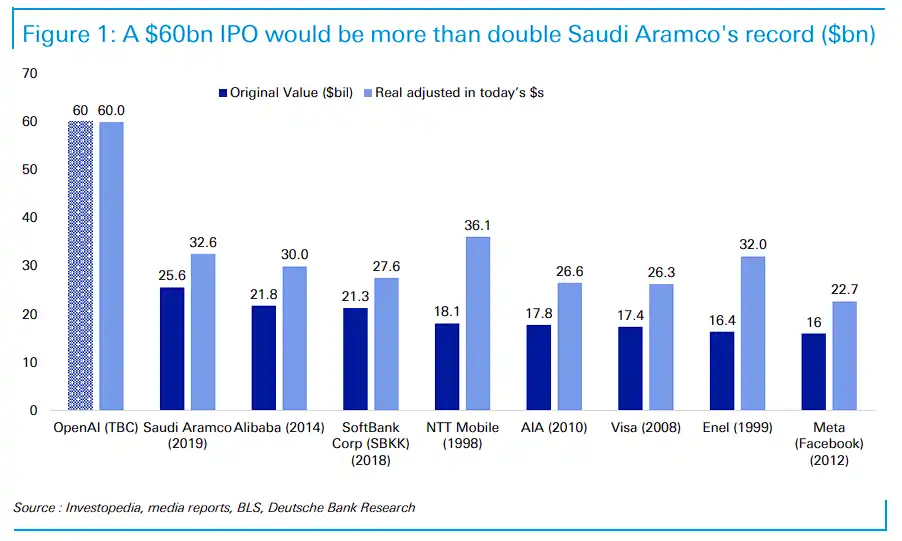
On May 22, according to a Wall Street News article, OpenAI has prepared to confidentially file its IPO application with regulators. The listing could happen as early as September this year, targeting a valuation exceeding $1 trillion and aiming to raise approximately $60 billion. This would more than double the $25.6 billion IPO record set by Saudi Aramco in 2019.

Meanwhile, rival Anthropic is also advancing its own listing plans and disclosed that its Q2 revenue is expected to double sequentially to $10.9 billion, potentially achieving quarterly operating profitability for the first time. Deutsche Bank noted in a research report that the landing of these two IPOs "is likely to become a major swing factor for the direction of risky assets this year," and is a macro theme that must be closely watched.

However, beneath the glossy valuations, the two companies' financial fundamentals are starkly different. OpenAI's Q1 revenue was $5.7 billion, but its adjusted operating profit margin was -122%, meaning it lost $1.22 for every dollar of revenue generated. It is not expected to achieve positive cash flow until 2029 or 2030 at the earliest. Anthropic's revenue was $4.8 billion in the same quarter and is projected to jump to $10.9 billion in Q2, with an expected operating profit of about $559 million, having already touched the threshold of profitability.

Analysis points out that these two companies are competing on the same stage but present vastly different business logics, presenting public market investors with a rare dilemma.

The Largest IPO in History: How Shocking Are the Numbers?

Deutsche Bank noted in a research report that the scale of either OpenAI's or Anthropic's single IPO would exceed twice the fundraising amount of Saudi Aramco's 2019 IPO. Even after inflation adjustment, it would easily become the largest IPO in history.
Deutsche Bank stated in another report that if OpenAI achieves its target valuation of over $1 trillion, it would become the world's 14th largest company by market capitalization, trailing only Berkshire Hathaway and surpassing Eli Lilly.
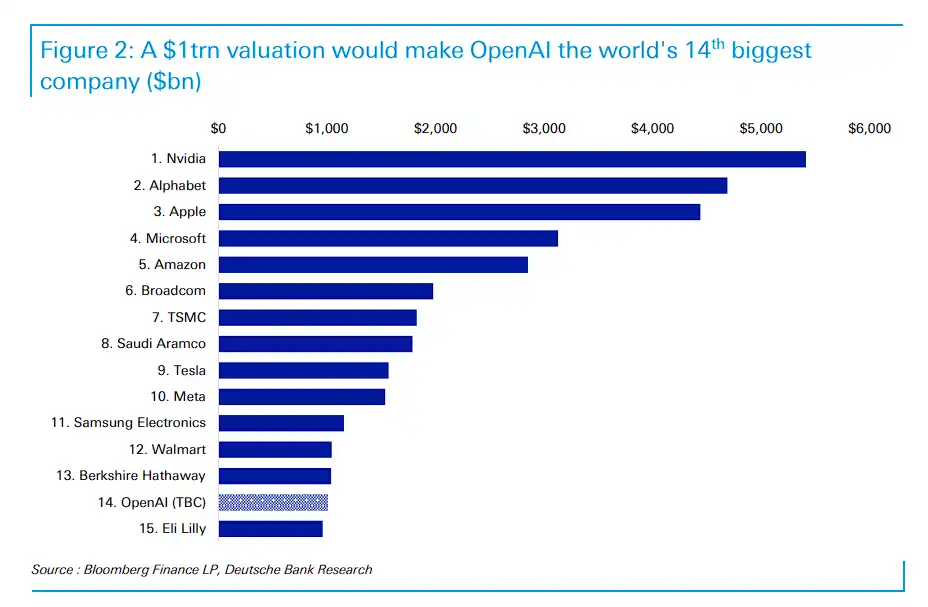
For comparison, Berkshire's revenue last year exceeded $370 billion with a net profit of $67 billion; Eli Lilly's sales exceeded $65 billion with a profit of $21 billion. In contrast, OpenAI is not yet profitable, has an annualized revenue of about $30 billion, and only has thousands of employees.

From a market capacity perspective, Deutsche Bank believes the current total U.S. stock market capitalization is about $70 trillion, five times that of the peak of the dot-com bubble. The market's digestion capacity is far stronger than in the late 1990s.

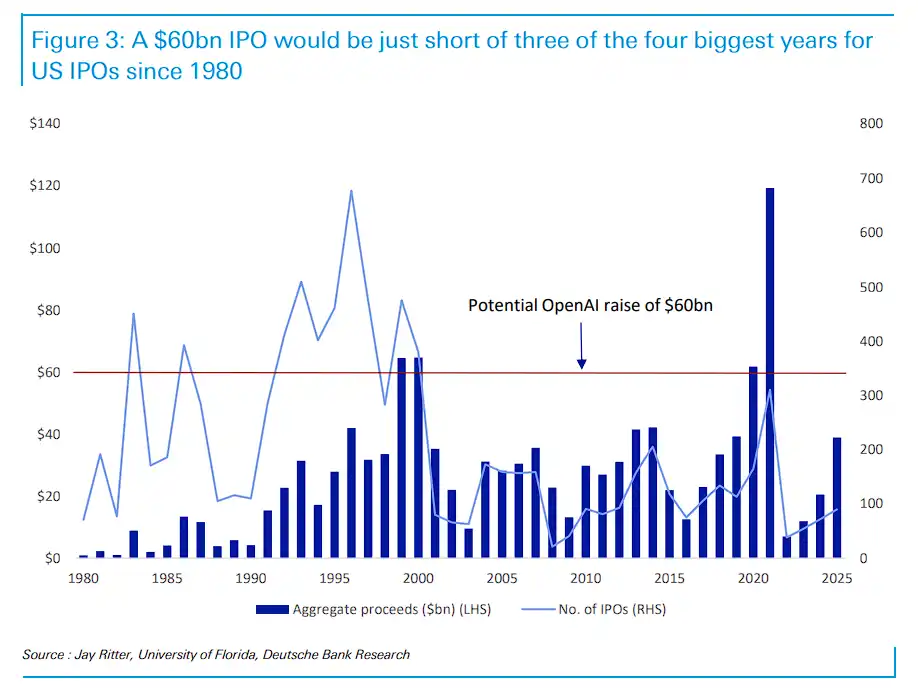
Back then, there were nearly 500 IPOs annually on average, whereas this decade averages only about 120, and today's listed companies are generally more mature.

Furthermore, a single $60 billion IPO is slightly less than the total fundraising for all U.S. IPOs in both 1999 and 2000 (each around $65 billion), equivalent to half of the record $119 billion set in 2021.
The 'Siphoning Effect' of the Behemoths and the Massive Passive Fund Reallocation

As these giants move towards public markets, their potential liquidity drainage effect on the U.S. stock market has already raised high alert on Wall Street.

The clustering of SpaceX, OpenAI, and Anthropic listings, combined with Nasdaq's newly introduced "fast inclusion" mechanism, is brewing an unprecedented massive reallocation of passive funds—the siphoning effect of the AI behemoths.

As mentioned in a Wall Street News article, JPMorgan Chase estimates that if SpaceX targets a $2 trillion valuation and ultimately achieves a 50% free float, passive funds would have to sell approximately $95 billion of their holdings in the current eight major Wall Street tech stocks (Nvidia, Apple, Microsoft, Amazon, Google, Broadcom, Meta, Tesla) to make room for the new entries.

Todd Sohn, Chief ETF Strategist at Strategas, points out that since the initial public float of an IPO is typically only 5%, while ETFs track trillions in assets, this extreme supply-demand imbalance will make the index inclusion process "slightly crazy." Passive investors may have no choice but to buy at high prices.

Valérie Noël, Head of Trading at Syz Group, stated that the market has already begun betting on downward pressure on existing large-cap stocks.

According to information disclosed on March 28 this year, OpenAI's public listing will be a substantial referendum on the entire AI investment logic. That information showed that OpenAI's revenue reached $13.1 billion in 2025, but its net loss in 2026 is projected to be $14 billion.

Simultaneously, OpenAI has committed to investing approximately $1.4 trillion in infrastructure construction before 2033. If S&P Global, FTSE Russell, and Nasdaq adopt fast-inclusion rules, they could force passive funds to buy around $24 billion to $48 billion immediately after the listing.

Faced with such a massive fund restructuring, ordinary investors, whether active or not, will see their portfolios passively reshaped as rules change.

Deutsche Bank noted in its report that the landing method of these IPOs will be a major swing factor for the direction of risky assets this year. PitchBook's analysis is more blunt:

There has been a "systematic quality inversion" in the private market—the companies with the highest valuations score lowest on the business quality metrics that truly matter for pricing in the public market.

For ordinary investors holding index funds or ETFs, it's hard to stay out of this game: whether active or not, their investment portfolios will be passively reshaped as index rules change.

For active investors, once the S-1 filings are public and all financial secrets are laid bare, the market will face a clear choice: to believe in a company that has already found a profitable model, or a giant asking the market for several more years and hundreds of billions of dollars to explore profitability?

The answer will determine whether this frenzy marks the start of a new cycle or the last dance before the party ends.

A Tale of Two Extremes: Anthropic Profits vs. OpenAI's Huge Losses

Despite soaring valuations, the financial conditions of the two AI leaders present starkly different pictures. Anthropic has begun to turn a profit, challenging the traditional notion that massive spending by AI companies would hinder near-term profitability.

According to a Wall Street News article, on Wednesday local time, The Wall Street Journal reported that Anthropic's Q2 revenue is expected to more than double to $10.9 billion and achieve an operating profit of approximately $559 million.

Anthropic's gross margin has jumped from 38% to over 70%. Its CEO, Dario Amodei, once joked that revenue growth had become "too difficult to handle."

The company's success is largely attributed to explosive demand from enterprise clients for its programming tools. About 85% of its revenue comes from enterprise and developer customers, a model with clear willingness to pay and relatively lower service costs.

In contrast, OpenAI is still losing money.

As mentioned in a Wall Street News article, data shows OpenAI's Q1 revenue was $5.7 billion, but its adjusted operating profit margin was -122%, meaning it loses $1.22 for every dollar earned.

Approximately 85% of OpenAI's revenue is related to ChatGPT consumer subscriptions. Despite having 55 million paying users, it supports a vast pool of over 900 million weekly active users, creating a massive cost black hole due to inference expenses for the free users.

OpenAI is not expected to achieve positive cash flow until 2029 or 2030. Its CEO Sam Altman and Head of Applied Business Fidji Simo are trying to shift focus towards commercial clients who can directly generate revenue.

At the IPO narrative level, the two companies are telling entirely different stories. Anthropic, armed with verified quarterly profitability data, tells a story comparable to Salesforce or ServiceNow—the logic of an enterprise software company.

OpenAI needs to convince the market to believe that AI agents, image generation, and even advertising businesses will eventually turn its massive consumer traffic into profit.

In Sam Altman's plan, the ChatGPT advertising business might bring in about $102 billion in revenue by 2030. But this requires time, and time is precisely the most scarce resource for OpenAI as it trades losses for growth.

AI Giants Rushing to IPO: Essentially Passing the 'Hot Potato' to Retail Investors?

According to a Wall Street News article, in the view of Joachim Klement, Managing Director at Panmure Liberum, this wave of AI giant IPOs is essentially a "risk transfer"—a large-scale offloading of early-stage investment risks onto retail investors, pension funds, and other institutions.

He believes that companies like OpenAI and Anthropic are accelerating their listings while investor sentiment is high, aiming to cash in at high valuations before the hype fades. Early institutional investors can exit entirely in the public market, while the retail investors and pension funds that take over will directly face the risk of financial logic eventually returning to reality.

He directly characterized this process as "the action of transferring investment risk on a massive scale from current holders to those willing to pay for the story."

Klement referenced Alan Greenspan's 1996 "irrational exuberance" warning as a benchmark—it was three years before the bubble burst. He judged that the AI hype in 2026 could still persist, and the likelihood of hyperscale cloud providers cutting investments is not high. However, the "impossible math" will eventually return to reality, "perhaps not in 2026, but 2027 or 2028 might see it arrive."


Связанные с этим вопросы

QAccording to the article, what is the estimated target valuation for OpenAI's upcoming IPO?

AOpenAI's target valuation for its upcoming IPO is over $1 trillion (more than 1 trillion US dollars).

QWhich AI company is highlighted as achieving operational profitability ahead of OpenAI?

AAnthropic is the AI company highlighted as achieving operational profitability ahead of OpenAI, expecting about $5.59 billion in operating profit for Q2.

QWhat significant financial risk is associated with OpenAI's current business model according to the article?

AA significant financial risk for OpenAI is its negative adjusted operating margin of -122%, meaning it loses $1.22 for every dollar of revenue it generates.

QWhat potential market impact does the article suggest could result from the massive IPOs of AI giants like SpaceX and OpenAI?

AThe article suggests a potential 'siphoning effect' or massive passive fund reallocation, where passive funds might need to sell significant holdings in existing large tech stocks to make room for the new giants, potentially putting downward pressure on those stocks.

QHow does Joachim Klement from Panmure Liberum characterize the wave of AI giant IPOs?

AJoachim Klement characterizes the AI giant IPO wave as essentially a 'risk transfer', a large-scale shifting of early-stage investment risks from current holders to retail investors, pension funds, and other institutions willing to buy into the narrative.

Похожее

When Futu Turns into a Matchmaking Corner: Overseas Identity Becomes the Hard Currency for the Middle Class

When Futu Becomes a Matchmaking Corner: Overseas Status as the New Hard Currency for China's Middle Class Following a severe penalty announcement from Chinese regulators on May 22nd targeting offshore brokerages like Futu, its app community unexpectedly transformed into an impromptu matchmaking platform. Users posted相亲 (matchmaking) requests, explicitly seeking partners with overseas residency or citizenship, revealing a stark new reality: for China's middle class, an overseas identity has become a crucial asset. The regulatory crackdown, which restricts mainland Chinese residents from opening new accounts to buy overseas securities like US stocks, has sharply escalated the value of a foreign passport or permanent residency. This status now acts as a gateway to global asset allocation—including US equities, offshore property, and foreign currency deposits—effectively becoming a new form of "hard currency." Its scarcity, non-transferability (except through marriage, inheritance, etc.), and role as a hedge against domestic uncertainty have driven its premium. The article traces the evolution of how China's middle class views overseas resources: from an investment for opportunity (2000s), to risk diversification (2010s), and now to a mandatory "insurance policy" for financial access. With the regulatory window closing for many, the demand is shifting towards securing such status for the next generation through international education. The surreal scene of high-performing investors posting dating resumes underscores a 2026 where financial talent can be secondary to the right passport.

marsbit15 мин. назад

When Futu Turns into a Matchmaking Corner: Overseas Identity Becomes the Hard Currency for the Middle Class

marsbit15 мин. назад

Understanding Bound in One Article: The "Multi-signature + Timelock" Escape Mechanism and the Off-Chain Matching Black Box

**Title**: Understanding Bound: The Escape Mechanism of "Multi-Sig + Time Lock" and the Off-Chain Matching Black Box **Summary**: Bound Exchange, evolved from the earlier radFi platform, introduces a novel approach to Bitcoin trading by combining self-custody security with exchange-like speed. Its core mechanism relies on a 2-of-2 multi-signature (multi-sig) address for user deposits. One private key is held by the user via a passkey, and the other is held by Bound. This setup requires both keys to sign any transaction, preventing Bound from unilaterally accessing user funds (non-custodial). To address the risk of Bound becoming unavailable, a 3-month timelock is integrated into the Bitcoin script. After this period, users can withdraw their assets with just their single signature, ensuring an escape hatch. For trading, Bound operates a concentrated liquidity AMM. However, as Bitcoin L1 lacks smart contracts, the AMM curve, liquidity management, and trade price calculations occur off-chain in Bound's backend database. On-chain Bitcoin transactions serve only as final settlement receipts for pre-determined amounts. This creates a centralization point: the critical sequence of trade execution—which determines the exact price along the curve for each order—is managed off-chain by Bound in a non-transparent "black box." While the 2-of-2 setup protects user本金 (principal), the pricing and ordering of trades introduce potential operational MEV risks, as the order processing is invisible and unverifiable on-chain. In practice, users can also connect external wallets (like Unisat) for fully self-custodied trading, but this requires manually signing every transaction. The platform currently supports deposits of BTC and Runes only.

marsbit20 мин. назад

Understanding Bound in One Article: The "Multi-signature + Timelock" Escape Mechanism and the Off-Chain Matching Black Box

marsbit20 мин. назад

Amid Internal and External Challenges, Is Ethereum's Neutral Route Still Viable?

"Ethereum is facing a dual crisis of market pressure and internal challenges. Its native token ETH is in a mid-term downtrend, with negative sentiment prevailing, weak price action, and significant outflows from ETFs. The ETH/BTC ratio has hit a ten-month low, and institutional holdings have shrunk. Concurrently, the Ethereum Foundation has seen a major exodus of core personnel following its commitment to a neutral, non-commercial development roadmap focused on censorship resistance, openness, privacy, and security (CROPS). This stance has sparked debate. Critics, including former members, argue that the ecosystem lacks a dedicated, well-funded entity to promote ETH's commercial value and compete with rival chains. Proposals suggest creating a new, independent body to drive adoption and token value, forming a dual-model with the Foundation. While some investors view the personnel changes as normal turnover and remain bullish on Ethereum's long-term fundamentals, the immediate path forward is unclear. Analysts believe Ethereum must execute its technical roadmap (like upcoming upgrades), clarify governance, and focus on high-value sectors like DeFi and tokenization to convert its technological edge into a compelling investment thesis. The current downturn tests whether its decentralized model can adapt to balance core principles with commercial competitiveness."

marsbit26 мин. назад

Amid Internal and External Challenges, Is Ethereum's Neutral Route Still Viable?

marsbit26 мин. назад

Technology Has No Barriers, 24/7 Trading is the Key to Hyperliquid's Success

The article argues that Hyperliquid's competitive edge lies not in technological superiority but in its 24/7 trading model, which fundamentally challenges traditional finance's fixed market hours. Based in Singapore with an 11-person team, Hyperliquid has generated significant revenue and trading volume. Its core advantage is the ability to facilitate trading continuously, including during weekends when major exchanges like the CME are closed. This was demonstrated when Hyperliquid listed a SpaceX pre-IPO perpetual contract on a Sunday, allowing the market to price the company hours before traditional institutions opened. This disruption has drawn regulatory scrutiny from traditional giants like CME and ICE, who cite risks like lack of KYC and market manipulation. However, the article suggests their concern stems from Hyperliquid eroding the "time monopoly" of established markets. The piece contrasts Hyperliquid's synthetic derivatives—pure price-betting contracts with no underlying asset or centralized issuer—with other models like PreStocks (dependent on real股权) and Ondo (licensed but targetable). Hyperliquid's code-based, decentralized structure makes it resilient to takedowns, even if founders face legal action. Ultimately, the author concludes that while it raises legitimate regulatory questions, Hyperliquid's "unforgeable" competitive barrier is the time advantage of non-stop trading, a feature legacy systems cannot replicate.

marsbit26 мин. назад

Technology Has No Barriers, 24/7 Trading is the Key to Hyperliquid's Success

marsbit26 мин. назад

New Information Laundering in Prediction Markets: How Secrets Blend into Investment Signals

"The New Information Laundering in Prediction Markets: How Secrets Infiltrate Investment Signals In late February 2026, nine linked anonymous wallets on Polymarket placed over 80 bets on specific details of a US-Iran war, winning over $2.4 million with a 98% win rate. This exemplifies 'information laundering'—a destructive flaw inherent to prediction markets. These markets function by aggregating trader supply and demand on an order book to set prices, which represent collective probability estimates. This makes them valuable real-time sentiment indicators for institutions. However, the system cannot distinguish between public information and stolen secrets. Confidential information enters one end, and 'clean' market prices—bearing no trace of their illicit origin—emerge from the other. For example, an insider knowing of an imminent strike can buy contracts at low odds, pushing the price up and disguising the secret as a savvy market signal, then profit massively when the event occurs. Analysts can sometimes uncover these schemes due to the blockchain's transparency, as seen with Bubblemaps. Paradoxically, this same transparency can inadvertently broadcast secrets to adversarial observers, providing them with low-cost intelligence. Current laws, like insider trading regulations focused on corporate information, fail to address this issue, especially concerning events like military actions with no 'issuer.' Jurisdictional challenges are amplified as platforms operate offshore, easily bypassing national bans with VPNs. Recent US congressional investigations and proposed bills aim to ban war betting and trading on non-public information by officials. The core issue is that information laundering is not a bug but a feature: a market that perfectly converts knowledge into price will inherently reward those with the best information, including those who obtained it illicitly. As prediction markets grow, potentially reaching hundreds of billions in volume, society must confront whether it can tolerate a machine that profitably transforms its most guarded secrets into public, tradable numbers."

链捕手35 мин. назад

New Information Laundering in Prediction Markets: How Secrets Blend into Investment Signals

链捕手35 мин. назад

Торговля

Спот
Фьючерсы
活动图片