Ray Dalio: The Return of a China-led 'Tribute System', and the AI Industry Will Develop Like the Electric Vehicle Industry

marsbitОпубликовано 2026-06-08Обновлено 2026-06-08

Введение

Ray Dalio, founder of Bridgewater Associates, discusses shifting global power dynamics and AI competition between China and the US. Following recent visits to China by world leaders, Dalio observes a decline in the perceived reliability of the US as a global power and a rise in China's influence. He suggests a modern "tribute system" is emerging, where nations acknowledge China's strength, impacting global trade and security. This geopolitical shift creates market uncertainty, leading Dalio to advise investors to diversify assets, including holding gold. Regarding AI, Dalio contrasts the approaches of the two nations. He states China views AI as a public utility, akin to electricity, aiming for broad workforce accessibility over immediate profitability. Chinese companies focus on widespread adoption and productivity gains, following a strategy similar to their success in the electric vehicle industry. In contrast, US AI firms are more focused on commercialization and subscription models. A Morgan Stanley executive noted the Chinese perspective lacks fear of AI displacing jobs, instead emphasizing its use to drive development and dominate future industries like robotics.

Original Source:"Wall Street Week" Program: Dalio's Warning&Ray Dalio on U.S.-China AI Development

Compiled by | Odaily Planet Daily (@OdailyChina)

Translated by | Wenser (@wenser2010)
Editor's Note: As the founder of Bridgewater Associates, the world's largest hedge fund, Ray Dalio's remarks have always garnered significant attention from all sectors of society. His insights into the global macroeconomic landscape and various industries are particularly popular topics of discussion. Following the consecutive visits to China last month by world leaders including U.S. President Trump and Russian President Putin, Ray Dalio offered a new perspective on the matter—"The world order is changing, and a China-led tribute system is being established." Recently, he also shared his targeted views on the "competition between AI giants in China and the United States." The following content is compiled and translated by Odaily Planet Daily, with some details edited for clarity.

Ray Dalio on a 'China-led World': The Return of the Tribute System

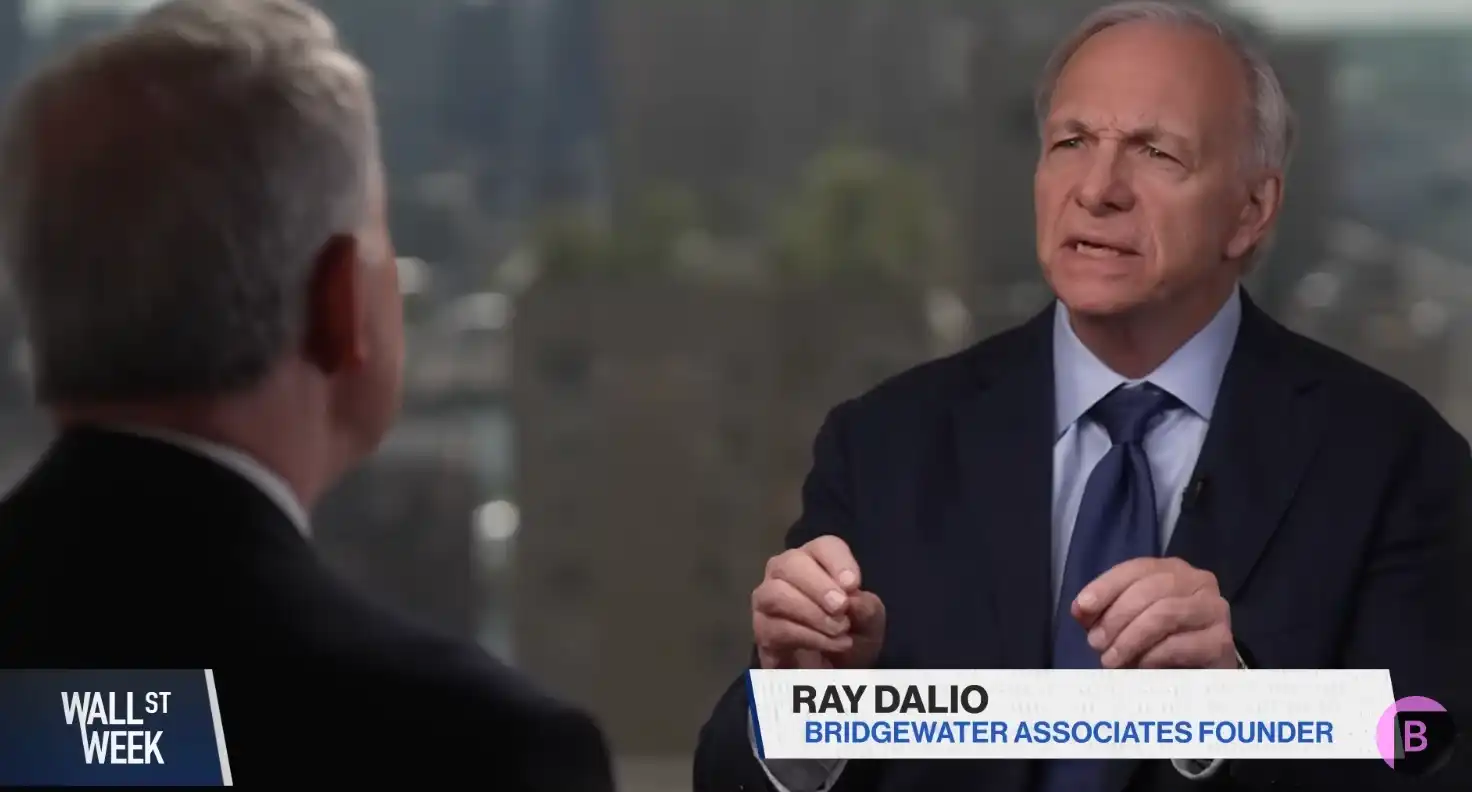
Last month, following the visits to China by U.S. President Trump and Russian President Putin, Ray Dalio was interviewed by David Westin on Bloomberg's "Wall Street Week" program.

During the interview, Ray Dalio stated bluntly, "The credibility of the United States as a global power willing to fight to defend its interests is declining, while China is steadily accumulating its own global wealth and influence. This situation is fundamentally changing how other countries view these two nations."

"Currently, the United States has approximately 750 military bases in over 80 countries worldwide, so it has long been seen as a trustworthy ally in the face of (wartime) attacks." However, after concluding a roughly month-long trip to Asia (which included about 10 days of meetings with various leaders in China), Ray Dalio sensed a significant shift: an increasing number of countries are gradually coming to believe that "the United States cannot be relied upon to win wars."

Ray Dalio's comments further elaborate on his long-held view: "American power is gradually waning, while China's power is correspondingly increasing." Thanks to Bridgewater's extensive engagement with China, this perspective has gained considerable acceptance. However, on the other hand, due to his relatively close relationship with Chinese leaders, these views have also faced criticism.

Dalio went on to say that international recognition is very important for China. Currently, China's economy is about 60% to 70% the size of the United States', a ratio that has more than tripled over the past 20 years. He stated that while China does not seek to conquer or occupy other countries, it places great importance on the recognition from political leaders of various nations. "You can see many national leaders visiting China one after another, which is akin to the 'tribute system' in Chinese history—countries coming to acknowledge and respect China's formidable strength, but this system is not oppressive or controlling." (Odaily Planet Daily Note: The original phrase was 'tribute system')

"So, this tribute system is actually a hierarchical structure. When dealing with other countries, what matters is how this system affects trade and national security between them. I believe, from a political perspective, we are now entering a period where arrangements similar to the tribute system will form between (China and) various countries, and the relative power of nations will become the decisive factor (in the world's political landscape)." During the discussion, Ray Dalio also mentioned that concepts like the nation-state and national borders only gradually emerged in Western societies around the mid-17th century. Before that, power structures in Western societies were composed of different royal families, which is fundamentally different from the concept of frontiers consistently present throughout Chinese history.

He believes this change will directly impact (global) markets, including capital and finance. Because investors must navigate the current turbulent situation: there are risks to currency values, and global uncertainty requires investors to maintain liquidity and diversify their asset allocations, including investing in gold.

Ray Dalio on the 'U.S.-China AI Competition Landscape': China's AI Industry Will Develop Like the Electric Vehicle Industry

In June, Business Insider reported Ray Dalio's views on the competition in the AI sector between China and the United States, also highlighting the significant differences and potential impacts.

Ray Dalio stated that China views artificial intelligence as an important tool that should be accessible to all workers. "It's like electricity and running water—something everyone should have access to," he said.

As a prominent entrepreneur who first visited China as early as 1984, Ray Dalio has long been optimistic about China's development. He previously told attendees at a Forbes magazine conference in New York: "China has earned huge profits through exports, and these funds are being extensively used for research and development in the field of artificial intelligence, thereby driving economic growth by enhancing production efficiency."

It is worth noting that Ray Dalio emphasized that while American companies like OpenAI and Anthropic are adjusting (AI model) subscription package structures, striving to increase revenue in preparation for going public, Chinese companies are focused on enabling as many ordinary employees as possible to use their models. "It doesn't necessarily have to be expensive, nor does it even have to be profitable (right now)."

"In a way," Dalio believes, "it mimics the successful path the country has taken in industries like electric vehicles—where domestic Chinese companies like BYD have achieved rapid growth in markets such as Europe."

During a guest discussion following Dalio's speech, JPMorgan executive Mary Callahan Erdoes pointed out that unlike the social atmosphere in the United States where "job issues are treated as political topics," executives of Chinese AI companies and politicians "do not express fear about AI impacting employment" when mentioning AI. Instead, the country focuses more on "leveraging AI to drive various developments" and is committed to finding the next industrial field where it can achieve dominance. "The robotics sector can basically be seen as China's 'next-generation electric vehicle industry,'" she said.


Связанные с этим вопросы

QWhat is Ray Dalio's main argument about the changing world order, according to the article?

ARay Dalio argues that the world order is shifting, with a China-led 'tribute system' re-emerging. He states that U.S. credibility as a global power is declining while China is accumulating global wealth and influence, leading more countries to acknowledge and respect China's strength through visits and engagements, reminiscent of a historical tributary relationship.

QHow does Ray Dalio characterize the difference in approach between U.S. and Chinese AI companies?

ADalio characterizes U.S. AI companies like OpenAI and Anthropic as focusing on adjusting subscription models and increasing revenue, often with an eye towards going public. In contrast, Chinese AI companies are focused on making their AI models widely accessible and affordable for ordinary workers, prioritizing broad adoption and integration into productivity, even if it is not immediately profitable.

QWhat historical analogy does Ray Dalio use to describe the current geopolitical dynamic centered on China?

ARay Dalio uses the historical analogy of China's 'tribute system' to describe the current dynamic. He suggests that the visits of numerous world leaders to China represent a modern form of this system, where countries acknowledge and respect China's power, forming a hierarchical structure in international relations based on relative strength.

QAccording to the article, what investment strategy does Ray Dalio suggest due to the current global uncertainties?

ADue to the current global uncertainties and risks to currency values, Ray Dalio suggests that investors should maintain liquidity and diversify their asset allocations. This diversification includes investments in assets like gold as a hedge against the turbulent geopolitical and economic landscape.

QWhat comparison is made regarding the development path of China's AI industry?

AThe article compares the development path of China's AI industry to that of its electric vehicle (EV) industry. It suggests that China aims to replicate the success of companies like比亚迪 (BYD) in the EV market by focusing on making AI a ubiquitous tool for enhancing productivity and seeking dominance in future strategic industries, such as robotics, in a similar manner.

Похожее

Different Choices After the Plunge: Institutions Buy the Dip, Traders Shift to US Stocks

Title: Diverging Strategies After the Crash: Institutions Buying the Dip, Traders Shifting to US Stocks Following a sharp decline where Bitcoin briefly fell below $60,000 on June 6th, market sentiment remains "extreme fear" despite a partial recovery. This has led to varied responses from major market participants. Several institutional figures and analysts present a cautiously optimistic long-term view for Bitcoin. Glassnode's co-founder identifies $46k-$54k as a probable key bottom range based on historical on-chain models, while a Standard Chartered executive suggests the bottom is nearly formed. Strive's CEO points to Bitcoin touching its 200-week moving average as a historically reliable buy signal. Analysts highlight metrics like MVRV ratio and the "Power Law" model indicating Bitcoin is in an extremely undervalued zone. Conversely, some traders are exiting the crypto space. One trader cited a more attractive risk/reward profile and deeper research opportunities in US stocks, particularly with AI-related equities outperforming and capital rotating away from crypto. This shift is partly attributed to perceived ongoing risks, including those related to Strategy's Bitcoin sales. Market prediction data suggests a high probability (72%) of Bitcoin falling below $55,000, but lower odds for a deeper crash below $35k-$40k. The overall picture is one of division: institutions and long-term analysts see a accumulating opportunity, while some active traders are seeking alpha elsewhere amidst the volatility and shifting capital flows.

marsbit21 мин. назад

Different Choices After the Plunge: Institutions Buy the Dip, Traders Shift to US Stocks

marsbit21 мин. назад

Tech Stocks in the Midst of Deleveraging: Rather Than Rushing to Buy the Dip, Wait for the Macro Environment to Stabilize First

"Technology Stocks in Deleveraging Phase: Wait for Macro Stability Before Buying the Dip" The current sell-off in tech/AI stocks is primarily driven by macro headwinds, not a breakdown in AI fundamentals. After a parabolic rise, the market faced a perfect storm: an overcrowded trade, a massive SpaceX IPO draining liquidity, pre-CPI/PPI/FOMC hedging, and strong jobs data renewing "higher-for-longer" rate fears. This triggered a concentrated deleveraging in hot tech names. Key historical context: Unlike the December 2023 sell-off focused on AI capex returns, the current correction centers on the "denominator" – rising concerns over rates, inflation, the Fed, geopolitics, and liquidity. Leading memory stocks like Micron have seen ~20% pullbacks, significant but not yet at panic levels seen in March. The intense selling wave may be largely over, but a quick V-shaped recovery is unlikely. The market will likely churn in high volatility, awaiting clarity. The immediate catalyst needed for a sustainable reversal is a "stop-bleeding" signal from macro conditions. This doesn't require a major positive shock (like the April Iran ceasefire), but simply a halt to further deterioration: CPI not surprising hotter, Treasury yields stabilizing, the Fed not turning more hawkish, and post-SpaceX IPO liquidity easing. Once macro pressure plateaus, the intact AI investment thesis – centered on persistent compute/memory shortages and accelerating commercialization – can quickly regain market focus. The strategy is clear: prioritize monitoring macro stabilization over rushing to bottom-fish individual AI stories. Patience is key.

marsbit28 мин. назад

Tech Stocks in the Midst of Deleveraging: Rather Than Rushing to Buy the Dip, Wait for the Macro Environment to Stabilize First

marsbit28 мин. назад

South Korean Stocks Plunge, Global Funds Liquidate: Has the Semiconductor Fundamentals Really Changed?

South Korean stocks experienced their sharpest decline of the year, with the KOSPI index plunging nearly 9% on Monday, triggering a market circuit breaker. Leading semiconductor firms Samsung Electronics and SK Hynix were heavily sold off, raising questions about whether the AI-driven bull market has reached an inflection point. This sell-off was largely triggered by a significant drop in the U.S. semiconductor sector late last week. Concurrently, NVIDIA CEO Jensen Huang visited Seoul over the weekend, meeting with top executives from SK Group, Samsung, LG, and NAVER. He announced a new multi-year partnership with SK Hynix to co-develop next-generation memory products for AI data centers. Huang emphasized that AI infrastructure build-out remains in its early stages, creating a stark contrast between market panic and ongoing, strengthened industry collaboration. The article argues that South Korea has become one of the most sensitive markets for global AI-related capital flows, functioning like a large AI memory ETF due to the heavy weighting of its chipmakers. The current market turmoil reflects a shift in investor focus: from simply betting on overall AI growth to scrutinizing which companies will actually capture the profits from that growth. This "profit pool reassessment" phase is causing high volatility based on supply chain news and earnings guidance. Ultimately, the direction of the Korean market will be determined by external factors—NVIDIA's orders, HBM supply-demand dynamics, and capital expenditures from cloud service providers—rather than domestic conditions. The disconnect between sharp price corrections and continued strong signals from the industry core leaves the market at a crossroads, awaiting clearer data on the durability of AI infrastructure demand.

marsbit1 ч. назад

South Korean Stocks Plunge, Global Funds Liquidate: Has the Semiconductor Fundamentals Really Changed?

marsbit1 ч. назад

Trump in Talks with AI Companies Over Profit Sharing, A Narrative Pressure of Industrial Revolution Scale Begins

In recent AI market discussions, a new dimension beyond growth and profits has emerged: the question of how the immense wealth potentially generated by AI should be shared with the wider public. Triggered by reports of White House officials discussing "voluntary equity transfers" with top AI firms, similar to models like Alaska's Permanent Fund, the conversation focuses on public wealth funds. OpenAI's own whitepaper proposes such funds, allowing households without direct tech stock ownership to benefit from AI gains. More radical proposals, like Bernie Sanders' call for high public equity stakes and board seats, represent an extreme end of the spectrum. Currently, these are early-stage policy probes, not enacted laws. OpenAI's initiative is seen as an attempt to secure "social license" for its future expansion, mitigating risks of public backlash, stricter regulation, or anti-trust actions as AI's economic impact grows. The core market implication is the introduction of a "policy discount" to AI valuations, particularly for private model companies like OpenAI, Anthropic, and xAI. Investors must now consider not just future earnings but also what portion might be allocated to public mechanisms. The impact varies greatly based on the mechanism. A small, voluntary transfer of non-voting economic rights (e.g., 5%) acts as a quantifiable long-term cost. Government acquisition of economic rights via warrants tied to support differs from direct equity with governance power. The most disruptive scenario would be forced high-percentage public ownership affecting control and innovation incentives. Key signals to watch include whether other AI companies follow suit, if the White House formalizes proposals, related disclosures in future IPO documents, and any market price reactions. For now, this represents a shift from pricing pure AI growth to pricing its potential distribution. A manageable, voluntary economic share is akin to an insurance cost for societal acceptance, while a forced shift toward control and governance would fundamentally alter valuation logic.

marsbit1 ч. назад

Trump in Talks with AI Companies Over Profit Sharing, A Narrative Pressure of Industrial Revolution Scale Begins

marsbit1 ч. назад

From Record Highs to a Two-Week Low: Why Did AI Concept Stocks Suddenly Pull Back?

From Record Highs to Two-Week Lows: Why Did AI Stocks Suddenly Pull Back? U.S. stock indices, led by the tech-heavy Nasdaq 100, fell sharply to two-week lows. This marked a reversal from earlier in the week when AI infrastructure and semiconductor stocks had propelled major indices to record highs. Investors are rotating out of these previously high-flying tech sectors into other areas. The sell-off was driven by profit-taking and concerns that the AI rally had become overextended, exacerbated by chipmaker Broadcom's sales outlook falling short of lofty market expectations. The decline accelerated following a stronger-than-expected U.S. May nonfarm payrolls report, which showed 172,000 jobs added versus an estimated 88,000. This data sparked a jump in bond yields, with the 10-year Treasury yield rising to 4.553%, as it reinforced market speculation that the Federal Reserve's next move could be a rate hike rather than a cut. Globally, equities also declined, with European and Asian markets falling. Within the U.S. market, chip and AI-related stocks like Super Micro Computer and Arm Holdings led the losses, dropping over 7%. Cryptocurrency-linked stocks and mining shares also fell sharply amid drops in Bitcoin and commodity prices. While the overall Q1 earnings season remained solid, with 83% of S&P 500 companies beating estimates, the weakness was concentrated in tech. Excluding the tech sector, Q1 earnings growth was around 3%, the weakest in two years.

marsbit1 ч. назад

From Record Highs to a Two-Week Low: Why Did AI Concept Stocks Suddenly Pull Back?

marsbit1 ч. назад

Торговля

Спот
Фьючерсы

Популярные статьи

Неделя обучения по популярным токенам (2): 2026 может стать годом приложений реального времени, сектор AI продолжает оставаться в тренде

2025 год — год институциональных инвесторов, в будущем он будет доминировать в приложениях реального времени.

1.8k просмотров всегоОпубликовано 2025.12.16Обновлено 2025.12.16

Неделя обучения по популярным токенам (2): 2026 может стать годом приложений реального времени, сектор AI продолжает оставаться в тренде

Обсуждения

Добро пожаловать в Сообщество HTX. Здесь вы сможете быть в курсе последних новостей о развитии платформы и получить доступ к профессиональной аналитической информации о рынке. Мнения пользователей о цене на AI (AI) представлены ниже.

活动图片