On Its Second Trading Day, SpaceX Jumps Nearly 20%, Valuation Reaches $2.5 Trillion

marsbitОпубликовано 2026-06-16Обновлено 2026-06-16

Введение

SpaceX's stock surged nearly 20% on its second day of trading, propelling its valuation to $2.5 trillion and ranking it among the world's top six public companies. The monumental IPO, with a very low initial float, has ignited intense market activity. The rally, fueled by strong retail demand and a favorable macro backdrop, has also made founder Elon Musk the world's first trillionaire. Analysts highlight two key dates in July that could drive extreme volatility. On July 7th, the stock's inclusion in major indexes like the Nasdaq-100 will force massive passive fund buying, colliding with the historically low float as early shareholders remain locked up. Later in July, following the Q2 earnings call, an estimated 10-15% of shares held by early insiders (excluding Musk) will be unlocked, testing institutional demand. Behind the scenes, market observers speculate about a potential stock-for-stock "merger of equals" between SpaceX and Tesla. This could help Musk manage a looming $7 billion tax bill from expiring Tesla options and consolidate his empire under SpaceX's robust governance structure, which features super-voting shares and mandatory arbitration. The IPO's underwriter selection is seen as potentially securing support for such a future merger vote.

Author: Ye Zhen

Source: Wall Street News

On its second day of trading, SpaceX's stock continued its strong momentum from the debut, pushing its market value above the $2.5 trillion mark and officially placing it among the top six listed companies globally by market capitalization. This unprecedented super IPO and its exceptionally low initial free float are setting the stage for a rare game of chip distribution in the global capital markets.

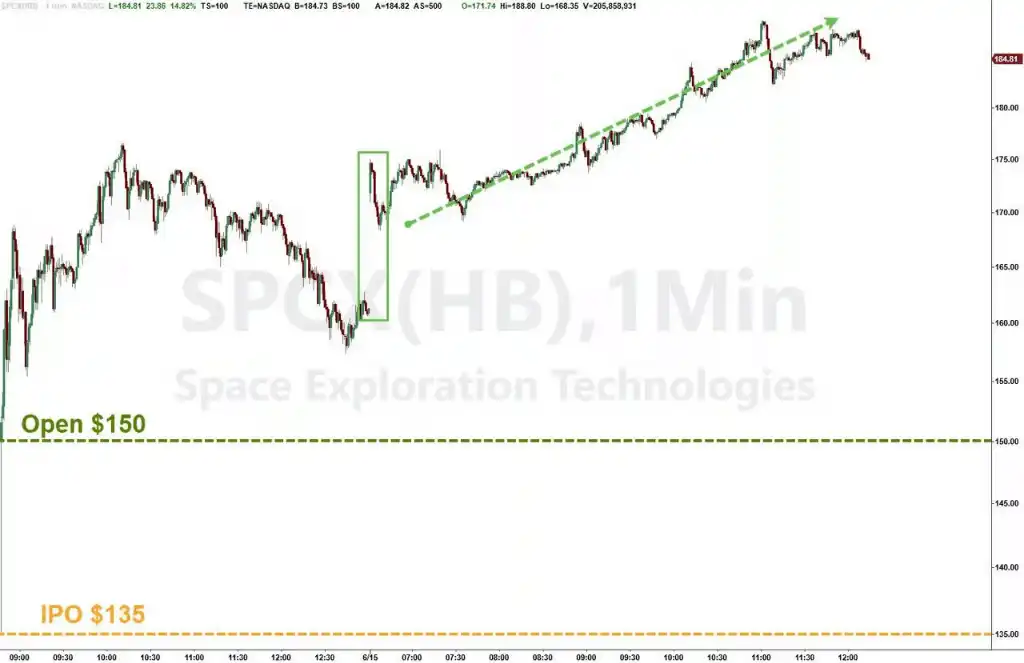
SpaceX's stock closed at $192.46 on Monday, surging nearly 20%, up more than 42% from the IPO price of $135, adding $412 billion in market value in a single day.
After the underwriters fully exercised their over-allotment option (greenshoe), the total capital raised by the company reached $86.2 billion, with a net proceed of $85.7 billion after underwriting fees. This robust market performance has not only directly boosted confidence in the artificial intelligence sector that has driven market gains this year but also set the tone for the valuation reset of the entire tech giant cohort.

The frenzied market demand has made founder Elon Musk the world's first trillionaire, with his net worth now exceeding three times that of the world's second-richest person, Google co-founder Larry Page. This successful listing has significantly alleviated Wall Street's concerns about the market's capacity to absorb mega IPOs and has paved the way for potential listings later this year by large AI rivals such as Anthropic and OpenAI.

However, amid the strong start and expectations for passive buying, market observers warn of dramatically heightened volatility in the stock in the coming months. In this meticulously engineered capital feast by Wall Street, investors must pay close attention to two key time points in July. These involve not only the clash between massive passive funds and the period of minimal share supply but may also reveal the more extensive merger strategies behind Musk's business empire.

Resonance of Retail Frenzy and Macro Environment

During the first two trading days of the listing, retail investors exhibited an extremely high level of buying enthusiasm.

According to data from Vanda Research, the amount of SpaceX shares bought by retail investors in the first two days was equivalent to the retail buying volume across the entire U.S. stock market last week. Max Gokhman, Senior Vice President of Investment Solutions at Franklin Templeton, pointed out that there was a significant build-up of investors off-exchange who previously had no access to the investment, making this massive initial demand unsurprising.

In addition to the micro-level fund inflows, the macro-geopolitical and liquidity backdrop also provided support for the stock's surge.

As the U.S. and Iran announced an agreement to reopen the Strait of Hormuz, coupled with market expectations for a potentially moderately accommodative stance by the Federal Reserve under its new Chair Kevin Warsh, both the S&P 500 and Nasdaq 100 indices recorded significant gains. Angelo Kourkafas, Senior Global Investment Strategist at Edward Jones, stated that the macro background is becoming more favorable, and declining yields may encourage investors to continue moving out along the risk curve.

July 7th: Nasdaq Inclusion Clashes with Extremely Low Float

As the initial frenzy from the listing cools, the market is about to face its first highly trading-sensitive key date: July 7th.

Former Wall Street analyst Alexandra Mertz notes that the Class A shares issued in this IPO represent only 4.3% of SpaceX's total market value, meaning the initial free float is extremely tight.

July 7th is the first trading day after the Independence Day holiday and the 15th trading day post-IPO, when the Nasdaq-100 index will formally include SpaceX. According to Bloomberg, based on calculations by index rebalancing forecasting firm Intropic, due to plans by major indices to rapidly incorporate the stock, the proportion of shares held by passive investors is expected to surge to approximately 30% after 15 days of trading.

At that point, major index funds like Vanguard CRSP and FTSE Russell must make unconditional passive purchases in the open market based on free-float adjustment mechanisms. Market estimates place the scale of this passive buying between $8 billion and $18 billion. Since early shareholders will still be in a lock-up period and unable to sell, the free float in the market will hit its lowest point.

Analysts warn that the direct collision of nationwide passive fund buying with historically low float, coupled with AI model predictions, could drive the stock price to experience an extreme rally during this period.

Late July: True Selling Pressure from Lock-up Expiration and Institutional Bottom Line

The second crucial date demanding high attention falls two business days after the expected second-quarter earnings call in late July. While regular IPO lock-ups typically use simple fixed terms, SpaceX's expiration schedule is precisely tied to the Q2 earnings conference.

Market rumors suggest a massive lock-up expiration for up to 30% of early insider shareholders will follow the earnings call. However, Alexandra Mertz clarifies that approximately 50% of these early insider shares belong to Musk himself, who, as the founder, is subject to an absolute 366-day lock-up. Therefore, the actual potential fresh supply entering the open market is only 10% to 15%.

Even more critical is that early major shareholders have extremely low willingness to sell.

Prominent investor Ron Baron has explicitly stated he will not sell and plans to add $1 billion in the open market. BlackRock has also publicly expressed an intention to buy between $5 billion and $10 billion. As Renaissance Capital senior strategist Matt Kennedy put it, the stock has been "priced to near perfection." When the booster rockets of retail demand fall away, and the stock begins to feel the gravitational pull of selling by institutional investors and employees post-lockup, marginal buyers will become critically important.

The Capital Game Plan: A $7 Billion Tax Event and the "Merger of Equals" Speculation

Behind the meticulously arranged listing, Wall Street is closely tracking Musk's personal financial calendar.

Musk must exercise his stock options from the 2018 Tesla compensation plan by August 15th of this year, triggering a massive personal tax event estimated at $7 billion. Before this key date, the higher the stock price of his assets, the more favorable net share settlement or margin loans become for him.

Market analysts have deduced a "Goldilocks scenario": In the window between the anticipated peak in SpaceX's share price driven by index fund buying on July 7th and the influx of fresh shares during the late-July lock-up expiration after earnings, SpaceX and Tesla could announce a stock-for-stock "merger of equals." This arbitrage mechanism in the public market would perfectly alleviate Musk's funding pressure for the tax bill.

This speculation also seems to have left clues in SpaceX's underwriter list. The IPO unusually included Charles Schwab, Morgan Stanley, and JPMorgan Chase as core underwriters. Market observers believe that granting these institutions, which had previously voted against the Tesla pay package, extremely lucrative IPO underwriting stakes might be to secure their yes votes in a potential merger vote at Tesla's November shareholder meeting.

Furthermore, the governance structure outlined in SpaceX's prospectus provides logical support for this potential merger.

SpaceX's Class B shares carry 10 times super-voting rights, and all shareholder litigation must go through mandatory private arbitration, creating a perfect "founder defense fortress." Analysis suggests that merging Tesla into SpaceX's legal framework is the ultimate capital market solution to fundamentally protect Musk's business empire from interference by activist investors and local courts.

Связанные с этим вопросы

QWhat happened to SpaceX's stock price on its second day of trading, and what milestone did its market capitalization reach?

AOn its second day of trading, SpaceX's stock price surged nearly 20%, closing at $192.46. This pushed its market capitalization above $2.5 trillion, placing it among the top six most valuable publicly traded companies globally.

QWhat are the two key time points in July that market observers are warning investors to watch closely for SpaceX stock?

AMarket observers are warning investors to watch two key time points in July: 1) July 7th, when major indices like the Nasdaq 100 are expected to add SpaceX, creating a clash between massive passive fund inflows and historically low free float. 2) Late July, following the expected Q2 earnings call, when a portion of insider shares (estimated 10-15% of the total) will be unlocked from their lock-up period.

QWhat potential financial strategy involving Tesla is speculated to help Elon Musk manage his upcoming $7 billion tax liability?

AMarket analysis speculates about a potential 'stock-for-stock' merger of equals between SpaceX and Tesla. This could provide a market arbitrage mechanism to help Elon Musk manage the approximately $7 billion tax liability he faces from exercising Tesla stock options due by August 15th.

QHow did retail investor activity contribute to SpaceX's strong initial trading performance?

ARetail investor buying was extremely strong. According to Vanda Research, the amount of SpaceX stock bought by retail investors in the first two trading days was equivalent to the total retail buying for the entire U.S. stock market in the previous week. This pent-up demand from investors previously unable to access the stock fueled the initial surge.

QWhat are some factors cited as supporting the broader macro environment for SpaceX's IPO success?

ASupportive macro factors included the announcement of a U.S.-Iran deal to reopen the Strait of Hormuz and market expectations for potential monetary easing under the new Fed Chair, Kevin Warsh. These factors contributed to gains in major indices like the S&P 500 and Nasdaq 100, creating a favorable backdrop for risk assets like the SpaceX IPO.

Похожее

Sharplink CEO: One Million Ethereum Developers, Who Can Compete?

Etherean Ecosystem: One Million Developers and a Formidable Moat The Ethereum network has surpassed a significant milestone: over one million unique lifetime developers, with approximately 232,000 active in the past year. This vast and growing talent pool is Ethereum's core advantage, far more critical than transient metrics like speed or transaction fees. The central question is not which blockchain is fastest, but where the best builders choose to build long-term. Ethereum's answer lies in a decade-long accumulation of infrastructure, standards, tools, liquidity, and collaborative culture that is exceptionally difficult to replicate. It has become the default operating system for programmable finance. This massive developer base is actively working on complex, high-risk challenges that deepen Ethereum's strategic moat: * **Glamsterdam Upgrade (2026):** Focused on core protocol scalability (ePBS, parallel execution) while preserving core values like credible neutrality. * **Synchronous Composability:** Aims to make numerous Rollups interoperate like a single chain, directly addressing fragmentation concerns. * **Quantum Resistance:** Ethereum leads mainstream ecosystems in coordinated preparation for post-quantum cryptography, with a targeted migration plan around 2029. This developer advantage is self-reinforcing, fueled by: * **Deep Composability:** Applications interact like interoperable financial Lego bricks via shared standards (e.g., EVM, Solidity). * **Credible Neutrality:** Secured by over 900,000 validators, making it trusted by major institutions. * **Modularity:** Rollups (Base, Arbitrium, etc.) expand, rather than fracture, the ecosystem into a tightly connected modular internet economy. * **Culture:** Attracts top-tier researchers and standard-setters who guide the entire industry. In essence, while other chains generate activity, Ethereum is consolidating as the trusted, long-term coordination layer for internet-native finance. Its future is being built now by the architects of the next-generation financial infrastructure.

Odaily星球日报35 мин. назад

Sharplink CEO: One Million Ethereum Developers, Who Can Compete?

Odaily星球日报35 мин. назад

Ethereum Reaches the Milestone of One Million Developers, Sharplink CEO Delves Deep into Ethereum's Future Possibilities

Ethereum Surpasses One Million Developers Milestone: A Look at Its Unshakeable Dominance and Future Joseph Chalom, CEO of Sharplink, reflects on his recent Asia trip where he engaged deeply with Ethereum developers and ecosystem leaders. The most striking takeaway was not just the industry's vibrancy, but the rigorous, long-term vision of local builders. This context brings to life a pivotal statistic: Ethereum has now surpassed one million cumulative developers (1,012,824), with approximately 232,000 remaining active in the past year—a talent pool unmatched by any other crypto ecosystem. The critical question isn't which blockchain is fastest, but where top developers choose to build long-term. Ethereum's answer is unequivocal. Its decade-long lead stems from a unique convergence of technology, institutional culture, economic systems, and composability, cementing its role as the foundational operating system for programmable finance. This massive developer base is tackling the industry's hardest problems, continuously strengthening Ethereum's moat. Key initiatives include: * **The Glamsterdam Upgrade (planned 2026):** Introducing ePBS and Block-level Access Lists for parallel execution and higher throughput while preserving core values like credible neutrality and fair MEV distribution. * **Synchronous Composability:** Projects are working to enable atomic transactions across dozens of Rollups, making them function as one unified chain and eliminating ecosystem fragmentation. * **Post-Quantum Security:** Ethereum is far ahead in preparing for quantum computing threats, with a dedicated foundation working group and testnets targeting a full migration by ~2029—a crucial factor for institutional adoption. Beyond developers, Ethereum's core network effects are its unparalleled composability and unified standards (like EVM and Solidity), which create a powerful flywheel: more developers → better tools → greater liquidity → more institutional participation. Its other decisive advantages include credible neutrality (over 900k validators), a secure modular architecture with interconnected Rollups, and a deeply entrenched culture shaped by top-tier researchers. Ultimately, there's a vast difference between generating short-term activity and becoming the trusted, long-term coordination layer for global native finance. Major institutions prioritize security, trust, and liquidity—areas where Ethereum holds dominant mindshare. The industry's trajectory shows resources consolidating around unified standards, deep liquidity, and developer consensus. After meeting the builders in Seoul and Hong Kong, Chalom is more convinced than ever: Ethereum's unshakeable future is being built right now.

Foresight News46 мин. назад

Ethereum Reaches the Milestone of One Million Developers, Sharplink CEO Delves Deep into Ethereum's Future Possibilities

Foresight News46 мин. назад

Saylor's Latest Long Read: Bitcoin is Not Money, It's Digital Capital, and Money is Built Upon It

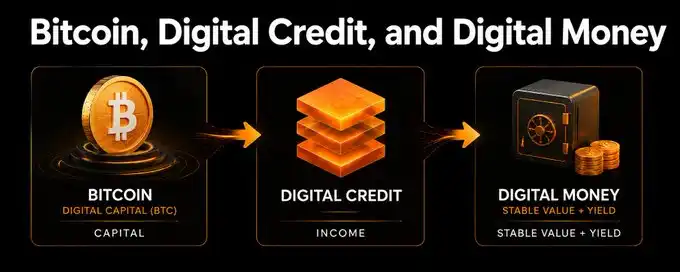
Michael Saylor presents his "Digital Asset Stack" theory, positioning Bitcoin as the foundational layer of digital capital. He argues Bitcoin itself should remain unchanged—no staking, inflation, or protocol alterations. Instead, a five-layer financial architecture should be built atop it: Digital Capital (BTC), Digital Credit (e.g., yield instruments like STRC), Digital Currency (stable, yield-bearing instruments pegged to fiat), Digital Yield (leveraged/structured products), and Digital Equity (e.g., MSTR stock, absorbing residual volatility). Saylor asserts this stack transforms Bitcoin's high-volatility, high-energy capital into tailored products: stable currencies for payments/savings, yield instruments for income seekers, and equity for growth investors. This approach meets diverse needs—corporate treasuries, banks, retirees, emerging market users—without compromising Bitcoin's core properties (scarcity, decentralization). The "killer use case" is rebuilding global money, credit, and capital markets on Bitcoin, bridging the fiat world with a superior digital asset foundation. The system leverages traditional finance principles (risk layering, structured products) while using Bitcoin as the ultimate collateral. This expands Bitcoin's utility, drives adoption, and offers a better monetary experience: digital, yield-bearing, stable-value tools for everyday use.

marsbit58 мин. назад

Saylor's Latest Long Read: Bitcoin is Not Money, It's Digital Capital, and Money is Built Upon It

marsbit58 мин. назад

Can SK Hynix's Stock Double Again in This Rally?

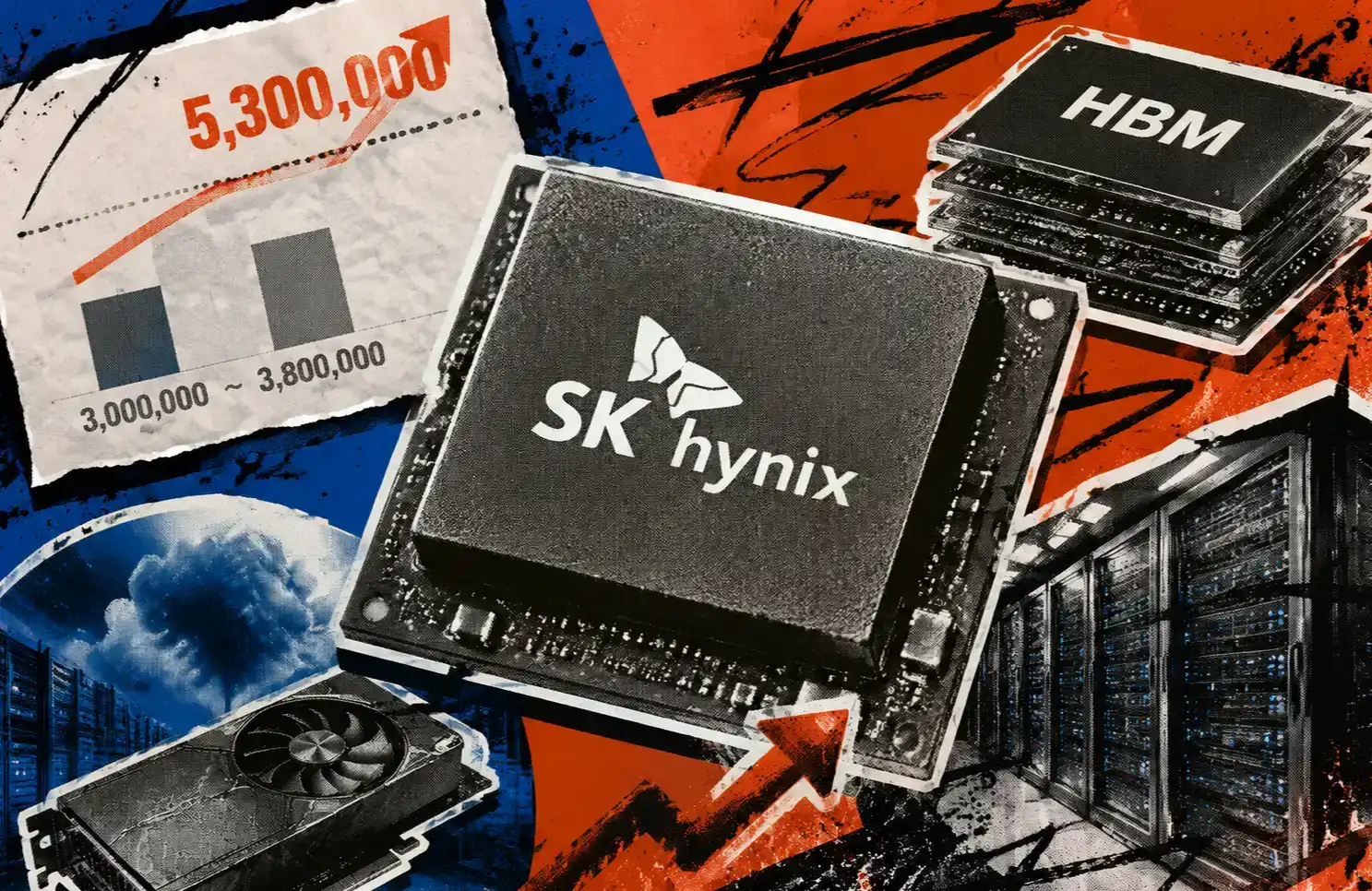
The article discusses the highly optimistic price target of approximately $3,500 for SK Hynix stock, set by Aletheia Capital. This target is significantly above the consensus range of $2,000-$2,520 from major brokerages. The core debate is whether SK Hynix deserves a fundamental re-rating beyond its traditional cyclical discount, based on the long-term impact of AI-driven demand. The $3,500 target hinges on three key assumptions holding simultaneously until at least 2027: 1) Continued shortage and high pricing for HBM (High Bandwidth Memory), a critical component for AI chips; 2) Sustained high prices for standard DRAM, as HBM production consumes capacity and constrains general supply; and 3) Strong AI server demand generating substantial, above-expectation free cash flow. SK Hynix's leading ~58% market share in HBM and its early certification with key clients like Nvidia provide a competitive advantage, allowing it to capture significant supply chain premiums. The HBM shortage is seen not just as a niche growth driver but as a catalyst that amplifies profitability across the entire memory business by tightening overall DRAM supply. However, the article cautions that this target represents an optimistic "tail scenario." Key risks include potential supply increases from competitors (Samsung, Micron) by 2027, a possible slowdown in HBM price growth, and high capital expenditures that could erode the projected free cash flow. The divergence in analyst targets reflects the market's uncertainty over whether the current AI-driven boom will temporarily elevate earnings or permanently raise the memory industry's profit baseline.

marsbit1 ч. назад

Can SK Hynix's Stock Double Again in This Rally?

marsbit1 ч. назад

Торговля

Спот
Фьючерсы

Популярные статьи

Как купить S

Добро пожаловать на HTX.com! Мы сделали приобретение Sonic (S) простым и удобным. Следуйте нашему пошаговому руководству и отправляйтесь в свое крипто-путешествие.Шаг 1: Создайте аккаунт на HTXИспользуйте свой адрес электронной почты или номер телефона, чтобы зарегистрироваться и бесплатно создать аккаунт на HTX. Пройдите удобную регистрацию и откройте для себя весь функционал.Создать аккаунтШаг 2: Перейдите в Купить криптовалюту и выберите свой способ оплатыКредитная/Дебетовая Карта: Используйте свою карту Visa или Mastercard для мгновенной покупки Sonic (S).Баланс: Используйте средства с баланса вашего аккаунта HTX для простой торговли.Третьи Лица: Мы добавили популярные способы оплаты, такие как Google Pay и Apple Pay, для повышения удобства.P2P: Торгуйте напрямую с другими пользователями на HTX.Внебиржевая Торговля (OTC): Мы предлагаем индивидуальные услуги и конкурентоспособные обменные курсы для трейдеров.Шаг 3: Хранение Sonic (S)После приобретения вами Sonic (S) храните их в своем аккаунте на HTX. В качестве альтернативы вы можете отправить их куда-либо с помощью перевода в блокчейне или использовать для торговли с другими криптовалютами.Шаг 4: Торговля Sonic (S)С легкостью торгуйте Sonic (S) на спотовом рынке HTX. Просто зайдите в свой аккаунт, выберите торговую пару, совершайте сделки и следите за ними в режиме реального времени. Мы предлагаем удобный интерфейс как для начинающих, так и для опытных трейдеров.

1.5k просмотров всегоОпубликовано 2025.01.15Обновлено 2026.06.02

Как купить S

Sonic: Обновления под руководством Андре Кронье – новая звезда Layer-1 на фоне спада рынка

Он решает проблемы масштабируемости, совместимости между блокчейнами и стимулов для разработчиков с помощью технологических инноваций.

2.3k просмотров всегоОпубликовано 2025.04.09Обновлено 2025.04.09

Sonic: Обновления под руководством Андре Кронье – новая звезда Layer-1 на фоне спада рынка

HTX Learn: Пройдите обучение по "Sonic" и разделите 1000 USDT

HTX Learn — ваш проводник в мир перспективных проектов, и мы запускаем специальное мероприятие "Учитесь и Зарабатывайте", посвящённое этим проектам. Наше новое направление .

1.8k просмотров всегоОпубликовано 2025.04.10Обновлено 2025.04.10

HTX Learn: Пройдите обучение по "Sonic" и разделите 1000 USDT

Обсуждения

Добро пожаловать в Сообщество HTX. Здесь вы сможете быть в курсе последних новостей о развитии платформы и получить доступ к профессиональной аналитической информации о рынке. Мнения пользователей о цене на S (S) представлены ниже.

活动图片