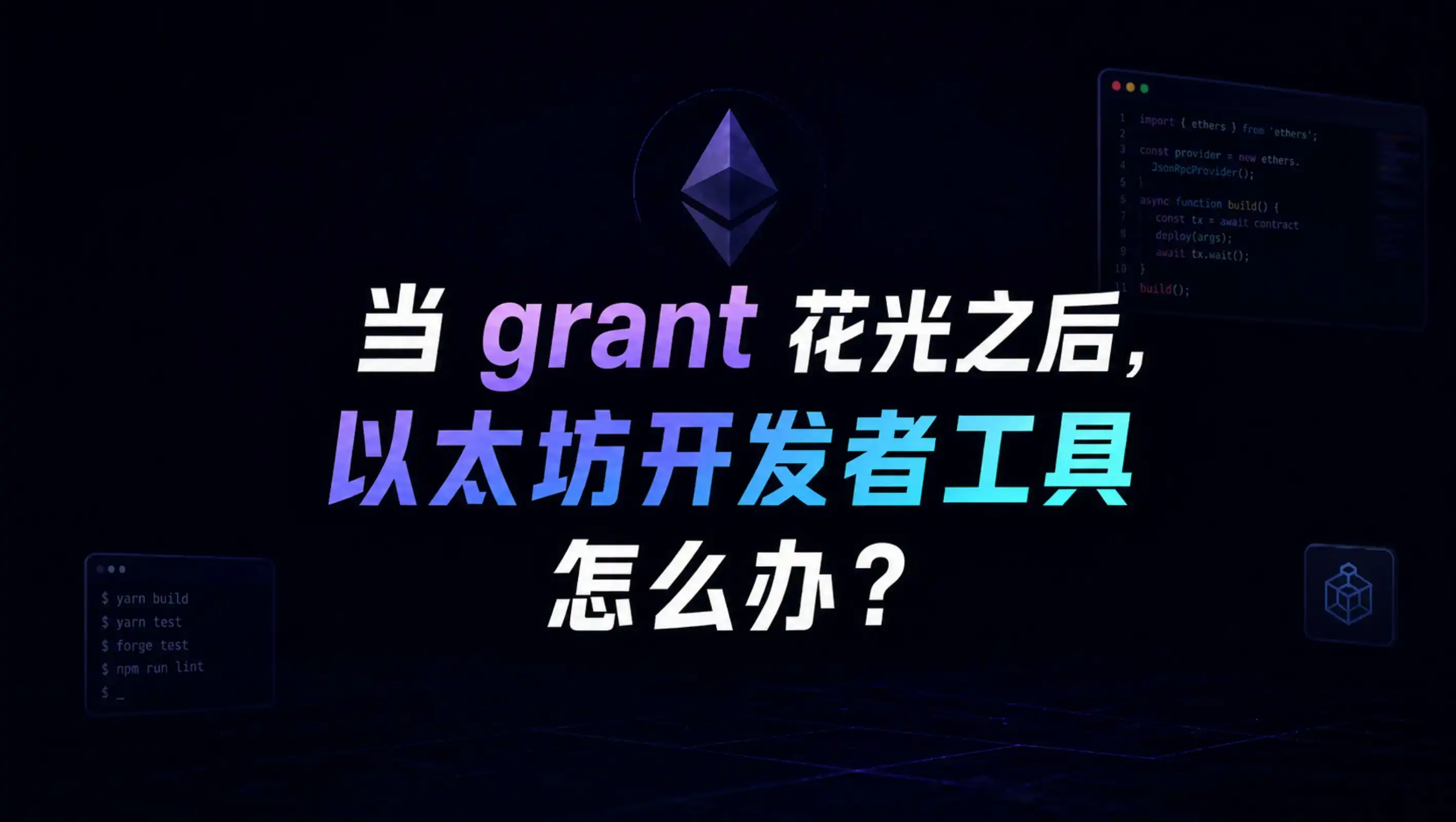
On February 27th, Raul Romanutti, a member of the Ethereum Foundation's funding coordination team, published an article titled "This Is Fine (Until the Grant Runs Out)." The article introduced Project Odin – a structured sustainability support program aimed at a select, strategic group of teams that have previously received substantial grants from the EF.
Viewed purely at the information level, Odin could easily be categorized as "the EF launching another public goods funding program." However, it differs from common grant programs: recipient projects are not given a new infusion of startup capital, nor is it an open application opportunity. Instead, it is a long-term accompaniment mechanism for existing grant-funded teams. The EF Blog outlines a goal set within a two-year timeframe: to help these teams establish credible, sustainable paths and reduce long-term reliance on a single funding source. The embedded strategic advisor will accompany and assist with execution for approximately 12 months.
Odin is concerned with the road *after* the grant.
The key point highlighted in 0xRahul's tweets also lies here. He did not frame the issue as "whether the EF should continue funding public goods," but rather focused on the sustainability of developer tool teams: large, complex, heavily used open-source tools cannot be sustained long-term on passion or short-term grants alone.
Past discussions in the Chinese community about public goods have often revolved around Gitcoin donations, RetroPGF distributions, EF grant lists, or whether a particular project deserves donations. Project Odin points to a later stage: after a public goods project has already proven its importance, how can it avoid being pulled along by the next grant?
Grants are still important, but the questions are starting to change
First, let's dispel a misinterpretation: Project Odin is not a signal that the EF is stopping public goods funding.
From recent public information, the EF continues to fund protocol research, clients, cryptography, ZK, developer tools, education, and public goods experiments. Projects listed in the EF Ecosystem Support Program's Q1 2026 Allocation Update still cover multiple infrastructure and tool directions, including EthereumJS maintenance, BuidlGuidl, WalletConnect clear signing library, L2BEAT 2026, DISC-NG Geth, Lighthouse, Vero, formal verification, and more. Similar quarterly grant lists have been appearing for several years.
Grants haven't disappeared; it's just that they alone cannot solve all problems.
For early-stage projects, grants can reduce startup costs; for research-oriented work, grants can cover exploratory efforts not easily commercialized; for community education and public infrastructure, grants remain a crucial funding source. However, if a tool team already heavily relied upon by numerous projects has only one primary funding source long-term, the risk becomes concentrated.
The EF Blog mentions that many teams are not lacking in technical ability; their shortfalls appear in non-technical capacities like fundraising, external communication, organizational design, and legal structure. Teams can write compilers, conduct research, and maintain network stacks, but may not have the bandwidth to answer questions like: Who depends on us the most? Which users are willing to sign long-term support contracts? Which tasks could be procured by enterprises? What revenue streams would not compromise the project's neutrality?
Odin aims to supplement these very capabilities.
Why developer tools most easily get stuck here
In his long thread, 0xRahul listed four traditional developer tool models: large corporate open-source, bundling with a larger product, commercial SaaS, and unpaid maintenance.
Applying these four models to Ethereum reveals clear limitations.
Tools open-sourced by large corporations are often powerful, but their longevity depends on corporate strategy. The ecosystem benefits while the company is willing to invest; when the company's direction shifts, maintenance priority often follows. For an ecosystem like Ethereum, which emphasizes credible neutrality, entrusting critical tools to the long-term interest of a single company is unstable.
Tools bundled with large products are similar. They can serve users of a specific product line or platform well but struggle to remain fully open. Ethereum developer tools need to work across wallets, clients, L2s, and protocols; walled gardens weaken their public good nature.
Commercial SaaS can solve some problems, but not all. Many crypto teams are still in their early stages with limited R&D budgets. More importantly, tools like compilers, languages, base libraries, network stacks, and transparency platforms often derive their value from the security and efficiency of the entire ecosystem, making direct per-user charging difficult.
Finally, there's unpaid maintenance. Small libraries or personal tools can progress in the short term based on interest, but not large-scale infrastructure. Compilers require long-term testing and security response; languages require roadmaps and community governance; P2P network stacks require cross-project coordination; risk monitoring platforms require continuous data maintenance. These are not one-time tasks.
Developer tools often fall into an awkward position: they are too foundational, and no one wants to lose them; yet they are too public, making it hard to naturally generate revenue.
Project Odin is not an "accelerator"
The EF Blog describes Odin as a structured support program, but it's not the same as a startup accelerator.
Accelerators typically serve growth-stage companies, with goals around product, market, fundraising, and scaling. Odin does not require public goods teams to pitch a venture-scale story; it cares about whether these teams can continue delivering across multiple funding cycles, gradually becoming more stable institutions.
Odin's basic mechanism is that each team gets an embedded strategic advisor. This advisor isn't there for a one-off training session but to participate long-term in the team's sustainability planning and execution. The process roughly includes three stages:
- The first stage involves sorting realistic options. What is the team currently surviving on? What fundraising methods have been tried before? Who in the ecosystem benefits from it? What funding channels are available? What are the trade-offs of each channel?
- The second stage involves validating paths. For example, initiating conversations with potential funders, partners, enterprise users, DAO delegates, or protocol teams to assess which directions are viable beyond paper plans.
- The third stage is execution. This includes preparing fundraising or partnership materials, building a pipeline of collaborations, and, when necessary, designing support contracts, service agreements, or other repeatable forms of revenue.
This process might sound less inspiring than the "public goods" narrative, but it addresses a project's most immediate reality: a team cannot afford to start looking for its next funding source only when the runway is nearly depleted.
Why Vyper was selected
Vyper is the first pilot participant in Project Odin.
This choice is not surprising. Vyper is a Pythonic smart contract language for the EVM, emphasizing security, simplicity, and readability. The EF Blog mentions that Vyper has, at its historical peak, secured over $27 billion in on-chain value. Even today, it still underpins thousands of contracts and tens of billions in TVL.
Languages and compilers are classic public infrastructure. When they encounter issues, the impact isn't on a single application, but on all protocols and developers that depend on them. Yet, from a business model perspective, such projects are difficult: the core language should remain open, while security and formal verification capabilities require continuous investment. Relying solely on community donations can hardly support a long-term team.
The establishment of the Foundation for Verified Software (FVS) by the Vyper team precisely brings this problem to the forefront. The FVS website shows the institution focuses on formal verification research, open tools, and ecosystem support, with current projects including Vyper, Vyper-HOL, Verifereum, and HOL4. The EF Blog also discusses Vyper / FVS in its position as the first Odin pilot.
This is not yet a proven commercial model. More accurately, it's an experimental organizational form: a foundation undertakes long-term research and open-source tools, while the team explores whether stable revenue can be formed around formal verification, auditing, training, support contracts, or enterprise POCs.
In the context of the Chinese community, Vyper is more than just "a language project receiving EF support." As DeFi, L2s, and institutional funds place higher demands on contract security, capabilities like formal verification may gradually shift from research topics to procurable professional services.
libp2p and L2BEAT: Two contrasting cases
The EF Blog begins by mentioning libp2p. It's a P2P networking stack used by many Web3 systems, including Ethereum clients for node discovery, message propagation, and block and validator vote propagation. The EF Blog uses it as a recent case of funding pressure to illustrate that widely depended-upon open-source infrastructure can also reach a state of calling for help when resources are insufficient.
This case highlights the funding dilemma of foundational dependencies: the more foundational a tool is, the more users it has, yet direct payment relationships become less clear. Every project wants libp2p to be stable, but it's difficult to say which single project should bear the main maintenance cost.
L2BEAT provides another perspective.
L2BEAT is a transparency tool very familiar to the Chinese community, long-tracking L2, bridge, DA, ZK risks and data. It is not an Odin pilot, but its publicly disclosed funding sources make it suitable as a case study for funding portfolio diversification.
According to L2BEAT's donation page, its funding sources include a Partnership Fund, Ethereum Foundation grants, Optimism RPGF, Gitcoin, rewards and compensation for participating in L2 governance frameworks, specific grants, conference sponsorships, report and dashboard exploration, and direct community donations.
This list is interesting. It shows that public goods teams do not necessarily have only two paths: rely entirely on grants or become a SaaS. A team providing neutral data and professional judgment long-term can receive support from multiple ecosystem actors. But the prerequisite is that it needs to clearly articulate its funding sources, allowing the outside world to continuously examine its incentive structure.
Combining funding mechanisms, not betting on a single answer
In recent years, the Chinese community has become relatively familiar with public goods funding mechanisms like Gitcoin, Optimism Retro Funding, Protocol Guild, and Drips. They are often discussed in contexts like "diversification of funding sources" and "sustainable revenue streams."
However, these mechanisms address different problems: Gitcoin Grants is better suited for aggregating community signals and helping early-stage public goods gain exposure and seed funding; Optimism Retro Funding rewards work that has already had an impact, suitable for compensating past contributions; Protocol Guild targets Ethereum L1 core R&D contributors, establishing a longer-term on-chain funding mechanism; Drips focuses on dependency funding, aiming for funds to flow upstream to open-source projects along dependency lines.
For large developer tool teams, the key is not to pick the single best answer from these mechanisms, but to understand the applicable boundaries of each funding type. QF requires projects to repeatedly campaign for votes; Retro Funding results carry uncertainty; DAO grants are affected by governance cycles and token volatility; direct donations typically cannot cover stable team costs.
The focus of Project Odin is also not to invent a new funding mechanism, but to help teams combine existing mechanisms and potential revenue streams: grants can support research, retro funding can reward impact, DAOs or protocols can provide targeted support, enterprise users can purchase services or support contracts, partners can co-develop POCs.
These sound like ordinary business problems, but for many public goods teams, ordinary business capability is precisely the shortfall. What Odin truly supplements is the ability to translate "the project has value" into "who depends on it, who is willing to support it continuously, and what revenue would not harm its public good nature."
In other words, "beyond grants" is not a slogan, but a more concrete set of funding portfolios, cooperative relationships, and organizational capabilities.
How the Chinese community might understand this
The Chinese community has typically approached public goods from two entry points.
One entry point is donation. For example, when each Gitcoin round begins, there are project recommendations, donation tutorials, and interaction guides. Public goods here resemble an act of community participation.
The other entry point is news. For example, the EF announces its quarterly grant list, Optimism opens Retro Funding, or a project receives a grant. Public goods here resemble the flow of ecosystem capital.
Project Odin provides a third entry point: the long-term operation of public goods teams.
For the Chinese community, this angle is closer to developers and protocol teams. If a protocol relies long-term on a particular open-source library, risk data platform, compiler, verification tool, or security infrastructure, it should not merely retweet calls for help when funding is low. A more reasonable approach is to list these dependencies in its own ecosystem budget: Which tools are our critical dependencies? Should we provide long-term support? Do we need to purchase support contracts? Should we participate in dependency funding? Should we allocate public goods expenditure in our governance budget?
Framing it as a charity issue isn't accurate; it's closer to a supply chain issue. Public goods are important not because they are "worthy of donations," but because many teams already depend on them in their daily development, security, data, and governance judgments. Since this dependency is real, supporting them is not merely an expression of goodwill but also a form of ecosystem risk management.
If a protocol is willing to spend on market making, incentives, growth, and branding but unwilling to pay for the foundational tools it depends on, it isn't saving costs; it's shifting those costs onto the maintainers and the entire ecosystem. The reason Project Odin deserves attention is precisely because it pushes this issue one step beyond "who is willing to fund": whoever truly depends on these teams should participate earlier in designing their sustainability.
Project Odin will not solve all public goods funding problems. It is currently only a structured support program for a select, strategic group of previously funded teams. But it clarifies a long-deferred problem: public goods projects cannot only prove their value when applying for grants; they must also, in their daily operations, identify who truly depends on them, who is willing to support them continuously, and what kind of revenue will not compromise their public good nature.
This might be a signal of Ethereum's public goods discussion entering its next stage. The past question was "who should be funded"; the question now is beginning to become "how can teams that have already proven their importance avoid having their fate decided by the next grant."