Ethereum Bears In Pole Position: $1,850 Could Be The Next Landing Spot

bitcoinistОпубликовано 2026-06-01Обновлено 2026-06-01

Введение

Ethereum's price remained bearish in May, with analysts predicting a potential drop to around $1,850. Crypto analyst Burak Kesmeci notes that ETH is trapped in a descending channel on the 4-hour chart, indicating seller dominance. If it fails to break the $2,033 resistance, a decline to the $1,822-$1,850 range is likely. While a breakout above $2,033 could target $2,400, the downward move appears more probable. This bearish outlook is reinforced by significant outflows from spot Ethereum ETFs, totaling over $241 million in the past week—the third consecutive week of major outflows. ETH has lost nearly 15% of its value over the last three weeks and is currently trading around $2,023.

The price performance of Ethereum was disappointing for most of May, as the bears seemed to be in full control. It doesn’t seem like much will change for the “King of Altcoins” in the new month, which appears to be a mere continuation of the established downward trend. According to a popular analyst on the social media platform X, the Ethereum price could be on its way down to around $1,850.

Is ETH Price Stuck In A Descending Channel?

Crypto analyst Burak Kesmeci took to the X platform to share his projection for the Ethereum price over the coming days. The market pundit posited that the second-largest cryptocurrency could decline toward the $1,822-$1,850 range if it fails to break the $2,033 resistance in the next few days.

This bearish outlook is premised on the fact that sellers have been in a dominant position in the short term and for much of the past month. This dominance is evident in the formation of a descending channel on the four-hour timeframe of the Ethereum price chart.

A descending channel is a technical analysis chart pattern characterized by two major trendlines: the upper boundary connecting the lower highs and the lower line connecting the lower lows. This chart formation is often correlated to a bearish structure, with the upper trendline acting as resistance and the lower boundary as the price floor.
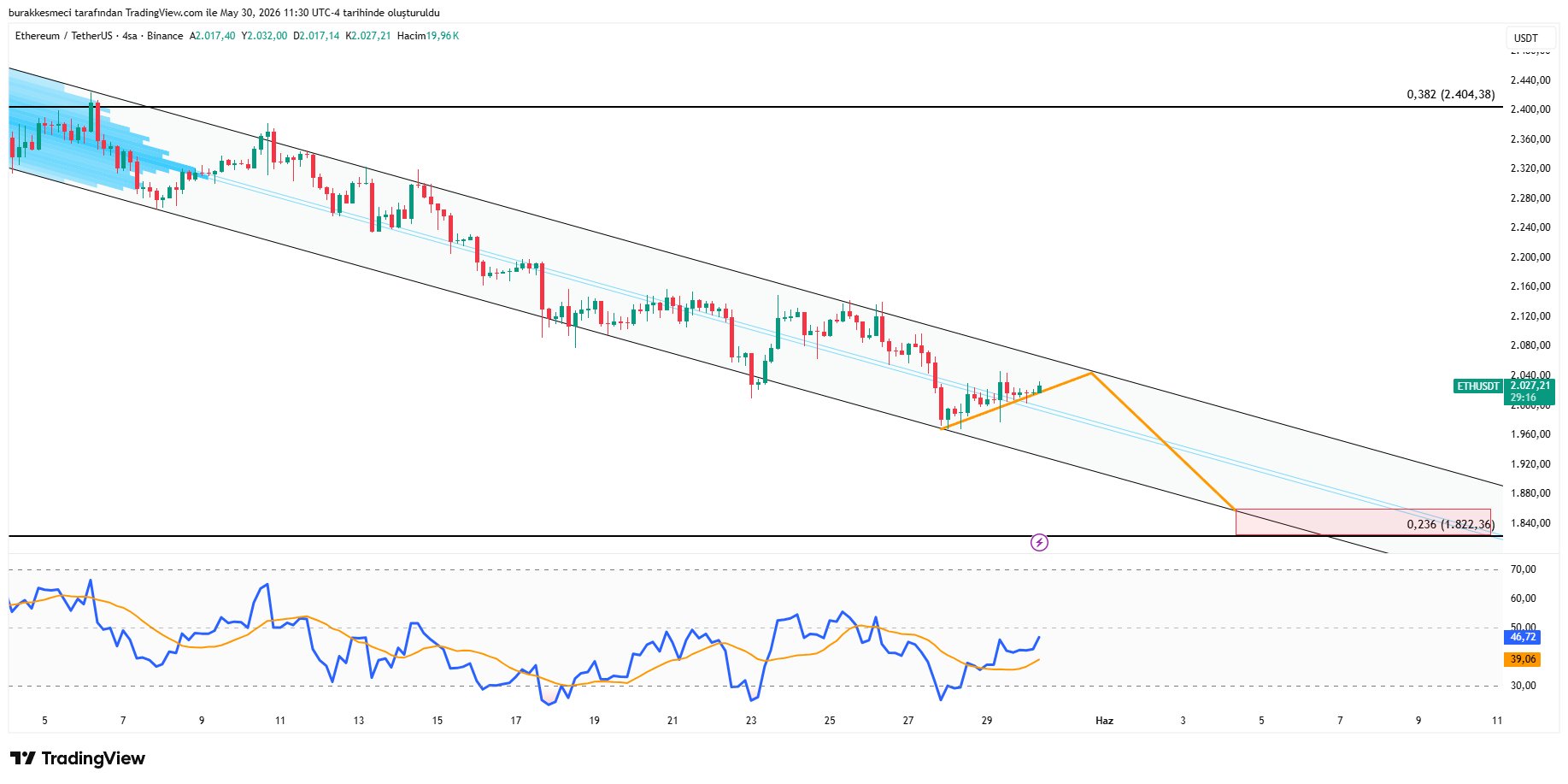
Source: @burak_kesmeci on X

According to Kesmeci, the persistence of the Ethereum price within the descending channel and the weak price momentum suggest that a downward move is on the cards. The crypto analyst highlighted that ETH could drop to the $1,822 – $1,850 range, so long as the overhead resistance at the upper boundary of $2,033 (Fibonacci 0.5) holds.

However, there is also the flipside scenario in which the price of Ethereum could break out toward $2,400 if the $2.033 resistance is breached. However, the decline toward the $1,850 region seems more likely, especially given current demand conditions.

Ethereum ETFs Post $241 Million In Outflows Over The Past Week

This dwindling demand in the Ethereum market is evident in rising spot ETF outflows, which climbed above $241 million over the past week. This past week’s record marked the third consecutive week with significant net outflows for the spot ETH exchange-traded funds.

The Ethereum price action over the past three weeks has been a fair reflection of this pessimistic market condition. According to CoinGecko data, the second-largest cryptocurrency has lost nearly 15% of its value in the last three weeks.

As of this writing, the price of ETH stands at around $2,023, with no significant change in the past 24 hours.

The price of ETH on the daily timeframe | Source: ETHUSDT chart on TradingView


Связанные с этим вопросы

QWhat is the main bearish price target for Ethereum mentioned in the article, and who provided this analysis?

AThe main bearish price target mentioned is a decline to the $1,822-$1,850 range. This analysis was provided by crypto analyst Burak Kesmeci on the social media platform X.

QWhat technical chart pattern is the analyst using to support the bearish outlook for Ethereum?

AThe analyst is using a descending channel pattern on the four-hour timeframe of the Ethereum price chart to support the bearish outlook.

QAccording to the article, what is the key resistance level Ethereum needs to break to invalidate the bearish scenario?

AThe key resistance level Ethereum needs to break is $2,033. If breached, the price could potentially break out toward $2,400.

QWhat recent market development reflects the dwindling demand for Ethereum, and what is the specific figure mentioned?

AThe recent market development reflecting dwindling demand is the rising outflows from spot Ethereum ETFs, which climbed above $241 million over the past week.

QHow much value has Ethereum lost in the last three weeks according to CoinGecko data cited in the article?

AAccording to CoinGecko data cited in the article, Ethereum has lost nearly 15% of its value in the last three weeks.

Похожее

CPU, Quietly Returning to the Center of the AI Computing Power Stage

Over the past three years, AI computing power narratives have been dominated by GPUs. However, starting in 2026, this story began to shift. While training large models remains GPU-intensive, the rapid growth of inference and AI agent workloads, which require high levels of task orchestration, concurrency, and data flow management, has highlighted a renewed critical role for CPUs. These are tasks GPUs are not designed to handle. Intel's recent launch of the Xeon 6+ processor, built on its Intel 18A process and featuring up to 288 efficiency cores (E-cores), exemplifies this strategic pivot. It is positioned not as a mere companion to GPUs but as the essential "control plane" for AI infrastructure, optimized for high-density, energy-efficient, and high-throughput workloads characteristic of AI agents and inference. This "CPU resurgence" is not about CPUs outperforming GPUs in raw computation. It reflects a systemic bottleneck: as AI scales from training single models to deploying countless intelligent agents, the demand for coordination and data handling surges. Major cloud providers are also developing their own high-density ARM-based server CPUs for similar workloads. However, Intel's success with this strategy faces significant challenges. Competition includes NVIDIA's integrated CPU-GPU solutions, the expanding adoption of cloud vendors' in-house ARM CPUs, and the crucial market test of Intel's 18A manufacturing process against rivals like TSMC's N2. In conclusion, CPUs are indeed reclaiming a central, though redefined, role in AI compute—managing the complex orchestration that enables massive-scale AI deployment. While the trend is clear, which company will ultimately lead this CPU resurgence remains an open question to be decided in the data centers of 2027 and beyond.

marsbit4 мин. назад

CPU, Quietly Returning to the Center of the AI Computing Power Stage

marsbit4 мин. назад

After Collaborating with 35+ DeFi Projects, Pink Brains Discovers the New 2026 KOL Marketing Rules

After collaborating with over 35 leading DeFi projects on marketing over three years, Pink Brains identifies a key shift for effective marketing in 2026: prioritizing the user journey over traditional campaign tactics. The most effective marketing mirrors how users actually behave—starting with discovery on social platforms like X (formerly Twitter), followed by data-driven verification on sites like DefiLlama, and finally, participation with small test funds. Success hinges on genuine, verifiable mechanisms, not just marketing hype. Current user interest centers on several key themes: new DeFi trends (RWA, perps, crypto x AI), meaningful airdrops requiring real contributions, real yield from protocol revenue, and tokens with value capture mechanisms directly tied to product usage. Case studies like Hyperliquid's HYPE (with its aggressive buyback program) and Venice's VVV (linking demand to AI compute) exemplify how strong tokenomics foster user retention. New trading venues like prediction markets, collectibles platforms, and GambleFi are also gaining traction, driven by verifiable activity. The article outlines common mistakes in DeFi KOL marketing, such as using creators unfamiliar with the product, generic messaging, or relying on a few top-tier KOLs. Instead, effective strategies align with different KOL types—educators, content creators, airdrop hunters, and niche experts—for various stages of the user journey. Ultimately, long-term user retention depends on a combination of a genuinely useful product, responsive support, community-aligned tokenomics, and strategic community building. The core takeaway is that sustainable growth stems from products whose value is validated by data and real-world utility, not just promotional efforts.

marsbit23 мин. назад

After Collaborating with 35+ DeFi Projects, Pink Brains Discovers the New 2026 KOL Marketing Rules

marsbit23 мин. назад

Торговля

Спот
Фьючерсы

Популярные статьи

Manyu: восходящая мем-звезда на Ethereum, готовая открыть новую эру культуры Shiba

Manyu - это мемтокен на Ethereum, который приносит децентрализованную культурную и развлекательную ценность через вирусное влияние в соцсетях и вовлечённость сообщества.

1.9k просмотров всегоОпубликовано 2025.11.27Обновлено 2025.11.27

Manyu: восходящая мем-звезда на Ethereum, готовая открыть новую эру культуры Shiba

Неделя обучения по популярным токенам 14: Glamsterdam — самое ожидаемое обновление Ethereum в 2026 году

Ordinals/Runes по-прежнему стимулируют доходы от комиссий за блоки и активность разработчиков, рассматриваются как отправная точка «нативной эмиссии активов» в сети.

1.5k просмотров всегоОпубликовано 2026.04.29Обновлено 2026.04.29

Неделя обучения по популярным токенам 14: Glamsterdam — самое ожидаемое обновление Ethereum в 2026 году

Обсуждения

Добро пожаловать в Сообщество HTX. Здесь вы сможете быть в курсе последних новостей о развитии платформы и получить доступ к профессиональной аналитической информации о рынке. Мнения пользователей о цене на ETH (ETH) представлены ниже.

活动图片