Loss Exceeding $26 Million: Analysis of Truebit Protocol Security Incident and Tracking of Stolen Funds Flow

marsbitОпубликовано 2026-01-09Обновлено 2026-01-09

Введение

On January 9, the Truebit Protocol suffered an attack resulting in a loss of 8,535.36 ETH (approximately $26.4 million) due to an exploit in a five-year-old unaudited and unopen-sourced contract. The attack involved a suspected arithmetic logic flaw, possibly due to integer truncation, in an unverified function (0xa0296215). The attacker repeatedly called this function with a minimal msg.value to mint a large number of TRU tokens, which were then burned to withdraw ETH from the contract’s reserves. According to Beosin’s analysis, the stolen funds—totaling 8,535.36 ETH—were primarily transferred to two addresses: 0xd12f6e0fa7fbf4e3a1c7996e3f0dd26ab9031a60 (holding 4,267.09 ETH) and 0x273589ca3713e7becf42069f9fb3f0c164ce850a (holding 4,001 ETH). The attacker’s address (0x6c8ec8f14be7c01672d31cfa5f2cefeab2562b50) still retains 267.71 ETH. All related addresses have been flagged as high-risk by Beosin KYT. The incident underscores the importance of security audits, contract upgrades, and incorporating emergency pause mechanisms and modern Solidity safety features to mitigate risks in legacy smart contracts.

Author: Beosin

In the early hours of January 9, an unopen-sourced contract deployed by Truebit Protocol 5 years ago was attacked, resulting in a loss of 8,535.36 ETH (worth approximately $26.4 million). The Beosin security team conducted an analysis of the vulnerability and fund tracking for this security incident and shares the results as follows:

Attack Technique Analysis

For this incident, we take the most significant attack transaction as the analysis subject, with the transaction hash: 0xcd4755645595094a8ab984d0db7e3b4aabde72a5c87c4f176a030629c47fb014

1. The attacker calls getPurchasePrice() to obtain the price

2. Subsequently calls the flawed function 0xa0296215(), setting the msg.value extremely low
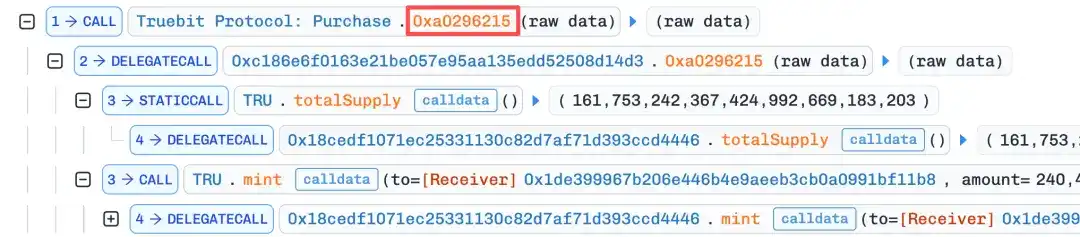
Since the contract is not open-source, it is inferred from the decompiled code that this function has an arithmetic logic vulnerability, such as integer truncation issues, allowing the attacker to successfully mint a large number of TRU tokens.

3. The attacker "sells back" the minted tokens to the contract through the burn function, extracting a large amount of ETH from the contract reserves.
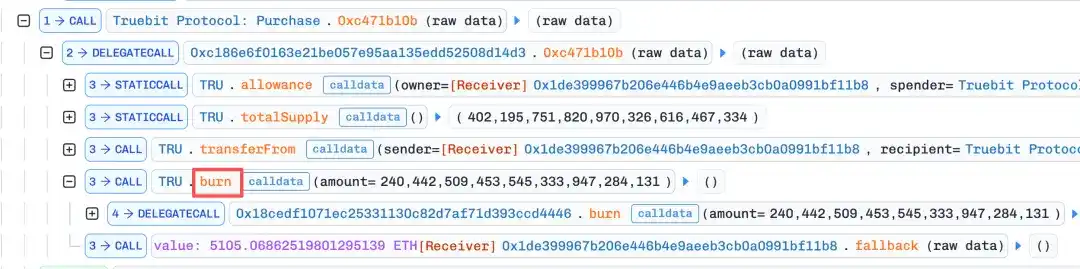
This process is repeated 4 more times, with the msg.value increasing each time, until almost all ETH in the contract is extracted.

Stolen Funds Tracking

Based on on-chain transaction data, Beosin conducted a detailed fund tracking through its blockchain on-chain investigation and tracking platform, BeosinTrace, and shares the results as follows:

Currently, the stolen 8,535.36 ETH, after transfers, are mostly held in 0xd12f6e0fa7fbf4e3a1c7996e3f0dd26ab9031a60 and 0x273589ca3713e7becf42069f9fb3f0c164ce850a.

Among them, address 0xd12f holds 4,267.09 ETH, and address 0x2735 holds 4,001 ETH. The address from which the attacker initiated the attack (0x6c8ec8f14be7c01672d31cfa5f2cefeab2562b50) still holds 267.71 ETH. There have been no further fund transfers from these three addresses yet.
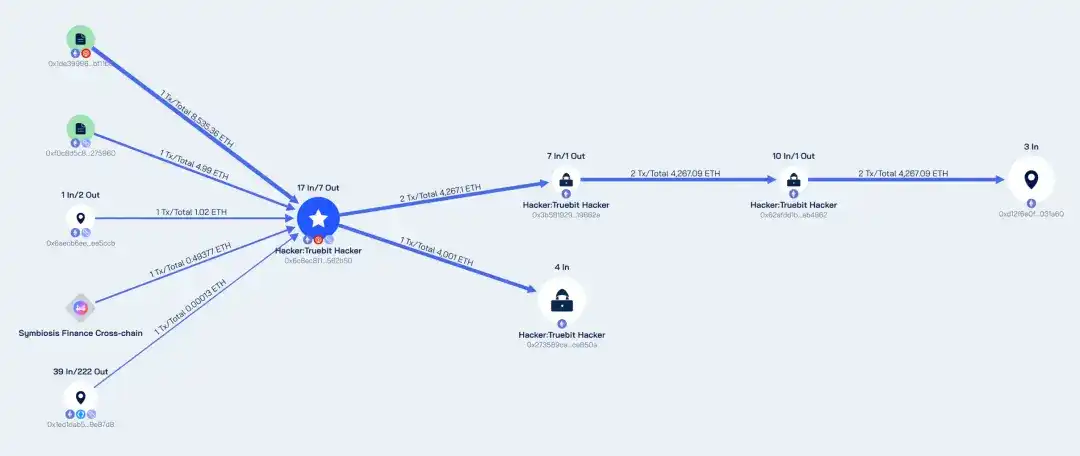
Stolen Funds Flow Analysis Diagram by Beosin Trace

The above addresses have been marked as high-risk addresses by Beosin KYT. Taking the attacker's address as an example:
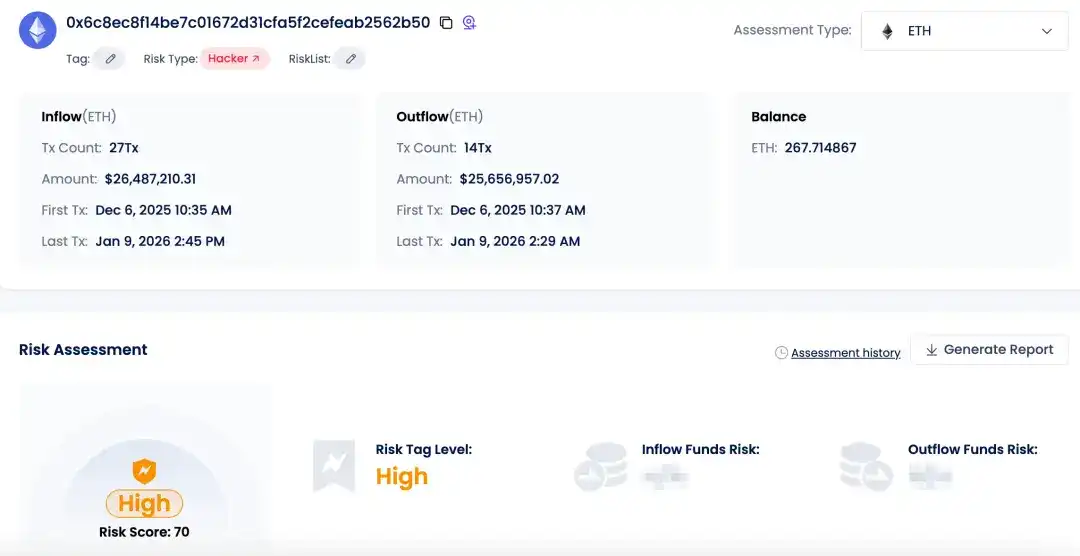
Beosin KYT

Conclusion

This stolen fund incident involves an unopen-sourced smart contract from 5 years ago. For such contracts, the project team should upgrade the contract, introduce emergency pause functions, parameter limitations, and new Solidity security features. Furthermore, security audits remain an essential step for contracts. Through security audits, Web3 enterprises can comprehensively detect smart contract code, identify and fix potential vulnerabilities, and enhance contract security.

*Beosin will provide a complete analysis report of all fund flows and address risks for this incident. Welcome to request it via the official email [email protected].


Связанные с этим вопросы

QWhat was the total amount of ETH stolen in the Truebit Protocol security incident?

A8,535.36 ETH, valued at approximately $26.4 million.

QWhich function did the attacker call to exploit the vulnerability in the unopened contract?

AThe attacker called the function 0xa0296215() with a very small msg.value to exploit an arithmetic logic vulnerability, likely due to integer truncation issues.

QHow did the attacker convert the fraudulently minted TRU tokens into ETH?

AThe attacker used the burn function to 'sell back' the minted TRU tokens to the contract, extracting a large amount of ETH from the contract reserves.

QWhat are the two main addresses where the stolen ETH is currently held?

AThe majority of the stolen ETH is held in addresses 0xd12f6e0fa7fbf4e3a1c7996e3f0dd26ab9031a60 (4,267.09 ETH) and 0x273589ca3713e7becf42069f9fb3f0c164ce850a (4,001 ETH).

QWhat security measures does Beosin recommend to prevent such incidents?

ABeosin recommends upgrading the contract to include emergency pause functions, parameter limits, and new Solidity security features, as well as conducting thorough security audits to detect and fix potential vulnerabilities.

Похожее

In a Losing Bear Market, Who Is Quietly Making a Fortune?

Amid a prolonged bear market where most crypto participants are losing money, a few projects continue to generate significant revenue. A closer look at Defillama’s revenue rankings reveals that profitable projects share simple and clear revenue models, primarily falling into two categories: spread income and transaction fees. Spread-based revenue models involve acting as capital intermediaries—absorbing funds at lower costs and deploying them at higher yields. Examples include stablecoin issuers like Tether and Circle, which earn from interest on reserve assets like U.S. Treasuries; lending protocols such as Aave, which profit from the spread between borrowing and deposit rates; and liquid staking services like Lido, which retain a portion of staking rewards as fees. Transaction fee models generate revenue by taxing activities like trading, token creation, or other on-chain actions. Platforms such as Hyperliquid and EdgeX (perpetual trading), Polymarket (event prediction), pump.fun and GMGN (meme trading), Aerodrome and Jupiter (spot trading), as well as Phantom (via swap fees) and NFT marketplaces like Courtyard and Fragment, all rely heavily on transaction fees. Notable exceptions include Grayscale (traditional asset management fees), Chainlink (oracle data service fees), and Titan Builder (which profited unusually from a large MEV capture incident). The key insight is that sustainable profitability in a bear market comes from straightforward revenue models combined with sophisticated product execution, liquidity management, and user engagement—not complex or high-risk strategies.

Odaily星球日报32 мин. назад

In a Losing Bear Market, Who Is Quietly Making a Fortune?

Odaily星球日报32 мин. назад

Торговля

Спот
Фьючерсы
活动图片