A Repeat Of February? Watch Out For These Bitcoin Price Levels In March

bitcoinistОпубликовано 2026-02-28Обновлено 2026-02-28

Введение

The Bitcoin price had a disappointing performance in February, struggling to sustain a break above the $70,000 level and facing sharp reversals after briefly reaching $71,000. A market analyst highlights several key price levels to watch in March. The strongest support is the realized price at approximately $54,600, which has historically acted as a critical floor. On the upside, significant resistance levels include the 1-4 Week Realized Price at $71,600, where recent buyers may look to exit at break-even. A decisive break above the Short-Term Holder Realized Price (STH RP) at $90,800 could signal a shift from a bearish to a bullish trend. Further resistance exists at the 365-day Simple Moving Average ($98,900) and the 3-6 Month Realized Price (~$100,800). Bitcoin is currently in a bearish phase and must overcome these resistance levels for a meaningful recovery. As of the time of writing, BTC is trading around $63,696, down over 5% in 24 hours.

The Bitcoin price performance was quite disappointing over the past month. The flagship cryptocurrency has struggled to break sustainably above $70,000 throughout February, with prices only reaching $71,000 before facing sharp reversals.

It, then, becomes intuitively evident that this price region might be a key level acting as resistance to Bitcoin’s bullish attempts. Below are some other crucial levels to watch for in March and what they could potentially mean for the Bitcoin price.

BTC Realized Price Sits At $54,600 – What This Means

In a Quicktake post on the CryptoQuant platform, market analyst Burak Kesmeci highlighted five “cost clusters” that might reveal the next move for the Bitcoin price. For context, Cost clusters are essentially price levels that represent the average acquisition price of an asset (Bitcoin, in this case) by different investor cohorts

To start with, Kesmeci immediately revealed Bitcoin’s surest support price — the realized price — to be around the $54,600 mark. The realized price is a strong support region because it reflects the average cost basis of all the BTC in circulation.
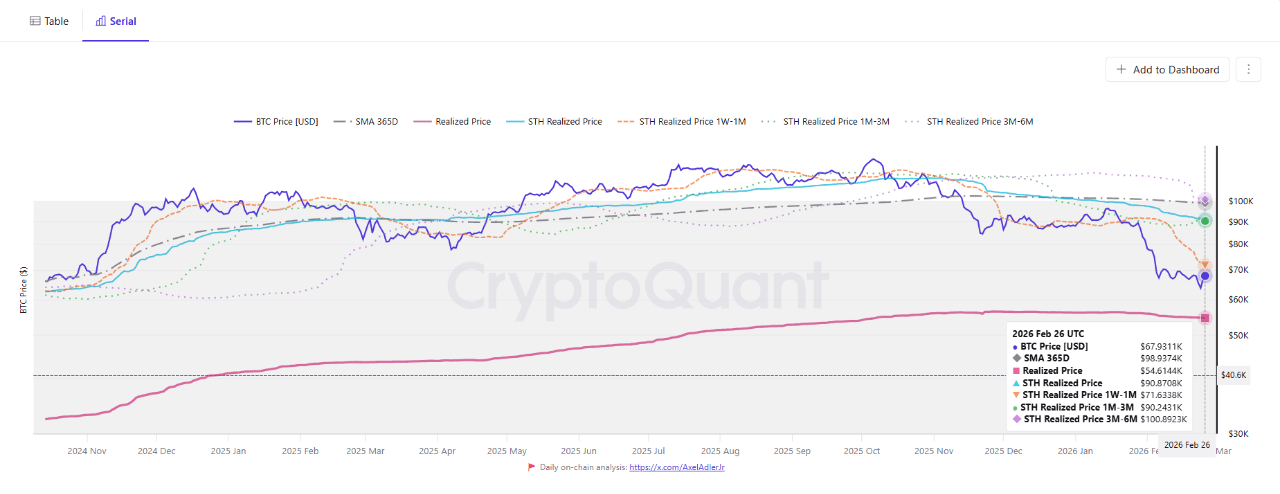
Source: CryptoQuant

Also, realized prices have historically served as long-term price support during bear phases. As a result, when the Bitcoin price trades above this level, it is often a sign of extant structural strength, while a break beneath the realized price is usually a sign of impending doom.

Bitcoin Could Switch Bullish In March — But On This Condition

While the Bitcoin price may be displaying its higher timeframe backing, it is also true that the world’s leading cryptocurrency has a series of battles to fight as it ascends. According to the crypto pundit, four resistance zones lie in wait to reject possible upward recovery.

The first of these zones is the 1 – 4-Week Realized Price, which reveals the average price at which recent buyers entered the BTC market. According to the highlighted CryptoQuant data, this cost basis stands at around the $71,600 level.

When the Bitcoin price trades beneath this level, it signals that the latest participants are under severe heat. Hence, recovery attempts towards this price level would typically be met with significant resistance, as this cohort would want to exit at break-even.

The analyst further highlighted that the Short-Term Holder Realized Price (STH RP) is around $90,800; this concerns investors who have held BTC for less than 155 days. If the Bitcoin price manages to overcome the evident resistance at this level, it could signal a change in Bitcoin’s trend from bearish to bullish.

Beyond the STH RP, the 365-day Simple Moving Average sits, occupying the $98,900 price level; then, a little more up North, the 3–6 Month Realized Price stands around $100,800. These metrics reflect the activity of Bitcoin’s medium-term holders, showing their realized price and average closing prices over the past year.

In the grand scheme, Bitcoin is clearly in a bearish phase. Thus, before March can stand as the pivotal month for market participants, BTC has to overcome those critical resistance levels. As of this writing, Bitcoin is valued at around $63,696, reflecting an over 5% decline in the past 24 hours.

The price of BTC on the daily timeframe | Source: BTCUSDT chart on TradingView


Связанные с этим вопросы

QWhat is the realized price of Bitcoin and why is it considered a strong support level?

AThe realized price of Bitcoin is around $54,600. It is considered a strong support level because it reflects the average cost basis of all the BTC in circulation and has historically served as long-term price support during bear phases.

QWhat is the four resistance zones that Bitcoin needs to overcome for an upward recovery according to the analyst?

AThe four resistance zones are: the 1-4 Week Realized Price at ~$71,600, the Short-Term Holder Realized Price (STH RP) at ~$90,800, the 365-day Simple Moving Average at ~$98,900, and the 3-6 Month Realized Price at ~$100,800.

QWhat could a break above the Short-Term Holder Realized Price (STH RP) signal for Bitcoin's trend?

AIf the Bitcoin price manages to overcome the resistance at the Short-Term Holder Realized Price (~$90,800), it could signal a change in Bitcoin's trend from bearish to bullish.

QWhy would the 1-4 Week Realized Price level act as significant resistance for Bitcoin's price?

AThe 1-4 Week Realized Price (~$71,600) reveals the average price at which recent buyers entered the market. When the price is below this level, these buyers are at a loss, so they are likely to sell at break-even, creating significant selling pressure and resistance.

QWhat was the Bitcoin price performance like in February and what is its value as of the writing of the article?

AIn February, Bitcoin struggled to break sustainably above $70,000, only reaching $71,000 before facing sharp reversals. As of the writing of the article, Bitcoin is valued at around $63,696, reflecting an over 5% decline in the past 24 hours.

Похожее

Hong Kong Issues Licenses, Stablecoin Landscape Shifts: Who is Reshaping the Next Generation Financial Map?

Hong Kong's financial landscape has entered a new phase with the issuance of the first stablecoin licenses by the Hong Kong Monetary Authority (HKMA) on April 10, 2026. Anchor Fintech and HSBC were granted the initial approvals, marking the completion of a regulatory framework that spans legislation, review, and licensing. This move signals a strategic shift in the role of stablecoins—from being auxiliary tools in crypto trading to integral components in cross-border payments, tokenized asset transactions, and programmable finance. With only 2 licenses issued from 36 applications, HKMA has adopted a highly selective, quality-over-quantity approach. The licensing process underscores Hong Kong’s ambition to position itself as a leader in digital finance infrastructure, combining banking credibility, payment networks, and blockchain capabilities. Compared to the EU’s MiCA framework and the UK’s upcoming crypto regulations, Hong Kong has gained a first-mover advantage in institutionalizing stablecoins. The city has already laid the foundation with initiatives like tokenized green bonds, e-HKD trials, and the Project Ensemble Sandbox. Globally, dollar-backed stablecoins still dominate over 90% of the market. Hong Kong’s strategy is not to directly challenge the dollar’s dominance but to create a regulated, scalable path for non-dollar stablecoins. It also complements mainland China’s digital yuan system, forming a two-tiered structure: onshore digital RMB for domestic use, and Hong Kong’s licensed stablecoins for offshore and international applications. While this is a significant step, success will depend on whether Hong Kong can build sufficient network effects and real-world adoption to compete with established dollar stablecoins. The focus remains on turning a high-standard regulatory model into a system with tangible scale and influence.

marsbit5 ч. назад

Hong Kong Issues Licenses, Stablecoin Landscape Shifts: Who is Reshaping the Next Generation Financial Map?

marsbit5 ч. назад

Торговля

Спот
Фьючерсы

Популярные статьи

Как купить F

Добро пожаловать на HTX.com! Мы сделали приобретение Synfutures (F) простым и удобным. Следуйте нашему пошаговому руководству и отправляйтесь в свое крипто-путешествие.Шаг 1: Создайте аккаунт на HTXИспользуйте свой адрес электронной почты или номер телефона, чтобы зарегистрироваться и бесплатно создать аккаунт на HTX. Пройдите удобную регистрацию и откройте для себя весь функционал.Создать аккаунтШаг 2: Перейдите в Купить криптовалюту и выберите свой способ оплатыКредитная/Дебетовая Карта: Используйте свою карту Visa или Mastercard для мгновенной покупки Synfutures (F).Баланс: Используйте средства с баланса вашего аккаунта HTX для простой торговли.Третьи Лица: Мы добавили популярные способы оплаты, такие как Google Pay и Apple Pay, для повышения удобства.P2P: Торгуйте напрямую с другими пользователями на HTX.Внебиржевая Торговля (OTC): Мы предлагаем индивидуальные услуги и конкурентоспособные обменные курсы для трейдеров.Шаг 3: Хранение Synfutures (F)После приобретения вами Synfutures (F) храните их в своем аккаунте на HTX. В качестве альтернативы вы можете отправить их куда-либо с помощью перевода в блокчейне или использовать для торговли с другими криптовалютами.Шаг 4: Торговля Synfutures (F)С легкостью торгуйте Synfutures (F) на спотовом рынке HTX. Просто зайдите в свой аккаунт, выберите торговую пару, совершайте сделки и следите за ними в режиме реального времени. Мы предлагаем удобный интерфейс как для начинающих, так и для опытных трейдеров.

440 просмотров всегоОпубликовано 2024.12.21Обновлено 2025.03.21

Как купить F

Обсуждения

Добро пожаловать в Сообщество HTX. Здесь вы сможете быть в курсе последних новостей о развитии платформы и получить доступ к профессиональной аналитической информации о рынке. Мнения пользователей о цене на F (F) представлены ниже.

活动图片