[daily public chain] sol exchange accounts for 37%, and avax accounts for us $10.1 billion

Huobi ResearchОпубликовано 2022-03-25Обновлено 2022-03-29

Введение

Since 2017, large-scale ambushes have emerged and the fittest have been eliminated in the wheel of the times.

Since 2017, large-scale ambushes have emerged and the fittest have been eliminated in the wheel of the times. Until this year, the public chain has ushered in a collective outbreak, from Polkadot, a cross chain network of slot auction, to many emerging public chains such as Solana, avalanche and Cardano. Ethereum has created a public chain with great competition demand, giving birth to greater market opportunities.

More than 100 public chain projects are common and cross chain, which is a new trend

At present, there are more than 100 active public chains, which can be divided into single chain and cross chain according to the attributes of the chain, and the cross chain is represented by Boca and has become the mainstream trend of this era. Overall, the number of public chains has formed a certain scale, and the competition is quite fierce.

1、Solana

Solana started the upsurge of public chain. What's the difference between them?

Solana's fire has directly stirred the upsurge of the public chain camp, including avalanche, fantom, near and so on. The market pays more attention to the public chain, and both capital, project parties and developers are full of interest in this track. So, what are the differences between them?

In terms of technical architecture:

Solana: poh clock scheme

Different from most pieces + eth2 0 scheme, Solana created a unique and innovative poh clock mechanism in the public chain circle The scheme decouples the block out time and state. In terms of global consensus, it is not limited by the hard requirements of block size and block out time. Through the global clock, a globally available time chain is generated for all nodes. The state update can be carried out asynchronously. The verifier can send state updates to other nodes in real time. The poh clock gives the participants of Solana ecology more expandable space, Further improve and expand the overall throughput capacity.

Lock data

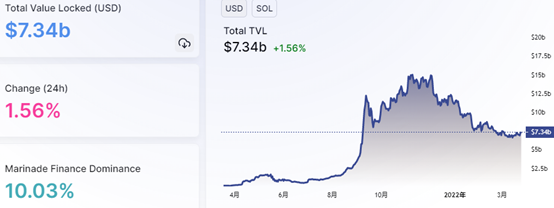
Sol's lock up scale has been pulled back from a high level, with a peak of US $15 billion in 2021. On March 24, the scale of lock up reached US $7.34 billion, and there is a large space for data callback of lock up volume.
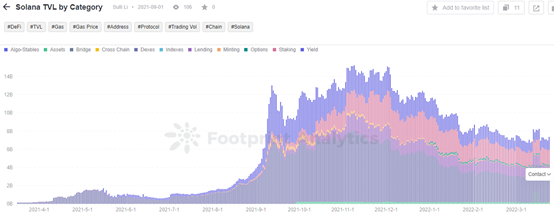
In terms of the proportion of lock up on the sol chain, the proportion of loan lock up and decentralized exchange lock up is relatively large, while the scale of loan, pledge and mining lock up is small. According to the latest data on March 24, the decentralized exchange locked positions of US $2.76 billion, while loans, pledges and mining were US $1.17 billion, US $1.65 billion and US $1.4 billion.
Token price

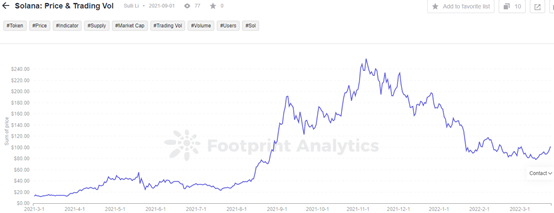
The linkage effect between slol price and lock volume is good, and the sol price has dropped from a high of more than $240 to a minimum of $80. The current price on March 24 is $102. In the later stage, we can pay attention to the ecological development, as well as the trading opportunities of the upward lock up volume and price recovery.
2. Avalanche: three chain structure

Avalanche agreement entered the public view by means of incentives, and realized the sharp rise of currency price and lock up volume. Similarly, as a smart contract platform, avalanche is very novel in architecture design and adopts the three chain structure of X chain, C chain and P chain. X chain is a transaction chain, which mainly deals with point-to-point asset creation and transaction transactions between individuals; C-chain is a smart contract chain compatible with EVM, and the basic defi projects are built on C-chain; P chain is a platform chain, which is mainly responsible for token pledge, coordinating network verifiers, creating user-defined subnets and other affairs. The three chains perform their respective functions, but complement each other, further liberating avalanche's network performance.

Lock data

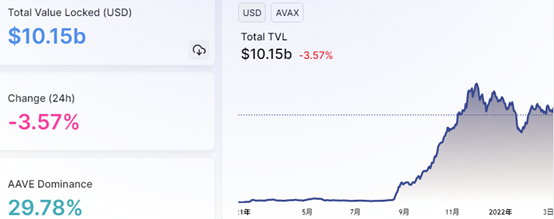
Avax lock up data increased by leaps and bounds in 2021. The data rebounded from a low of $2 billion to a maximum of more than $14 billion, with a growth space of more than six times. The current TVL value is US $10.15 billion.
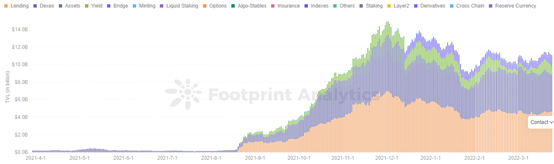
In terms of the proportion of avax chain lock, the proportion of lending, lock and decentralized exchange lock is relatively large, while the scale of mining and cross chain lock is small. On March 24, the loan lockup reached its peak. The scale of loan lockup was US $4.6 billion, that of decentralized exchange lockup was US $4 billion, and that of mining and cross chain lockup was US $900 million and US $1.1 billion.
Token price

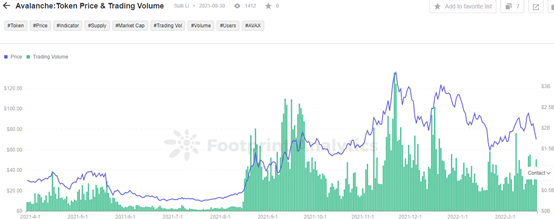
Avax experienced great growth in 2021, rising from $15 in August 2021 to a high of $135. From the second half of 2021 to the beginning of 2022, the price of avax remained around $85. Compared with the vicinity of TVL's decline, there is more room for price correction. Next, we can focus on low absorption opportunities.

Похожее

A Nation Blocks Chips, a Giant Buys a Nuclear Power Plant: Why It's Time to Seriously Consider DeAI

**Title: Great Powers Blockade Chips, Giants Buy Nuclear Plants: Why It's Time to Seriously Consider DeAI** In May 2026, the US closed loopholes for Chinese firms to acquire advanced NVIDIA chips via overseas subsidiaries. That same month, Kenya halted a $1B geothermal data center project involving Microsoft, fearing its immense energy consumption. Meanwhile, Huawei announced mass production of its Ascend AI chip. These disparate events underscore a new reality: the competition for computing power ("compute") has escalated beyond the tech industry, becoming a geopolitical and infrastructural battleground. A new era of oligopoly is forming, with control over the AI stack—from GPU chips (NVIDIA) and cloud platforms (AWS, Azure, Google Cloud) to foundational models (OpenAI, Anthropic)—concentrating in a few Western "AI Octopus" corporations. This centralization creates systemic risks: pricing power and platform lock-in for users, infrastructure fragility, and a widening "compute divide" that threatens to marginalize nations without independent AI capacity. An "AI Iron Curtain" is deepening through export controls. In response, some nations like Saudi Arabia and the UAE are investing heavily to buy compute power, aiming to transition from oil to AI economies. The EU seeks to triple its compute capacity by 2030 to reduce dependency. However, the spending gap is vast, with four US tech giants alone planning ~$750B in AI capex for 2026. The race is increasingly constrained by energy, with AI tasks consuming up to 1000x more power than web searches, pushing firms to even acquire nuclear plants. This landscape is fueling interest in Decentralized AI (DeAI). It proposes a third way: using open protocols to coordinate a global network of idle GPUs, independent developers, and data centers, creating an AI infrastructure without a single controlling entity. Leveraging blockchain and cryptographic verification, DeAI aims to break market concentration, disperse energy demands, reduce geopolitical dependencies, and enhance transparency. While still nascent in performance and stability, DeAI's core promise is not immediate superiority but providing a crucial alternative architecture to resist monopoly, censorship, and centralized power. As specialized AI hardware costs fall and open-source models flourish, the window to build this foundation is open. The very existence of such competition serves as a vital check against the inevitable abuse of concentrated power.

marsbit5 мин. назад

A Nation Blocks Chips, a Giant Buys a Nuclear Power Plant: Why It's Time to Seriously Consider DeAI

marsbit5 мин. назад

Outpoll Review: A Prediction Market Platform Built for Active Traders

Outpoll Review: A Prediction Market Platform Built for Active Traders In recent years, prediction markets have grown from a niche sector to a mainstream arena, attracting billions in trading volume and institutional capital. However, the user experience and tools for traders have not kept pace. Outpoll, a new global prediction market platform, aims to fill this gap by providing enhanced trading infrastructure for active and professional traders. Built on standard prediction market principles, Outpoll allows users to trade on the outcome of specific events. It uses fully collateralized contracts with USDC settlement, charges a competitive 0.1% fee per trade, and provides clear settlement rules upfront to minimize disputes. A key focus for Outpoll is its professional-grade trading tools. The platform supports limit and market orders, as well as take-profit and stop-loss orders for open positions—features uncommon in prediction markets. For automated trading, Outpoll offers comprehensive REST and WebSocket APIs, enabling portfolio management, price arbitrage, and integration with existing tools. The platform also features a creator-led market model, where approved experts and community leaders can create and manage markets for niche topics under platform supervision. Its integrated interface combines news feeds directly with trading functions, allowing users to monitor events and manage positions seamlessly. Outpoll launched with a native Android app (available on Google Play) and plans an iOS version later this year. In summary, Outpoll distinguishes itself with trader-focused tools, practical APIs, transparent and collateralized markets, integrated news, and an expanding creator program. For active traders, its advanced order types and API access alone make it a platform worth watching. Outpoll is now globally accessible via outpoll.com and Google Play.

marsbit13 мин. назад

Outpoll Review: A Prediction Market Platform Built for Active Traders

marsbit13 мин. назад

Bitwise: Crypto Becomes a Contrarian Investment, Three Logics to Understand the Current Market

**Summary** Matt Hougan, Bitwise's CIO, analyzes the current crypto market through three key lenses, arguing it has shifted from a momentum-driven to a contrarian investment. **1) Crypto Becomes a Contrarian Play:** The market is weak, with major assets like Bitcoin and Ethereum down significantly. Capital has moved to hot sectors like AI, leaving crypto as an "unloved" asset class. This transforms crypto investing from trend-following to a test of patience and fundamental analysis. Investors now favor projects with solid fundamentals (e.g., Hyperliquid) over speculative ones. **2) Regulatory Overhang:** The uncertain fate of the U.S. CLARITY Act, a major crypto regulatory framework, is a key headwind. With its passage in 2024 seen as far from guaranteed (estimates range from 30-55%), institutional capital remains on the sidelines, choosing less risky alternatives like AI stocks. The market needs clarity—whether the bill passes or fails—more than any specific outcome to move decisively. **3) Capital Rotates to New Fundamentals:** This cycle differs from past bear markets where money fled to Bitcoin. Now, capital seeks smaller assets with strong use cases. While major cryptos fell in May 2024, tokens like Hyperliquid (+72%), Zcash (+50%), and XLM (+44%) rallied on their specific fundamentals. This rotation confirms the new contrarian, fundamentals-driven logic and signals the bear market may be in its later stages. **Conclusion:** Short-term pressure persists due to regulatory uncertainty and competition from AI narratives. Investing in crypto now requires a contrarian mindset—acting against the crowd and focusing on fundamental value. Patience and targeting high-quality projects based on their merits are essential for capturing long-term gains.

marsbit56 мин. назад

Bitwise: Crypto Becomes a Contrarian Investment, Three Logics to Understand the Current Market

marsbit56 мин. назад

ChatGPT Might Be Disappearing Soon

OpenAI announced at its "Intelligence at Work" event that its coding assistant, Codex, will be fully integrated into the ChatGPT app within weeks. This move marks a strategic shift from a conversational AI (Chat) towards a unified "agentic" platform capable of execution. Codex, originally launched to compete with Anthropic's Claude Code, has grown rapidly to 5 million weekly active users, with 20% being non-developers like analysts and designers. Its enterprise revenue now constitutes 40% of OpenAI's total. The integration is the first step in creating a super-app combining ChatGPT (interface), Codex (execution engine), and the Atlas browser (web access). OpenAI also unveiled new Codex features: specialized Agent plugins for six professional roles, an "Annotations" tool for direct document editing, and a "Sites" function to turn work into shareable web apps. Internally, this reflects a power shift; the Codex team now leads core product strategy. While the ChatGPT brand remains for its vast user base, the platform's future is focused on autonomous agents that perform tasks, not just chat. The article notes that competition with Claude Code pushed OpenAI's development, with Codex competing on cost-effectiveness and accessibility rather than raw coding quality. It concludes that the essence of "ChatGPT" is evolving from a chatbot into an AI agent platform, with the name potentially becoming a legacy symbol of its original function.

marsbit1 ч. назад

ChatGPT Might Be Disappearing Soon

marsbit1 ч. назад

Торговля

Спот
Фьючерсы
活动图片