$700 Billion Poured into AI, Americans Taste the Bitter Fruit of Inflation First

marsbitОпубликовано 2026-04-02Обновлено 2026-04-02

Введение

A Federal Reserve analysis from the St. Louis Fed argues that AI optimism itself is a driver of inflation. The "news shock" of AI's revolutionary potential causes households and businesses to increase spending and investment in anticipation of future gains, pushing demand beyond current supply and creating inflationary pressure. This is supported by a Deutsche Bank experiment where AI models (dbLumina, Claude, ChatGPT-5.2) assessed a 20-40% probability that AI would raise inflation in the next year, citing surging demand for data centers, semiconductors, and electricity. They saw only a 5% chance of AI significantly reducing inflation. Massive capital expenditure underscores this demand. Amazon, Microsoft, Google, and Meta are projected to spend a combined ~$663B in 2026, a fourfold increase in four years. A significant portion funds power-hungry data centers. For example, OpenAI's "Stargate" project plans a 10-gigawatt capacity, equivalent to the entire electricity load of 16 Vermont states. U.S. data center electricity consumption is forecast to triple by 2030. While AI could eventually boost productivity and be disinflationary long-term, current data shows no such productivity jump. The U.S. economy now faces a cycle: massive AI investment fuels inflation, delays interest rate cuts, raises financing costs—yet the investment continues to accelerate. The outcome hinges on whether these AI models will ultimately make the economy more efficient, a question that remains unan...

On April 1, St. Louis Fed economists Miguel Faria-e-Castro and Serdar Ozkan published a blog post with a restrained title and a sharp conclusion: AI optimism itself is an inflation driver. Not because electricity bills are rising, not because of a chip shortage, but because everyone believes AI will make the future better—this belief makes them spend more money now.

On the same day, Fortune disclosed an experiment by Deutsche Bank: they had three AI models evaluate the "impact of AI on inflation." The conclusion was that even AI itself believes it is pushing up prices.


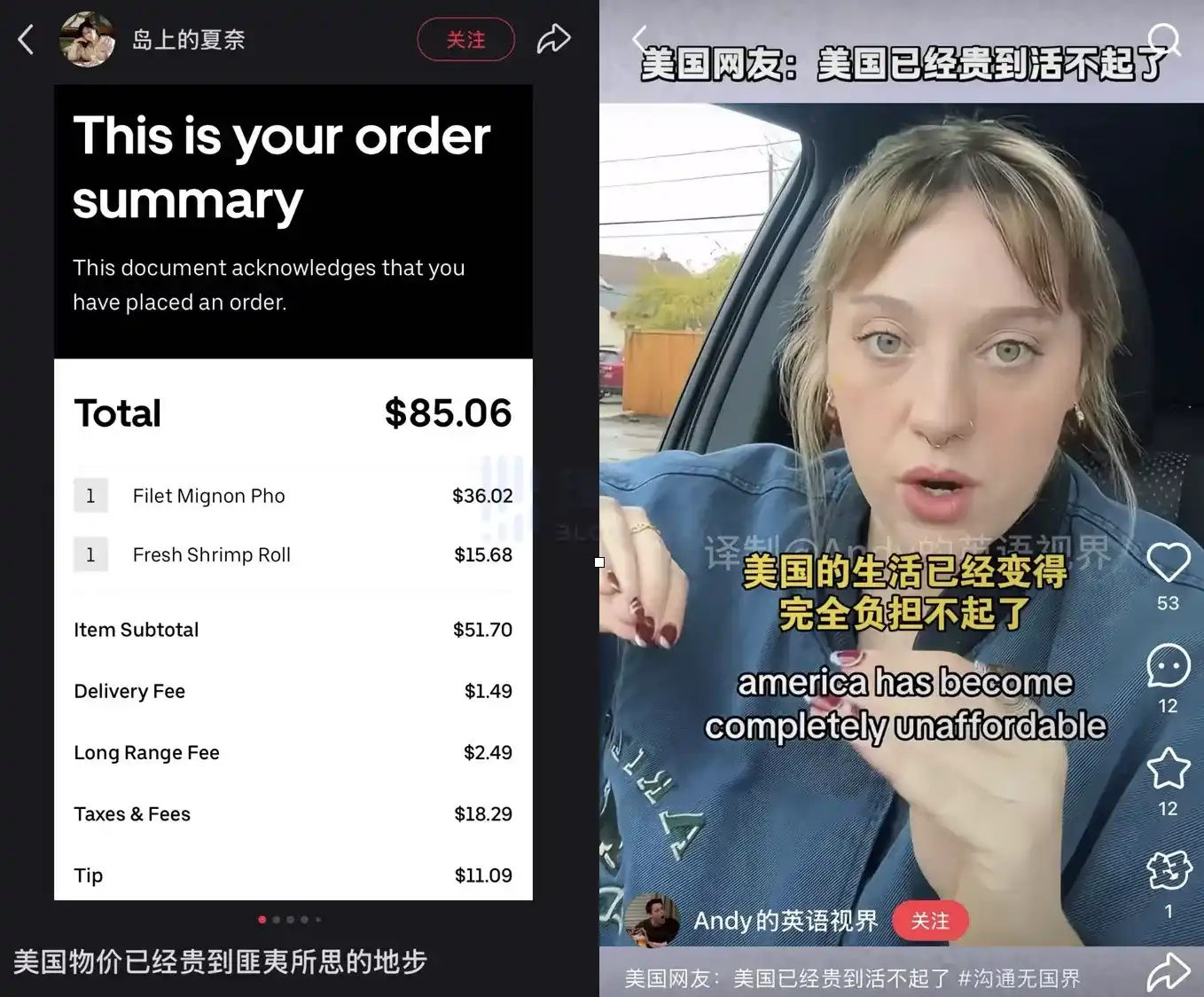
On social media, posts about soaring US prices are abundant

These two pieces together point to an uncomfortable cycle: the more investment in AI, the higher inflation, the further away interest rate cuts are, the higher financing costs become—yet investment continues to accelerate.

The Unstoppable Arms Race

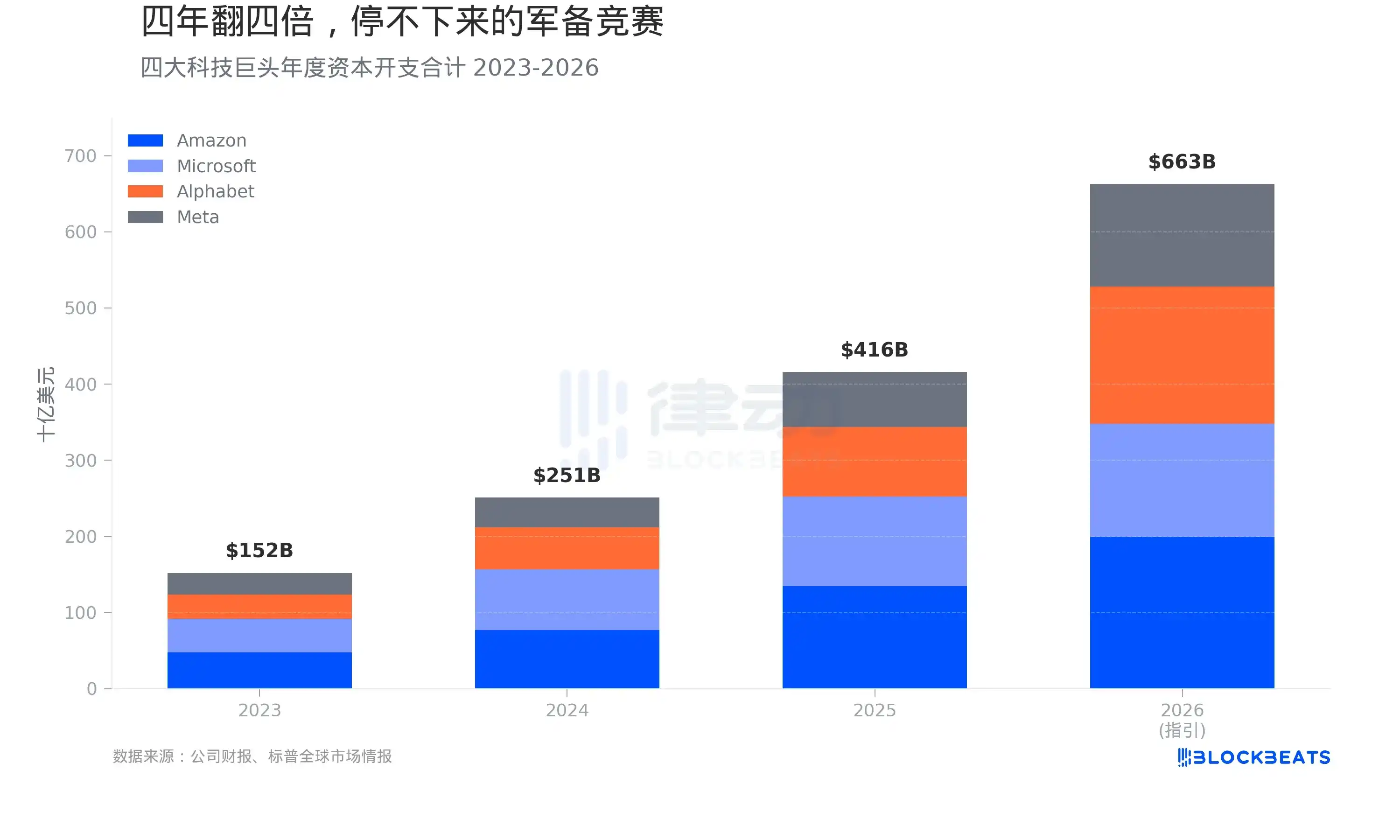
First, look at the money. According to company financial reports, the combined capital expenditures of Amazon, Microsoft, Google, and Meta in 2023 were approximately $152 billion. By 2024, this number jumped to $251 billion, a 65% increase. For the full year 2025, it settled at $416 billion, another 66% increase.

Company guidance for 2026 is even more aggressive. According to a summary by Wolf Street, Amazon guided for $200 billion, Google for $175 to $185 billion, Microsoft for $145 to $150 billion, and Meta for $135 billion. The four together amount to about $663 billion. Adding Oracle's $42 billion, the total for the five companies approaches $700 billion.

In four years, the capital expenditures of these four companies have quadrupled. This growth rate is unprecedented in US corporate history. According to a Fortune report, this scale already exceeds Sweden's annual GDP.

One Data Center, Consuming as Much Power as an Entire State

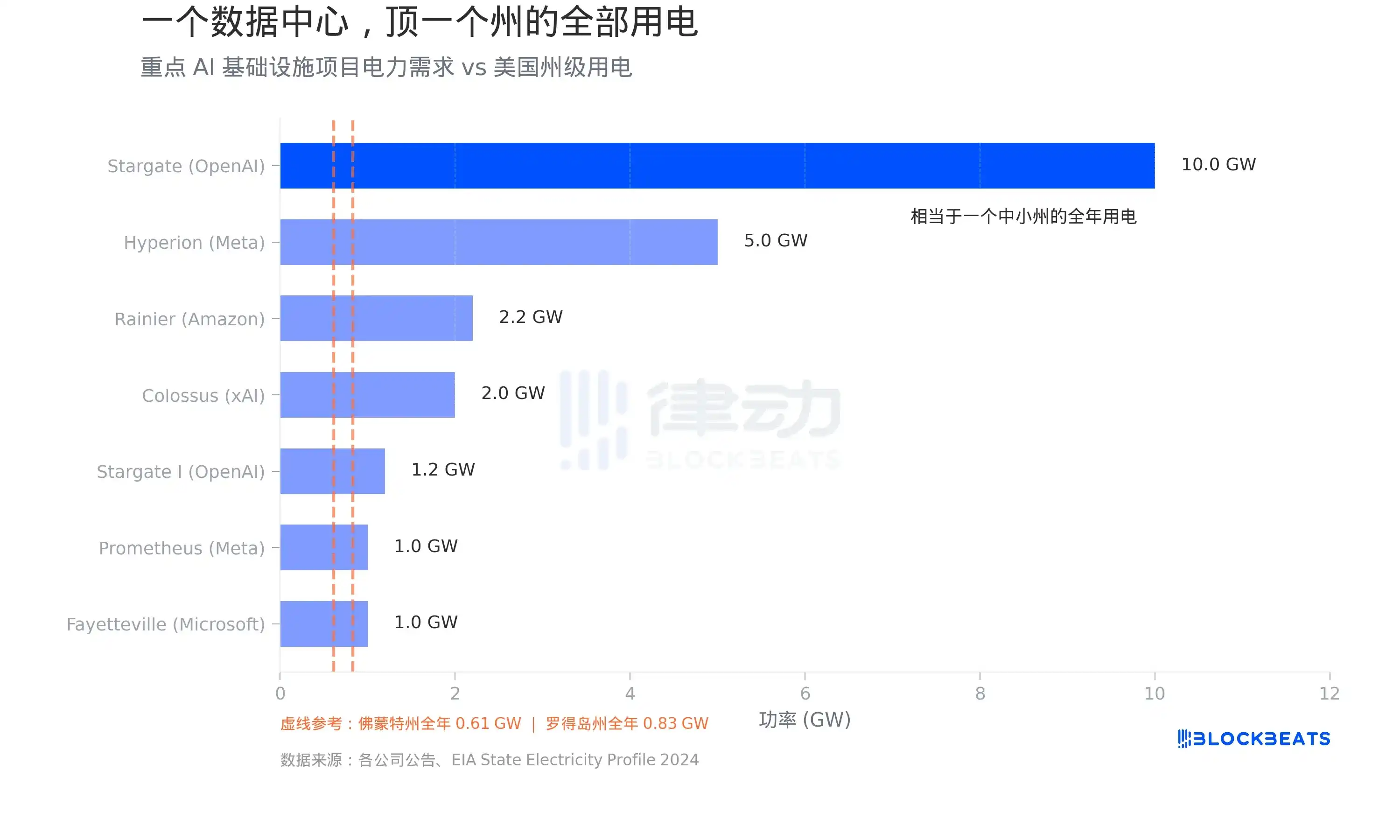
Most of this money is flowing into data centers. And the biggest bottleneck for data centers is not land, but electricity. According to EIA data, Vermont's annual electricity consumption is about 5,364 GWh, which translates to an average load of 0.61 GW. Rhode Island is slightly higher, about 0.83 GW.

Now look at what data centers are doing. According to company announcements, the total planned power capacity for the Stargate project, a collaboration between OpenAI, Oracle, and SoftBank, reaches 10 GW, equivalent to the entire electricity consumption of 16 Vermonts. Meta's Hyperion campus in Louisiana is planned for 5 GW, with an investment of $27 billion. Musk's xAI Colossus in Memphis, Tennessee, has expanded to 2 GW; according to an Introl report, it deployed 555,000 Nvidia GPUs, costing about $18 billion. Amazon and Anthropic's joint Project Rainier in Indiana is planned for 2.2 GW.

According to S&P Global data, US data centers consumed 183 TWh of electricity in 2024, accounting for over 4% of the nation's total electricity consumption. By 2030, this number is expected to triple.

This power demand is not a distant, planned story; it is already straining existing grids. According to a CBRE report, the vacancy rate for North American data centers dropped from 3.3% in the first half of 2023 to a record low of 1.6% in the first half of 2025. According to Cushman & Wakefield data, the vacancy rate slightly recovered to 3.5% in the second half of 2025, but only because a large amount of new capacity was delivered—absolute levels remain at historical lows, and meaningful supply relief is unlikely to appear before 2030.

Even AI Itself Says It's Pushing Up Inflation

While these investments are driving demand, pushing up electricity prices, and causing chip shortages, there is also a more hidden inflation channel.

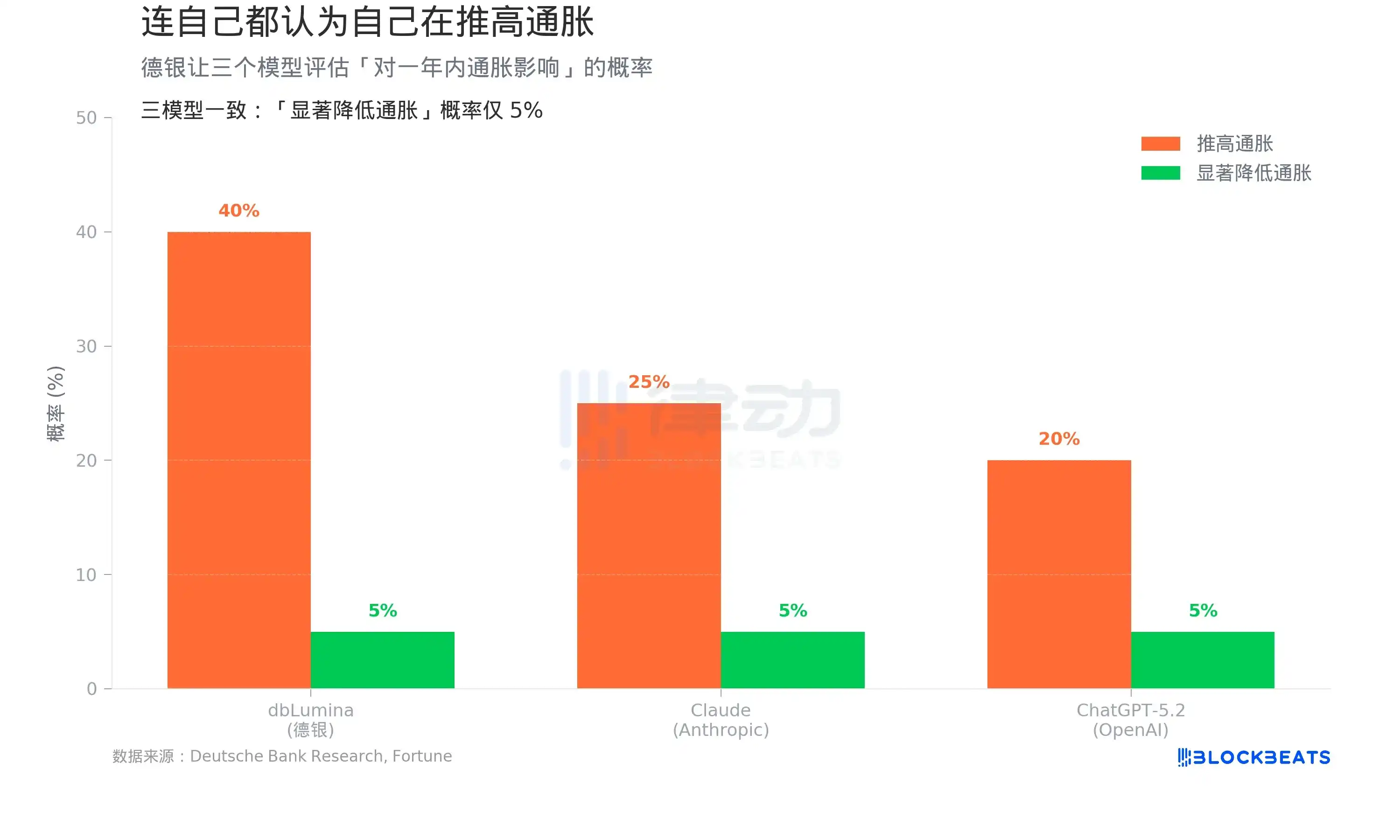
According to a Fortune report on April 1, a team led by Deutsche Bank's chief US economist, Matthew Luzzetti, conducted an experiment: they asked Deutsche Bank's own model dbLumina, Anthropic's Claude, and OpenAI's ChatGPT-5.2 to respectively assess the "probability that AI will push up inflation in the next year."

Results: dbLumina gave 40%, Claude gave 25%, and ChatGPT-5.2 gave 20%. All three models were consistent in their assessment of the probability of "AI significantly reducing inflation": only 5%.

The inflation drivers cited by the three models were highly consistent: data centers are expanding massively, semiconductor demand is soaring, and the power consumption of AI workloads is growing rapidly—all of these are demand-pull price pressures.

This is the opposite of the consensus among some Wall Street investors. The Deutsche Bank team wrote in their research report: "Will AI be a major deflationary force? Even AI itself doesn't think so."

On a five-year horizon, the models did turn to more deflationary possibilities. But the probability of "AI causing large-scale deflation" is still relegated to the tail risk zone.

Optimism Itself Is Inflationary

The St. Louis Fed paper provides a theoretical framework to explain all of this.

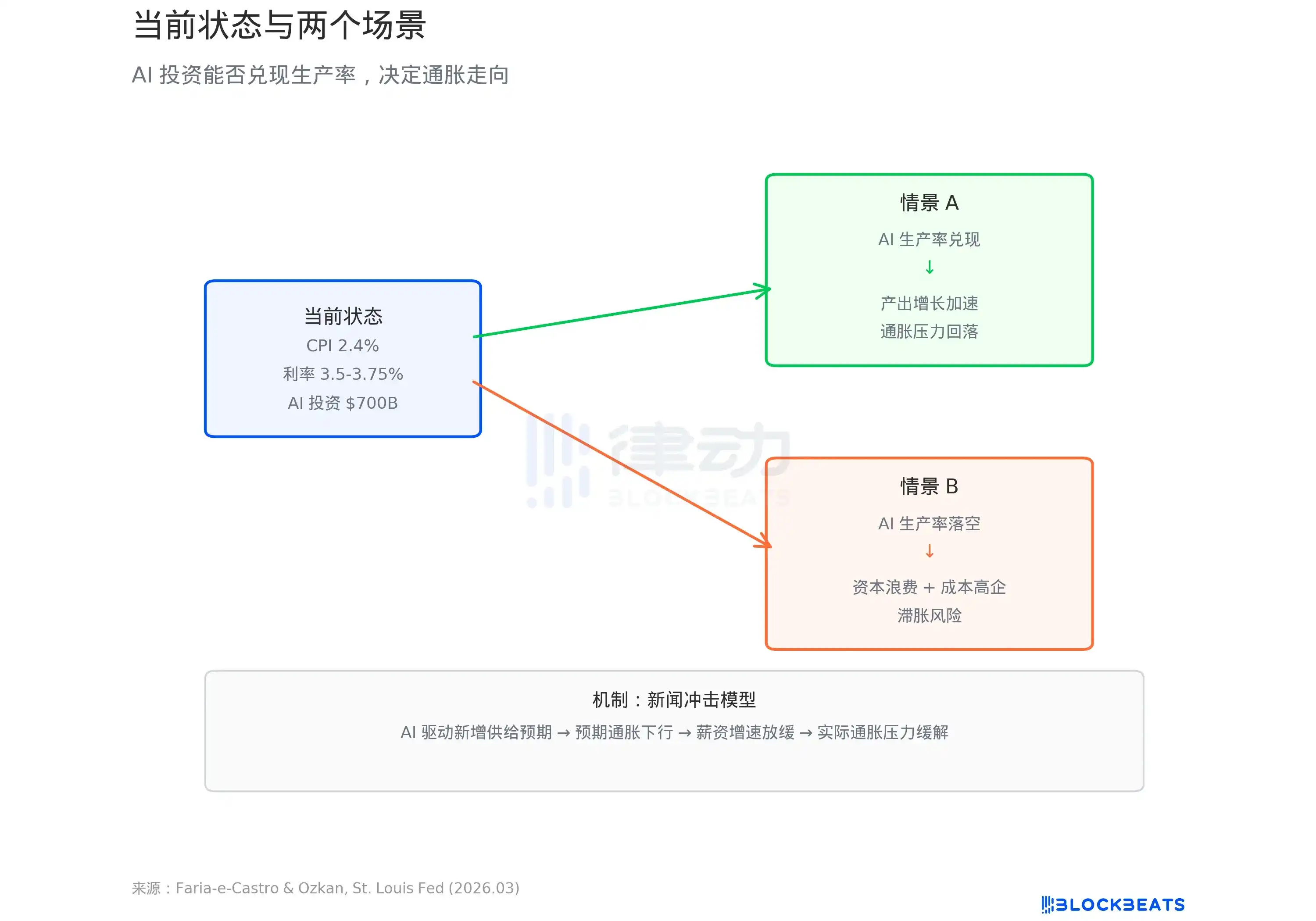
Faria-e-Castro and Ozkan used a standard macroeconomic model, defining the AI investment boom as a "news shock." According to the Fed blog post, the model's logic is: when households see AI described as a revolutionary technology, they expect future income to rise and increase consumption提前 (in advance). Firms expect productivity gains and increase investment. The two combined cause demand to quickly exceed supply. The paper states: "These forces together generate an inflationary surge in aggregate demand—a core feature of the initial phase of a news shock."

The model presents two paths. If AI does bring a productivity leap, short-term inflation will be digested by long-term output growth, and the economy enters a virtuous cycle. But if productivity does not materialize—the paper uses the term "persistent low growth and stubborn high inflation," i.e., stagflation.

According to data cited in the Fed blog post, the annualized growth rate of US Total Factor Productivity (TFP) since the release of ChatGPT has been 1.11%, lower than the historical average of 1.23%. So far, AI has left no mark on productivity data.

Meanwhile, according to BLS data, the US CPI in February 2026 was 2.4% year-on-year, and core CPI was 2.5%, neither yet back to the Fed's 2% target. The Fed's March dot plot shows a median forecast for the year-end rate of 3.4%, pointing to only one rate cut this year.

$700 billion is pouring into AI infrastructure. Whether this money is a cause of inflation or the prelude to a productivity revolution depends on a question no one can yet answer: will the models running in these data centers actually make the economy more efficient.

Связанные с этим вопросы

QAccording to the St. Louis Fed economists, what is the primary mechanism through which AI optimism is driving inflation?

AThe primary mechanism is a 'news shock' where households, believing AI will increase future income, increase current consumption, and firms, expecting productivity gains, increase investment. This surge in aggregate demand outpaces supply, creating inflationary pressure.

QHow much did the combined capital expenditures of Amazon, Microsoft, Google, and Meta increase from 2023 to their projected 2026 total?

ATheir combined capital expenditures increased from $152 billion in 2023 to a projected total of approximately $663 billion in 2026 for the four companies, representing a more than fourfold increase.

QWhat was the consensus among the three AI models (dbLumina, Claude, ChatGPT-5.2) regarding AI's probability of significantly lowering inflation in the next year?

AThe consensus was a low probability of only 5% for AI significantly lowering inflation in the next year.

QWhat is the major bottleneck for the expansion of AI data centers mentioned in the article?

AThe major bottleneck is the supply of electricity, not land.

QWhat does the St. Louis Fed model present as the two potential economic outcomes from the current AI investment boom?

AThe two potential outcomes are: 1. A benign cycle where short-term inflation is digested by long-term output growth if AI delivers a productivity leap. 2. Stagflation, characterized by persistent low growth and stubborn high inflation, if productivity gains fail to materialize.

Похожее

The Midlife Crisis of Crypto GPs: No PMF, No Next Check from LPs

The article "The Midlife Crisis of Crypto GPs: No PMF, No Next LP Check" analyzes the shifting crypto fundraising landscape. It argues the era of selling grand visions to LPs is over; GPs must now offer products with clear Product-Market Fit (PMF). The author categorizes crypto fundraising products into three types: Primary (VC funds), Liquid (trading strategies), and CeFi/DeFi Native Yield. This summary focuses on the Primary market. Key points include: * **Market Shift:** LPs are impatient, demand immediate returns, and are skeptical of future promises. The "easy money" narrative has faded. * **GP Value Erosion:** LP learning curves have shortened (aided by AI), reducing the value of a GP's basic "crypto knowledge." Superior judgment is now rare. * **Weakened LP Motivations:** Traditional reasons for LPs to invest in crypto VC funds (capturing industry beta, gaining access, leveraging GP judgment) have weakened due to new products like ETFs and increased LP sophistication. * **Surviving in Primary:** The primary market will likely persist for: 1) large funds in endowment mandates treating it as a lottery ticket, 2) family offices/HNWIs using proprietary capital, 3) a few funds with proven recent outperformance, and 4) funds with strong ecosystem "deal-making" capabilities. * **Conclusion:** For most GPs, rebuilding trust requires starting over in a niche, demonstrating alpha-generating ability, or providing concrete value/services to LPs.

marsbit19 мин. назад

The Midlife Crisis of Crypto GPs: No PMF, No Next Check from LPs

marsbit19 мин. назад

Crypto GPs' Midlife Crisis: No PMF, No LP's Next Check

The article "The Midlife Crisis of Crypto GPs: No PMF, No LP's Next Check" analyzes the shifting crypto fundraising landscape. It argues that the era of LPs funding vague "vision" is over; GPs must now offer products with clear Product-Market Fit (PMF) to secure capital. The market has matured. LPs, disillusioned by the last cycle's failures and wary of long lock-up periods, now demand tangible, near-term returns rather than speculative narratives. The proliferation of accessible crypto ETFs and other liquid products has reduced the need for VC blind pools as an entry point. The author categorizes crypto fundraising products into three types: Primary (VC funds, with blind pools or clear pipelines), Liquid (alpha/beta, directional/market-neutral strategies), and CeFi/DeFi Native Yield (crypto-specific mechanisms like staking, farming). Focusing on the Primary market, the piece details why traditional LP rationales for investing in crypto VCs have weakened: easier beta access via ETFs, diminished "access" and "judgement" premiums as LPs build internal teams, and a widespread lack of proven superior returns from GPs. Ultimately, only specific players are likely to remain at the primary VC table: large funds with access to patient endowment capital, family offices/HNWIs investing proprietary capital, the few funds with demonstrable excess returns from the last cycle, and those with clear "deal-making" or ecosystem resource advantages. For others, the path forward is to rebuild trust by proving alpha-generation capability in a niche or providing concrete, valuable services.

链捕手44 мин. назад

Crypto GPs' Midlife Crisis: No PMF, No LP's Next Check

链捕手44 мин. назад

The Age of Decoupling Has Arrived: Bitcoin is No Longer the Sole Compass of Crypto

The era of the cryptocurrency market moving in lockstep with Bitcoin is ending, as the industry splits into two distinct asset categories: endogenous and exogenous. Endogenous assets, like Bitcoin, derive value purely from the crypto market's cycles. Their narratives swing between being "interstellar money" in bull markets and "digital collectibles" in bear markets. Exogenous assets, however, are nominally crypto but operate with independent value drivers. Examples include: * **Venice:** An AI inference service using tokens for payments; its consumer-AI business model is decoupled from crypto price swings. * **Figure:** A fintech lender using blockchain to speed up loan approvals; its core value is in credit, not crypto. * **Stablecoin firms like BVNK:** Acquired by traditional finance giants (Mastercard, Stripe), their growth is tied to payment infrastructure, not market cycles. Hybrid projects like **Hyperliquid** (a decentralized exchange) show a shift, with a growing share of non-crypto trading (e.g., prediction markets). This divergence is fundamental. Endogenous assets remain highly correlated to Bitcoin, similar to gold miners to gold. Exogenous assets are evolving to have their own fundamentals, like the weak correlation between gold and the S&P 500. This changes investment analysis. Evaluating exogenous assets requires traditional fundamental research—assessing user bases, unit economics, and moats—more akin to fintech investing than charting Bitcoin. Promising exogenous sectors include: on-chain exchanges/brokers, AI-crypto fusion, privacy-focused digital banks, lending (institutional/private credit), stablecoins/real-world asset tokenization, payment rails, and non-financial crypto-consumer products. Currently, investing via equity is often safer than via tokens, as token value accrual mechanisms need further regulatory and industry development (e.g., the CLARITY Act). Nonetheless, the core trend is clear: crypto market drivers are diversifying from a single factor (Bitcoin) to multiple fundamentals, ending the era of uniform market moves.

marsbit1 ч. назад

The Age of Decoupling Has Arrived: Bitcoin is No Longer the Sole Compass of Crypto

marsbit1 ч. назад

Five Cryptos That Could Outperform Bitcoin Over the Next Cycle Due To Higher Growth Velocity

Bitcoin's growth often sets market trends, but analysts believe the next cycle's highest percentage gains may come from assets with greater growth velocity. While Bitcoin provides stability, several cryptocurrencies are positioned for stronger relative upside. This article highlights five such assets, with a particular focus on Ozak AI as the potential high-growth standout of the cycle. Ethereum (ETH) is noted for its ongoing evolution and institutional adoption. Solana (SOL) is recognized for its high throughput and history of sharp rallies. Chainlink (LINK) is highlighted as essential infrastructure for DeFi and AI applications. Avalanche (AVAX) is mentioned for its subnet architecture and enterprise potential. Ozak AI ($OZ) is presented as a distinct early-stage opportunity, currently in presale at $0.014 with a target listing price of $1.00. The project is building a full AI-native blockchain ecosystem, including prediction agents, a data stream network, and structured data vaults. Analysts suggest its early valuation stage and focus on AI infrastructure could allow for exponential growth velocity compared to more mature assets like Bitcoin, which requires massive capital inflows for significant price movement. The final takeaway positions Ozak AI as a high-asymmetry bet for investors seeking exponential upside alongside more stable assets.

TheNewsCrypto2 ч. назад

Five Cryptos That Could Outperform Bitcoin Over the Next Cycle Due To Higher Growth Velocity

TheNewsCrypto2 ч. назад

Торговля

Спот
Фьючерсы

Популярные статьи

Неделя обучения по популярным токенам (2): 2026 может стать годом приложений реального времени, сектор AI продолжает оставаться в тренде

2025 год — год институциональных инвесторов, в будущем он будет доминировать в приложениях реального времени.

1.8k просмотров всегоОпубликовано 2025.12.16Обновлено 2025.12.16

Неделя обучения по популярным токенам (2): 2026 может стать годом приложений реального времени, сектор AI продолжает оставаться в тренде

Обсуждения

Добро пожаловать в Сообщество HTX. Здесь вы сможете быть в курсе последних новостей о развитии платформы и получить доступ к профессиональной аналитической информации о рынке. Мнения пользователей о цене на AI (AI) представлены ниже.

活动图片