$60B trading giant BlockFills hits ‘pause’ as ‘extreme fear’ takes over market

ambcryptoОпубликовано 2026-02-12Обновлено 2026-02-12

Введение

BlockFills, a major Chicago-based crypto trading firm that handled over $60 billion in trades last year, has paused all client deposits and withdrawals due to extreme market instability. The decision follows Bitcoin’s sharp decline of nearly 25% to around $60,000, though trading on the platform remains active. The move has heightened investor anxiety, evoking memories of the 2022 crypto collapses. Despite Bitcoin’s slight recovery to $67,490, institutional clients face significant risk. Analysts note parallels to past market crashes but suggest Bitcoin may be oversold and poised for a rebound if key support levels hold. The situation underscores ongoing regulatory uncertainty and fragile market sentiment.

In high-risk crypto trading, BlockFills is a major Chicago-based firm that handled over $60 billion in trades last year. After a difficult week in the market, when Bitcoin [BTC] dropped by nearly 25% to around $60,000, the company decided to take urgent action.

The company has paused all client deposits and withdrawals, saying this is needed because of unstable market and financial conditions.

Even though clients can still trade on the platform, they cannot move money in or out right now. This has made many investors nervous, especially since the industry still remembers the major failures of 2022.

In 2025, the company was doing extremely well. It handled $61.1 billion in trades and worked with more than 2,000 institutional clients around the world.

However, things changed after the “October Crash” of 2025, when Bitcoin fell sharply from its record high of $124,500. Even though Bitcoin has now recovered slightly to about $67,490, the damage to big investors and lenders remains serious.

Community reactions

Needless to say, the crypto community reacted strongly to this incident, as noted by Walter Bloomberg.

“The move echoes past crypto downturns, including the 2022 collapse of FTX and other lenders. Bitcoin’s recent drop below $65,000—down ~45% from October highs—has intensified pressures, while stalled U.S. crypto legislation continues to weigh on the market.”

Usually, small retail traders suffer the most when crypto exchanges go down. On the contrary, the BlockFills situation is different.

This time, it is not about regular users panicking. Instead, it may be a serious problem for large institutions with big money at stake, according to Milk Road’s analysis.

How is this incident acting in favor of Bitcoin?

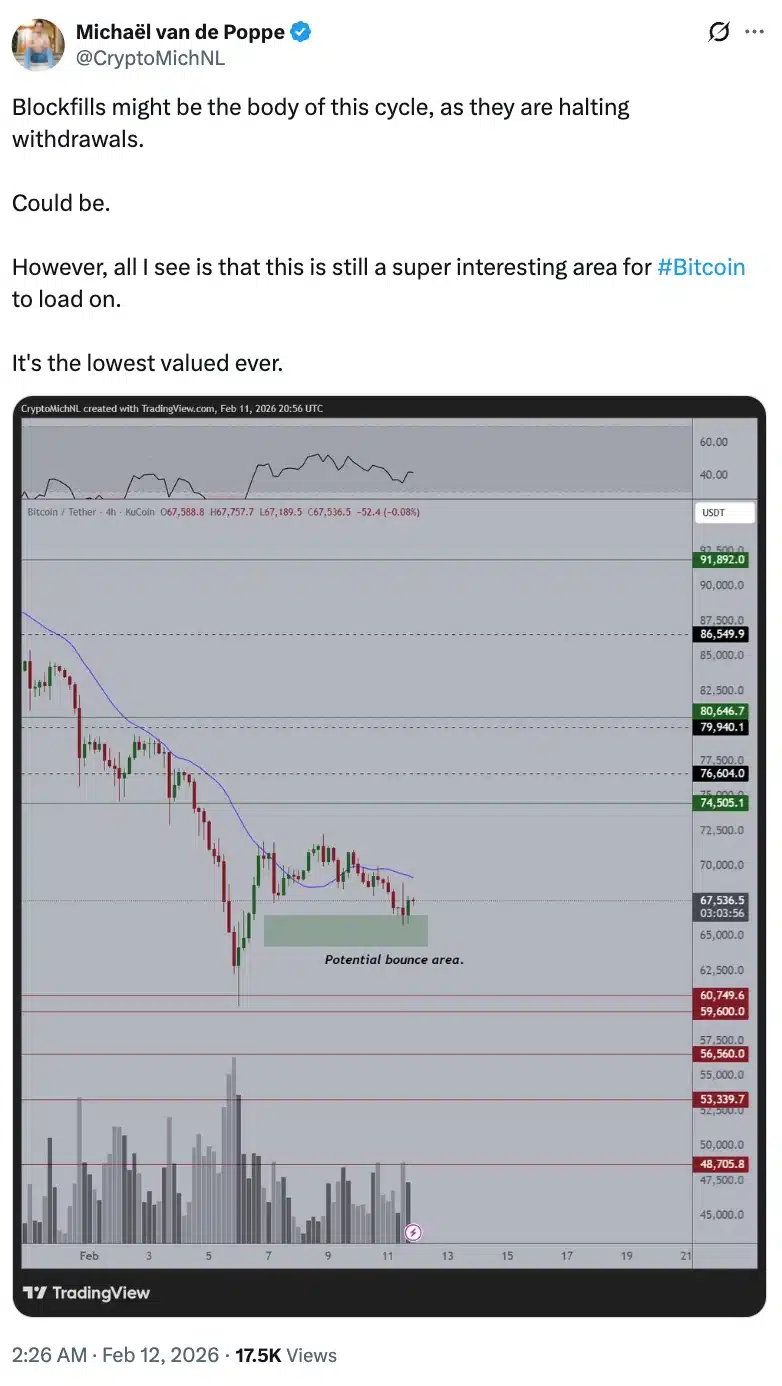
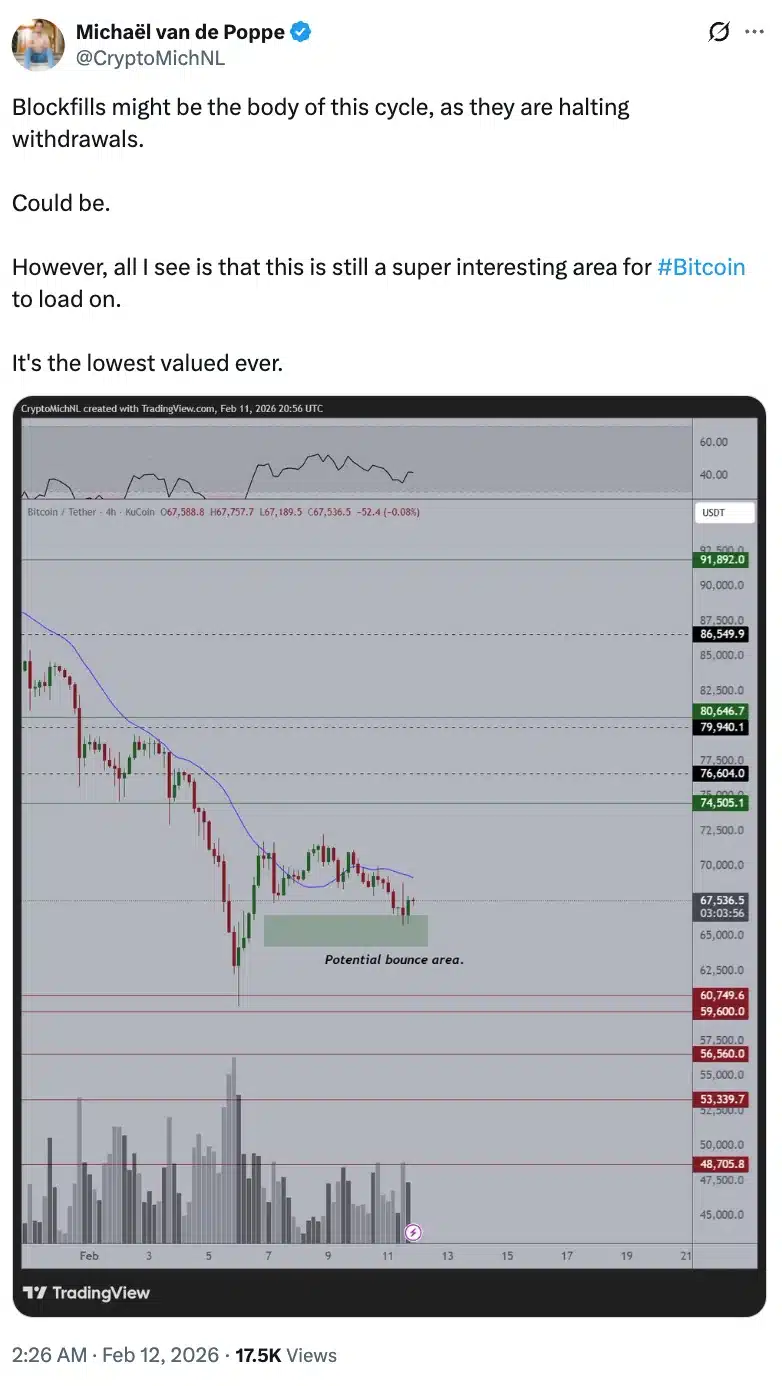
At the same time, there is some positive news due to this incident. Well-known analyst Michaël van de Poppe believes Bitcoin may be close to a strong turning point.

Even though Bitcoin is still around $67,490, he believes that market fear is extremely high right now. Recently, fear levels dropped to just 7 – A sign that many investors are worried.

Van de Poppe compared the current situation to the 2020 COVID crash, when prices fell sharply before recovering. He believes Bitcoin is now oversold and may be ready to bounce back.

If key support levels hold, BTC’s price could still move towards $100,000 in the coming months.

Source: Michaël van de Poppe/X

Former chairman of the National Vocational and Technical Training Commission, Javed Hassan, also weighed in. He noted,

“Thanks to Trump and his bandito family, this latest scam has full institutional respectability. Wall Street has adopted it. Yup, the same bunch of sharks who packaged subprime sh*t under exotic wrappers like: Mortgage-Backed Securities (MBS) , CDO, CDS, etc. Once again there’s the anything goes regulatory shrug.”

Past triggers

The pause in activity at BlockFills brings back memories of Celsius Network and Voyager Digital – Both of which collapsed after freezing user funds.

Binance [BNB] also experienced a similar situation in 2025, when it temporarily restricted withdrawals during market turmoil.

This coincided with recent data from Santiment as retail traders are full of doubt and fear right now. In fact, negative posts on social media are at a four-year high too.

Thus, for now, it is still unclear whether BlockFills is facing a small, temporary cash problem or something more serious. In the coming days, how open the company is with its 2,000+ institutional clients will matter the most.


Final Thoughts

  • Pausing withdrawals may protect the company in the short term, but it has clearly shaken investor confidence.
  • Memories of past failures like Celsius Network and Voyager Digital are making investors extra cautious.

Связанные с этим вопросы

QWhy did BlockFills pause all deposits and withdrawals?

ABlockFills paused all client deposits and withdrawals due to unstable market and financial conditions following a sharp drop in Bitcoin's price.

QHow much trading volume did BlockFills handle in 2025, and how many clients did it serve?

AIn 2025, BlockFills handled $61.1 billion in trades and worked with over 2,000 institutional clients worldwide.

QAccording to analyst Michaël van de Poppe, what does the current market fear level indicate for Bitcoin's price?

AMichaël van de Poppe believes the extreme fear, with levels dropping to just 7, indicates that Bitcoin is oversold and may be close to a strong turning point, potentially bouncing back towards $100,000 if key support levels hold.

QHow does the BlockFills situation differ from typical crypto exchange failures in terms of affected users?

AUnlike typical crypto exchange failures that most severely impact small retail traders, the BlockFills situation is primarily a problem for large institutions with significant money at stake.

QWhich past crypto company failures does the article mention as similar to the current BlockFills incident?

AThe article mentions that the pause in activity at BlockFills brings back memories of the collapses of Celsius Network and Voyager Digital, which also froze user funds before failing.

Похожее

The Tao (τ) Law Makes EDA Go Viral

In May 2026, Huawei's semiconductor division introduced the "Tao (τ) Law" at IEEE ISCAS, shifting the industry focus from Moore's Law's geometric scaling to "time scaling." Unlike traditional approaches relying on transistor miniaturization, τ Law optimizes the time constant (τ) across device, circuit, chip, and system levels to improve information processing speed and efficiency. Huawei has already applied this principle, mass-producing 381 chips across various applications, with a target to achieve performance equivalent to 1.4nm technology by 2031. The implementation of τ Law, involving techniques like Chiplet, 3DIC, and Logic Folding, places new demands on EDA tools, highlighting gaps in current offerings. Traditional 2D or pseudo-3D EDA flows lack native support for true 3D design, cross-layer co-optimization (STCO), and coupled multi-physics analysis (thermal, power, stress), which are crucial for advanced integration. Chinese EDA companies, such as Empyrean Software, Primarius Technologies, and Xpeedic, are evolving from point-tool specialists to providing full-flow, system-level solutions. For instance, Peking University has developed a prototype "true 3D" EDA tool showing significant improvements in wirelength and timing. Empyrean Software has also launched a comprehensive 3DIC design and verification platform. The τ Law framework presents an opportunity for the domestic EDA industry to transition from achieving basic functionality to developing robust, integrated toolsets essential for next-generation chip design.

marsbit50 мин. назад

The Tao (τ) Law Makes EDA Go Viral

marsbit50 мин. назад

It's Not Jensen Huang Who Wants to Change the PC, But the PC That's Revolting Against Itself

The 40-year-old PC industry is undergoing a fundamental transformation, driven by the rise of AI PCs. At the GTC Taipei 2026 event, NVIDIA, backed by Microsoft and major PC OEMs, announced the RTX Spark super chip for Windows PCs, marking its official entry into the PC core processor market. This move aims to redefine the AI PC by shifting its core from the CPU to an AI-focused SoC (System on Chip). NVIDIA envisions the PC evolving from a personal computer to a "personal AI"—a platform where local AI Agents can autonomously perform tasks. While Intel pioneered the AI PC concept earlier in 2026, NVIDIA's aggressive push, leveraging its vast CUDA developer ecosystem of 6 million, positions it to potentially reshape the industry's long-standing Wintel (Windows-Intel) power structure. NVIDIA's strategy extends beyond hardware; it's about embedding its CUDA, RTX, and AI software stack into the PC platform itself. The article identifies key shifts: 1) The move from a CPU-centric to an AI SoC-centric architecture, similar to Apple's approach with its M-series chips. 2) The PC's evolution from a human-operated tool to a platform for human-Agent collaboration. 3) The extension of NVIDIA's data center-centric CUDA ecosystem to personal devices via RTX Spark. Ultimately, the change is driven by the broader trend of AI moving to personal devices. Companies like Intel, AMD, Qualcomm, and Apple are all participating in this shift. NVIDIA's entry accelerates the competition, but the core driver is the technology itself finding its optimal expression in the PC. The industry is reinventing itself, with the outcome hinging on execution, ecosystem development, and the creation of compelling local AI applications.

marsbit3 ч. назад

It's Not Jensen Huang Who Wants to Change the PC, But the PC That's Revolting Against Itself

marsbit3 ч. назад

Торговля

Спот
Фьючерсы
活动图片