$50 Million Funding Ignites Airdrop Anticipation, Variational Becomes New Focus of Perp DEX

Odaily星球日报Опубликовано 2026-05-21Обновлено 2026-05-21

Введение

Variational, a perpetual decentralized exchange (Perp DEX) on Arbitrum, has become a focal point in the crypto community after announcing a $50 million Series A funding round led by Dragonfly Capital, with participation from Bain Capital Crypto and Coinbase Ventures. This news caused a significant pre-listing price surge and increased predictions of a high fully diluted valuation (FDV) upon launch. A key feature of Variational is its zero-trading-fee model. It differentiates itself by aggregating multi-source liquidity, including traditional and crypto-native market makers, to address on-chain liquidity challenges. According to DefiLlama, it ranks fourth among Perp DEXs by open interest and is notable as the only top-five platform yet to issue a token. The primary way for users to engage is through its "Trade-to-Earn" Omni Points program. Points are awarded weekly based on trading activity, with bonuses for early users and a tiered reward system that incentivizes higher trading volumes. The program also includes a referral system offering USDC rewards and extra points. The design emphasizes organic trading over mere volume farming. While an exact Token Generation Event (TGE) date for the VAR token is not confirmed, official documentation states the points program will run at least until the end of Q3 2026. Community and prediction market sentiment generally expects the TGE to occur in Q3 or Q4 of this year.

Original | Odaily Planet Daily (@OdailyChina)

Author | Asher (@Asher_0210)

A funding announcement has made Perp DEX Variational the hot topic in the airdrop farming community.

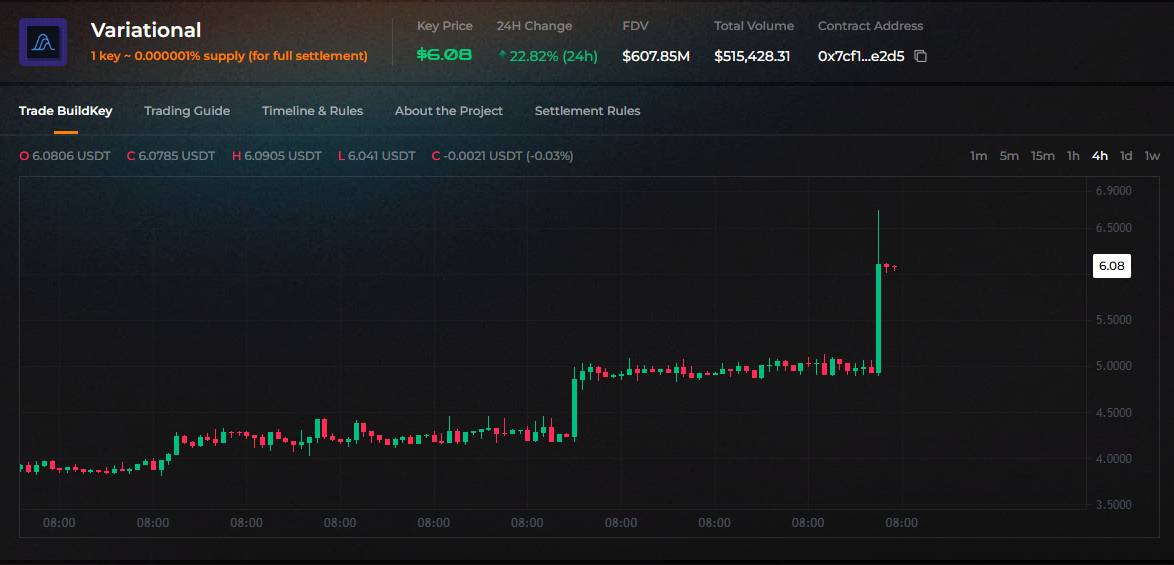
Last night, Variational announced the completion of a $50 million Series A funding round, led by Dragonfly Capital, with participation from Bain Capital Crypto and Coinbase Ventures. Influenced by this news, Variational's pre-market price surged over 36% briefly, hitting $6.9 at one point (corresponding to an FDV of $690 million). It has since pulled back and is currently quoted at $6.1 (corresponding to an FDV of $610 million).

Variational pre-market price movement

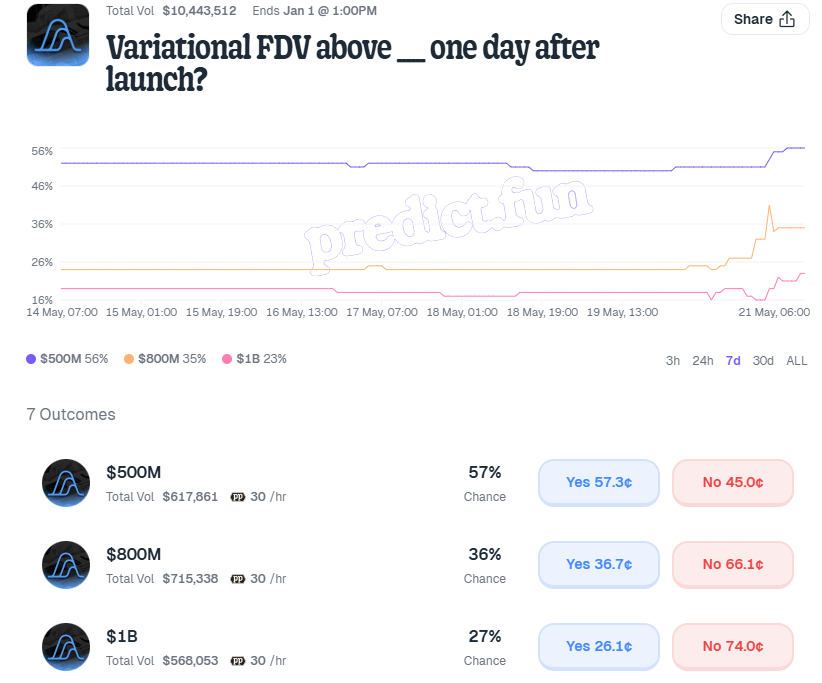
Additionally, the probability for the event “Variational's FDV exceeds $500 million one day after listing” on prediction platform predict.fun has risen to 57%; the probability for “Variational's FDV exceeds $1 billion one day after listing” has risen to 27%.

Prediction event for "Variational FDV one day after listing" on predict.fun

Next, Odaily Planet Daily will introduce Variational, its trade-to-earn points rules, and the TGE timeline.

Variational: Zero-Fee Perp DEX Deployed on Arbitrum

Variational is a Perp DEX platform deployed on Arbitrum. The company is headquartered in the Cayman Islands, and its core product is Omni. In simple terms, users can trade perpetual contracts for mainstream crypto assets like BTC, ETH, and SOL on Variational, as well as for long-tail assets, stocks, commodities, volatility indices, and more.

Compared to most Perp DEXs, the most obvious feature of Variational is zero transaction fees. When trading on Omni, the platform does not charge regular transaction fees. The main costs come from spreads, slippage, funding rates, and deposit/withdrawal fees.

Furthermore, Variational's underlying design differs from traditional Perp DEXs. It does not rely solely on internal platform matching or a single liquidity pool to handle trades. Instead, it connects to multi-source liquidity through a "brokerage-like" model, including traditional financial market makers, crypto-native market makers, and major trading platforms, to solve the "liquidity cold start" problem in on-chain markets.

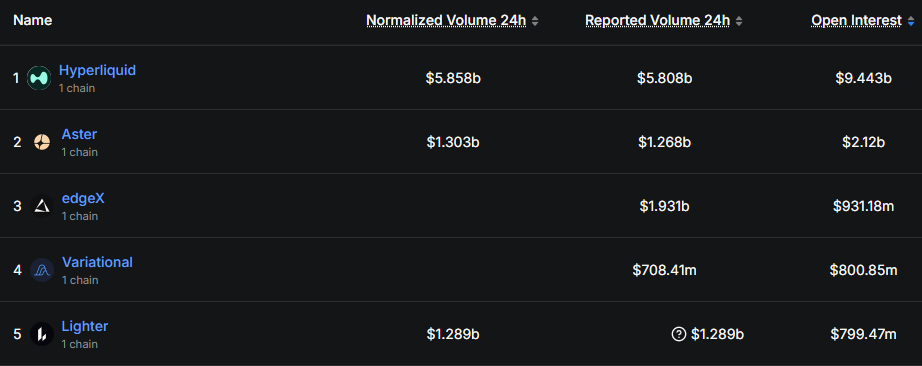
According to DefiLlama data, Variational's trading volume over the past month has exceeded $16 billion, and its current open interest exceeds $800 million, ranking fourth in the Perp DEX sector. Notably, among the top five Perp DEXs by open interest, Variational is the only platform that has not yet issued a token.

Perp DEX open interest ranking

Trade-to-Earn Points: Detailed Rules for Variational

For ordinary users, the most direct way to participate in Variational currently is still through trading to earn points.

Variational officially launched the Omni Points Program on December 17, 2025, and retroactively distributed 3 million points to historical traders at launch, covering activity up to December 11, 2025. Since then, points are distributed every Friday at 00:00 UTC, accounting for platform activity from the previous cycle ending Thursday at 00:00 UTC.

Additionally, according to the documentation, the project commits to allocating approximately 50% of the token supply to the community (through points, revenue sharing, and other mechanisms, not solely airdrops), while also planning to use at least 30% of protocol revenue for VAR token buybacks and burns.

The core of Variational's points system is not complicated: the more active the trading, the greater the chance to earn more points. However, Variational does not distribute points solely based on trading volume; it incorporates designs that favor trading quality. Specifics include:

  • Points are directly related to user trading activity: The platform rewards page indicates that the points program is designed to reward protocol users, who can earn points through platform activities. The official team reserves the right to adjust points and address non-organic behavior, meaning that obvious meaningless volume farming or arbitrage-style point farming may be subject to reduction or disqualification later;
  • Early users receive an extra bonus: Accounts that traded before the points program launched receive a 10% point bonus on subsequently earned points;
  • Introduction of a Reward Tiers system: A user's total trading volume over the past 30 days affects their tier, calculated as personal trading volume plus 0.2 times the invited trading volume. Different tiers correspond to different point multipliers: Iron at 0%, Bronze at 0.5%, Silver at 1%, Gold at 2%, Platinum at 3%, Diamond at 4%, Infinity at 5%. The thresholds are: Bronze requires $1 million Total Volume in the past 30 days, Silver $5 million, Gold $25 million, Platinum $100 million, Diamond $750 million, Infinity $2.5 billion;
  • Referrals also bring points and USDC rewards: Referrers receive 5% USDC of the spreads paid by the referred users. Additionally, whenever a referred user earns 10 points, the referrer earns 1 point.

Judging from the rules, Variational's points design leans more towards organic trading rather than pure volume farming. For airdrop farmers, the focus is not just on completing a single transaction, but on considering whether their trading frequency, capital efficiency, position risk, and points cost align.

When Will Variational Conduct Its TGE?

Currently, Variational has not announced a clear TGE date for VAR. However, based on information disclosed in the official documentation, points distribution will continue at least until the end of Q3 2026. Therefore, the community generally expects the TGE to occur in Q3 to Q4 of this year.

Data source: Variational official documentation

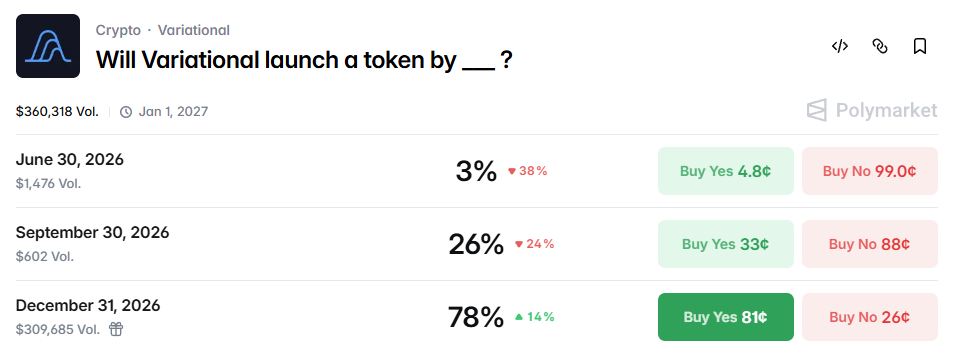
Furthermore, prediction markets lean towards Q4. Polymarket data shows the probability for the event "Variational will launch its token before September 30 this year" is only 26%, while the probability for "Variational will launch its token before December 31 this year" is 78%.

Polymarket prediction event "When will Variational TGE?"

Связанные с этим вопросы

QWhat is the key news that caused a stir in the airdrop farming community regarding Variational?

AThe key news is that Variational announced the completion of a $50 million Series A funding round, led by Dragonfly Capital, with participation from Bain Capital Crypto and CoinBase Ventures.

QWhat is Variational, and what is its most distinctive feature as a Perp DEX?

AVariational is a perpetual decentralized exchange (Perp DEX) deployed on Arbitrum. Its most distinctive feature is that it charges zero trading fees to users. Costs for traders mainly come from the bid-ask spread, slippage, funding rates, and deposit/withdrawal fees.

QHow does Variational's 'Omni' points program work, and what is a key consideration for users farming points?

AThe Omni points program rewards users based on their trading activity on the platform. Points are distributed weekly. A key consideration is that the system is designed to favor 'organic' trading behavior, meaning users should focus on trading frequency and capital efficiency rather than simply high-volume, low-risk arbitrage trades, as such behavior risks having points reduced or invalidated.

QWhat is the current market expectation for Variational's Token Generation Event (TGE) timeline based on the article?

ABased on the article, there is no official TGE date. However, official documentation states the points program will run at least until the end of Q3 2026. Community expectations and prediction market data (e.g., on Polymarket) suggest the TGE is more likely to occur in Q4 2026, with a 78% probability of happening before December 31, 2026.

QAccording to the article, what percentage of the VAR token supply is promised to be allocated to the community, and what is planned for protocol revenue?

AThe project has promised to allocate approximately 50% of the token supply to the community through mechanisms like points and revenue sharing. Furthermore, it plans to use at least 30% of protocol revenue to buy back and burn VAR tokens.

Похожее

Two Companies Capture 90% of AI Startup's $80 Billion ARR

The AI startup landscape is highly concentrated, with OpenAI and Anthropic capturing 89% of an estimated $80 billion in annualized revenue among 34 leading companies. OpenAI, with $24-25B in revenue, primarily drives growth through ChatGPT's consumer subscriptions, while Anthropic, exceeding $30B, focuses on enterprise API integration and has rapidly grown its U.S. enterprise market share from under 1% to 34.4% in under two years. The remaining 32 companies share just 11% of the revenue, facing intense pressure as resources, talent, and market attention consolidate around the two giants. This creates a self-reinforcing cycle where higher revenue fuels greater compute investment and model improvement. Despite their dominance, both leaders face challenges. OpenAI is navigating significant legal disputes and partnership tensions, while Anthropic operates under the high expectations of its massive backers like Amazon. Historical parallels in tech infrastructure (e.g., search engines, mobile OS) suggest such oligopolistic tendencies are common due to scale, network effects, and high switching costs, indicating the market could become even more concentrated. However, the rapid pace of AI innovation leaves room for disruption. For other players, the strategic path forward is not direct competition with the giants but specialization in vertical domains where general-purpose models fall short—such as legal, medical, or industrial applications—building indispensable, niche solutions.

marsbit3 мин. назад

Two Companies Capture 90% of AI Startup's $80 Billion ARR

marsbit3 мин. назад

Silicon Bull, Carbon Bear: The Wealth Code of 2026 is Only 'Chips' and 'Light'

The article, titled "Silicon Bull, Carbon Bear: In 2026, the Wealth Code Lies Only in 'Chips' and 'Optics'", discusses the extreme market divergence in 2026 driven by the AI investment frenzy. Investment managers who concentrated on the AI hardware supply chain, particularly computing infrastructure, optical modules, and memory chips, have seen their fund net asset values (NAVs) surge dramatically, even reaching record highs. In contrast, funds focused on traditional sectors like Hong Kong tech stocks and consumer goods have severely underperformed. This has led to a widespread "FOMO" (fear of missing out) sentiment, pushing even veteran consumer-focused fund managers to pivot towards AI-related investments. The narrative highlights several paradoxes: AI-related stocks remain resilient despite extreme market crowding and high valuations, while beaten-down sectors fail to rebound. The author dubs this split market "Silicon Bull, Carbon Bear," suggesting a bull market only for those invested in silicon-based tech (AI hardware) and a bear market for carbon-based traditional economy sectors. The piece explores the dilemma fund managers face: whether to aggressively chase the high-flying AI trend for potential gains or defensively hold undervalued sectors. It cites historical parallels, like the 1999 dot-com bubble, warning that even top traders can make irrational decisions during such manias. Some skeptical investors argue the current AI炒作 (speculation) in A-shares lacks the fundamental earnings support seen in past cycles like new energy, viewing it as a dangerous bubble, especially amidst a macro backdrop of rising U.S. bond yields. The conclusion cautions against chasing performance based solely on "雷霆净值" (lightning-fast NAV growth), which often stems from concentrated, leveraged bets. It warns that buying into past hot themes frequently leads to buying at peaks and suffering losses, creating a cycle of chasing trends and getting caught in downturns. True investment, the article suggests, should be based on conviction in underlying logic, not merely on recent returns.

marsbit22 мин. назад

Silicon Bull, Carbon Bear: The Wealth Code of 2026 is Only 'Chips' and 'Light'

marsbit22 мин. назад

Торговля

Спот
Фьючерсы
活动图片