Grayscale Reassesses Zcash: In the Era of AI Surveillance, What is Financial Privacy Worth?

marsbitОпубликовано 2026-08-24Обновлено 2026-08-24

Введение

Grayscale Research reevaluates Zcash (ZEC) in the context of AI-powered financial surveillance. The report posits that stablecoins, transparent blockchains, and AI analytics tools are increasing the traceability of digital finance, potentially reigniting mainstream demand for financial privacy as a core monetary attribute. While AI could drive a third wave of privacy concern, Zcash's investment thesis hinges on whether this theoretical demand translates into sustained adoption. Zcash, operational for nearly a decade, uses zero-knowledge proofs to offer users a choice between transparent and shielded transactions, placing control of information disclosure back in users' hands. Recent infrastructure improvements—like wallet enhancements, mining pool expansions, and protocol upgrades—have reduced usability barriers. On-chain data shows shielded transactions comprise ~90% of transaction count, with ~25% of circulating ZEC in shielded pools, indicating existing use. However, significant risks remain. These include regulatory hurdles for exchanges and custodians dealing with shielded assets, past protocol vulnerabilities (theoretical, now patched), long-term quantum computing threats, and execution risks for future scalability upgrades. Grayscale's analysis suggests ZEC's current low market share (~0.6% of the "digital currency" crypto sector) offers valuation upside *if* the market reprices privacy. A scenario analysis notes that capturing 5% of this sector could imply a ~9x val...

Editor's Note: Stablecoins, on-chain payments, and AI are simultaneously transforming the financial system. On one hand, fund flows have become faster and more transparent; on the other, the combination of public ledgers, address labeling, and AI analysis tools makes account balances, transaction counterparts, and business relationships easier to track continuously.

Against this backdrop, Grayscale Research brings Zcash back into investors' view. The focus is not on "whether privacy coins are experiencing a new round of hype," but on a more fundamental question: as the traceability of digital finance continues to increase, will privacy remain a niche demand, or will it re-emerge as a core attribute of money?
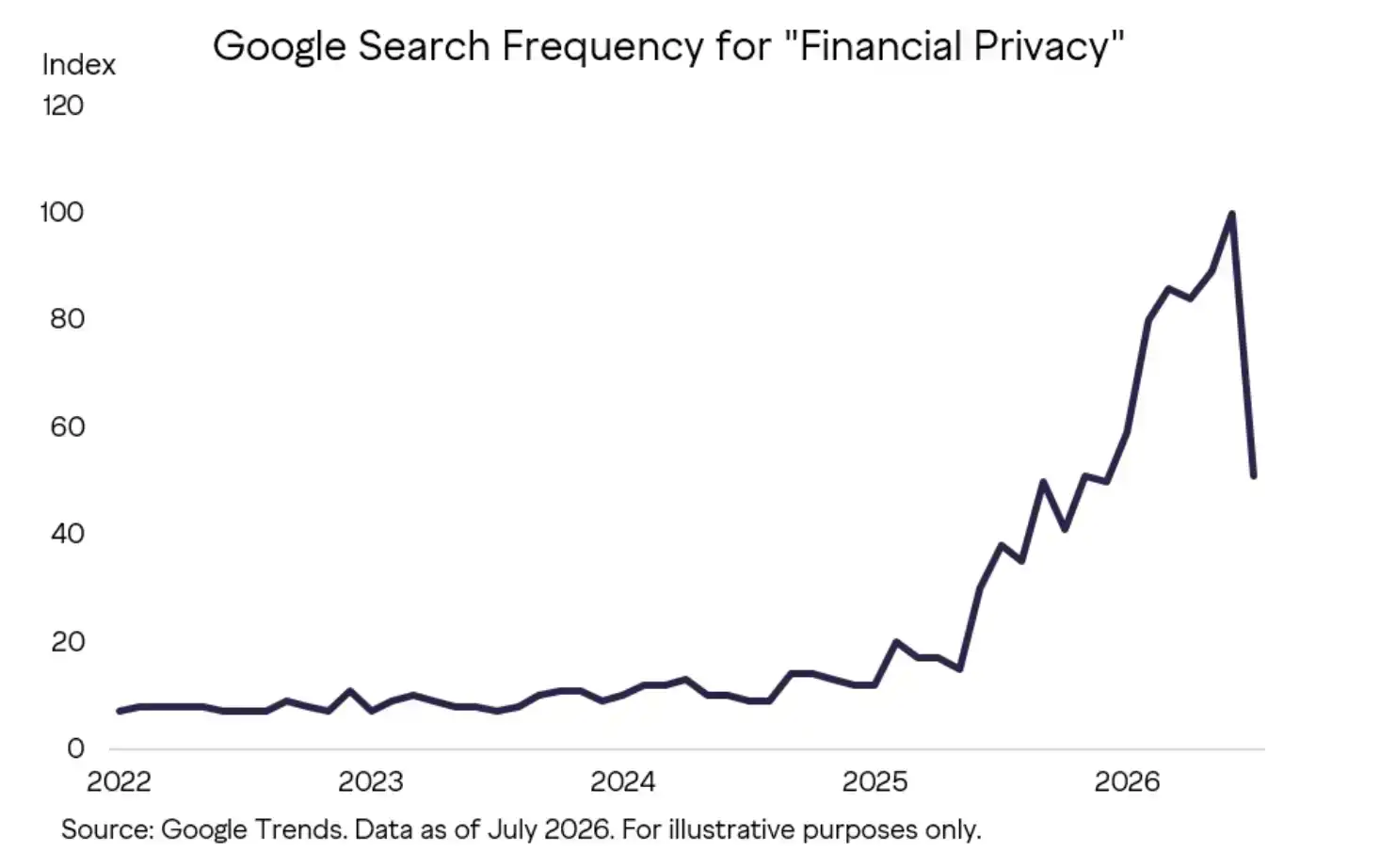
Grayscale believes that the development of stablecoins, public blockchains, and AI analysis tools is pushing financial privacy back into public discourse.

Grayscale researcher Michael Zhao argues in the report that AI may drive financial privacy into its third wave of attention cycles, following bank digitization and internet popularization. Zcash has been operational for nearly a decade, with recent improvements in shielded transactions, wallets, and mining infrastructure, yet its market share remains low. If the market begins to reprice privacy, ZEC could undergo a valuation reassessment.

This remains an investment thesis with a clear stance. Whether AI will significantly increase demand for privacy-focused currencies, whether shielding functionality can translate into sustained usage, and whether trading platforms and regulators are willing to support such assets have yet to be validated. Zcash's opportunity and risk precisely stem from this significant gap.

The following is the translated original text:

Financial privacy is not an add-on feature of money; it is part of what makes money usable.

Cash inherently possesses this attribute: transactions are not, by default, publicly disclosed. In the banking system, individual accounts and fund transfers are also typically not directly accessible to the public, and law enforcement generally requires legal procedures to obtain such information.

Technological progress constantly shifts this balance. In the 1970s, the digitization of financial records and the implementation of the U.S. Bank Secrecy Act sparked a new round of discussion about financial privacy; after the popularization of the internet and online banking, the risks of data breaches and network surveillance pushed encryption, two-factor authentication, and other security tools into the mainstream.
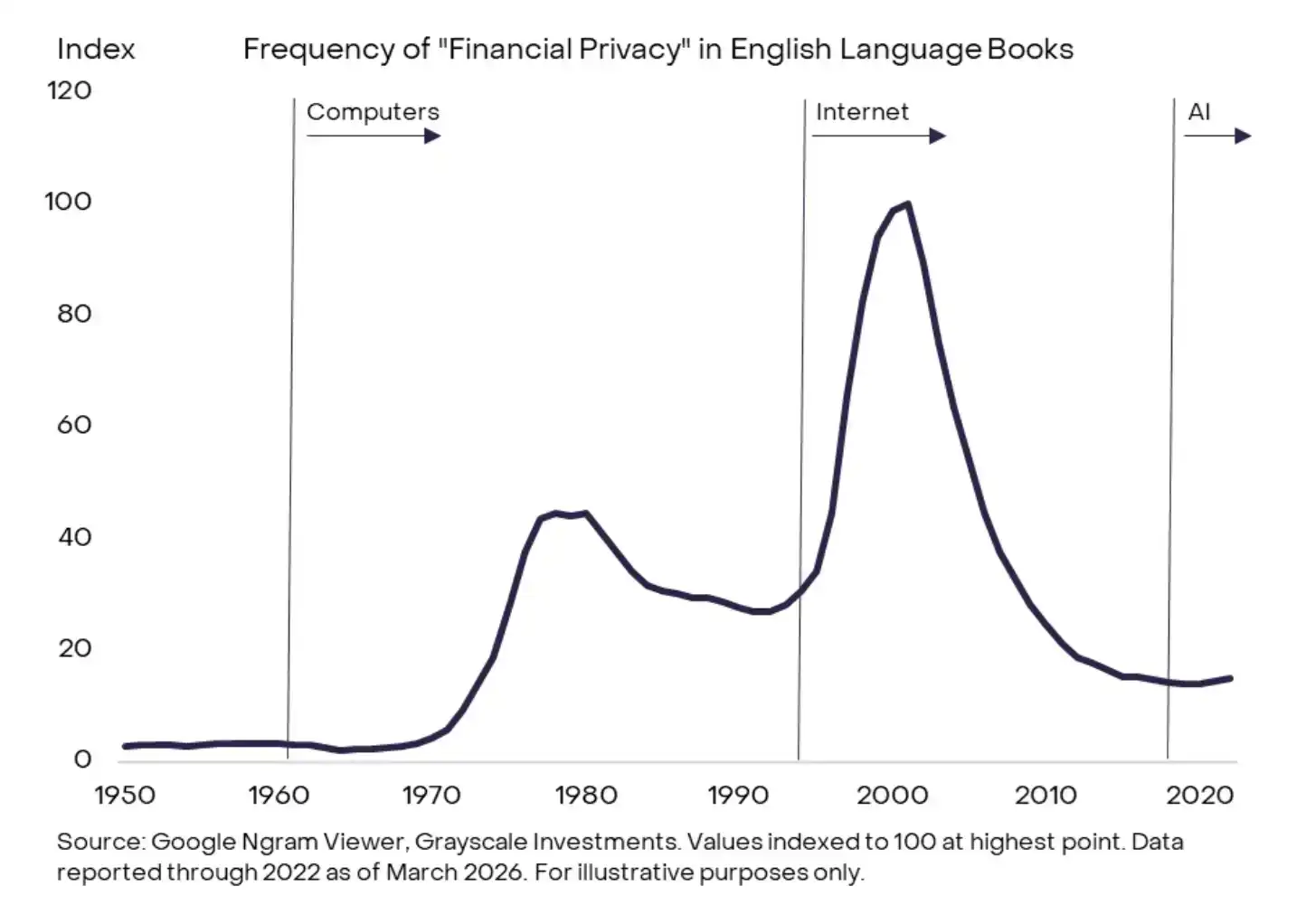
From the digitization of bank records and internet finance to AI analysis, technological advancement continuously alters the balance between privacy and traceability while improving financial efficiency.

Grayscale believes that the development of stablecoins, blockchain applications, and AI may trigger a third wave of financial privacy discussions. Especially on public blockchains, AI can combine addresses, exchange records, wallet behaviors, and counterparty information to continuously identify chain users who were originally only "pseudonymous."

Under this assessment, Zcash's value does not solely come from a cryptographic feature, but from its potential to become "private digital cash" outside of public ledgers.

Bitcoin Solved Digital Scarcity, But Not Transaction Privacy

Bitcoin established verifiable digital scarcity through public ledgers, but this transparency also limits its use in certain payment scenarios.

Balances, transaction counterparts, and historical records on public blockchains can be preserved long-term. Even if users employ addresses that don't directly display names, exchange accounts, transfer recipients, wallet operation habits, and on-chain analysis tools can gradually link them to real-world identities.

This affects not only individual users. Businesses typically don't want suppliers, salary payments, fund allocations, and customer relationships to be monitored in real-time by competitors; institutions may also be unwilling to publicize wallet structures and trading strategies. Therefore, financial privacy is not synonymous with complete anonymity; more often, it is the confidentiality required for normal business activities.

Zcash shares a similar monetary structure with Bitcoin: a total supply cap of 21 million coins, using a proof-of-work mechanism, with peer-to-peer value transfer as its primary purpose. The most important distinction is that Zcash allows users to choose whether to disclose transaction information.
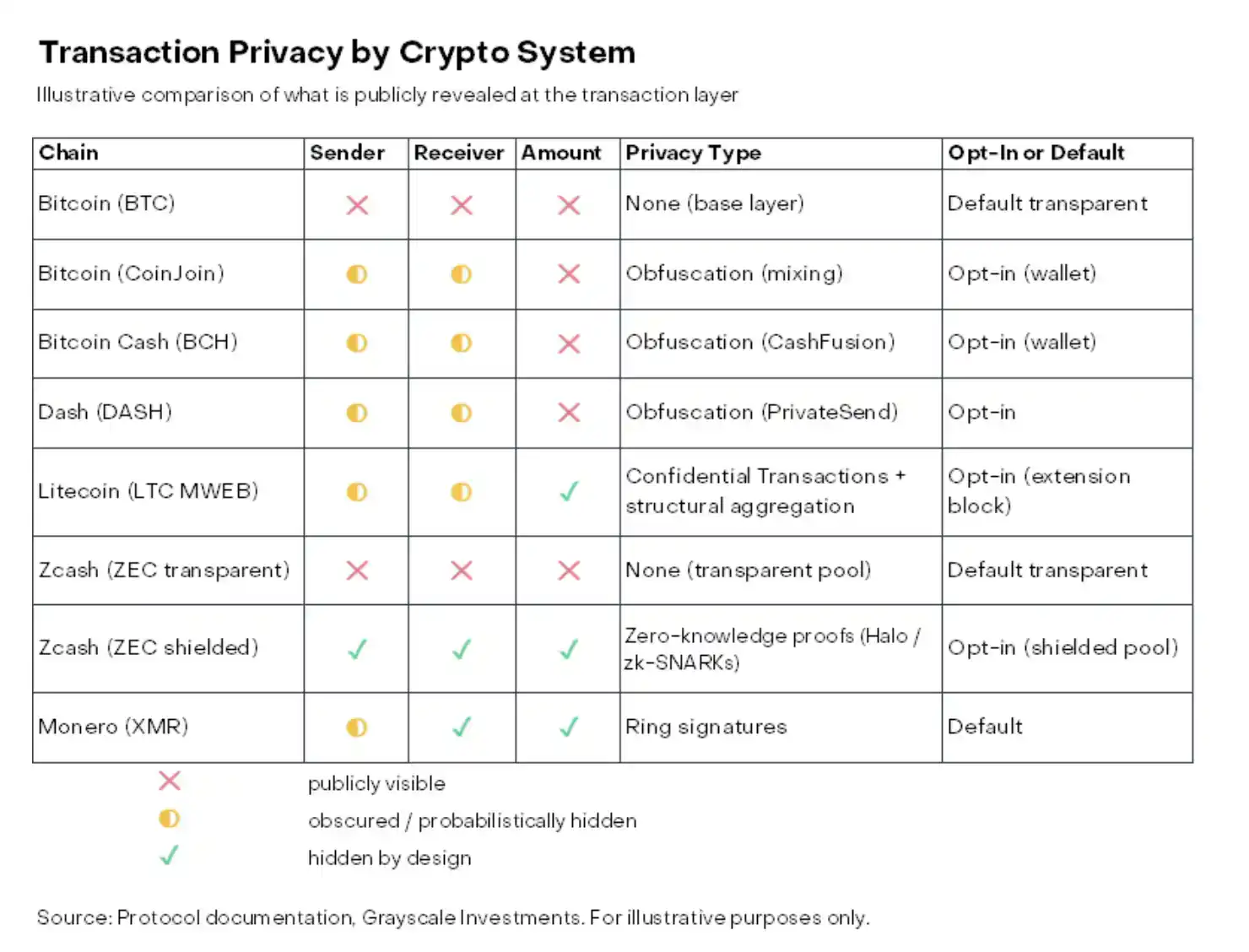
CoinJoin and other coin mixing mechanisms primarily increase transaction tracing difficulty, Monero hides key transaction information by default, while Zcash allows users to choose between transparent or shielded transactions.

Zcash supports two types of transactions:

1. Transparent Transactions: Sender, receiver, and amount are public, resembling Bitcoin's transaction model.

2. Shielded Transactions: The network can confirm the transaction's validity without disclosing the sender, receiver, or amount.

Its underlying tool is zero-knowledge proofs, meaning users can prove a transaction complies with rules without revealing the original information used for verification. The network can confirm the payer is authorized to use the funds, the amounts balance before and after the transaction, and that no new coins were created out of thin air, all without seeing the specific transaction details.

Zcash also supports selective disclosure via viewing keys. Users can open parts of their shielded transaction history to audit institutions, counterparties, or other designated third parties. Therefore, Zcash's design is not to make transactions permanently unviewable, but to transfer the right to disclose information from the public ledger back to the user.

The Technology Has Operated for a Decade; the Real Bottleneck Remains Usability

Zcash launched in 2016 and was one of the earliest projects to attempt to use zero-knowledge proofs directly in a base-layer digital currency. However, its early challenge was not whether private transactions were possible, but the high cost of using them.

Initial shielded transactions required long proof-generation times and significant memory, making smooth experiences difficult for ordinary wallets and mobile devices. Subsequent rounds of upgrades primarily focused on lowering these usage barriers:

The 2018 Sapling upgrade significantly reduced the time and memory required for shielded transactions.

The 2022 NU5 upgrade introduced the Orchard shielding protocol and Halo 2, eliminating the need for trusted setups for new shielding pools.

Unified addresses improved the interaction experience between transparent and shielded addresses.

The Zodl wallet began supporting cross-asset swaps, cross-asset receipts, and cold storage for shielded balances, attempting to allow users to maintain privacy throughout the entire transaction flow.

Mining infrastructure is also expanding. Foundry announced in March 2026 the launch of a US Zcash mining pool targeting institutions and publicly listed mining companies, providing more standardized operational and compliance support for the network.

Grayscale believes these changes may signal that Zcash is entering a new development phase. However, wallet functionality and pool expansion only indicate improved infrastructure, not direct proof of large-scale growth in end-user demand.

What's more critical next is "whether privacy can scale." Tachyon aims to reduce the computational and synchronization costs of shielded transactions; Crosslink focuses on improving transaction finality and network reliability; if shielded asset proposals are advanced again, Zcash's privacy features could extend from native ZEC to other assets.

Most of these projects still involve complex technical development and network coordination, with their timelines and actual effects not yet fully determined.

90% Shielded Transactions: Enough to Prove Real Demand?

Grayscale's core evidence comes from on-chain usage.

According to the report's methodology, as of July 20, 2026, shielded transactions accounted for approximately 90% of Zcash transaction count; the shielded pool held about 4.2 million ZEC, equivalent to roughly 25% of the circulating supply at that time.
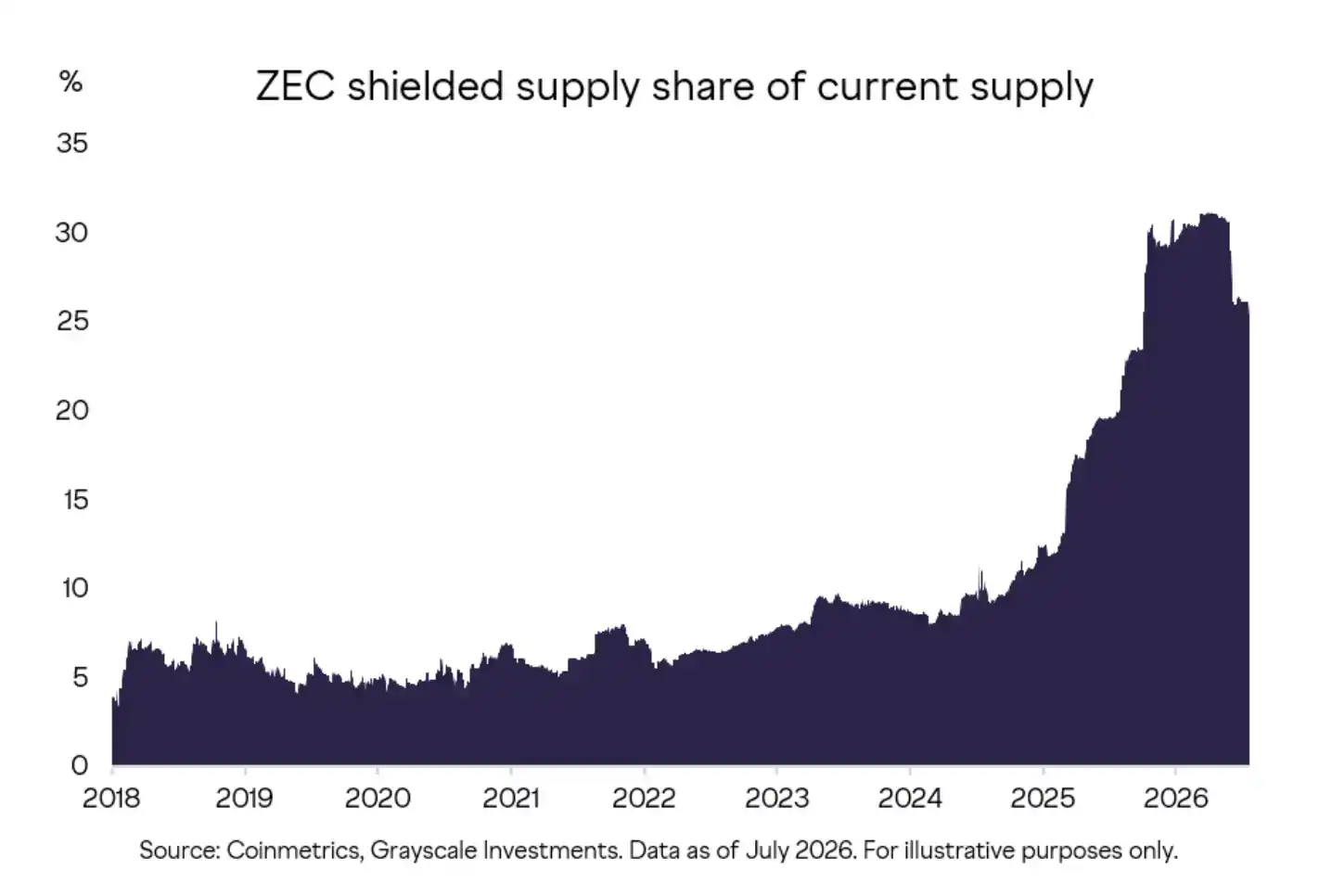
As of the statistical point used in the Grayscale report, approximately 4.2 million ZEC were in the shielded pool, representing about 25% of the circulating supply.

This indicates the shielding feature is not just a product narrative but has formed observable on-chain behavior. However, this data requires careful interpretation: different analytics platforms may have varying classification methods for "shielded transactions," statistical dates, and whether they consolidate multiple shielding pools, potentially leading to different percentages externally. An increase in shielded transaction count also does not equate to synchronous growth in user numbers, payment volume, or economic activity.

What Grayscale is truly betting on is not that Zcash has already achieved mass adoption, but that the market may change its valuation of privacy in the future. As of the July 2026 data used in the report, the total market cap of the "Digital Currency" crypto sector as defined by Grayscale was approximately $1.4 trillion, with Bitcoin comprising about 90%, and ZEC's market cap around $8 billion, accounting for about 0.6% of this sector.
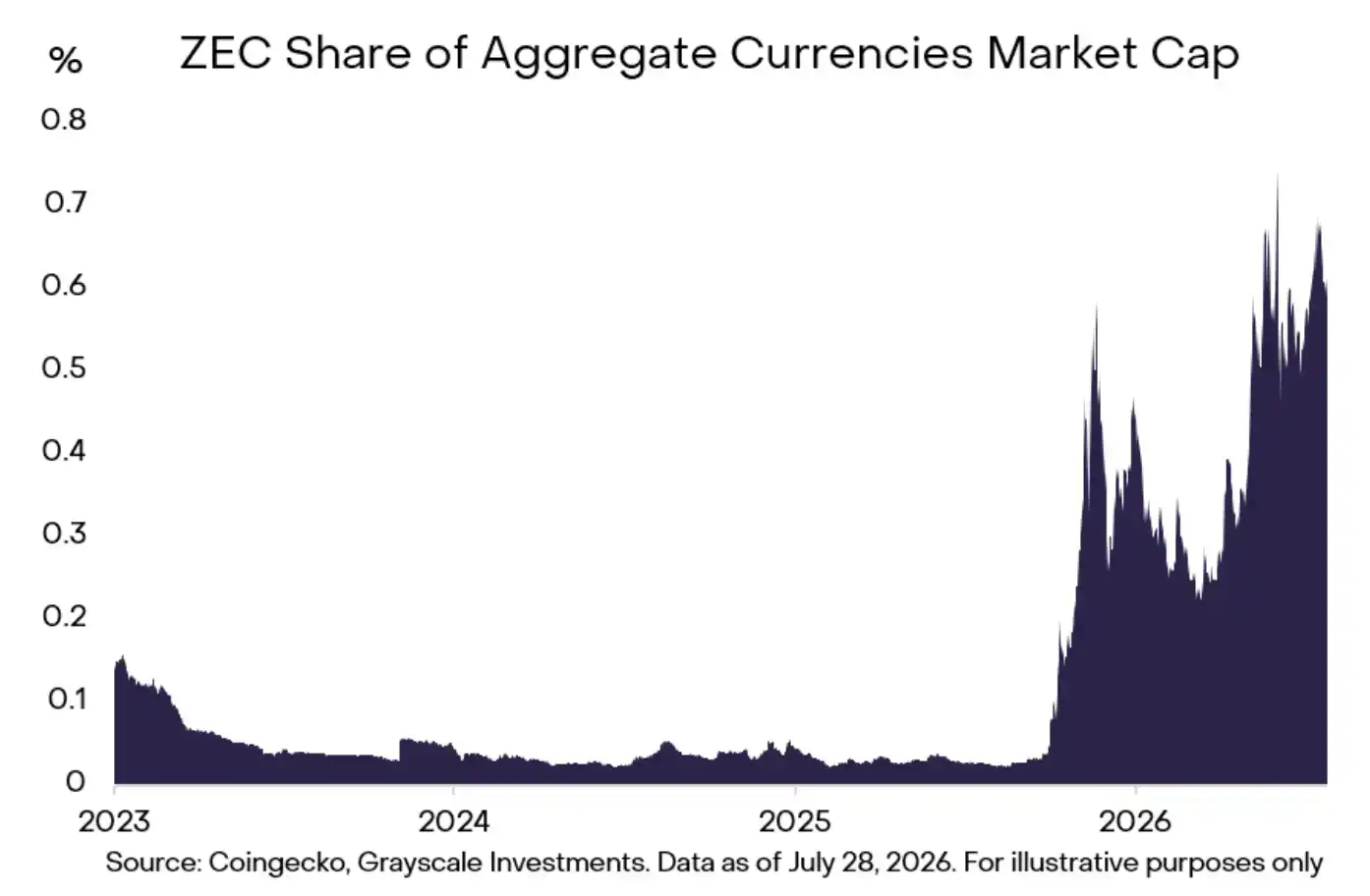
According to Grayscale's methodology, ZEC's market cap accounts for about 0.6% of the Digital Currency sector; "rising to 5% corresponds to ~9x valuation" is merely a market share scenario analysis, not a price target.

The report constructs a scenario analysis based on this: if ZEC could capture a 5% market share of this sector in the future, corresponding to a market cap of about $70 billion, that would be approximately 8.75x its market cap at the time, rounded to about 9x.

This is not a price target, nor does it represent Grayscale's prediction that ZEC will necessarily rise 9x. It is merely a sensitivity analysis based on market share changes, and it incorporates simplified assumptions such as the Digital Currency sector's total market cap remaining unchanged, and ZEC's supply and competitive landscape not undergoing major shifts.

More accurately, Grayscale believes the current valuation reflects the expectation that "privacy will remain a marginal market feature." If investors are willing in the future to view privacy as a foundational attribute of digital currency, ZEC's low market share may offer valuation elasticity.

Rising Privacy Demand Doesn't Guarantee Zcash Will Benefit

This investment thesis first faces regulatory and distribution risks.

Zcash's viewing keys can help users disclose transaction records to specific entities, providing some tools for compliance audits. However, information is still selectively released by the user, not equivalent to the default traceability of public blockchains. Simultaneously, the Financial Action Task Force (FATF) continuously requires Virtual Asset Service Providers to implement Customer Due Diligence, record-keeping, Suspicious Transaction Reporting, and the "Travel Rule."

Therefore, selective disclosure can reduce some compliance friction but cannot guarantee that exchanges, custodians, and regulatory bodies are willing to support shielded transactions. The stronger the privacy protection, the more likely ZEC may face restrictions in listing, custody, wallet integration, and fiat on/off-ramps.

The second risk comes from protocol security.

In 2026, developers discovered a soundness vulnerability in the original Orchard circuit, theoretically usable to create undetectable counterfeit ZEC. NU6.2 fixed the relevant circuit. The subsequently launched Ironwood new shielding pool further restricts funds from entering the old Orchard pool and restores the ability to verify the integrity of the shielded supply through a fund migration mechanism.

It is crucial to emphasize this was a theoretical vulnerability, not an actual discovery of ZEC counterfeiting. Ironwood improves the future security structure, but the old shielding pool and its fund migration remain a legacy risk requiring ongoing observation.

Quantum computing is a longer-term concern. The mechanisms introduced by Ironwood help preserve a recovery path for future quantum-resistant migration, but the official technical proposal clearly states this change itself does not give Zcash full quantum resistance.

Finally, there is execution risk. Zcash's investment thesis still relies on simultaneous improvements in wallet experience, protocol scaling, and ecosystem distribution. Any delay in an upgrade, coordination failure, or lack of user adoption could weaken the "privacy at scale" narrative.

The Next Step is to See if Privacy Becomes a Demand, Not Just a Topic

The bullish thesis for Zcash does not require it to replace Bitcoin. Grayscale is betting on another possibility: as on-chain fund flows become increasingly transparent and AI analysis capabilities continue to strengthen, the market may begin to pay a premium for "verifiable but not public" digital currency.

To validate this assessment, the next indicators to watch are not whether the ZEC price continues to rise, but several more specific metrics: whether shielded pool funds and real users continue to increase, whether wallets can lower the usability barrier for complete private transaction flows, whether upgrades like Tachyon proceed as planned, and whether exchanges and custodians expand rather than restrict support.

If privacy usage grows but liquidity and compliance channels continue to deteriorate, Zcash may still struggle to form a larger market. Conversely, if usage, infrastructure, and market access improve simultaneously, ZEC could transition from an "established privacy coin" to a tool for pricing digital financial privacy demand.

Zcash's current valuation gap essentially corresponds not to a confirmed growth story, but to an option that has yet to be fully validated: In the AI era, what is financial privacy really worth?


Трендовые криптовалюты

Связанные с этим вопросы

QAccording to the GrayScale report, what are the three historical periods of heightened public discussion about financial privacy?

AAccording to the article, the GrayScale report identifies three periods: 1) The digitization of banking records and the implementation of the U.S. Bank Secrecy Act in the 1970s. 2) The rise of the internet and online banking, which brought risks of data breaches and surveillance. 3) The current potential period driven by the development of stablecoins, blockchain applications, and AI analytics.

QWhat are the two main types of transactions supported by Zcash, and how do they differ?

AZcash supports two types of transactions: 1) Transparent transactions, where the sender, receiver, and amount are public, similar to Bitcoin. 2) Shielded transactions, where the network confirms a transaction is valid without revealing the sender, receiver, or amount. The latter uses zero-knowledge proofs for validation without disclosure.

QWhat is the core investment thesis presented by GrayScale regarding Zcash's potential valuation?

AGrayScale's core thesis is not that privacy is currently valued, but that the market may *future* re-price privacy as a core attribute of digital currency in an era of increasing AI-powered financial surveillance. Zcash's low current market share (about 0.6% of the digital currency sector) provides valuation elasticity if this shift in perception occurs, potentially leading to a significant re-rating. A scenario analysis suggests a ~9x increase if ZEC captured 5% of the sector's market share.

QWhat are the key risks mentioned to the investment case for Zcash?

AThe article highlights several key risks: 1) Regulatory and distribution risk, where exchanges and custodians may limit support for shielded transactions due to compliance pressures. 2) Protocol security risks, including a past theoretical vulnerability and the long-term challenge of quantum computing. 3) Execution risk, where delays or failures in planned upgrades (like Tachyon, Crosslink) or lack of user adoption could undermine the narrative of privacy scaling.

QWhat key metrics should be observed to validate the thesis that privacy is becoming a genuine demand, not just a topic?

ATo validate the thesis, the article suggests observing: whether the shielded pool's funds and real user count grow consistently; if wallets can lower the usability barrier for full privacy transactions; if planned protocol upgrades (like Tachyon) are successfully implemented on schedule; and whether exchanges and custodians expand, rather than restrict, their support for Zcash and shielded transactions.

Похожее

Что Уолл-стрит думает о дебюте Уоша в Джексоне Хоуле? Ястребы "исправляют" коммуникацию июля, отказ от повышения в сентябре может снова ударить по репутации ФРС

Председатель ФРС США Джеймс Уош на своем дебютном выступлении на симпозиуме в Джексон-Хоуле представил обновленную позицию, которую аналитики Уолл-стрит единодушно охарактеризовали как "ястребиную корректировку" коммуникации после июльского заседания FOMC. В своей речи Уош решительно подтвердил неприкосновенность 2%-й цели по инфляции, заявив, что текущие финансовые условия нельзя считать сдерживающими, а недавнее улучшение данных по PCE и CPI не убедило его в значимом улучшении базовой тенденции. Он подчеркнул, что ФРС "предстоит проделать работу", если инфляция не будет уверенно и достаточно быстро снижаться к цели. Это заявление радикально сместило фокус рынков на возможность повышения ставки в сентябре. Эксперты Morgan JPMorgan и Aberdeen сочли выступление попыткой восстановить антиинфляционную репутацию после "неудачной коммуникации" в июле, предупредив, что отказ от повышения в сентябре может нанести новый удар по доверию к ФРС. Барклайс и Societe Generale пересмотрели свои прогнозы в сторону ужесточения, ожидая повышения ставки на 25 б.п. в сентябре и декабре. Рынки отреагировали ростом краткосрочных доходностей казначейских облигаций, а вероятность сентябрьского повышения по данным CME выросла примерно с 35% до 50-60%. Однако, как отмечает Ник Тимираос ("новый Федкоммюникейтор"), Уош предоставил рынку лишь "компас", а не "GPS". Он четко обозначил ястребиные принципы (упор на 2%, недостаточный прогресс по инфляции), но сознательно отказался давать конкретные указания по будущим шагам или четко поддержать сентябрьское повышение, стремясь сохранить гибкость. Таким образом, консенсус Уолл-стрит сводится к следующему: Уош провел ястребиную коррекцию курса, значительно повысив вероятность повышения ставки в сентябре. Однако окончательное решение будет зависеть от новых данных по инфляции и занятости. Главный вопрос для Уоша теперь заключается в том, готов ли он превратить эту жесткую риторику в реальное действие, если данные не покажут существенного улучшения.

marsbit30 мин. назад

Что Уолл-стрит думает о дебюте Уоша в Джексоне Хоуле? Ястребы "исправляют" коммуникацию июля, отказ от повышения в сентябре может снова ударить по репутации ФРС

marsbit30 мин. назад

Последнее выступление Уорша: Время, в котором мы живем

В своей речи на симпозиуме в Джексоне 28 августа 2026 года председатель ФРС Кевин Уорш подчеркнул, что борьба с инфляцией остается главным приоритетом денежно-кредитной политики. Несмотря на устойчивость экономики и рынка труда, инфляция, измеряемая индексом PCE, составляет 3,7% и значительно превышает целевой показатель ФРС в 2%. Уорш отметил, что, хотя летние данные по ценам были лучше ожиданий, они не свидетельствуют о значительном улучшении базовой инфляционной тенденции. Его критерий для изменения политики — уверенность в том, что инфляция уверенно и достаточно быстро движется к цели. Уорш также подробно изложил свой подход к коммуникации, критикуя чрезмерное использование «пропедевтического руководства» в нормальные периоды. Он предупредил о проблеме «зала зеркал», когда рынки чрезмерно зависят от сигналов ФРС, а ФРС, в свою очередь, от рыночных цен, что может привести к ошибкам в политике. Вместо этого он выступает за более сдержанную коммуникацию, позволяющую рынкам самостоятельно оценивать экономические условия, в то время как ФРС сохраняет гибкость для принятия решений на основе данных. В речи также обсуждалось влияние искусственного интеллекта (ИИ) на экономику, потенциал повышения производительности и связанные с этим вопросы для политики. Уорш представил ключевые принципы своей политики, включая приверженность двойному мандату (ценовая стабильность и максимальная занятость), важность денег и необходимость надежных данных для принятия решений. Он оценил текущие финансовые условия как не особенно ограничительные, отметив силу корпоративных инвестиций и прибылей, здоровое потребление и стабильный рынок труда.

marsbit2 ч. назад

Последнее выступление Уорша: Время, в котором мы живем

marsbit2 ч. назад

Валидаторы Solana одобрили предложение об ускорении дезинфляции SOL

Валидаторы Solana одобрили предложение SGP-0002, удваивающее годовой темп дезинфляции (снижения инфляции) сети с 15% до 30%. Это решение было поддержано 67% голосов при участии 60,7% от общего объема стейкинга. Изменение ускорит достижение целевого долгосрочного уровня инфляции в 1,5% примерно до 2,8 лет вместо 5,7 лет. В результате в течение следующих шести лет будет выпущено примерно на 18,9 млн монет SOL меньше, что снизит инфляционное давление на держателей, но также уменьшит вознаграждения за стейкинг. Крупные валидаторы разошлись во мнениях: Figment проголосовал против, а Helius и Jupiter поддержали предложение. Криптобиржа Kraken в итоге также изменила свою позицию на поддержку. Голосование стало частью первого обязательного процесса управления Solana. На его фоне активы американского Solana ETF от Bitwise превысили $1 млрд, а совокупный чистый приток в Solana ETF в США достиг примерно $1,7 млрд.

cryptonews.ru5 ч. назад

Валидаторы Solana одобрили предложение об ускорении дезинфляции SOL

cryptonews.ru5 ч. назад

Доступ к активным сессиям вместо баз данных: как изменился теневой рынок в России

Российский теневой рынок сменил приоритет: вместо продажи устаревших баз данных злоумышленники переключились на торговлю активным, краткосрочным доступом к аккаунтам пользователей. Стоимость такой «свежей» информации, перехваченной вредоносным ПО с зараженных устройств, за год выросла почти на 13%. В продажу поступают токены активных сессий, действующие пароли и доступы к корпоративным сетям, позволяющие обходить двухфакторную аутентификацию. Подписка на такие данные стоит $250–300 в месяц, тогда как архивы устаревших сведений оцениваются всего в $10–15. Государственные меры, ужесточившие ответственность компаний за утечки из централизованных хранилищ, оказались неэффективны против новой модели угроз. Вредоносное ПО теперь похищает данные уже на личных устройствах пользователей, формально не затрагивая корпоративные базы и оставаясь вне зоны действия регуляторов. Аналогичный разрыв наблюдается и в сфере связи, где новые правила маркировки звонков столкнулись с трудностями реализации даже у крупнейших банков. Эксперты отмечают, что эта тенденция повторяет мировой сценарий и создает структурный риск: спрос на актуальные данные стимулирует злоумышленников долго поддерживать зараженные устройства как постоянный источник дохода. Ключевой вопрос заключается в том, смогут ли регуляторы выработать инструменты для контроля над этой «серой зоной» между личным устройством и корпоративным периметром безопасности.

cryptonews.ru5 ч. назад

Доступ к активным сессиям вместо баз данных: как изменился теневой рынок в России

cryptonews.ru5 ч. назад

Первые данные налоговой службы Великобритании (HMRC) по криптовалютам показывают, что большую часть прибыли зафиксировало молодое мужское меньшинство

Впервые выделив данные по криптовалютам отдельно, британская налоговая служба (HMRC) сообщает, что в 2024-2025 финансовом году 17 600 человек задекларировали налогооблагаемую прибыль от криптоопераций на сумму 1,38 млрд фунтов. Из них 240 человек (менее 2% от общего числа) получили более 1 млн фунтов каждый, что в сумме составило 717 млн фунтов, то есть более половины всей прибыли. Большинство же (65%) заявили о прибыли менее 25 000 фунтов. Подавляющее большинство декларантов (87%) — мужчины, на которых пришлось 93% общей прибыли. Основная возрастная группа (71% объема продаж, 54% налогоплательщиков) — лица от 25 до 44 лет, однако их доля в прибыли составляет лишь 45%. В целом, плательщики налога на криптоприбыль значительно моложе типичных инвесторов. HMRC активизировала рассылку напоминаний о декларировании, а с 2027 года, в рамках реализации стандартов ОЭСР, начнет автоматически получать данные о клиентах от криптобирж по всему миру, что серьезно упростит выявление нарушителей.

cryptonews.ru5 ч. назад

Первые данные налоговой службы Великобритании (HMRC) по криптовалютам показывают, что большую часть прибыли зафиксировало молодое мужское меньшинство

cryptonews.ru5 ч. назад

Торговля

Спот

Популярные статьи

Как купить ERA

Добро пожаловать на HTX.com! Мы сделали приобретение Caldera (ERA) простым и удобным. Следуйте нашему пошаговому руководству и отправляйтесь в свое крипто-путешествие.Шаг 1: Создайте аккаунт на HTXИспользуйте свой адрес электронной почты или номер телефона, чтобы зарегистрироваться и бесплатно создать аккаунт на HTX. Пройдите удобную регистрацию и откройте для себя весь функционал.Создать аккаунтШаг 2: Перейдите в Купить криптовалюту и выберите свой способ оплатыКредитная/Дебетовая Карта: Используйте свою карту Visa или Mastercard для мгновенной покупки Caldera (ERA).Баланс: Используйте средства с баланса вашего аккаунта HTX для простой торговли.Третьи Лица: Мы добавили популярные способы оплаты, такие как Google Pay и Apple Pay, для повышения удобства.P2P: Торгуйте напрямую с другими пользователями на HTX.Внебиржевая Торговля (OTC): Мы предлагаем индивидуальные услуги и конкурентоспособные обменные курсы для трейдеров.Шаг 3: Хранение Caldera (ERA)После приобретения вами Caldera (ERA) храните их в своем аккаунте на HTX. В качестве альтернативы вы можете отправить их куда-либо с помощью перевода в блокчейне или использовать для торговли с другими криптовалютами.Шаг 4: Торговля Caldera (ERA)С легкостью торгуйте Caldera (ERA) на спотовом рынке HTX. Просто зайдите в свой аккаунт, выберите торговую пару, совершайте сделки и следите за ними в режиме реального времени. Мы предлагаем удобный интерфейс как для начинающих, так и для опытных трейдеров.

1.0k просмотров всегоОпубликовано 2025.07.17Обновлено 2026.06.02

Как купить ERA

Обсуждения

Добро пожаловать в Сообщество HTX. Здесь вы сможете быть в курсе последних новостей о развитии платформы и получить доступ к профессиональной аналитической информации о рынке. Мнения пользователей о цене на ERA (ERA) представлены ниже.

活动图片