Dark Pools Prevail, Whales Vanish: How Credible Are Public Market Signals?

marsbitОпубликовано 2026-08-07Обновлено 2026-08-07

Введение

Institutional cryptocurrency trading is increasingly shifting towards dark pools and over-the-counter (OTC) desks, with data from sFOX showing such venues accounted for 15% of total monthly volume by June, up from negligible levels in April. In July, 77.7% of institutional capital on sFOX's platform was routed through OTC desks, while only 18.4% went to public exchanges. A key driver is institutions' need to conceal large orders to avoid revealing trading patterns, preventing front-running and minimizing price impact. Firms like Jane Street and Citadel use dark pools and order-splitting across multiple venues to execute trades discreetly. This structural shift mirrors earlier developments in equities and forex markets. As a result, public order books now reflect only a fraction of actual market activity, eroding the once-significant advantage retail traders had in tracking large wallets and exchange flows. The proliferation of prime brokers and aggregation platforms is also rapidly closing simple arbitrage opportunities. The market may evolve toward a brokerage model for retail, similar to traditional stocks. Two scenarios emerge: an optimistic one where retail gains from narrower spreads and better order routing, and a pessimistic one where transparency declines faster than benefits trickle down, leaving smaller investors in the dark. Regardless, traders must adapt by not relying solely on exchange volume, comparing total execution costs, and using limit orders in thin marke...

Original Author: Gino Matos

Original Compilation: Saoirse, Foresight News

Data from sFOX shows that cryptocurrency dark pool trading volume continues to climb, growing from negligible levels in April to account for 15% of total monthly volume by June. The firm's July 30th report also noted that 77.7% of institutional capital on its platform was matched through OTC desks, with only 18.4% flowing to public exchanges. In May alone, dark pool transaction volume reached $147 million.

In an interview with CryptoSlate, sFOX's Diana Pires described this as a structural shift, similar to the industry transformation experienced by stock and foreign exchange markets years ago.

Why Institutions Choose Crypto Dark Pools

Large orders placed on public order books leave clear footprints. Other traders can identify these trading patterns, execute trades ahead of the order, or push prices in the opposite direction before the order is filled, thereby increasing trading slippage.

Pires gave an example: institutions like Jane Street and Citadel have strong incentives to hide their trading trails. Once trading patterns are identified by the market, other participants will conduct targeted reverse trades.

This is also the fundamental reason why more and more crypto orders are choosing dark pools, OTC desks, and platforms that can route single orders to over a dozen trading venues simultaneously.

sFOX alone is connected to over 40 exchanges and OTC desks, and its institutional clients typically use 14 to 19 of these channels to complete trades each month on average.

OTC desks that receive large orders typically break them down into smaller orders before distributing them to avoid single transactions from causing severe market fluctuations.

Pires summarized the core logic of crypto dark pools as follows: trading platforms privately take on large positions, then split them into small orders to be sent to exchanges; these small orders hardly disturb the order book. She believes that this type of capital inflow into the public market helps deepen the order book and further narrow the bid-ask spread.

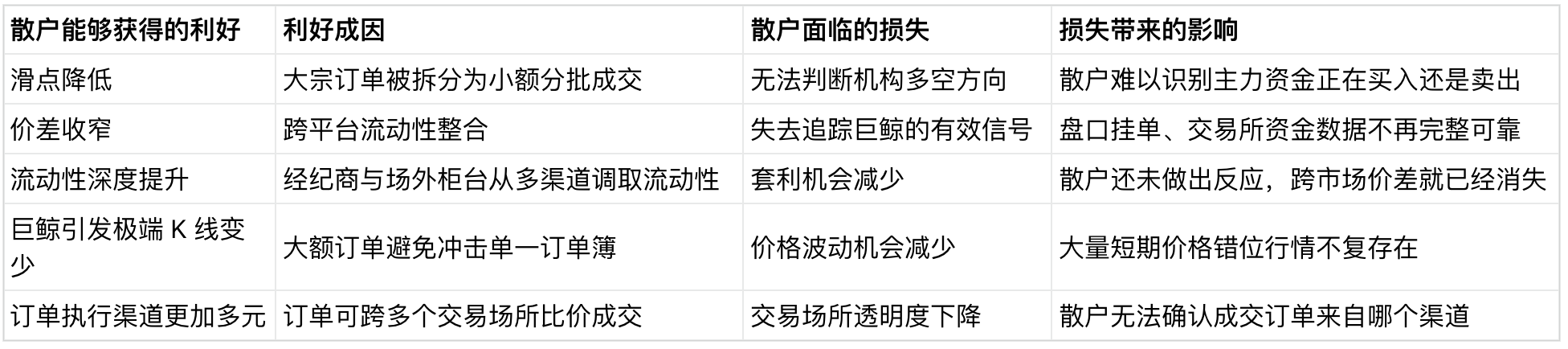
In the past, public order books could reflect the vast majority of real market trading activity, but now they only represent a small fraction of it. Quiet exchange order books do not mean institutions are not trading. Large buyers can accumulate positions over weeks without posting any visible buy orders; large sellers can complete significant reductions in holdings without massive sell pressure appearing on the order book.
The Information Advantage of Tracking Whales Is Being Actively Diminished

Bitcoin and crypto traders once had a natural advantage over participants in other markets: everyone could continuously monitor exchange fund balances, large orders on the order book, and large on-chain holdings.

Pires pointed out that dark pools, by design, eliminate this advantage. Trading platforms, OTC desks, and brokers can see the underlying fund flows. This information is protected by regulatory rules and client agreements, preventing retail traders from knowing whether institutions are buying or selling.

Simple cross-market arbitrage opportunities are also disappearing. Information once spread slower than capital flows, allowing investors to buy low on one exchange and sell high on another for profit. Pires stated that as prime brokers and aggregation platforms simultaneously scan dozens of trading venues, completing arbitrage and closing price gaps before retail traders can capture them, such opportunities are shrinking year by year.

She predicts the crypto trading market will eventually evolve towards a structure similar to the stock market: individual investors will no longer connect directly to exchanges but will instead go through brokers, who will seek the best prices across major trading venues on their behalf.

Retail account trading volumes typically struggle to meet the minimum fee tier thresholds set by exchanges, while brokers aggregating massive institutional orders can easily meet them. Pires believes this disparity will continue to drive ordinary traders towards brokers, although this shift won't be mandated by regulation as it was in the stock market.

Two Market Outlook Scenarios

Optimistic Scenario

Order aggregation platforms and mainstream trading venues handle retail orders in the same way they handle institutional orders. Market spreads continue to narrow, slippage decreases further, and instances of large orders piercing thin order books diminish.

Trading opportunities lost from public exchanges shift to other arenas. On-chain and DeFi markets still maintain public data on large holdings, providing channels for traders wanting to speculate on price volatility; regulated, compliant trading markets will exhibit more stable trends.

Pessimistic Scenario

For traders with ordinary capital sizes, the loss of trading transparency outpaces the realization of expected trading optimization benefits. Retail and medium-sized investors completely lose the ability to discern institutional capital movements.

Spread optimization and premium order routing services remain exclusively for large clients with sufficient capital to access prime brokers and aggregation platforms. Public exchange price signals continue to weaken, with participants relying on monitoring exchange order books being the first to feel the change.

Regardless of the market's direction, traders need to adjust their habits: do not treat the trading volume of a single exchange as a reflection of the entire market; compare total trading costs across different channels before referencing exchange-listed fee rates; when order book depth is insufficient, use limit orders as much as possible to guard against market orders impacting prices.

Beneath seemingly calm order books may lurk large-scale institutional trading.

As the crypto market matures and trading experiences continuously optimize, the difficulty of interpreting the market increases. Retail traders encounter fewer sudden price shocks from whales, but they also find it harder to observe the movements of the most influential capital.


Трендовые криптовалюты

Связанные с этим вопросы

QWhat is the main trend highlighted in the sFOX report regarding cryptocurrency trading?

AThe sFOX report highlights a significant structural shift, showing that dark pool and OTC trading volumes are rising sharply. In April, dark pool volume was negligible, but by June it accounted for 15% of the total monthly volume. In May alone, dark pool transaction volume reached $147 million.

QWhy are institutional players increasingly using crypto dark pools according to the article?

AInstitutions use dark pools to hide their trading patterns. Large orders on public order books leave clear traces, allowing other traders to front-run them or push prices against them before execution, increasing slippage. Dark pools and OTC desks allow them to break large orders into smaller ones executed across multiple venues, minimizing market impact.

QHow does the rise of dark pools affect the information advantage previously held by crypto traders?

AIt actively dismantles that advantage. Dark pools are designed to obscure large trade flows. Information on institutional buying or selling is protected by regulations and client agreements, making it inaccessible to retail traders. Furthermore, opportunities for simple cross-exchange arbitrage are disappearing as prime brokers and aggregators execute trades faster than retail can.

QWhat are the two potential future scenarios for the crypto market outlined in the article?

AThe article outlines one optimistic and one pessimistic scenario. The optimistic scenario envisions benefits like tighter spreads and lower slippage trickling down to retail traders via aggregators. The pessimistic scenario predicts that transparency will erode faster than benefits materialize for retail, leaving them unable to gauge institutional moves, with premium services remaining exclusive to large clients.

QWhat practical adjustments does the article suggest for traders in light of the rising use of dark pools?

ATraders should adjust by: 1) Not treating a single exchange's volume as representative of the whole market. 2) Comparing comprehensive transaction costs across different channels before referencing exchange-listed fees. 3) Using limit orders over market orders when order book depth is insufficient to prevent price impact.

Похожее

Galaxy снижает шансы на принятие Закона о ясности (CLARITY) до 10%

Galaxy Digital снизила свою оценку вероятности принятия Закона о ясности рынка цифровых активов (CLARITY Act) в 2026 году до 10%. Аналитики предупреждают, что остаются нерешенными множество политических вопросов, и у Сената будет всего около двух-трех недель для его утверждения после возобновления работы 14 сентября. Глава исследовательского отдела Galaxy Алекс Торн отметил, что для прохождения закона он должен будет доминировать практически во всей рабочей сессии, иначе времени не хватит. Среди ключевых спорных моментов — этические правила для госслужащих в криптосфере и давление со стороны банков относительно положений о доходах от стейблкоинов. Ранее Galaxy уже снижала прогнозы с 75% до 60% в начале июня и с 60% до 50% в конце июня. Закон, направленный на создание первого в США регуляторного режима для цифровых активов, был одобрен комитетом по банковскому делу Сената в мае, но столкнулся с сопротивлением большинства демократов и банковской индустрии, которые критикуют возможность криптокомпаний предлагать доходность по стейблкоинам без банковских требований. В начале июня более 200 криптокомпаний и организаций призвали Сенат принять данный закон.

cointelegraph1 ч. назад

Galaxy снижает шансы на принятие Закона о ясности (CLARITY) до 10%

cointelegraph1 ч. назад

Илон Маск строит Terafab: крупнейший завод чипов для ИИ, роботов и космических дата-центров

SpaceX и Tesla запустили проект Terafab по строительству крупнейшего в мире полупроводникового завода в Техасе. Первая очередь, стоимостью $16,8 млрд, займет более 9,3 млн кв. м и создаст 3000 рабочих мест. Цель — производство вычислительных мощностей свыше 1 тераватта в год для роботов Optimus, беспилотных автомобилей Cybercab и орбитальных дата-центров SpaceX. Проект получил государственную поддержку, включая грант Texas Enterprise Fund. Ключевым технологическим партнером выступит Intel с использованием техпроцесса 14A. Инициатива направлена на диверсификацию цепочек поставок и укрепление позиций США в глобальной технологической конкуренции, в контексте программ вроде Pax Silica. Однако опыт подобных мегапроектов, таких как завод Intel в Огайо, показывает, что реализация часто сталкивается с задержками и непредвиденными сложностями.

cryptonews.ru1 ч. назад

Илон Маск строит Terafab: крупнейший завод чипов для ИИ, роботов и космических дата-центров

cryptonews.ru1 ч. назад

"AI-божество" потянуло за собой: Jane Street потеряла в июле 15 млрд долларов, впервые за десять лет показав убыток за месяц

Одна из самых загадочных и прибыльных компаний проп-трейдинга Уолл-стрит, Jane Street, понесла в июле рекордные убытки в размере около 15 миллиардов долларов, что стало ее первым месячным убытком за примерно десять лет. Основными причинами стали проблемы у хедж-фонда, инвестировавшего в акции AI, Situational Awareness, который из-за резкого падения котировок был вынужден распродать активы, а также убытки по другим технологическим акциям в Азии. Несмотря на серьезный единичный убыток, чистая торговая выручка Jane Street с начала года все еще превышает 40 миллиардов долларов. Компания заявила, что закроет часть рискованных позиций, приведших к потерям, и в целом станет более избирательной в принятии рисков. На фоне этих событий Jane Street также проводит рефинансирование долга на сумму около 14,6 миллиарда долларов, переводя часть обязательств с публичного на частный рынок, чтобы повысить гибкость и сократить раскрытие информации, даже ценой более высоких затрат на финансирование. Ситуация с фондом Situational Awareness высветила риски в экосистеме прайм-брокеров, где высокая долговая нагрузка и схожие инвестиции многих фондов в одни и те же активы AI могут привести к каскадным продажам при смене рыночной конъюнктуры.

marsbit1 ч. назад

"AI-божество" потянуло за собой: Jane Street потеряла в июле 15 млрд долларов, впервые за десять лет показав убыток за месяц

marsbit1 ч. назад

Аналитики QCP Capital объяснили, почему биткоин застрял у $63 000

Аналитики QCP Capital отмечают, что биткоин застрял в диапазоне около $63 000, несмотря на благоприятную макростатистику США (замедление инфляции и слабый рынок труда). На цену давят несколько кросс-рыночных факторов: геополитические риски (переговоры по Ормузскому проливу), высокие цены на нефть, неопределенность глобальной ликвидности и слабая реакция на макроданные. Рынок демонстрирует устойчивость, поглощая негатив, но восходящего импульса нет. Регуляторная повестка в США развивается, а корпоративные казначейства (на примере Strategy) теперь могут выступать как покупателями, так и продавцами биткоина, делая потоки средств менее предсказуемыми. Историческая сезонная слабость августа-сентября служит контекстом, но не определяющим фактором. Ключевыми событиями ближайших недель станут данные по PCE (26 августа), симпозиум в Джексон-Хоуле и заседание ФРС в сентябре, которые могут проверить прочность текущего торгового диапазона.

cryptonews.ru1 ч. назад

Аналитики QCP Capital объяснили, почему биткоин застрял у $63 000

cryptonews.ru1 ч. назад

Торговля

Спот

Популярные статьи

Как купить DATA

Добро пожаловать на HTX.com! Мы сделали приобретение DATA Network (DATA) простым и удобным. Следуйте нашему пошаговому руководству и отправляйтесь в свое крипто-путешествие.Шаг 1: Создайте аккаунт на HTXИспользуйте свой адрес электронной почты или номер телефона, чтобы зарегистрироваться и бесплатно создать аккаунт на HTX. Пройдите удобную регистрацию и откройте для себя весь функционал.Создать аккаунтШаг 2: Перейдите в Купить криптовалюту и выберите свой способ оплатыКредитная/Дебетовая Карта: Используйте свою карту Visa или Mastercard для мгновенной покупки DATA Network (DATA).Баланс: Используйте средства с баланса вашего аккаунта HTX для простой торговли.Третьи Лица: Мы добавили популярные способы оплаты, такие как Google Pay и Apple Pay, для повышения удобства.P2P: Торгуйте напрямую с другими пользователями на HTX.Внебиржевая Торговля (OTC): Мы предлагаем индивидуальные услуги и конкурентоспособные обменные курсы для трейдеров.Шаг 3: Хранение DATA Network (DATA)После приобретения вами DATA Network (DATA) храните их в своем аккаунте на HTX. В качестве альтернативы вы можете отправить их куда-либо с помощью перевода в блокчейне или использовать для торговли с другими криптовалютами.Шаг 4: Торговля DATA Network (DATA)С легкостью торгуйте DATA Network (DATA) на спотовом рынке HTX. Просто зайдите в свой аккаунт, выберите торговую пару, совершайте сделки и следите за ними в режиме реального времени. Мы предлагаем удобный интерфейс как для начинающих, так и для опытных трейдеров.

578 просмотров всегоОпубликовано 2026.07.01Обновлено 2026.07.01

Как купить DATA

Обсуждения

Добро пожаловать в Сообщество HTX. Здесь вы сможете быть в курсе последних новостей о развитии платформы и получить доступ к профессиональной аналитической информации о рынке. Мнения пользователей о цене на DATA (DATA) представлены ниже.

活动图片