Can Generative Models Finally Be Trained End-to-End? The Core Is a For Loop

marsbitОпубликовано 2026-08-03Обновлено 2026-08-03

Введение

This article introduces a novel training paradigm for generative models called Explorative Modeling (XM), which enables true end-to-end training. Traditionally, powerful generative models like autoregressive and diffusion models are not trained end-to-end. They are trained to predict a single small step but require iterative multi-step sampling for inference. This "exposure bias" leads to error accumulation and limits performance. The core challenge XM addresses is "mode blurring." In generative tasks, a single input (e.g., "generate a dog") corresponds to many valid outputs (multiple modes). Standard training objectives like reconstruction loss force the model to average these modes, producing unrealistic, blurry outputs. To avoid this, existing models break generation into many small, almost deterministic steps, sacrificing end-to-end training. XM tackles this by restructuring the training loop itself. Its key insight is to amplify "generative expressivity." For each training input, instead of generating one sample, the model generates K candidate outputs. Only the candidate closest to the real data is used for computing the loss and updating the model via backpropagation. This simple "best-of-K" mechanism is implemented as a short for-loop. By exploring multiple possibilities, the model learns to distribute its guesses across different modes rather than collapsing to their uninformative average. The paper demonstrates that "exploration" acts as a new, powerful scaling a...

In 2012, AlexNet decisively ended an era with an overwhelming victory. Before that, image recognition relied on manually designed, multi-stage feature extraction pipelines. AlexNet proved something that would be repeatedly validated later: handing the entire task to the model to learn end-to-end almost always outperforms human-designed, staged workflows.

From image classification to object detection to image segmentation, behind every leap in deep learning was the same mantra: let it learn everything in one go.

There has been only one consistent exception: generative models.

Today's strongest, most scalable generative models (whether autoregressive or diffusion models) are not end-to-end.

During training, they only learn to predict "one small step," but during inference, they have to recurrently unfold this step hundreds or thousands of times.

The sampling methods used for training and inference are not the same. This discrepancy leads to an old problem: errors from one step are fed into the next, the input gradually drifts away from the distribution seen during training, and errors accumulate layer by layer. Academically, this is called "exposure bias."

In other words, the core tenet of deep learning—"end-to-end is better"—has for over a decade failed to fully materialize in generative modeling.

Recently, however, a paper from UIUC and Harvard University attempts to complete this final piece of the puzzle.
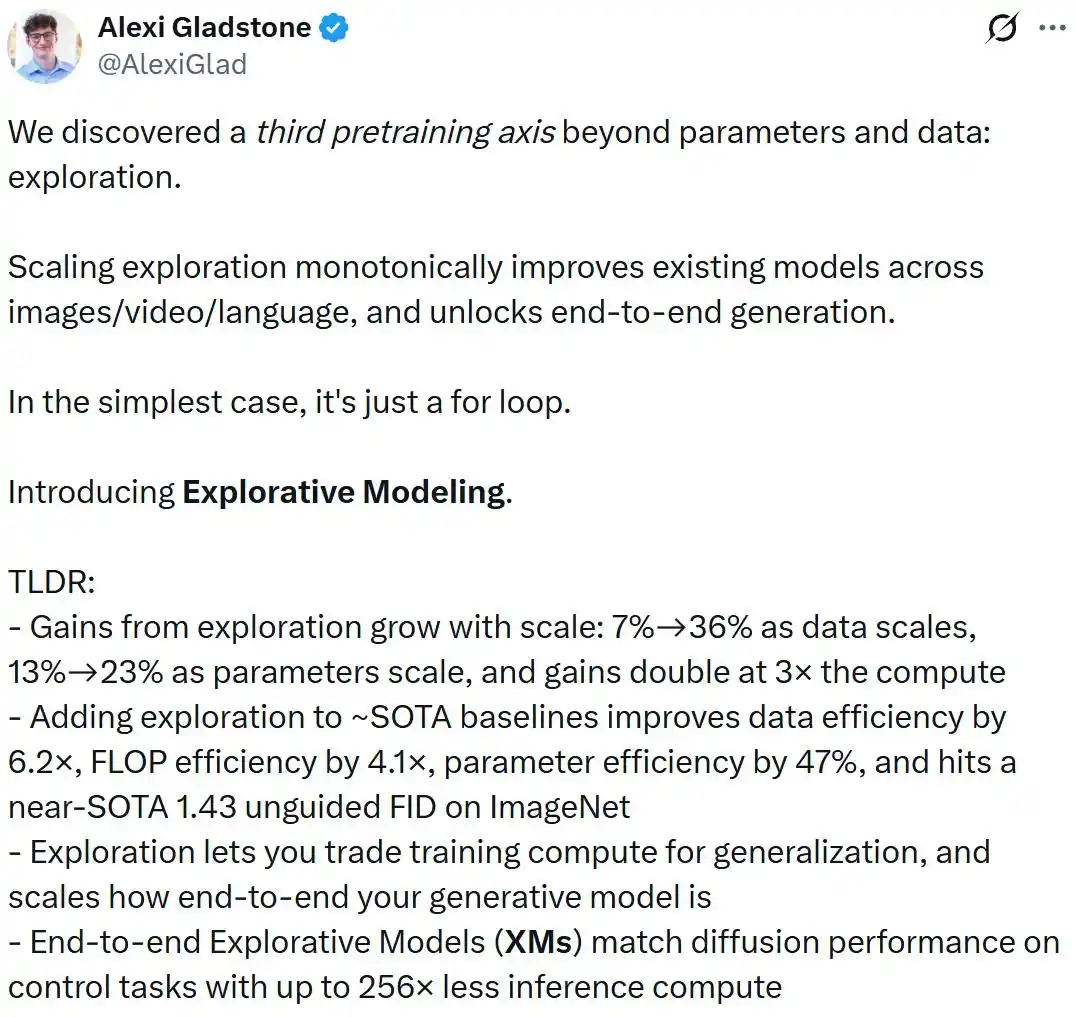
The authors named this new paradigm Explorative Modeling, abbreviated as XM. Its idea is so simple it borders on naive, yet points to a bold conclusion: Beyond parameters and data, generative models actually have a third axis that can be scaled.
Project Website: https://explorative-modeling.github.io

Paper: https://arxiv.org/abs/2607.27372

Code Repository: https://github.com/alexiglad/XM

The Root Problem: Models Only Know How to "Take the Average"

To understand what this paper solves, one must first understand why generation is hard.

In ordinary supervised learning (e.g., classification), each input essentially has only one correct answer; the model learns a deterministic mapping.

But generation is different. When you ask a model to "generate a dog," there can be infinitely many correct answers. These valid outputs are the many modes (i.e., distinct peaks) within the data distribution. Generation is difficult precisely because it must capture all these modes simultaneously.

The trouble is, mainstream generative models are trained with reconstruction losses (e.g., squared error). When an input is paired with many different valid targets at random, the optimal solution for a reconstruction loss is the average of those targets. For most real-world data, this average does not lie on the data manifold but falls between modes, resembling none of them.

A figure in the paper illustrates this clearly: when asked to regress directly end-to-end without any tricks, three clusters of points would be predicted as a single point in the middle, a photo of a dog would blur into a smudge, and a sentence would degenerate into endless repetitions of "the." This is "mode blurring," where the optimal solution is precisely the answer least resembling real data.
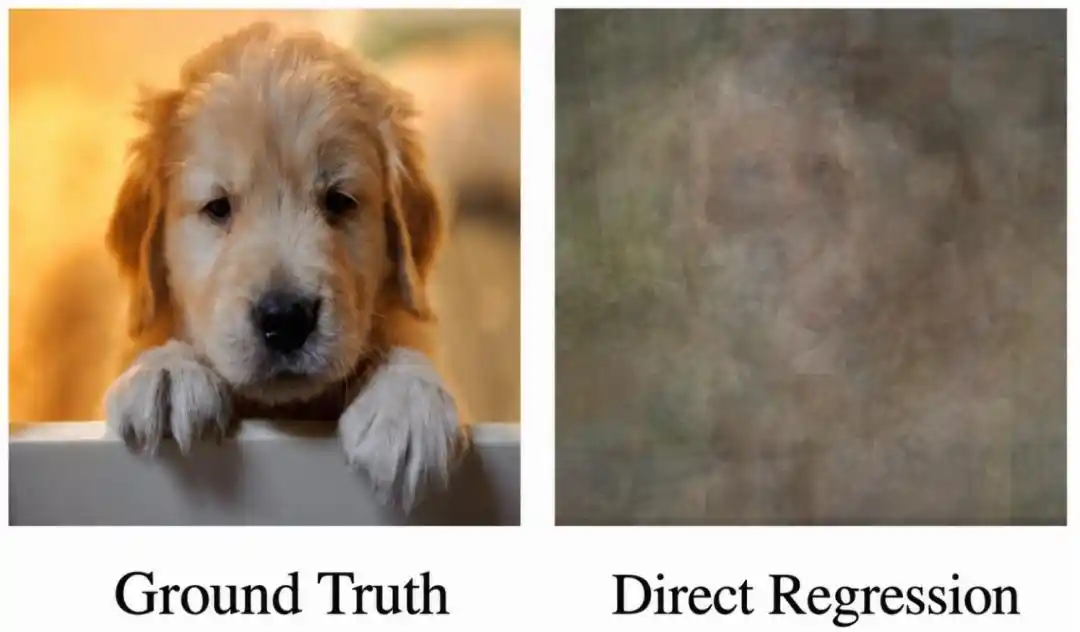
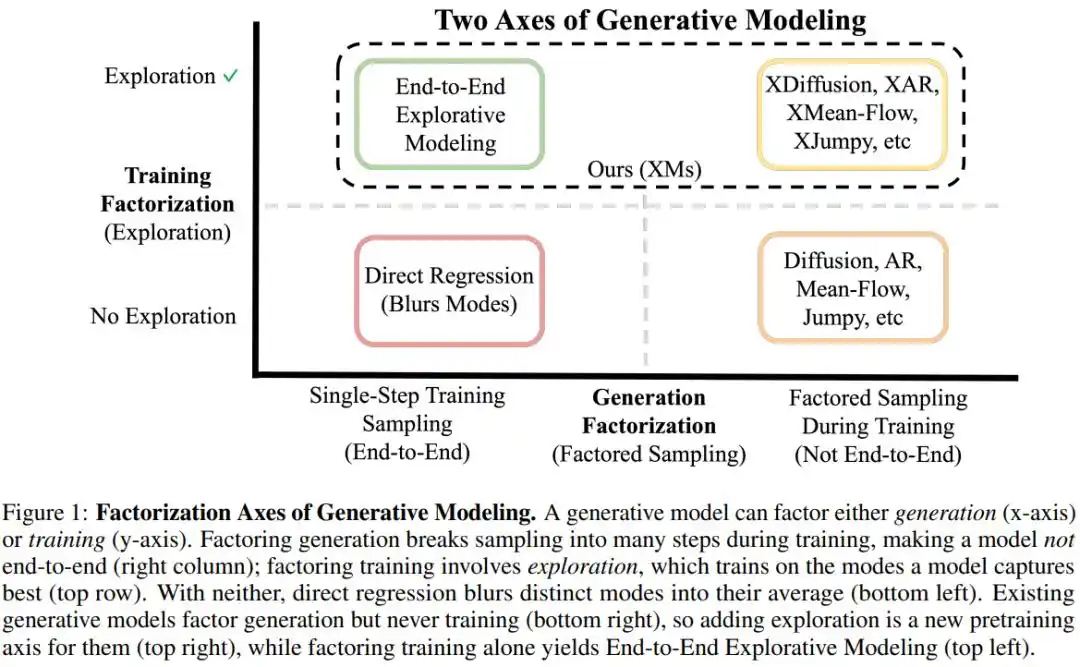
How do existing models circumvent this? By breaking the "generation" process into tiny pieces. Autoregressive models predict only one element at a time; diffusion models remove a little noise at each step. Each small-step target is sliced until it contains essentially a single mode, preventing the reconstruction loss from averaging.

This strategy of "splitting the generative process" is precisely why diffusion and autoregressive models can produce high-quality samples, but it is also why they cannot be end-to-end.

The authors thus pose a crucial question: A generative model has only two things that can be broken down—how it generates and how it trains.

Since breaking the generation process destroys end-to-end capability, why not break the training instead?
A For Loop: The Entire Essence of Explorative Modeling

Explorative Modeling breaks down the training loop itself.

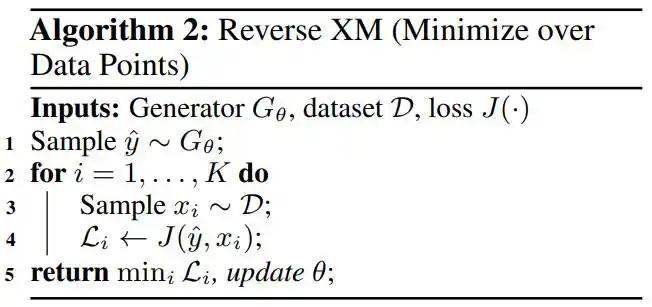
Its mechanism can be stated in one sentence: In each training step, instead of generating one sample to fit the target, the model generates K candidates and then selects only the one closest to the real data for training and gradient backpropagation. The paper implements this as a 3-5 line for loop, so simple it's almost suspicious (Algorithm 1).
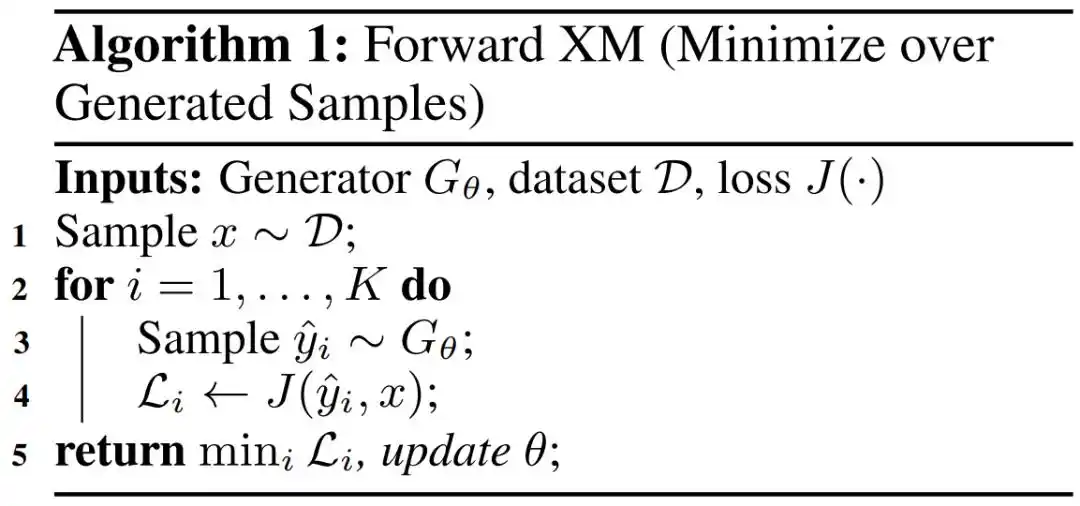
Why does this solve mode blurring?

Think of a real-life analogy: guessing dart landing positions. If you are only allowed one guess, your optimal strategy is to guess the average position of all darts—but that's often a spot on the board where few darts actually land. However, if you are allowed K guesses and are scored only on your closest guess, the optimal strategy immediately changes: you would spread your guesses, letting each cover a different cluster of landing points.
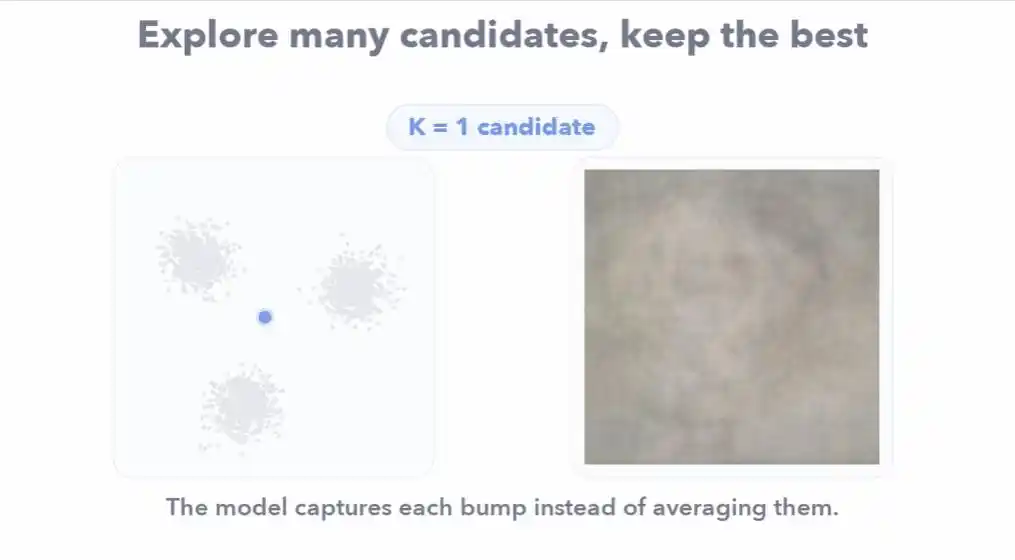
The model behaves similarly. When allowed to explore K candidates, different input noises will "claim" different modes, instead of all crowding towards the middle to take the average. The number of explorations directly determines how many modes the model can stably capture.
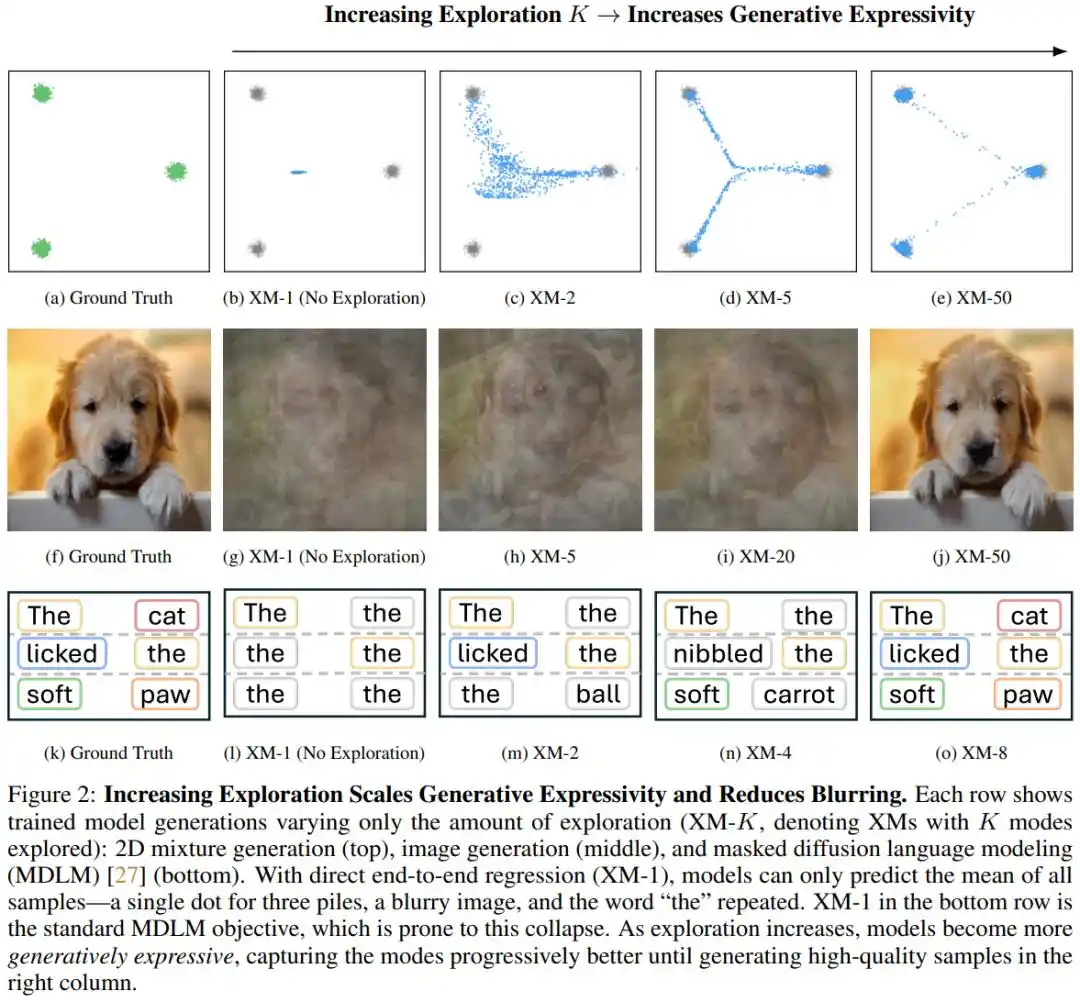
The authors name this long-overlooked capability "generative expressivity," noting that it is determined by the training objective itself—no matter how much you scale parameters and data, it won't increase on its own.

This also explains a phenomenon long observed in the field: why today's best models are so reliant on "guidance" techniques.

Classifier-free guidance essentially "pushes" the prediction away from that blurry average. But if the model itself weren't blurry, why push it? The usefulness of guidance stems precisely from the lingering disease of mode blurring.

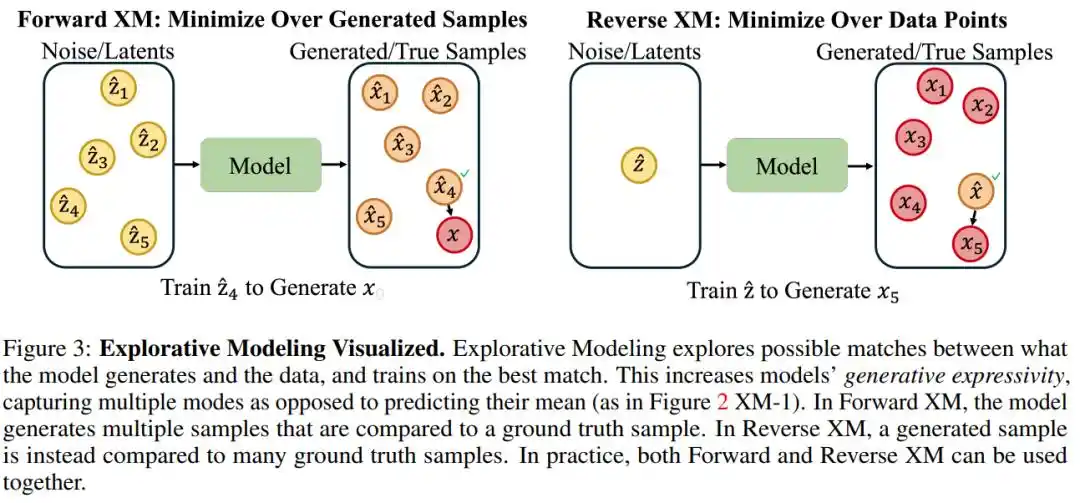
The paper also introduces Forward and Reverse exploration directions. Forward fixes a real target and searches among its own generations for the closest one, favoring "recall" (covering all modes). Reverse fixes a generation and searches among real data for the closest one, favoring "precision," and incurs almost no additional computational cost, at the risk of collapsing to a few modes. The two are complementary and can be used in combination.
The Third Axis: Greater Gains as You Scale

The most substantial conclusion of this paper is that it validates "exploration" as a genuine scaling axis.

The authors applied exploration to diffusion/flow models, Jumpy models, and even masked diffusion language models, observing consistent, monotonic performance improvements across image, video, and language modalities. More importantly, the trend of gains with scale: the bigger you go, the greater the benefit.

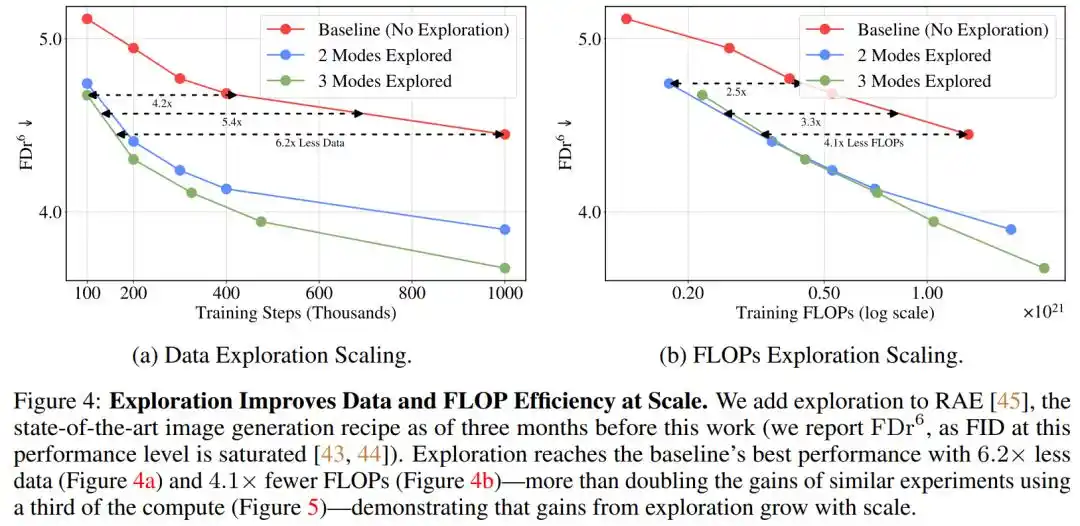
The numbers reported in the paper show: as data scale increases, gains from exploration rise from 7% to 36%; as model size grows, from 13% to 23%; when compute is tripled, efficiency gains more than double.

Specifically in efficiency, exploration improved FLOP efficiency by 4.1x, sample efficiency by 6.2x, and parameter efficiency by 47%. In image generation, it pushed the current strongest RAE formulation to an unguided FID of 1.43 on ImageNet, nearing the state-of-the-art.
A Large model exploring 5 modes can even outperform an XLarge model with 47% more parameters but no exploration.
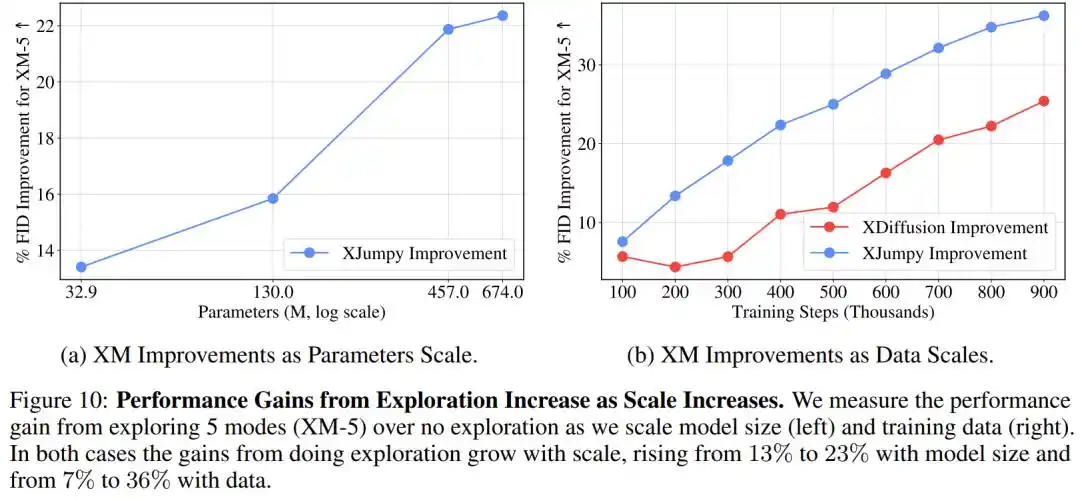
The implications of this trend are significant. The authors explain: at small scale, models are primarily bottlenecked by parameters and data; generative expressivity isn't the limiting factor yet. But once parameters and data are scaled to the point where they are "no longer the limit," generative expressivity increasingly becomes the real bottleneck. And that is exactly what exploration directly scales.

Considering that true foundation model training today uses roughly four orders of magnitude more compute than the largest experiment in this paper, the authors believe the reported numbers likely represent only a lower bound for the gains at larger scales.

Truly End-to-End Generation

If exploration is pushed to the extreme, what happens? The answer circles back to the opening suspense: Generative models can finally be end-to-end.

The authors used XM as a standalone end-to-end model for robot control tasks. In Behavior Cloning, their Explorative Policy matched or even surpassed Diffusion Policy (which requires 100 forward passes) using only a single network forward pass. In goal-directed world modeling, the Explorative World Model achieved better average performance than Diffuser, using 16 to 256 times less inference compute.
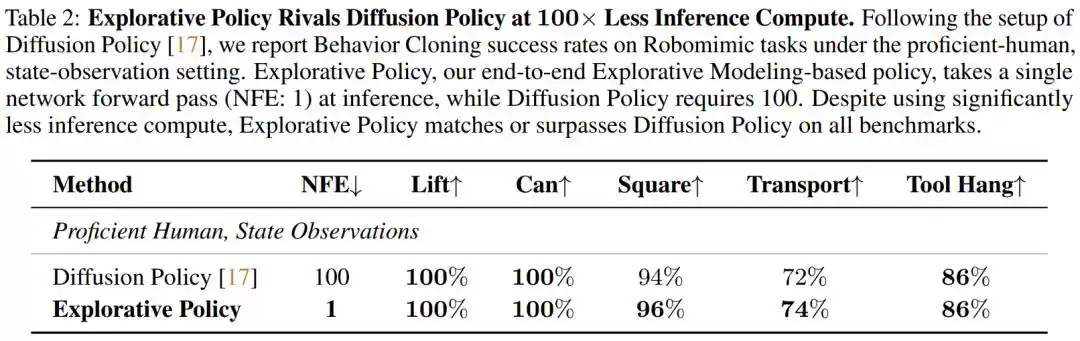
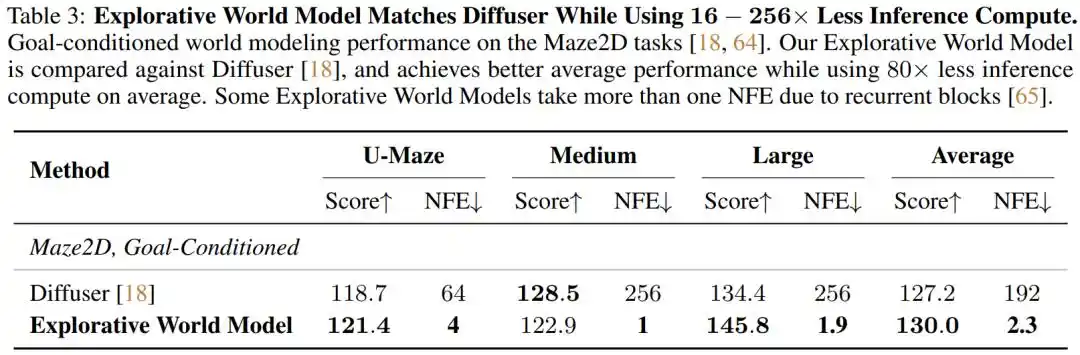
The source of this gap is clear: diffusion models trade hundreds of inference steps for expressivity, while end-to-end XM shifts this cost to exploration during training, allowing inference with just one forward pass. "Handling multi-modality"—the same thing—can be done either by breaking it down slowly during inference or by exploring it thoroughly once during training; this paper chooses the latter.

About the Authors

The first author of this paper, Alexi Gladstone, is not a newcomer. As recently as July 2025, his work on Energy-Based Transformers (EBT) sparked considerable discussion on social platforms.

That work claimed to "beat" the scaling curve of standard feedforward Transformers on multiple dimensions for the first time and attempted to generalize "System 2 thinking" to arbitrary modes. See the Machine Heart report: "New Paradigm Arrived! New Energy Model Breaks Transformer++ Scaling Limits, Training Scaling Rate 35% Faster."
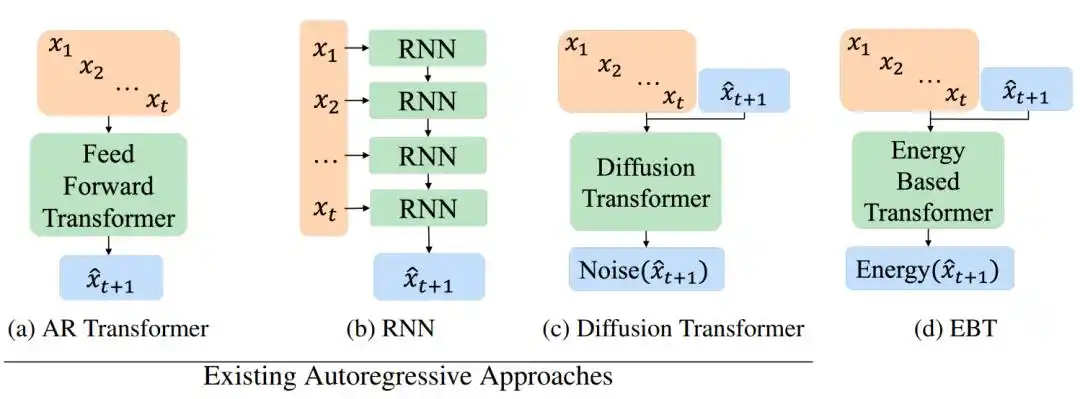
Explorative Modeling aligns with his consistent line of thinking: questioning "whether a model can, through some form of search or exploration, achieve what a single forward pass cannot." Furthermore, this paper builds upon another theory, Mode Forcing, by him and his collaborators (Yilun Du and Heng Ji). The paper candidly states that because of that prior theoretical foundation, most of XM's results were theoretically predicted first and then experimentally verified, which is relatively rare in the deep learning field, where the norm is often "run experiments first, explain later."
The authors are also frank about limitations: the best-of-K idea itself is not new and has been tried many times before; their real contribution is clarifying what this simple loop actually does: it directly amplifies generative expressivity without breaking down the generative process.

Additionally, autoregressive language models remain the toughest challenge, and pure end-to-end Forward XM is still too expensive for highly multi-modal distributions (like image generation), leaving room for future work.

For over a decade, we've grown accustomed to tuning generative models with two knobs: making them bigger and feeding them more data.

The third knob proposed in this paper is remarkably simple: let the model guess multiple times and keep only the best one. But if the trend it reveals holds true, then as scale continues to expand, the first two knobs will eventually be maxed out, while the third has only just begun to turn.

Reference Links

https://x.com/AlexiGlad/status/2083230922196107288

This article is from the WeChat public account "Machine Heart" (ID: almosthuman2014), author: Panda


Трендовые криптовалюты

Связанные с этим вопросы

QWhat is the core idea behind 'Explorative Modeling (XM)' as described in the article?

AThe core idea is to modify the training loop by having the model generate K candidate samples for each training step and then backpropagate gradients only from the candidate closest to the real data. This simple 'best-of-K' for-loop strategy helps the model capture multiple modes of the data distribution, solving the 'mode blurring' problem that plagues direct end-to-end generative modeling.

QAccording to the article, what is the 'third axis' for scaling generative models introduced by Explorative Modeling?

AThe 'third axis' is 'generative expressivity,' which is the inherent ability of a model to capture multiple modes in a data distribution. The paper argues that this expressivity is determined by the training objective itself and does not automatically scale with more parameters or data. Explorative Modeling directly amplifies this axis by increasing the exploration factor K during training.

QWhat problem do current powerful generative models (like autoregressive and diffusion models) have that prevents them from being truly end-to-end?

ACurrent powerful generative models are not truly end-to-end because they train to predict only 'one small step' (e.g., the next token or a denoising step), but during inference, they must unroll this step hundreds or thousands of times iteratively. This creates a mismatch between training and inference distributions, leading to the 'exposure bias' problem where errors accumulate step-by-step.

QWhat key advantage does an end-to-end Explorative Model (XM) demonstrate in the robotics control tasks mentioned in the article?

AIn robotics control tasks like Behavior Cloning, the Explorative Policy, using a single network forward pass, matched or exceeded the performance of Diffusion Policy, which required 100 forward passes. For goal-directed world modeling, the Explorative World Model achieved better average performance using 16 to 256 times less inference compute than a Diffuser model, highlighting its efficiency gains from shifting the computational cost from inference to training-time exploration.

QWho is the first author of the Explorative Modeling paper, and what was their related prior work mentioned in the article?

AThe first author is Alexi Gladstone. His related prior work is 'Energy-Based Transformers (EBT),' which claimed to surpass the scaling curves of standard feedforward Transformers across multiple dimensions. His research consistently explores how models can use search or exploration mechanisms to achieve what a single forward pass cannot.

Похожее

SEC и CFTC в один день подали иск против Goliath: Раскрыта криптопирамида на $400 млн, платформам, привлекающим клиентов высокими процентами, больше нет регуляторных лазеек

Авторы: Клод, Deep Wave TechFlow Компания Goliath Ventures, обещавшая инвесторам доход от комиссий в "криптовалютных пулах ликвидности", оказалась финансовой пирамидой, собравшей около $4 млрд с более чем 1300 человек. Соучредитель Кристофер Дельгадо присвоил не менее $51 млн на личные нужды. Комиссия по ценным бумагам и биржам (SEC) и Комиссия по торговле товарными фьючерсами (CFTC) США в один день подали гражданские иски против компании, демонстрируя скоординированный надзор за криптоиндустрией. Схема предлагала "гарантированную" ежемесячную доходность от 3% до 10%, финансируя выплаты старым инвесторам за счет новых вкладчиков. Реальных операций с криптоактивами не проводилось. К ноябрю 2025 года пирамида рухнула, когда приток новых средств прекратился. Дельгадо уже признал себя виновным по уголовным обвинениям в мошенничестве и отмывании денег и согласился на конфискацию активов. Однако инвесторам, вероятно, не удастся вернуть свои средства, общие потери которых оцениваются в $2.5 млрд. Одновременные действия SEC и CFTC сигнализируют о закрытии регуляторных лазеек для платформ, предлагающих нереалистично высокие гарантированные доходы.

marsbit10 мин. назад

SEC и CFTC в один день подали иск против Goliath: Раскрыта криптопирамида на $400 млн, платформам, привлекающим клиентов высокими процентами, больше нет регуляторных лазеек

marsbit10 мин. назад

Уолл-стрит начинает подвергать сомнению историю о ИИ от технологических гигантов

Уолл-стрит начал подвергать сомнению «историю ИИ» технологических гигантов, переходя от общих нарративов к детальному анализу финансовых и физических показателей. Хотя такие компании, как Google (Alphabet), Microsoft и NVIDIA, сообщают о сильном росте выручки и спроса на ИИ-услуги, инвесторы теперь сосредоточены на движении денежных средств и окупаемости огромных капиталовложений. Ключевым тревожным сигналом стало первое отрицательное значение свободного денежного потока (FCF) у Alphabet (-$58.55 млрд) из-за рекордных капитальных затрат ($449.24 млрд) на инфраструктуру ИИ, что привело к падению акций. В отличие от них, Microsoft, несмотря на высокие инвестиции, сохранила положительный FCF ($196 млрд) благодаря росту операционного денежного потока, что было позитивно воспринято рынком. Объявление NVIDIA о планах по привлечению $500 млрд стороннего капитала для финансирования инфраструктуры ИИ также было встречено с осторожностью. Рынок интерпретирует это как признак того, что затраты на ИИ становятся настолько высокими, что превышают внутренние финансовые возможности даже крупных технологических компаний. Аналитики сместили фокус с подтверждения спроса на ИИ на оценку скорости, с которой этот спрос превращается в реальные доходы, прибыль и денежные потоки, способные оправдать стремительные инвестиции. Сейчас Уолл-стрит использует показатель свободного денежного потока в качестве первого фильтра, чтобы отличить компании, которые могут финансировать рост за счёт собственных средств, от тех, кто может столкнуться с финансовым напряжением. Долгосрочная рентабельность капиталовложений в дорогую и быстро устаревающую инфраструктуру ИИ остаётся под вопросом.

marsbit14 мин. назад

Уолл-стрит начинает подвергать сомнению историю о ИИ от технологических гигантов

marsbit14 мин. назад

На рынок литографических установок ворвался неожиданный игрок

В 2026 году Илон Маск анонсировал проект TeraFab по производству чипов, нацеленный на обеспечение вычислительной мощности в 1 тераватт для SpaceX и Tesla. Позже появились сообщения о его возможном выходе на рынок фотолитографии через технологию FEL (свободный электронный лазер), которая рассматривается как потенциальная альтернатива доминирующей технологии EUV от ASML. FEL предлагает иной подход к созданию источника света для литографии по сравнению с текущим методом LPP в EUV-установках ASML. Он обладает потенциальными преимуществами: более высокая мощность (до 10 кВт), отсутствие загрязнения от олова и возможность работы в более коротком, «пограничном с рентгеновским» диапазоне длин волн (2–7 нм). Стартап xLight, поддержанный экс-гендиректором Intel Патом Гелсингером, активно развивает это направление. В статье рассматриваются три основных направления в индустрии фотолитографии. Первое — это постепенная эволюция технологии EUV от лидера рынка ASML, включая разработку дорогостоящих установок High-NA EUV. Второе — революция в источниках света (например, FEL), которая может позволить модернизировать существующие линии, меняя только источник. Третье — альтернативные, не-EUV технологии, такие как наноимпринт-литография (NIL) и электронно-лучевая литография (EBL), которые находят свою нишу. Выход Маска и развитие FEL бросают вызов устоявшимся правилам игры, где ASML долгое время был монополистом. Хотя преодоление пути от лабораторных разработок до массового производства остается сложной задачей, индустрия фотолитографии вступает в период потенциальных перемен.

marsbit14 мин. назад

На рынок литографических установок ворвался неожиданный игрок

marsbit14 мин. назад

Bitcoin Policy Institute призвал разработчиков ИИ предоставить защитникам криптоинфраструктуры доступ к передовым моделям

Институт биткоин-политики (BPI) предупреждает о рисках, которые передовые системы искусственного интеллекта (ИИ) представляют для безопасности криптоинфраструктуры. В открытом письме к разработчикам ИИ аналитики отмечают, что современные модели уже способны анализировать код, находить уязвимости и выполнять сложную техническую работу, и эти возможности могут быстрее попасть в руки злоумышленников, чем защитников открытого ПО. Под угрозой находятся кошельки, криптографические библиотеки, ПО узлов, биржи и платежные сети, причем атаки на цифровые активы могут приводить к быстрым финансовым потерям. BPI подчеркивает, что разработчики критически важного открытого ПО, такие как команда Bitcoin Core, не имеют доступа к самым мощным ИИ-моделям и специализированным инструментам кибербезопасности, которые доступны ведущим лабораториям и их партнерам. Чтобы снизить риски, Институт призывает ИИ-лаборатории создать программы доверенного доступа для квалифицированных разработчиков, защищающих открытую финансовую инфраструктуру. Предложения включают ранний доступ к мощным моделям, выделение вычислительных ресурсов для длительных проверок безопасности, защищенные среды для анализа кода, а также доступ для небольших команд и независимых исследователей. Цель — позволить защитникам находить и устранять уязвимости до того, как ими воспользуются злоумышленники. BPI также призывает криптоиндустрию помочь в определении надежных участников таких программ и координации реагирования на угрозы.

cryptonews.ru32 мин. назад

Bitcoin Policy Institute призвал разработчиков ИИ предоставить защитникам криптоинфраструктуры доступ к передовым моделям

cryptonews.ru32 мин. назад

Bitwise сократила 14% персонала на фоне спада крипторынка

Компания Bitwise Asset Management объявила о сокращении 14% персонала, или около 25 сотрудников, в связи со спадом на крипторынке. Численность штата снизилась со 180 до 155 человек, но конкретные затронутые подразделения не были названы. Генеральный директор Хантер Хорсли заявил, что данные меры подготовки компании к будущему росту рынка, который, по его мнению, будет обусловлен более глубокой интеграцией криптоактивов в мировую экономику. Bitwise является крупным провайдером биржевых продуктов, управляющим активами на сумму около $9 млрд, включая спотовый биткоин-ETF BITB с капиталом $2,3 млрд. Сокращения в Bitwise отражают общий тренд на консолидацию и оптимизацию расходов в криптоиндустрии, который также затронул и других крупных игроков, таких как Hashdex и Grayscale Investments.

cryptonews.ru32 мин. назад

Bitwise сократила 14% персонала на фоне спада крипторынка

cryptonews.ru32 мин. назад

Торговля

Спот

Популярные статьи

Как купить CORE

Добро пожаловать на HTX.com! Мы сделали приобретение CORE (CORE) простым и удобным. Следуйте нашему пошаговому руководству и отправляйтесь в свое крипто-путешествие.Шаг 1: Создайте аккаунт на HTXИспользуйте свой адрес электронной почты или номер телефона, чтобы зарегистрироваться и бесплатно создать аккаунт на HTX. Пройдите удобную регистрацию и откройте для себя весь функционал.Создать аккаунтШаг 2: Перейдите в Купить криптовалюту и выберите свой способ оплатыКредитная/Дебетовая Карта: Используйте свою карту Visa или Mastercard для мгновенной покупки CORE (CORE).Баланс: Используйте средства с баланса вашего аккаунта HTX для простой торговли.Третьи Лица: Мы добавили популярные способы оплаты, такие как Google Pay и Apple Pay, для повышения удобства.P2P: Торгуйте напрямую с другими пользователями на HTX.Внебиржевая Торговля (OTC): Мы предлагаем индивидуальные услуги и конкурентоспособные обменные курсы для трейдеров.Шаг 3: Хранение CORE (CORE)После приобретения вами CORE (CORE) храните их в своем аккаунте на HTX. В качестве альтернативы вы можете отправить их куда-либо с помощью перевода в блокчейне или использовать для торговли с другими криптовалютами.Шаг 4: Торговля CORE (CORE)С легкостью торгуйте CORE (CORE) на спотовом рынке HTX. Просто зайдите в свой аккаунт, выберите торговую пару, совершайте сделки и следите за ними в режиме реального времени. Мы предлагаем удобный интерфейс как для начинающих, так и для опытных трейдеров.

750 просмотров всегоОпубликовано 2024.03.29Обновлено 2026.06.02

Как купить CORE

Обсуждения

Добро пожаловать в Сообщество HTX. Здесь вы сможете быть в курсе последних новостей о развитии платформы и получить доступ к профессиональной аналитической информации о рынке. Мнения пользователей о цене на CORE (CORE) представлены ниже.

活动图片