With Two Consecutive Quarters of Losses, Coinbase Must Rely on Paths Beyond Trading

marsbitОпубликовано 2026-07-31Обновлено 2026-07-31

Введение

Coinbase posted its second consecutive quarterly net loss of $359 million on $1.22 billion in revenue for Q2, highlighting its vulnerability to crypto market cycles where weaker prices and lower volatility reduce user trading. However, the report also reveals a strategic shift in its business model. Despite a 25% quarter-over-quarter decline in global spot trading volume, Coinbase increased its market share to a company-record 10.3%. This suggests its position as a compliant U.S. on-ramp is strengthening even in a cooler market. A key development is the diversification of revenue streams. Transaction revenue fell to $599 million, nearly equaling subscription and services revenue of $555 million. Stablecoin services, generating $292 million, are becoming a crucial revenue "floor." This income, derived from interest on the $20 billion average USDC balance held on its platform, is less tied to daily trading activity. Furthermore, while spot trading volume dropped significantly, derivatives volume held steady at $1.03 trillion. Coinbase is pushing to integrate spot, stablecoin, and derivatives liquidity to create a more interconnected and sticky ecosystem for users. The GAAP net loss includes non-cash expenses like stock-based compensation and crypto asset valuation changes. Its adjusted EBITDA remained positive at $208 million for the 14th straight quarter, indicating core operations can cover ongoing costs. The company is also reducing expenses to manage the downturn. The ...

U.S. crypto trading platform Coinbase delivered an earnings report that's easy to misinterpret. In the second quarter, total revenue fell to $1.22 billion, with a GAAP net loss of $359 million. According to the earnings report supplement Coinbase filed with the U.S. Securities and Exchange Commission on July 30th, this marks the company's second consecutive quarter of net losses.

Looking solely at the income statement, the story seems familiar—the crypto cycle. Weak coin prices, declining volatility, reduced user trading, and consequently shrinking exchange revenue. But there's another narrative in this report. According to Coinbase's disclosure, its share of the crypto trading volume market rose to 10.3%, setting a new company-record high. In a receding quarter, it captured more traffic.

Coinbase's cyclicality hasn't disappeared; it's just that it no longer completely mirrors the cyclicality of spot trading. Market share, stablecoins, and derivatives are now splitting the company's revenue and liquidity sources into several distinct streams.

Why Does the Platform Grow Stronger as the Market Cools Down?
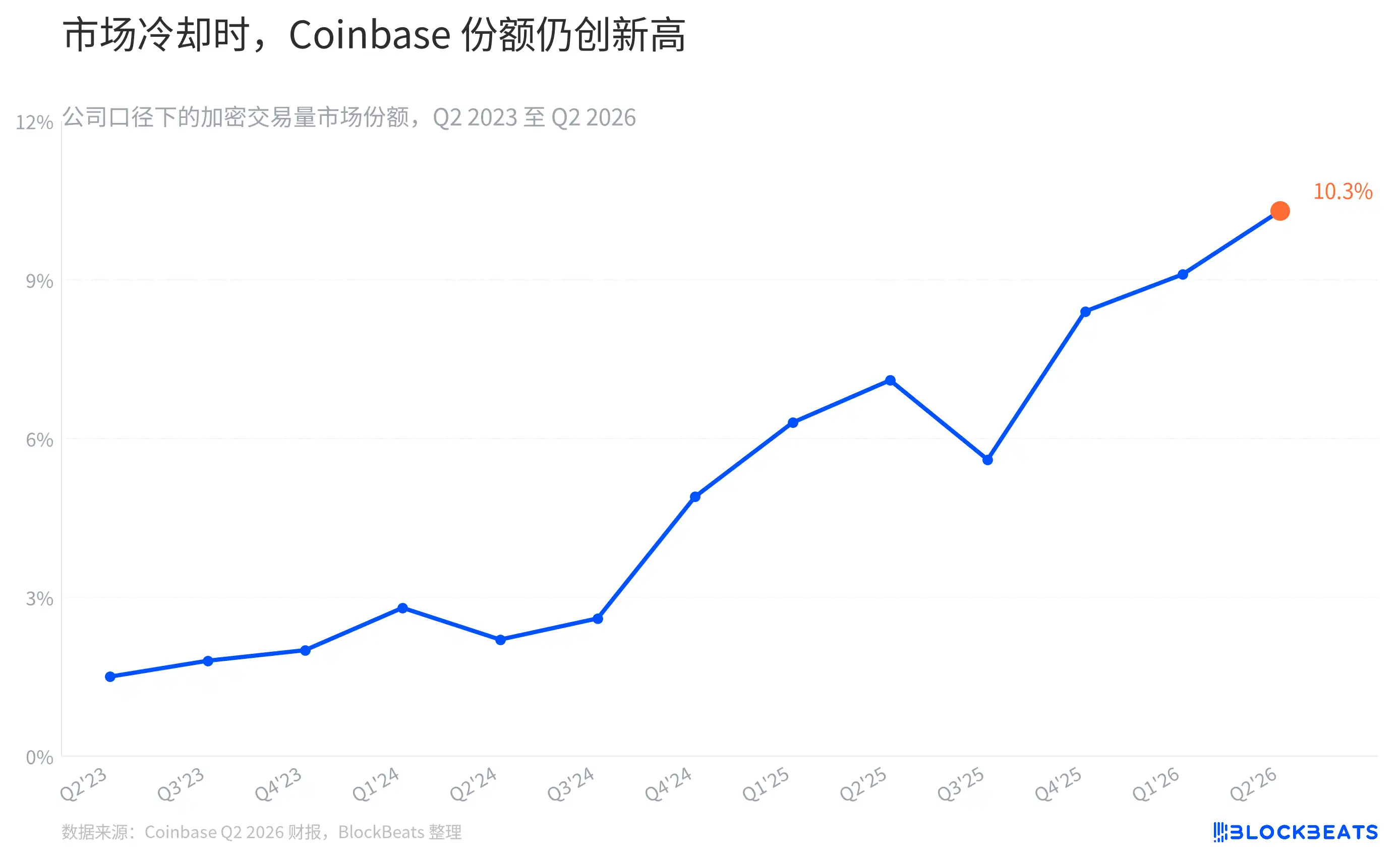
In the second quarter, the global crypto spot trading volume metric used by Coinbase fell 25% quarter-over-quarter. Yet, according to the company's earnings report, Coinbase's market share during the same period climbed from 9.1% in Q1 to 10.3%. Less revenue doesn't mean the platform's relative position has worsened.

Exchanges aren't fighting over a static pie. When the market is hot, retail investors flood in, and liquidity naturally thickens. When the market is dull, the users who remain test the platform's depth, product offerings, and compliant access channels. Coinbase's strongest tag has been its status as the compliant U.S. on-ramp. The current market share curve indicates this on-ramp is attracting a larger portion of trading activity.

However, this curve has its limits. Market share is Coinbase's internal calculation based on data from sources like CoinDesk Data, CoinMetrics, Dune, and Tardis, and includes stablecoin conversion activities. It's suitable for observing changes in its own competitiveness but should not be taken as the sole industry-wide market share standard.

What's Supporting Trading Revenue?
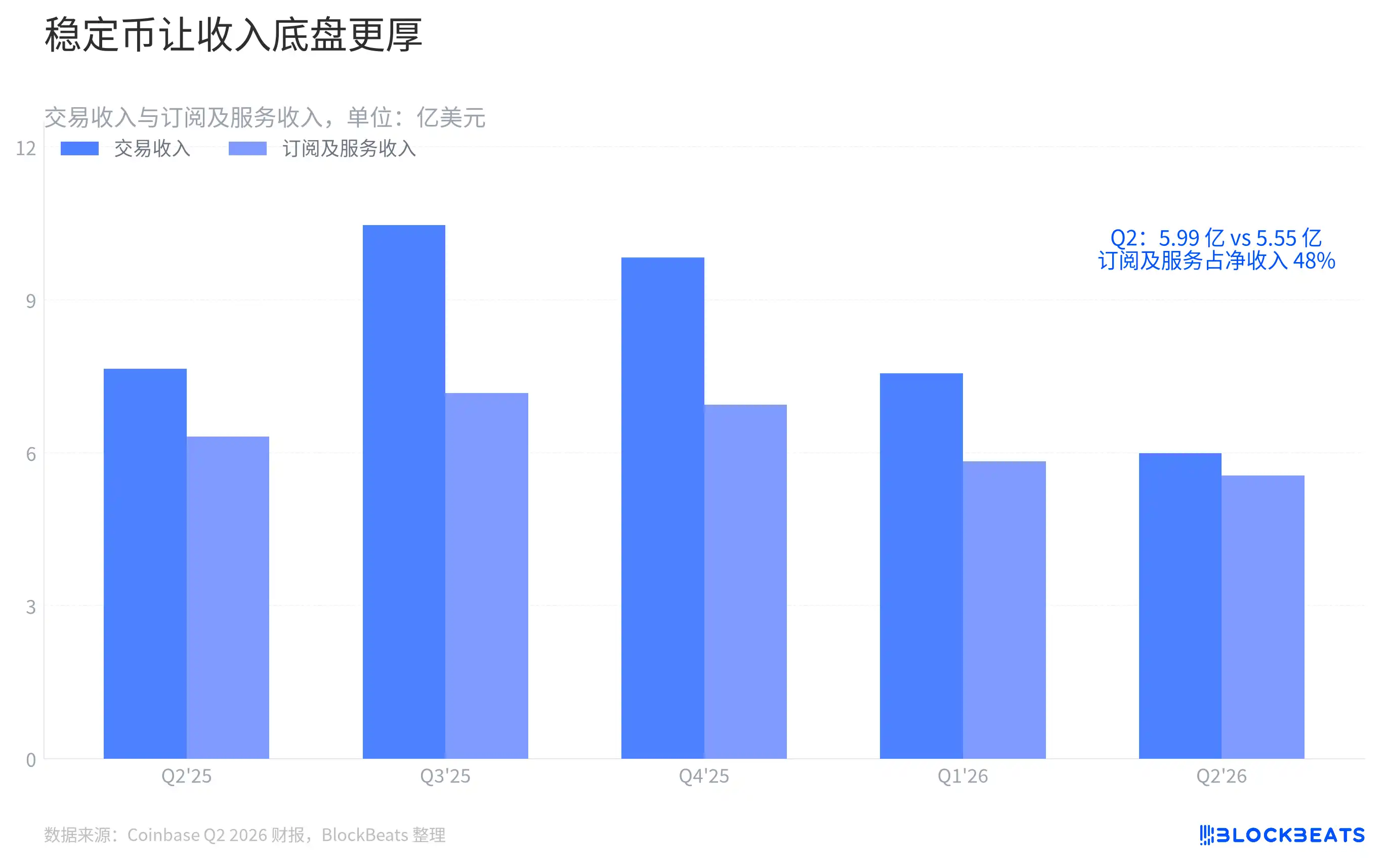
According to Coinbase's earnings report, second-quarter transaction revenue was $599 million, while subscription and services revenue was $555 million. The gap between them is now just a narrow sliver. In the past, transaction revenue was the primary beam that rose swiftly during bull markets. Now, subscription, custody, staking, interest, and stablecoin businesses are forming another layer of foundational income.

The largest portion comes from stablecoins. The company disclosed that stablecoin revenue this quarter was $292 million. Its logic differs from spot commission fees. When users hold USDC within Coinbase's products, the platform can share in the interest from reserve assets and partnership proceeds. A transaction commission is one-time. Stablecoin balances remain, generating returns on a daily basis.

This change is not abstract. The average USDC balance within Coinbase's products has risen to $20 billion. According to the company, over 30% of USDC's circulating supply was within its products at quarter-end. For the exchange, this is akin to turning wallets that were only opened during market rallies into accounts where funds can be parked.

This also explains why subscription and services revenue accounted for 48% of net revenue this quarter. This isn't to say Coinbase has become immune to coin price influences. Interest rate changes, fluctuations in USDC market cap, and user willingness to hold stablecoins will still impact this revenue line. However, its rhythm no longer needs to sync perfectly with spot trading volume.

After Spot Volume Shrinks, Where Does Liquidity Go?
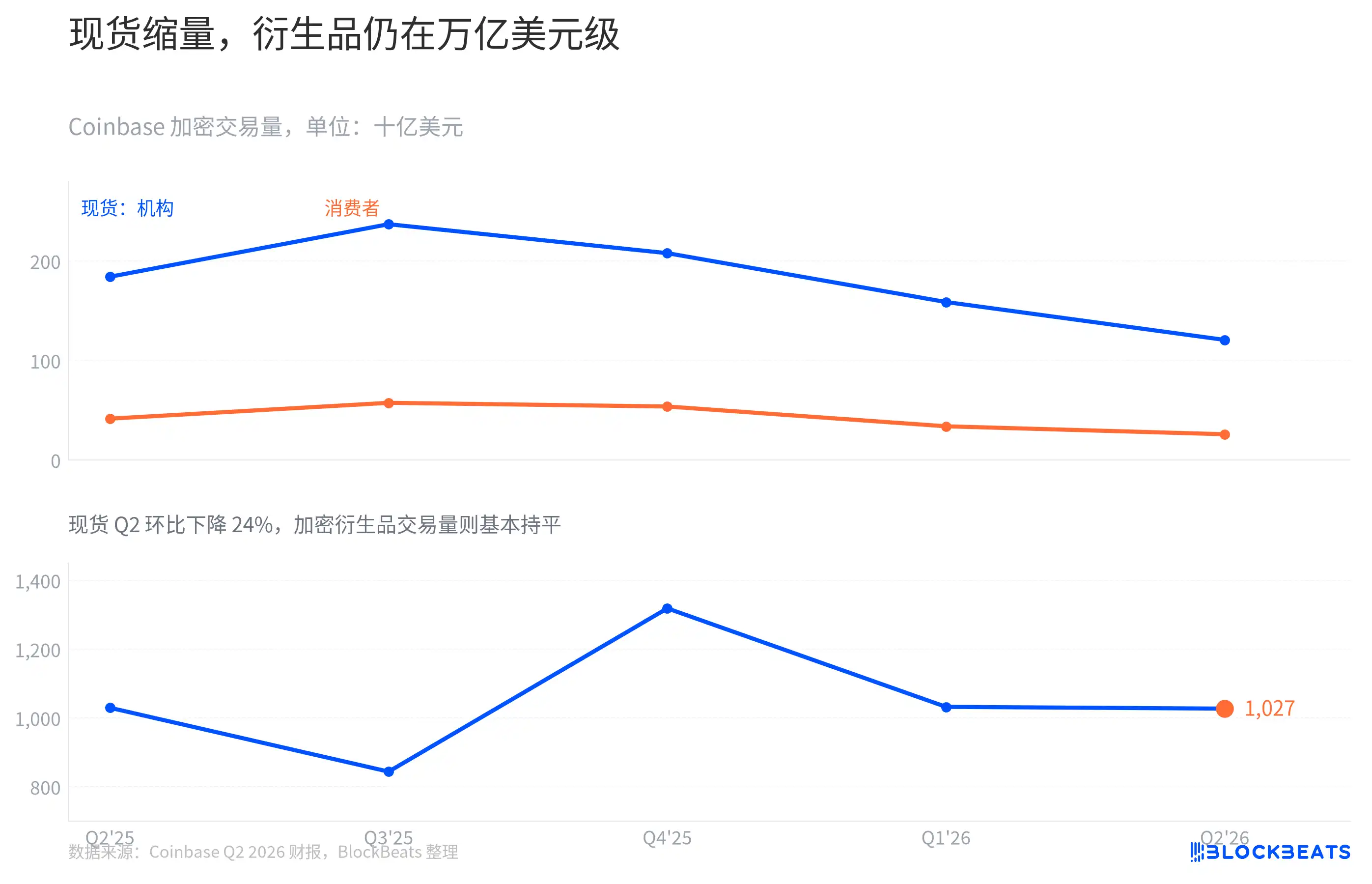
In the second quarter, Coinbase's crypto spot trading volume fell to $146.4 billion. Crypto derivatives trading volume remained at $1.03 trillion. According to the company's report, spot volume declined 24% quarter-over-quarter, while derivatives volume was largely flat.

This isn't a simple case of product substitution. Spot buying and selling are more akin to taking a directional bet on price, most likely to be postponed during low volatility. Derivatives serve purposes like leverage, hedging, and cross-market position adjustments; professional traders don't exit completely just because the market is quiet. Their trading volumes also can't be used directly to extrapolate revenue; derivatives are reported as notional amounts, and their fee structures and revenue recognition logic differ from spot.

Coinbase repeatedly emphasized global perpetual contracts, U.S. compliant access, and Deribit integration in its report. Its goal isn't just to add a derivatives tab next to the spot page; it's to enable one piece of collateral to support more trading needs. Once a platform can connect spot, stablecoins, and derivatives to the same pool of liquidity, the cost for users to leave is no longer just downloading another app.

Net Loss—Where Exactly Is the Loss?
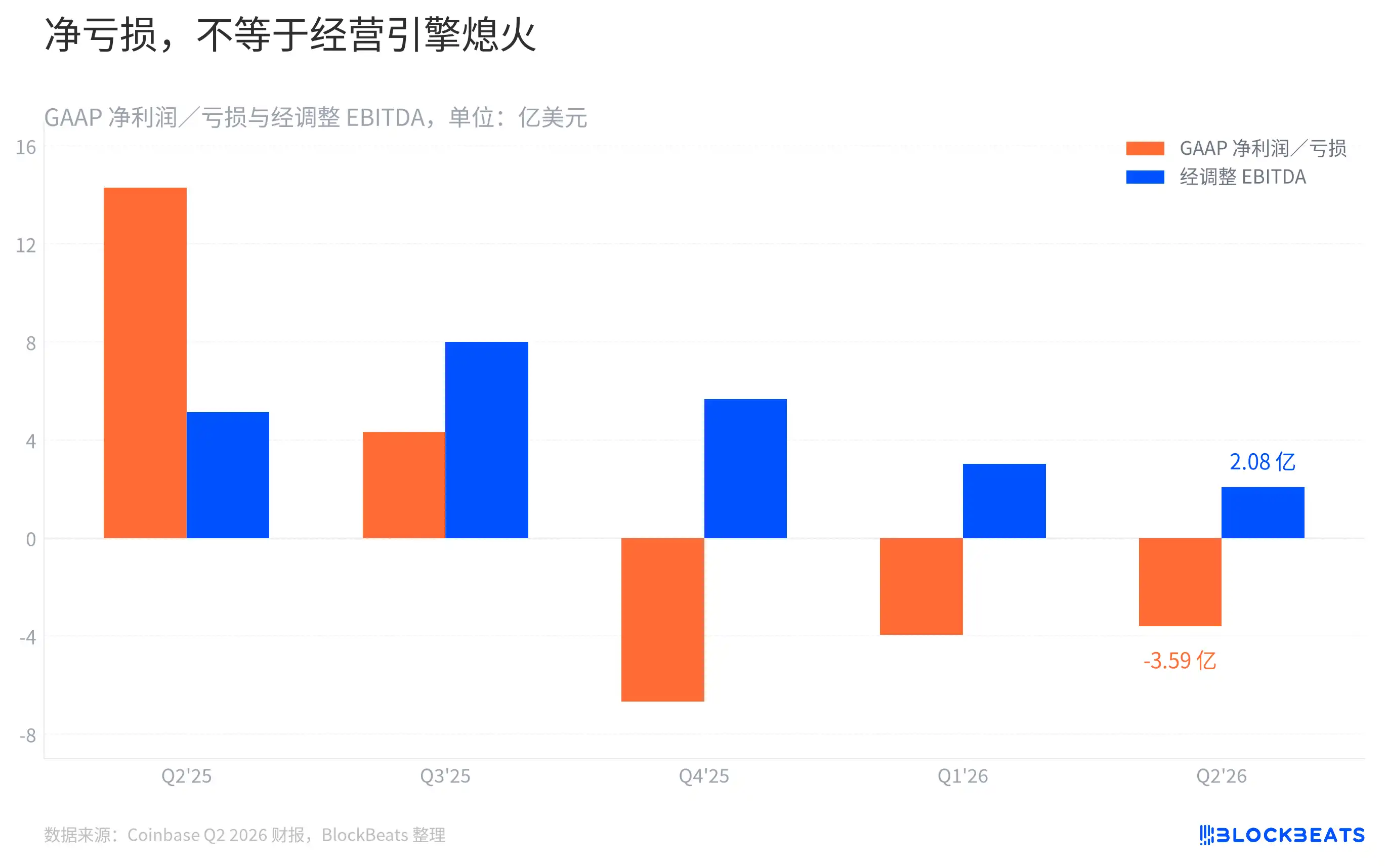
The GAAP net loss of $359 million this quarter is of course a real result. However, according to Coinbase's report, adjusted EBITDA for the same period remained positive at $208 million and has been positive for 14 consecutive quarters. The gap between these two bars is precisely what's most easily overlooked when reading the earnings report.

The GAAP income statement includes fair value changes of crypto asset investments, investment gains/losses, restructuring charges, and stock-based compensation in the current period's results. Adjusted EBITDA removes several of these items. It's a more direct gauge of whether operational activities can cover day-to-day costs in the period, but it's not an alternative scorecard to replace net profit.

According to the company's disclosure, the operating loss this quarter was $113 million, indicating that the decline in transaction revenue is still weighing on the profit side. Adjusted expenses decreased 9% quarter-over-quarter, and the full-year guidance for adjusted expenses was narrowed to $4.20 billion - $4.45 billion. Controlling expenses can reduce bleeding during low-volatility periods, but it cannot replace the validation of new revenue streams.

This is the real question left by Coinbase's earnings report. It has already proven it can gain market share even as the market cools and has stablecoins and derivatives keeping the platform afloat. The next time market trading volume declines, readers should watch not just how much revenue falls, but whether these new streams can continue channeling water into the same account.


Трендовые криптовалюты

Связанные с этим вопросы

QAccording to the article, what were the main financial results for Coinbase in Q2?

AIn Q2, Coinbase reported total revenue falling to $1.22 billion and a GAAP net loss of $359 million, marking its second consecutive quarter of net loss.

QDespite a market downturn, what key competitive metric improved for Coinbase according to its internal calculations?

ACoinbase's share of global crypto spot trading volume (as calculated by the company) rose to 10.3% in Q2, a new record high under its methodology.

QWhat is the primary revenue driver for Coinbase's 'Subscriptions and services' income, specifically from stablecoins?

AThe primary driver is USDC. Coinbase earns interest and partnership revenue by holding USDC reserves for users. This income stream is based on the average balance held ($20 billion in Q2), not on transaction commissions.

QHow did trading activity in spot markets versus derivatives markets differ for Coinbase in Q2, and what does the article suggest is the reason?

ASpot trading volume fell 24% to $146.4 billion, while derivatives volume remained roughly flat at $1.03 trillion. The article suggests derivatives are less sensitive to low volatility as they serve needs like hedging and leverage for professional traders who remain active even in quiet markets.

QWhat is the key difference between Coinbase's GAAP net loss and its Adjusted EBITDA for Q2, and what does this indicate about its core operations?

AThe GAAP net loss of $359 million includes items like investment gains/losses and stock-based compensation. Adjusted EBITDA, which was positive at $208 million, excludes these to show that its core business operations were still generating cash to cover ongoing costs for the 14th consecutive quarter.

Похожее

Распространяются слухи об альткоине: бывшие сотрудники высказываются по этому поводу

Платформа для обмена мем-токенами Pump.fun на основе Solana проводит увольнения сотрудников перед разблокировкой их токенов $PUMP. По данным Sandmark, увольнения начались примерно за два месяца до запланированного релиза токенов, при этом как минимум один бывший сотрудник лишился доли токенов стоимостью свыше $1 млн по текущим ценам, так как был уволен до их разблокировки. Согласно внутренним документам, в начале апреля компания расторгла контракты с рядом сотрудников, предложив им выходное пособие. Сообщается, что в середине июля прошла вторая волна увольнений, а общее число уволенных за два месяца превысило 40 человек. Посты в соцсетях от имени бывших сотрудников утверждают, что некоторые были уволены буквально за день до разблокировки токенов. Основатели Pump.fun Ноа Твиддейл и Алон Коэн не прокомментировали ситуацию. Несмотря на падение цены $PUMP примерно на 79% с пика 2025 года, платформа остается одной из самых прибыльных в криптосекторе с общим доходом около $1,3 млрд и ежедневной выручкой порядка $1 млн.

cryptonews.ru1 ч. назад

Распространяются слухи об альткоине: бывшие сотрудники высказываются по этому поводу

cryptonews.ru1 ч. назад

На Ethereum сформировалась 43-дневная очередь на стейкинг: но, по мнению одного эксперта, это не является настоящим бычьим сигналом

Резкий рост числа желающих стать валидаторами Ethereum привел к образованию очереди на активацию в ~2,5 млн ETH, что означает ожидание около 43 дней. Однако, как отмечает эксперт Томас Бруннер из Sygnum Bank, эту очередь не следует считать однозначным бычьим сигналом. Технические ограничения протокола после обновления Dencun, а также новые функции обновления Pectra (например, пополнение существующих валидаторов) также вносят вклад в формирование очереди, и не весь объем ETH в ней представляет собой спрос новых инвесторов. Более важным индикатором, по мнению Бруннера, является практически пустая очередь на вывод средств, что свидетельствует о доверии и удержании позиций существующими участниками. Несмотря на ослабление цены ETH, институциональный интерес к стейкингу сохраняется, однако его росту мешают вопросы конфиденциальности, так как операции валидаторов и депозиты публично отслеживаются в блокчейне. В настоящее время в стейкинге находится около 41,2 млн ETH, или примерно 33,8% от общего объема в обращении.

cryptonews.ru2 ч. назад

На Ethereum сформировалась 43-дневная очередь на стейкинг: но, по мнению одного эксперта, это не является настоящим бычьим сигналом

cryptonews.ru2 ч. назад

Банк Кореи рассказал о результатах тестирования токенизированных депозитов

Банк Кореи сообщил об успешных результатах пилотного тестирования системы токенизированных депозитов. В проекте приняли участие 28 центральных банков и международные финансовые организации, а также крупнейшие южнокорейские коммерческие банки, включая KB Kookmin Bank, NH NongHyup Bank, Shinhan Bank, Woori Bank и Hana Bank. В ходе испытаний было совершено 30 транзакций в 17 различных сценариях, включая корпоративные и межбанковские переводы в шести валютах (корейская вона, доллар США, евро и другие). Общая сумма операций составила около 800 000 швейцарских франков. Полный процесс расчетов, от платежного поручения до финального расчета, занимал в среднем одну минуту 20 секунд, при этом сама стадия окончательного расчета — около 80 секунд. Платформа работала стабильно, обеспечивая быстрые и прозрачные расчеты даже в условиях частичной интеграции с действующей банковской инфраструктурой. Кроме того, были успешно проведены тестовый внутренний перевод на 20 млн вон между банками NH NongHyup и Shinhan через платформу Project Agora, а также кросс-граничные платежи между южнокорейским KB Kookmin Bank и японским MUFG Bank с использованием депозитных токенов. Эти токены представляют собой цифровые сертификаты, выпускаемые банками в рамках пилота, и не являются прямой эмиссией центрального банка. Банк Кореи планирует продолжать тестирование платежей с депозитными токенами. Напомним, что в прошлом году власти страны объявили о намерении ужесточить регулирование стейблкоинов, номинированных в воне, для выпуска которых потребуется разрешение ЦБ и Комиссии по финансовым услугам (FSC).

cryptonews.ru2 ч. назад

Банк Кореи рассказал о результатах тестирования токенизированных депозитов

cryptonews.ru2 ч. назад

Глава крупного майнера оценил доходность от ИИ в десять раз выше майнинга

Глава канадской майнинговой компании HIVE Digital Technologies Фрэнк Холмс заявил об ускоренном развитии направления вычислений для искусственного интеллекта (ИИ). Он отметил, что доходность от ИИ-вычислений значительно превышает традиционный майнинг: один GPU Nvidia H100 приносит около $2 в час, что примерно в десять раз больше, чем прибыль от ASIC-майнеров ($0,12–0,14 в час). В связи с этим доля ИИ в выручке HIVE, по его прогнозам, вырастет с 10% до более 50% уже в текущем году. Многие крупные майнеры, включая Riot Platforms, Cipher Digital, MARA и TeraWulf, минимизируют убытки, переходя или совмещая добычу криптовалют с поддержкой ИИ-вычислений. Например, MARA Holdings недавно инвестировала $600 млн в площадку для дата-центров, ориентированных на обе задачи. При этом модель традиционного майнинга становится всё менее рентабельной. По оценкам, себестоимость добычи одного биткоина к лету 2026 года составит около $78 тыс., что выше текущей рыночной цены. Глава MARA ранее предупреждал, что без роста цены биткоина минимум на 50% в год майнинг станет убыточным, что уже вынуждает некоторых операторов отключать оборудование при росте сложности сети.

cryptonews.ru2 ч. назад

Глава крупного майнера оценил доходность от ИИ в десять раз выше майнинга

cryptonews.ru2 ч. назад

Торговля

Спот

Популярные статьи

Как купить T

Добро пожаловать на HTX.com! Мы сделали приобретение Threshold Network Token (T) простым и удобным. Следуйте нашему пошаговому руководству и отправляйтесь в свое крипто-путешествие.Шаг 1: Создайте аккаунт на HTXИспользуйте свой адрес электронной почты или номер телефона, чтобы зарегистрироваться и бесплатно создать аккаунт на HTX. Пройдите удобную регистрацию и откройте для себя весь функционал.Создать аккаунтШаг 2: Перейдите в Купить криптовалюту и выберите свой способ оплатыКредитная/Дебетовая Карта: Используйте свою карту Visa или Mastercard для мгновенной покупки Threshold Network Token (T).Баланс: Используйте средства с баланса вашего аккаунта HTX для простой торговли.Третьи Лица: Мы добавили популярные способы оплаты, такие как Google Pay и Apple Pay, для повышения удобства.P2P: Торгуйте напрямую с другими пользователями на HTX.Внебиржевая Торговля (OTC): Мы предлагаем индивидуальные услуги и конкурентоспособные обменные курсы для трейдеров.Шаг 3: Хранение Threshold Network Token (T)После приобретения вами Threshold Network Token (T) храните их в своем аккаунте на HTX. В качестве альтернативы вы можете отправить их куда-либо с помощью перевода в блокчейне или использовать для торговли с другими криптовалютами.Шаг 4: Торговля Threshold Network Token (T)С легкостью торгуйте Threshold Network Token (T) на спотовом рынке HTX. Просто зайдите в свой аккаунт, выберите торговую пару, совершайте сделки и следите за ними в режиме реального времени. Мы предлагаем удобный интерфейс как для начинающих, так и для опытных трейдеров.

983 просмотров всегоОпубликовано 2024.03.29Обновлено 2026.06.02

Как купить T

Обсуждения

Добро пожаловать в Сообщество HTX. Здесь вы сможете быть в курсе последних новостей о развитии платформы и получить доступ к профессиональной аналитической информации о рынке. Мнения пользователей о цене на T (T) представлены ниже.

活动图片