Stock Trading Has Become 'Crypto Trading', Welcome Back to the Native Home

marsbitОпубликовано 2026-07-30Обновлено 2026-07-30

Введение

"Stock Trading Becomes 'Coin Trading': A Market's Bizarre Reversal" The global stock market, particularly in tech sectors, is undergoing a radical transformation, increasingly mirroring the volatile, narrative-driven mechanics of the cryptocurrency world. This shift was starkly illustrated by the dramatic crash of South Korea's KOSPI index in July 2026, where leveraged ETFs tied to stocks like SK Hynix triggered massive, rapid liquidations, devastating hundreds of thousands of retail investors, many of them young. This "crypto-fication" of equities began as disillusioned cryptocurrency traders migrated to stock markets, bringing with them their speculative playbook: chasing high-beta narratives like AI and semiconductor cycles, relying on social media for investment cues, and employing heavy leverage. Ironically, while these traders sought the perceived safety of stocks with fundamentals, their methods turned parts of the equity market—especially in Korea, the US, and Japan—into arenas of extreme speculation. Stocks like SK Hynix experienced price collapses ("halving") in just over a month, a pace even faster than Bitcoin's historical crashes. The core of this change is the primacy of narrative over traditional valuation. Complex company analysis is reduced to viral slogans about AI's infinite demand, driving concentrated inflows into thematic sectors. This is amplified by leverage, particularly through risky single-stock leveraged ETFs, which create vicious cycles of forc...

Author: Dou Wan Le

July 13, 2026, Seoul.

The Korea Composite Stock Price Index (KOSPI) plummeted 8.95% in a single day, triggering its 7th trading halt of the year. SK Hynix, seen by Koreans as a "national destiny stock," plunged 15.37%, a drop not seen in nearly two decades. Samsung Electronics also fell over 10%.

Over 1.2 million leveraged accounts received margin calls, with broker systems automatically liquidating between 320,000 to 460,000 accounts. Even more heartbreaking, 62% of those wiped out were young people aged 20 to 30. Some lost their down payment for a home, others traded with borrowed money...

A man in his 20s in Busan, after losing money following a stock YouTuber's recommendation, stabbed the influencer with a knife.

In the past, these descriptions would likely have been used for scenes after a crypto market crash. Now, they are being reenacted in the markets of South Korea, the United States, and Japan following the tech stock downturn.

Sharp rises and falls are just the surface. What's truly changing is the pricing method: narrative outweighs valuation, leverage amplifies sentiment, and social media rapidly pushes consensus to extremes.

Global stock markets, especially tech stocks, are becoming more and more like the crypto sphere.

Returning to the Native Home

"Welcome back to the native home."

After the crash, crypto traders who had switched to stocks wrote numerous posts about their losses. Comments like the above were everywhere.
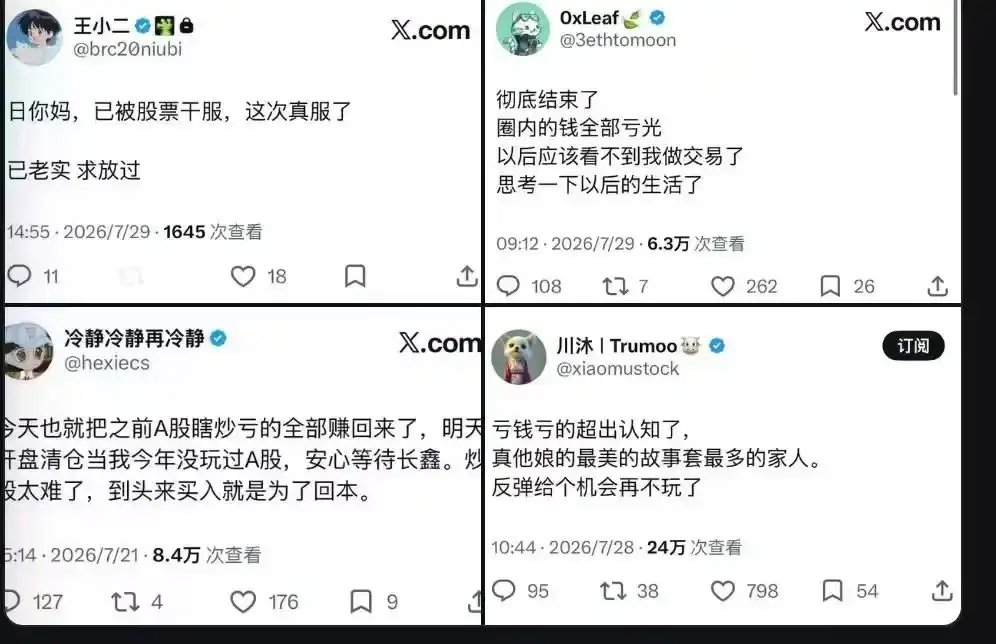
This "native home" refers to cryptocurrency. From the second half of 2025 to early 2026, a grand "departure from the native home" unfolded in the crypto world.

A group of KOLs and veterans who had been in the crypto market for years began losing confidence. Bitcoin was range-bound with low trading volume, meme coins were repeatedly harvested. Many felt "the scene is boring" and started turning their attention to US stocks.

This choice seemed very reasonable.

Stocks have revenue, profits, financial reports, and SEC regulation. Compared to crypto projects lacking cash flow and relying entirely on consensus pricing, US stocks at least seemed like a more mature, safer asset class.

The traders brought not just liquidity, but also their trading methods.

In the crypto market, they were accustomed to chasing new narratives, seeking high-volatility targets, using leverage, and rapidly switching positions based on social media sentiment. Entering the stock market, this method barely changed; only the trading objects switched from tokens to AI, memory chips, and leveraged ETFs, repeatedly achieving significant results.

Memory stocks quickly became the new collective consensus.

The logic wasn't complex: AI servers require more High Bandwidth Memory (HBM), supply can't meet demand, memory prices rise, so Micron, Samsung Electronics, and SK Hynix naturally become the most direct "shovel sellers." The phrase "there's never enough memory" became deeply ingrained.

Many crypto KOLs transformed, starting to talk about US stocks, memory cycles, and AI capital expenditures. Products like 2x leveraged ETFs on SK Hynix were also treated as "more efficient" betting tools than ordinary stocks.

Until the market reversed in July.

Bitcoin Becomes the "Low-Volatility Asset"

How long does it take to fall from peak to half?

Bitcoin took 268 days. Silver took 169 days for a similar magnitude of decline.

In contrast, SanDisk fell about 55% in just 36 days. SK Hynix fell about 53% in just 34 days.

Similarly "halving," Bitcoin took nearly nine months, while memory stocks took just over one month.
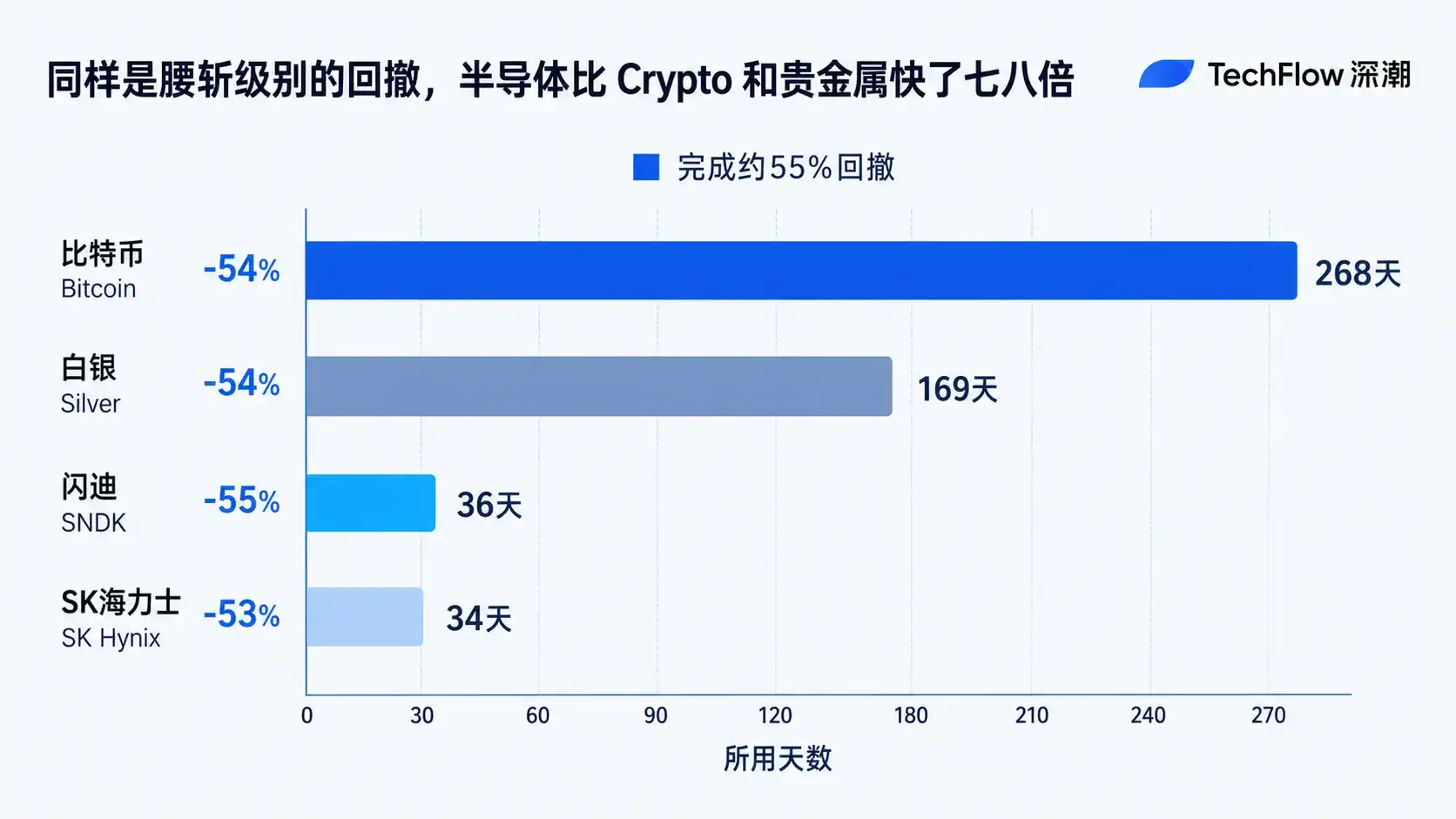
This is the perverse nature of this market cycle: In the past, investors worried Bitcoin would skyrocket or crash in days, while stocks adjusted slowly based on earnings and valuation. Now, some tech stocks are completing a full bubble burst in a shorter time than cryptocurrencies.

It's very counterintuitive. Compared to some tech stocks, Bitcoin is becoming relatively stable.

Charles Schwab statistics show Bitcoin's historical volatility in 2025 was about 42%, with a maximum drawdown of about 32%. Tesla's volatility in the same period was about 63% with a max drawdown of 48%, while Nvidia's volatility was about 50% with a max drawdown of 37%.

Bitcoin remains a high-risk asset, it's just that some large-cap tech stocks are even more volatile.

Bitwise even predicted in its 2026 outlook that Bitcoin's overall volatility might continue to be lower than Nvidia's.

So the current situation is quite absurd: Bitcoin is becoming more like tech stocks, while tech stocks are becoming more like Bitcoin.

When Narrative Becomes the Valuation Anchor

An old saying in crypto: Trading crypto is trading narratives.

In 2026, global tech stocks are turning this into reality.

AI is certainly not hot air. Nvidia, Microsoft, Google, and major cloud companies have real revenue and are investing real money building data centers.

But between "AI will indeed create value" and "any company associated with AI is worth buying at any price," there is a long road.

At the peak of the frenzy, the market simply skipped this road.

AI servers, optical modules, memory chips, data centers, power equipment, even nuclear energy companies—as long as they could be placed in the AI industrial chain, their stock prices could soar rapidly. Businesses were still in planning, orders not yet landed, but the market would price them based on the best-case scenario years in advance.

Korea's story was "AI semiconductors are tied to national destiny." As KOSPI kept hitting new highs, more families started opening stock accounts for their minor children, gifting them popular stocks like Samsung and SK Hynix as long-term presents.

A similar concentration appeared in the A-share market. In the first half of 2026, the TMT sector's market cap reached 41.78 trillion yuan, about 31.45% of the total A-share market cap; on some trading days, tech sector turnover once approached half of the entire market.

The US market long revolved around pricing a few large tech companies. When index gains rely increasingly on a handful of firms, when funds, options, and retail investors flood into the same stocks, seemingly diversified portfolios are actually betting on the same AI story.

This resembles the old crypto scene. Dogecoin's surge in 2021 wasn't due to technical breakthroughs, but because Elon Musk tweeted. The 2026 tech stock surge wasn't because all companies had explosive earnings, but because ChatGPT made everyone believe "AI will rewrite everything."

Narratives can dominate the market so quickly, also thanks to changes in dissemination methods.

In the past, stock information came mainly from financial reports, research reports, and institutional roadshows. Today, more people make investment decisions based on YouTube, X (Twitter), short videos, and paid communities.

Complex company research is compressed into a few phrases: Time will prove computing power and optical modules, AI computing power will never be enough...

Social media algorithms don't reward caution; overnight riches are always the traffic password: someone doubled their money overnight with options, an office worker achieved financial freedom by heavily investing in memory stocks, someone earned years of salary in months with leveraged ETFs.

Charts are the best advertising. Many mothers and aunts started investing their private savings, even selling properties to trade stocks, just like students dropping out to all-in on Web3 years ago...

Leverage Carnival

The most terrifying thing in crypto isn't volatility; it's the deadly combination of leverage plus volatility. In 2026, global stock markets are perfectly replicating it.

On May 27, 2026, the Korea Exchange approved the listing of 16 single-stock 2x leveraged ETFs, tracking Samsung Electronics and SK Hynix.

Retail investors went crazy. From approval to mid-July, Korean retail investors net purchased 14 trillion won (about 64 billion RMB) worth of these single-stock leveraged ETFs, while foreign investors bought only about 2 trillion won.

These ETFs have several fatal designs.

Such products rebalance daily. The more volatile the swings, the more severe the NAV erosion. If a stock first falls 10%, then rises 11.1%, the price returns to its origin. The corresponding 2x leveraged product would first fall 20%, then rise 22.2%, ultimately still losing about 2.2%.

During rapid declines, the problem is worse.

To maintain target leverage, the product must passively reduce risk exposure after a drop. Selling further depresses the underlying price, which triggers more de-leveraging, stop-losses, and margin pressure.

Goldman Sachs later noted that the "rapid de-leveraging" of these products was the main cause of KOSPI's intraday abnormal volatility, with 62% of institutional net selling coming from ETF-related liquidations.

Two months later, Korean regulators urgently halted all new single-stock leveraged ETF listings, significantly raising the minimum margin requirement from 10 million won to 30 million won, and only accepting cash.

But it was too late. 2.3 trillion won in forced liquidation amount, the wealth of hundreds of thousands of families vanished into thin air.

Even the deepest global market, the US stock market, is experiencing the backlash of leverage.

J.P. Morgan analysts recently pointed out that US stocks still have "de-leveraging space," needing three months to return to pre-April levels.

The ratio of memory chip stock leveraged ETF size to underlying market cap is three times the average of all stock ETFs. Even for broad leveraged stock index ETFs, their ratios are at historically high levels.

A Regression

"Stock markets turning crypto-like" doesn't mean stocks have become identical to cryptocurrencies.

Stocks still have companies, assets, revenue, and cash flow behind them, along with financial disclosure, auditing, and regulation. Even when market sentiment fades, a truly profitable company still has calculable value.

What's truly changing is the trading layer.

In the past, people bought a company's future profits. Now, more and more people are trading the hype of a theme.

The crypto-ification of stock markets is essentially a revolution of de-rationalization.

Traditional stock markets look at P/E, cash flow; crypto-ified stock markets look at narrative, imagination. Traditional stock volatility of 20% is considered high; crypto-ified stock markets see individual stock daily swings of 10% to 15% as normal.

Traditional stock leverage via margin financing; crypto-ified stock markets via ETFs, derivatives, quantitative strategies. Traditional stock information from research reports, financial statements; crypto-ified stock markets from Twitter, YouTubers, communities. Traditional markets have institutional rational pricing; crypto-ified markets have institutions acting like retail, quant funds chasing momentum...

What's even more laughable is that now Bitcoin is striving to become more like stocks, through ETFs, institutionalization, declining volatility, gradually gaining mainstream financial acceptance.

It's a surreal intersection.

Those who moved from crypto to stocks eventually found they never left their "native home"—it's the same mechanism repeating: grand stories, crowded trades, easily accessible leverage, and everyone believing they can exit before everyone else.

The sentence written by a Korean retail investor on a trading forum is worth remembering: I want to go back to the days before I traded stocks, give me my money back.

But the market never issues refunds.

Трендовые криптовалюты

Связанные с этим вопросы

QWhat is the core argument of the article regarding the relationship between the stock market and cryptocurrency markets?

AThe article argues that global stock markets, particularly in tech stocks, are becoming increasingly similar to the cryptocurrency market ('币圈化'). This is characterized by narrative-driven valuations, high volatility, amplified by leverage, and rapid consensus formation via social media, while Bitcoin itself is becoming relatively more stable.

QWhat does 'returning to the native family' refer to in the context of the article?

A'Returning to the native family' is a phrase used by cryptocurrency traders who moved to the stock market, only to experience severe losses similar to those in crypto. It refers to the cryptocurrency market itself, suggesting their trading experience in the volatile 2026 stock market felt like coming back to their risky, high-volatility 'home' (crypto).

QAccording to the article, what paradoxical development is noted about Bitcoin's volatility compared to some tech stocks?

AThe article notes a paradox: historically volatile Bitcoin is now exhibiting lower historical volatility and smaller maximum drawdowns than certain major tech stocks like Tesla and Nvidia. It states that compared to some tech stocks, Bitcoin is becoming a relatively stable asset.

QHow did leveraged ETFs contribute to the market crash in South Korea as described in the article?

ALeveraged ETFs on individual stocks like Samsung and SK Hynix, popular with Korean retail investors, amplified the crash. Their daily rebalancing mechanism caused significant volatility decay and forced selling during price drops. This selling pressure further depressed stock prices, triggering more liquidations and margin calls, creating a vicious cycle that exacerbated the market decline.

QWhat does the article identify as the key change in the 'trading layer' of stocks during this '币圈化' (crypto-ization) process?

AThe key change in the trading layer is a shift from valuing companies based on future profits, fundamentals (PE, cash flow), and institutional research to trading based on narratives, thematic hype, social media sentiment, and the use of complex leverage tools like derivatives and ETFs, mirroring crypto trading behaviors.

Похожее

На Ethereum сформировалась 43-дневная очередь на стейкинг: но, по мнению одного эксперта, это не является настоящим бычьим сигналом

Резкий рост числа желающих стать валидаторами Ethereum привел к образованию очереди на активацию в ~2,5 млн ETH, что означает ожидание около 43 дней. Однако, как отмечает эксперт Томас Бруннер из Sygnum Bank, эту очередь не следует считать однозначным бычьим сигналом. Технические ограничения протокола после обновления Dencun, а также новые функции обновления Pectra (например, пополнение существующих валидаторов) также вносят вклад в формирование очереди, и не весь объем ETH в ней представляет собой спрос новых инвесторов. Более важным индикатором, по мнению Бруннера, является практически пустая очередь на вывод средств, что свидетельствует о доверии и удержании позиций существующими участниками. Несмотря на ослабление цены ETH, институциональный интерес к стейкингу сохраняется, однако его росту мешают вопросы конфиденциальности, так как операции валидаторов и депозиты публично отслеживаются в блокчейне. В настоящее время в стейкинге находится около 41,2 млн ETH, или примерно 33,8% от общего объема в обращении.

cryptonews.ru1 ч. назад

На Ethereum сформировалась 43-дневная очередь на стейкинг: но, по мнению одного эксперта, это не является настоящим бычьим сигналом

cryptonews.ru1 ч. назад

Банк Кореи рассказал о результатах тестирования токенизированных депозитов

Банк Кореи сообщил об успешных результатах пилотного тестирования системы токенизированных депозитов. В проекте приняли участие 28 центральных банков и международные финансовые организации, а также крупнейшие южнокорейские коммерческие банки, включая KB Kookmin Bank, NH NongHyup Bank, Shinhan Bank, Woori Bank и Hana Bank. В ходе испытаний было совершено 30 транзакций в 17 различных сценариях, включая корпоративные и межбанковские переводы в шести валютах (корейская вона, доллар США, евро и другие). Общая сумма операций составила около 800 000 швейцарских франков. Полный процесс расчетов, от платежного поручения до финального расчета, занимал в среднем одну минуту 20 секунд, при этом сама стадия окончательного расчета — около 80 секунд. Платформа работала стабильно, обеспечивая быстрые и прозрачные расчеты даже в условиях частичной интеграции с действующей банковской инфраструктурой. Кроме того, были успешно проведены тестовый внутренний перевод на 20 млн вон между банками NH NongHyup и Shinhan через платформу Project Agora, а также кросс-граничные платежи между южнокорейским KB Kookmin Bank и японским MUFG Bank с использованием депозитных токенов. Эти токены представляют собой цифровые сертификаты, выпускаемые банками в рамках пилота, и не являются прямой эмиссией центрального банка. Банк Кореи планирует продолжать тестирование платежей с депозитными токенами. Напомним, что в прошлом году власти страны объявили о намерении ужесточить регулирование стейблкоинов, номинированных в воне, для выпуска которых потребуется разрешение ЦБ и Комиссии по финансовым услугам (FSC).

cryptonews.ru1 ч. назад

Банк Кореи рассказал о результатах тестирования токенизированных депозитов

cryptonews.ru1 ч. назад

Глава крупного майнера оценил доходность от ИИ в десять раз выше майнинга

Глава канадской майнинговой компании HIVE Digital Technologies Фрэнк Холмс заявил об ускоренном развитии направления вычислений для искусственного интеллекта (ИИ). Он отметил, что доходность от ИИ-вычислений значительно превышает традиционный майнинг: один GPU Nvidia H100 приносит около $2 в час, что примерно в десять раз больше, чем прибыль от ASIC-майнеров ($0,12–0,14 в час). В связи с этим доля ИИ в выручке HIVE, по его прогнозам, вырастет с 10% до более 50% уже в текущем году. Многие крупные майнеры, включая Riot Platforms, Cipher Digital, MARA и TeraWulf, минимизируют убытки, переходя или совмещая добычу криптовалют с поддержкой ИИ-вычислений. Например, MARA Holdings недавно инвестировала $600 млн в площадку для дата-центров, ориентированных на обе задачи. При этом модель традиционного майнинга становится всё менее рентабельной. По оценкам, себестоимость добычи одного биткоина к лету 2026 года составит около $78 тыс., что выше текущей рыночной цены. Глава MARA ранее предупреждал, что без роста цены биткоина минимум на 50% в год майнинг станет убыточным, что уже вынуждает некоторых операторов отключать оборудование при росте сложности сети.

cryptonews.ru1 ч. назад

Глава крупного майнера оценил доходность от ИИ в десять раз выше майнинга

cryptonews.ru1 ч. назад

В НКЦБФР раскрыли подробности подготовки законопроекта о криптовалютах

Глава НКЦБФР Алексей Семенюк сообщил, что работа над законопроектом о регулировании рынка виртуальных активов в Украине завершена примерно на 90%. Окончательную версию текста планируется подготовить в августе, однако это касается завершения разработки, а не принятия парламентом. На данный момент стороны согласовали ключевые положения: НКЦБФР определен как основной регулятор рынка с четким распределением полномочий с Национальным банком, утверждена классификация активов по стандартам MiCA, а также правила лицензирования поставщиков услуг и пруденциальные требования к ним. Отдельно согласован специальный режим работы рынка на время военного положения. Остаются нерешенными два основных блока: вопросы налогообложения операций с криптовалютами (ставки, база, льготы) и определение юридического статуса виртуальных активов в уголовном и исполнительном производстве. Консультации по этим пунктам, а также по переходному периоду, продолжаются. Законопроект был принят в первом чтении в сентябре 2025 года. Ожидается, что после подготовки в августе и принятия, закон может вступить в силу с 1 января 2027 года.

cryptonews.ru1 ч. назад

В НКЦБФР раскрыли подробности подготовки законопроекта о криптовалютах

cryptonews.ru1 ч. назад

Как укрепление японской иены может отразиться на биткоине?

Японская иена продемонстрировала самый значительный дневной рост против доллара США после разворота пары USD/JPY с недавнего максимума около 164,00. Это подчеркивает потенциальное влияние изменений курса иены на глобальные финансовые условия, включая рынок криптовалют, в частности, биткоин. На дневном графике пара USD/JPY упала ниже уровня 160,00 после многомесячного восходящего тренда, хотя к закрытию восстановилась до 160,59. Укрепление иены на целых 3% (с пиков около 164 до минимума 158,34) и высокие объемы операций напоминают о возможных интервенциях властей. Внимание рынка приковано к сигналам Банка Японии относительно будущей монетарной политики. Такое укрепление иены может оказать краткосрочное негативное влияние на биткоин. Инвесторы могут закрывать позиции в кэрри-трейде, которые финансировались за счет дешевых заимствований в йене, что создает давление на продажи. В день публикации статьи цена биткоина уже снизилась на 2.5% до $62,500. Однако в более долгосрочной перспективе, если укрепление иены приведет к снижению доходности японских гособлигаций и улучшит глобальную ликвидность, финансовые условия могут стать более благоприятными для рисковых активов, включая криптовалюты.

cryptonews.ru1 ч. назад

Как укрепление японской иены может отразиться на биткоине?

cryptonews.ru1 ч. назад

Торговля

Спот

Популярные статьи

Как купить HOME

Добро пожаловать на HTX.com! Мы сделали приобретение Defi.app (HOME) простым и удобным. Следуйте нашему пошаговому руководству и отправляйтесь в свое крипто-путешествие.Шаг 1: Создайте аккаунт на HTXИспользуйте свой адрес электронной почты или номер телефона, чтобы зарегистрироваться и бесплатно создать аккаунт на HTX. Пройдите удобную регистрацию и откройте для себя весь функционал.Создать аккаунтШаг 2: Перейдите в Купить криптовалюту и выберите свой способ оплатыКредитная/Дебетовая Карта: Используйте свою карту Visa или Mastercard для мгновенной покупки Defi.app (HOME).Баланс: Используйте средства с баланса вашего аккаунта HTX для простой торговли.Третьи Лица: Мы добавили популярные способы оплаты, такие как Google Pay и Apple Pay, для повышения удобства.P2P: Торгуйте напрямую с другими пользователями на HTX.Внебиржевая Торговля (OTC): Мы предлагаем индивидуальные услуги и конкурентоспособные обменные курсы для трейдеров.Шаг 3: Хранение Defi.app (HOME)После приобретения вами Defi.app (HOME) храните их в своем аккаунте на HTX. В качестве альтернативы вы можете отправить их куда-либо с помощью перевода в блокчейне или использовать для торговли с другими криптовалютами.Шаг 4: Торговля Defi.app (HOME)С легкостью торгуйте Defi.app (HOME) на спотовом рынке HTX. Просто зайдите в свой аккаунт, выберите торговую пару, совершайте сделки и следите за ними в режиме реального времени. Мы предлагаем удобный интерфейс как для начинающих, так и для опытных трейдеров.

828 просмотров всегоОпубликовано 2025.06.10Обновлено 2026.06.10

Как купить HOME

Обсуждения

Добро пожаловать в Сообщество HTX. Здесь вы сможете быть в курсе последних новостей о развитии платформы и получить доступ к профессиональной аналитической информации о рынке. Мнения пользователей о цене на HOME (HOME) представлены ниже.

活动图片