In the Second Half of 2026, Commodities Enter an Era of 'High-Frequency Black Swans'

marsbitОпубликовано 2026-07-24Обновлено 2026-07-24

Введение

Heading into the second half of 2026, Citigroup warns that the commodities market is entering an era of "High-Frequency Black Swans," where extreme, paradigm-shifting events are becoming increasingly common. The report outlines major tail-risk scenarios beyond its baseline forecasts. The highest-impact scenario is a prolonged US-Iran conflict disrupting Gulf energy infrastructure and key shipping chokepoints, potentially causing a sustained 5-10 million barrel per day oil supply deficit and pushing crude prices above $200/barrel. Other geopolitical risks include stricter sanctions on Russian energy, which would hit gas markets harder than oil, particularly liquefied natural gas (LNG). A high-probability risk is a global scramble by governments to stockpile critical minerals. Large-scale strategic buying, particularly of copper, could drive prices above $20,000/ton. For gold, Citigroup sees near-term downside risk towards $3,800/ounce before a potential long-term rally to $6,000/ounce, supported by central bank demand and de-dollarization trends. An extreme El Niño weather pattern poses a medium-probability, high-impact threat to agriculture, potentially sending cocoa prices back to $10,000/ton and sugar above 20 cents/pound. The AI boom presents a dual-sided risk: a bust would hurt metals and power demand, while sustained growth would exacerbate structural deficits in copper and aluminum. Two other significant scenarios are the finalization of Russia's Power of Siberia 2 ...

Original Author: Bao Yilong

Original Source: Wall Street Insights

Amidst the interweaving of geopolitics, climate, and technological shocks, Citigroup believes that "black swan" events in the commodity markets are evolving from once-a-decade occurrences to a near-normal state.

Zhuifeng Trading Desk News, July 23 – Citigroup Research’s Eric G Lee team released a report, outlining potential extreme risk scenarios for the second half of 2026 and beyond, with price shocks large enough to render traditional supply-demand analysis frameworks obsolete.

The tail-risk scenarios covered by Citigroup Research include: U.S.-Iran conflict evolving from a temporary shock into a multi-year persistent disturbance; a key mineral stockpiling race; gold falling 15-20% first and then doubling; extreme El Niño weather impacting agricultural products; AI bubble bursting or sustained boom triggering two-way volatility, etc.

Since 2020, the commodity markets have already experienced unprecedented density of extreme events: the COVID-19 pandemic, Russia-Ukraine conflict, trade wars, central bank gold-buying waves, and repeatedly flaring Middle East conflicts.
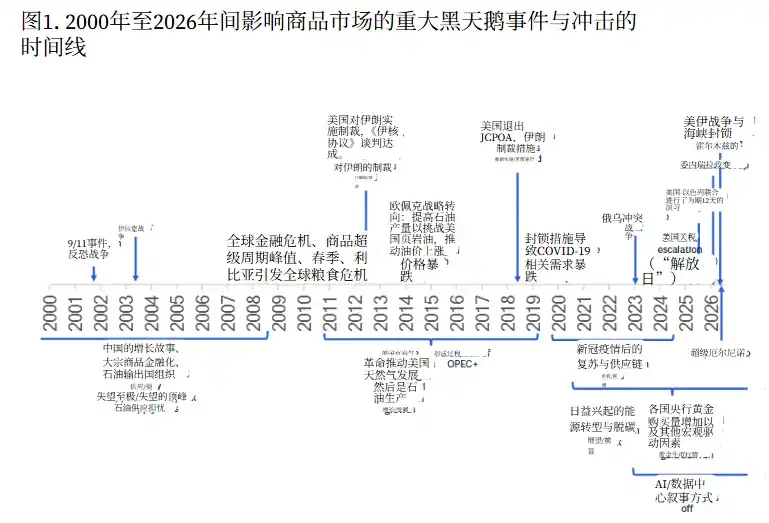
The report points out that these risk scenarios are not baseline forecasts, but rather "plausible events with high impact should they occur" tail scenarios, intended to supplement Citigroup's existing baseline forecast framework.

Highest Risk: U.S.-Iran Conflict Evolving into a Multi-Year Supply Crisis

Citigroup ranks the escalation of the U.S.-Iran conflict as the most impactful tail scenario, though its probability of occurrence is assessed as "low."

The report notes that from the "12-day war" in June 2025 when the U.S. and Israel jointly struck Iranian nuclear facilities, to the conflict resuming in February 2026, a fragile ceasefire agreement signed in June 2026, and renewed military escalation in July 2026, oil and refined product prices have already experienced multiple rounds of severe volatility.

If the conflict expands further, Iran could attack energy infrastructure in Gulf oil-producing countries. Combined with prolonged closures of the Strait of Hormuz and disruptions in the Bab el-Mandeb Strait, the world could face a sustained supply deficit of 5 to 10 million barrels per day.

Citigroup estimates that, assuming a demand elasticity of approximately -0.05, supply losses of this magnitude would drive oil prices up 100% to 200%, meaning flat price crude oil surpassing $200/barrel, with U.S. retail gasoline prices persistently remaining above $6/gallon.

Citing historical data, the report states, if global oil inventories excluding China fall below 70 days of consumption coverage, the corresponding actual Brent price has reached above $150/barrel.
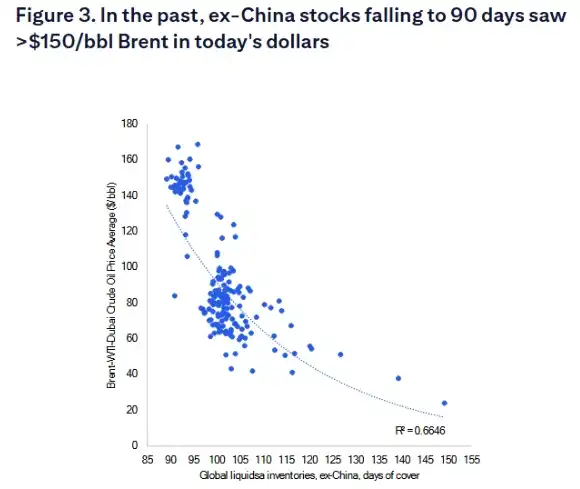
(Historically, if crude oil inventories in regions excluding China fell to the 90-day low point, Brent once reached above $150/barrel)

If the oil & gas expenditure's share of GDP were to repeat the 8% peak of the second oil crisis in the 1970s, the required oil price level would exceed $200/barrel.
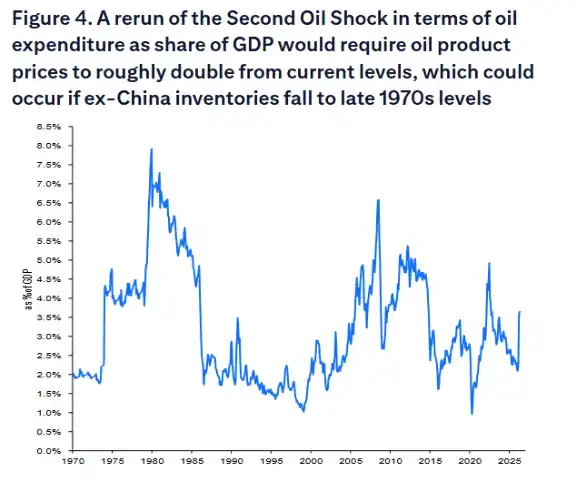
(If inventories outside China fall to levels seen in the late 1970s, oil product prices roughly double from current levels)

As of July 2026, total global oil inventories excluding China remain around 94 days of consumption. However, Citigroup predicts that if a global deficit of 7 to 8 million barrels per day persists, this metric could fall below 70 days by early 2027.

Russia-Ukraine Escalation: Natural Gas Market Impact Expected to Exceed Crude Oil

Citigroup rates the possibility of stricter restrictions on Russian energy exports as "medium probability," emphasizing its impact on the natural gas market would be greater than on crude oil.

For liquefied natural gas (LNG), Russia exported about 44 billion cubic meters (bcm) in 2025, accounting for approximately 7% of global LNG supply, mainly from the Yamal LNG and Sakhalin-2 projects.
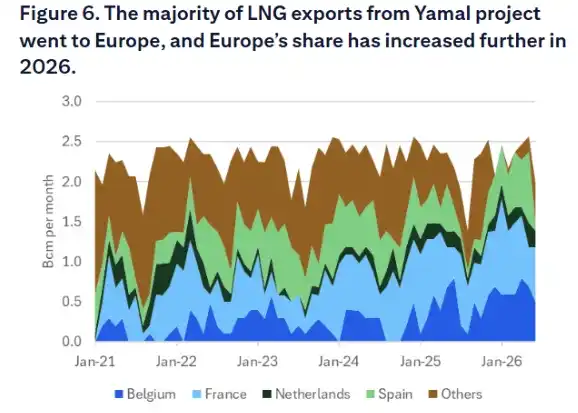
(Most LNG from the Yamal project is exported to Europe, with Europe's share set to rise further in 2026)

Of this, over 70% of Sakhalin-2 exports go to Japan and South Korea; around 90% of Yamal project exports are directed to Europe as of mid-2026.
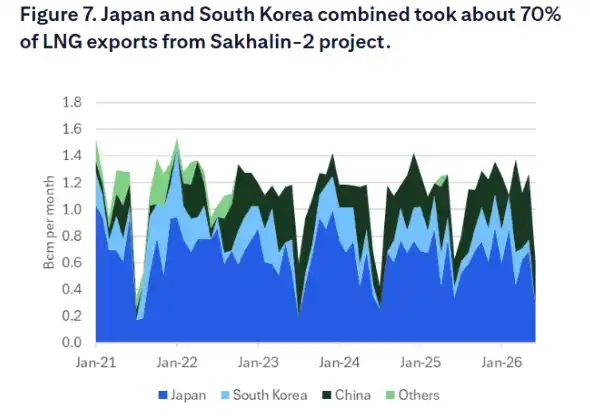
(Japan and South Korea together account for about 70% of LNG export share from the Sakhalin-2 project)

If a global ban on Russian LNG purchases were implemented, over 30 bcm of annual supply would need to be relocated. However, due to shipping and contractual limitations, the global LNG market would face a significant supply gap.

For pipeline gas, the damage from banning purchases of Russian pipeline gas would be even greater due to the physical constraints of pipelines limiting flexible redirection of gas flows.

Russia exports over 70 bcm of pipeline gas annually to markets outside China, with Europe and Turkey alone importing about 37 bcm combined.

Key Mineral Stockpiling: Copper Prices Could Break Through $20,000/Ton

Citigroup rates the probability of a key mineral stockpiling race as "high," with its impact varying by commodity and stockpiling scale. If governments engage in large-scale accumulation of strategic mineral stockpiles, copper prices could be pushed above $20,000 per ton.

The report points out that policy signals have emerged among major global economies such as the U.S. and the EU.

The U.S. "Project Vault" proposal plans to allocate $12 billion for stockpiling key industrial commodities, and the EU has announced a €3 billion fund for critical raw material security.

Citigroup uses the copper market as an example for calculation: if global refined copper inventories were to increase from the current ~1.3 months of consumption to 3 months, approximately 4 million tons of copper would need to be accumulated within two years.

Based on historical scrap copper supply elasticity, this would require copper prices to rise to around $23,000/ton. Citigroup's current benchmark scenario price for copper is around $13,500/ton.
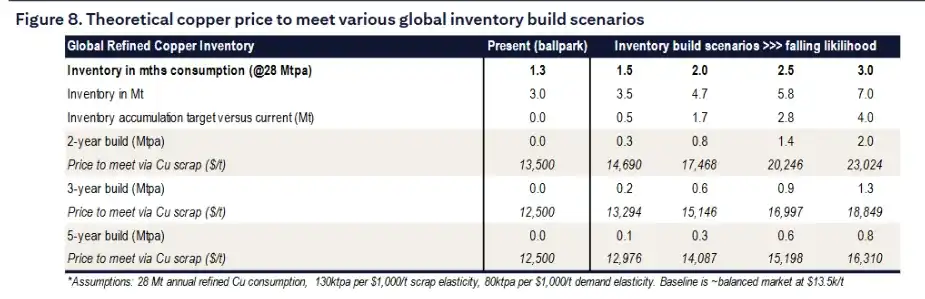
(Theoretical copper prices under various global inventory increase scenarios)

Gold: Could Fall Another 15-20% Short-Term, Then Double Later

Citigroup rates gold's tail risk as low probability, low direct impact, but highly significant within the scenario analysis framework.

Gold prices surged from $2,500/oz in January 2025 to a peak of $5,500/oz in February 2026, and have since retreated to around $4,000/oz.

The report believes the risk of a larger-than-expected decline is most concentrated in the next 4 to 6 weeks. Once prices fall below $3,800/oz, liquidation pressure from ETFs and leveraged positions could be triggered on a large scale.

Potential triggers include: a worsening Middle East situation pushing up real interest rates and the dollar, and equity/bond market adjustments triggering liquidity squeezes.

However, the report remains highly optimistic about gold's medium to long-term trend.

China's trade surplus exceeding $1.3 trillion, continued central bank purchases, global fiscal sustainability concerns, and de-dollarization trends constitute multiple supports for long-term gold demand.

Citigroup expects that, driven by major inflation declines and a new round of investor buying, gold has the potential to rise to $6,000/oz in the coming years, nearly doubling from current levels.

Extreme El Niño: Cocoa Prices Could Return to $10,000/Ton

The U.S. National Oceanic and Atmospheric Administration's (NOAA) updated July forecast raised the probability of a very strong El Niño event to 81%, with a 97% chance of persistence until Spring 2027. Citigroup rates this as a "medium probability, high impact" tail scenario.
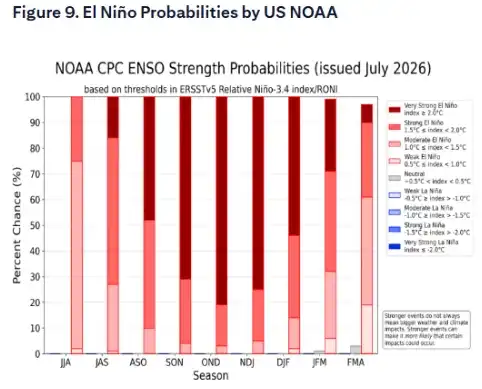
(NOAA's El Niño probability forecast)

The report notes that extreme El Niño impacts different agricultural products significantly. Cocoa, sugar, and Robusta coffee are most affected; soybeans are next; corn and wheat are relatively less affected.

If West Africa experiences a Harmattan wind season similar to 2023-2024, cocoa supply would be severely impacted. Cocoa prices could return to $10,000/ton or higher, having previously reached record highs in 2024-2025.

For sugar, below-average rainfall in India in June, coupled with potential dual risks of monsoon deficiency in Thailand and floods in Brazil, global sugar prices could rise above 20 cents/pound.

Corn and soybean prices may find some support because El Niño typically boosts yields in U.S. producing regions, though European heatwaves and a weaker Indian monsoon remain key downside risk sources.

AI Boom & Bust: Bidirectional Shocks Diverge Commodity Landscape

Citigroup characterizes the impact of AI scenarios on commodities as "low to medium probability, highly divergent impact."

AI infrastructure expansion is becoming a significant driver of demand for electricity, natural gas, uranium, and grid metals like copper and aluminum. The report projects U.S. data center power consumption will roughly double by 2030.

If the AI bubble bursts, data center construction will contract sharply. Actual and expected demand for copper, natural gas, and uranium would be simultaneously damaged, while a decline in global risk appetite would further trigger a contraction in commodity demand.

However, simultaneously, a weaker dollar could provide passive support for commodity prices, and significant Fed rate cuts would also cushion the market to some extent.

If AI productivity dividends materialize, accelerating energy consumption and advancing grid investment would further strengthen the structural deficit narrative for copper and aluminum. Citigroup views this as one pathway for copper prices to reach $17,000/ton in a bull scenario.

Gold is seen as the most asymmetric hedge instrument under AI scenarios, benefiting from logic in both boom and bust cycles.

Power of Siberia 2 & LNG Oversupply: 2030s Prices Could Fall Below $6/MMBtu

Citigroup rates the signing of a final agreement between Russia and China on the Power of Siberia 2 pipeline as a "medium probability, high impact" scenario.

The pipeline has an annual capacity of 50 bcm. If operational around 2030, it would significantly reduce China's LNG import needs, exacerbating the global LNG market's expected shift towards looser conditions from 2028 onward.

The report predicts that under this scenario, the JKM Asian LNG benchmark price could fall to $5-6/MMBtu, well below the current forward prices for 2029-2030 above $8, and far below the $7-10 breakeven range for most new LNG supply terminals.

Citigroup notes that the potential 50 bcm/year of new supply between China and Russia is almost equivalent to Russia's existing ~53 bcm/year of pipeline gas exports to Europe. Its impact on the global LNG oversupply situation would far outweigh the debate over whether Russian pipeline gas returns to Europe.

Extremization of the Monroe Doctrine: Blockade of Americas' Oil Could Trigger a 1973 Replay

If the U.S. pushes the "Monroe Doctrine" to an extreme, blockading oil exports from Latin America or even the entire Americas, the global oil price landscape would undergo severe distortion.

The Monroe Doctrine is a core U.S. foreign policy principle articulated in 1823. Its core assertion is that "the Americas are for the Americans," aimed at opposing European powers' interference in American affairs, while declaring U.S. non-interference in European internal matters.

Citigroup lists "U.S. blockade of all oil exports from the Americas" as a low probability, high impact scenario.

Under this assumption, Latin America (including Mexico), with approximately 9.8 million barrels/day of crude oil production (~10% of global total output), would see its exports cut off from global markets. The shock magnitude would match or even exceed the 1973 Arab oil embargo.
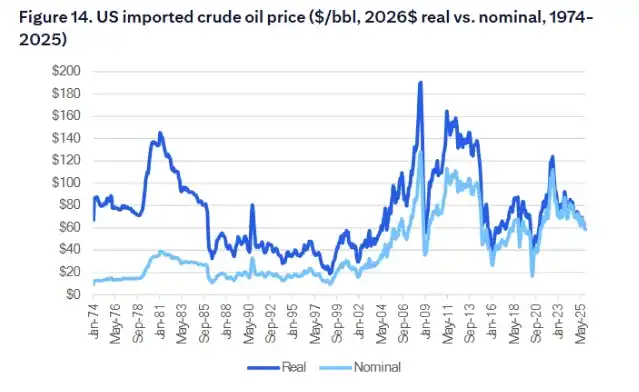
(U.S. imported crude oil price, 2026 real and nominal values, 1974-2025)

Back then, 7 OPEC member countries cut production by about 3.6 million barrels/day (~6% of global output), causing oil prices to surge from around $3/barrel to about $12/barrel in January 1974, a rise of approximately 300%.

Under this scenario, global benchmark crude prices (like Brent, Dubai) could surge above $100/barrel, while intra-Americas crude benchmarks (like WTI, WCS) could experience substantial discounts exceeding $30/barrel due to lack of outlets, creating a sharply divergent cross-regional price structure.


Трендовые криптовалюты

Связанные с этим вопросы

QAccording to Citi's report, what is the highest-impact tail risk scenario for the commodity market by 2026 H2, and what is its potential effect on oil prices?

AThe highest-impact tail risk scenario is an escalation and prolongation of the US-Iran conflict into a multi-year supply crisis. Citi estimates this could lead to a sustained global supply deficit of 5 to 10 million barrels per day. Assuming a demand elasticity of approximately -0.05, such a supply shock could drive oil prices up by 100% to 200%, pushing crude oil prices above $200 per barrel, with US retail gasoline consistently staying above $6 per gallon.

QWhat impact would a strategic stockpiling race for critical minerals have on copper prices according to Citi's analysis?

ACiti assesses the probability of a critical minerals stockpiling race as 'high'. Should governments undertake large-scale strategic stockpiling, it could push copper prices above $20,000 per tonne. Their modeling suggests that increasing global refined copper inventories from the current ~1.3 months of consumption to 3 months would require accumulating ~4 million tonnes of copper over two years, potentially requiring a price of around $23,000/tonne based on historical scrap supply elasticity.

QWhat is Citi's near-term and long-term outlook for gold prices in their tail risk analysis?

ACiti sees a heightened risk of gold declining by 15% to 20% in the next 4-6 weeks, potentially triggered by a break below $3,800/oz leading to ETF and leveraged position liquidations. However, their long-term outlook remains highly bullish. They expect gold could rise to around $6,000/oz in the coming years, nearly doubling from current levels, driven by factors like China's large trade surplus, sustained central bank buying, global fiscal sustainability concerns, and dedollarization trends.

QHow does Citi assess the potential impact of an extreme El Niño event on agricultural commodities, specifically cocoa and sugar?

ACiti rates an extreme El Niño as a 'medium probability, high impact' tail scenario. For agricultural commodities, cocoa, sugar, and Robusta coffee would be most affected. A severe Harmattan wind event in West Africa, similar to 2023-2024, could severely impact cocoa supply, potentially pushing prices back to $10,000/tonne or higher. For sugar, risks include deficient rainfall in India and potential monsoon issues in Thailand and Brazil, which could drive global sugar prices above 20 cents per pound.

QWhat are the two opposing potential impacts of AI development (boom vs. bust) on commodity markets, as outlined by Citi?

ACiti describes AI's impact as 'low to medium probability, highly differentiated impact'. In an AI boom scenario, infrastructure expansion drives demand for electricity, natural gas, uranium, and grid metals like copper and aluminum, reinforcing structural deficit narratives and potentially pushing copper to $17,000/tonne. In an AI bust scenario, data center construction contracts sharply, damaging actual and expected demand for copper, natural gas, and uranium, while a global risk-off sentiment further reduces commodity demand, though a weaker dollar and Fed rate cuts could provide some support. Gold is seen as an asymmetric hedge, benefiting in either scenario.

Похожее

Свадебное дело Чхве Тхэвона закрыто: раскрывая скрытые линии наследования за триллионной империей SK Hynix

Дело о разводе главы SK Group Чхве Тхэвона завершилось, раскрывая сложные сценарии наследования в конгломерате, стоящем за SK Hynix, чья капитализация превысила 1000 трлн вон. В отличие от традиционных сценариев наследования в чеблях, где ключевую роль играют первенец, доли, брачные связи и отцовское признание, трое детей Чхве Тхэвона от бывшей жены Но Соён — дочь Чхве Юнджон (1989 г.р.), дочь Чхве Минджон (1991 г.р.) и сын Чхве Ингын (1995 г.р.) — следуют разными путями. Чхве Юнджон, названная СМИ «наиболее очевидным кандидатом», занимает руководящую должность в SK Inc. и работает над стратегией развития в области биотехнологий и точной медицины, сочетая научную подготовку с бизнес-опытом. Её брак с основателем ИИ-стартапа символизирует новый тип элитных союзов. Чхве Минджон, добровольно служившая в ВМС Республики Корея и работавшая в сфере международной политики в SK Hynix в США, сейчас является основателем ИИ-стартапа в сфере здравоохранения. Её брак с бывшим офицером морской пехоты США подчёркивает связь с геополитическим контекстом, в котором теперь существует полупроводниковый гигант. Чхве Ингын, единственный сын и, казалось бы, естественный наследник по старой логике, сохраняет молчание. Имея образование в области физики, он покинул SK E&S, чтобы присоединиться к McKinsey, что рассматривается как стандартная внешняя стажировка, но без явных сигналов о наследовании. Громкое судебное разбирательство по разводу родителей, связанное с разделом активов на триллионы вон, стало фоном для их путей. По мере того как SK Hynix становится глобальным геополитическим активом в эпоху ИИ, наследование в SK перестаёт быть семейным делом, превращаясь в публичный экзамен на легитимность в новой, сложной реальности. Наследникам предстоит найти свои собственные ответы на вызовы эпохи.

marsbitВчера 09:08

Свадебное дело Чхве Тхэвона закрыто: раскрывая скрытые линии наследования за триллионной империей SK Hynix

marsbitВчера 09:08

Банки выступают против компромисса по доходности стейблкоинов – Найдёт ли закон CLARITY 60 голосов?

Американский Банковский институт политики выступил против нового проекта закона CLARITY Act, указав на пробелы в регулировании доходности стейблкоинов и мерах по борьбе с незаконными финансами. Банковский сектор добивается полного запрета любых форм вознаграждений по стейблкоинам и лоббирует сенаторов, что снижает поддержку со стороны республиканцев. Из-за смерти сенатора Грэма и болезни Макконнелла у республиканцев стало 51 голос. Если сенаторы Кёртис и Корнин откажут в поддержке, эта цифра упадет до 49, а для принятия закона потребуется 60 голосов. Необходимость заручиться поддержкой 11 демократов осложняется тем, что некоторые про-крипто демократы также выступают против законопроекта. Сроки ограничены: до августовских каникул Сената осталось две недели. Лидер большинства Джон Тюн сомневается в успехе до перерыва. Советник Белого дома по криптовалютам Патрик Уитт призывает провести голосование, утверждая, что новые этические нормы устраняют возражения демократов. Вероятность принятия закона в 2026 году, по рыночным оценкам, упала до 32%.

ambcryptoВчера 09:03

Банки выступают против компромисса по доходности стейблкоинов – Найдёт ли закон CLARITY 60 голосов?

ambcryptoВчера 09:03

За 2 месяца оценка выросла с 8,8 до 68 млрд юаней! Крупнейший AI-хаб OpenRouter может быть куплен

Stripe ведет переговоры о приобретении стартапа OpenRouter, агрегатора API крупных языковых моделей, за сумму около 100 миллиардов долларов. Это представляет собой семикратный рост по сравнению с оценкой OpenRouter в 13 миллиардов долларов двумя месяцами ранее. OpenRouter выступает в качестве «маршрутизатора» или агрегатора для более чем 400 AI-моделей (таких как GPT, Claude и множество открытых), позволяя разработчикам через единый API выбирать наиболее подходящую модель для каждой задачи на основе стоимости, скорости и сложности. Это помогает приложениям снижать расходы, автоматически направляя простые запросы к более дешевым моделям. Компания, основанная соучредителем OpenSea Алексом Аталлой, демонстрирует быстрый рост: ее ежегодный доход достиг 50 миллионов долларов, увеличившись в пять раз за полгода. Для Stripe, крупнейшего процессора онлайн-платежей, это вторая крупная сделка в сфере AI-инфраструктуры после приобретения платформы биллинга Metronome в 2025 году. Стратегия Stripe заключается в создании комплексного предложения для AI-экономики: OpenRouter будет «выбирать модель», Metronome — «подсчитывать потребление», а существующие платежные сервисы Stripe — «обрабатывать оплату». Таким образом, Stripe стремится контролировать ключевой уровень инфраструктуры, который определяет распределение трафика между моделями и формирует счета для конечных предприятий. Сделка подчеркивает растущую важность промежуточного слоя, который управляет стоимостью и выбором моделей для миллионов пользователей AI-приложений.

链捕手Вчера 09:00

За 2 месяца оценка выросла с 8,8 до 68 млрд юаней! Крупнейший AI-хаб OpenRouter может быть куплен

链捕手Вчера 09:00

От OpenSea до OpenRouter: Алекс Аталлах повторяет сценарий «ухода на пике»?

Автор: Нэнси, PANews Алекс Аталла, соучредитель NFT-платформы OpenSea, покинул компанию на пике пузыря NFT четыре года назад. Сейчас он снова оказывается в центре внимания на волне бума ИИ, готовясь продать созданную им агрегирующую платформу AI-моделей OpenRouter по высокой цене. По данным The Wall Street Journal от 23 июля, платежный гигант Stripe ведет переговоры о приобретении OpenRouter, при этом потенциальная оценка сделки может приблизиться к 100 миллиардам долларов. Если сделка состоится, это станет еще одним успехом Аталлы в создании компании на уровне ста миллиардов долларов после OpenSea. Ранее в этом месяце появились сообщения о том, что OpenRouter получил предложения о покупке от нескольких крупных технологических компаний. Потенциальная сделка со Stripe рассматривается как важный шаг для инфраструктурного гиганта в сфере платежей по расширению своего присутствия в области инфраструктуры ИИ. По данным информированных источников, если сделка будет заключена, оценка OpenRouter может приблизиться к 100 миллиардам долларов, что значительно превышает его предыдущие оценки при финансировании. Всего за три года компания добилась быстрого роста благодаря буму больших моделей. Это не первая компания Аталлы стоимостью в сто миллиардов. Ранее он был соучредителем OpenSea, ведущей мировой платформы для торговли NFT, пиковая оценка которой превысила 130 миллиардов долларов. Его уход с OpenSea до серьезного спада на рынке NFT рассматривался как знаковый сигнал. OpenRouter стала крупнейшим хабом в эпоху ИИ, подключившись к более чем 400 AI-моделям, имея около 10 миллионов пользователей и обрабатывая более 200 триллионов токенов в месяц. Однако, несмотря на быстрый рост, это бизнес с большими объемами, но ограниченной рентабельностью. Его основная бизнес-модель заключается в взимании комиссии за платформу (около 5-5,5%) при вызове разработчиками AI-моделей. Конкуренция на рынке агрегации AI-моделей также обостряется. Высокая оценка OpenRouter, возможно, больше отражает его будущий потенциал, чем текущую прибыльность. Для потенциальных покупателей наиболее ценным активом могут быть не текущие доходы, а накопленные реальные данные об использовании ИИ, которые трудно быстро воспроизвести. От NFT к ИИ Алекс Аталла дважды поймал волну технологического бума. Если продажа OpenRouter состоится с оценкой в 100 миллиардов долларов, это может означать либо переоценку стоимости инфраструктуры ИИ, либо сигнал о новом пике цикла. Ответ на этот вопрос даст только время.

链捕手Вчера 08:44

От OpenSea до OpenRouter: Алекс Аталлах повторяет сценарий «ухода на пике»?

链捕手Вчера 08:44

Приближается ли Биткойн к очередной зоне накопления? ЭТОТ сигнал говорит «да»

Аналитики отмечают, что Bitcoin (BTC) переживает один из самых длительных медвежьих периодов, охватывающий три квартала и два календарных года, при этом его динамика отклонилась от рынка акций. Однако сохраняется корреляция с акциями Apple (AAPL). График соотношения BTC/AAPL с 2017 года движется в восходящем канале, где его нижняя граница традиционно сигнализирует о зоне недооценки (накопления) для Bitcoin, а верхняя — о перекупленности. В настоящее время соотношение приближается к линии поддержки, что, по историческим данным, может предшествовать новой фазе роста BTC. При этом в 2025 году нарушилась многолетняя корреляция годовой доходности Bitcoin с индексами S&P 500 и Nasdaq 100, что объясняется его более резкой реакцией на макроэкономические потрясения. В качестве подтверждающего сигнала для разворота рассматриваются поступления стейблкоинов на криптобиржи, которые указывают на готовность капитала к реинвестированию. За последние семь дней чистый приток составил $1,42 млрд, что значительно меньше оттока в $10 млрд за предыдущие 30 дней и пока недостаточно для уверенного старта ралли. Таким образом, соотношение BTC/AAPL указывает на возможное приближение к зоне накопления, но для подтверждения тренда необходимы более значительные притоки стейблкоинов.

ambcryptoВчера 08:24

Приближается ли Биткойн к очередной зоне накопления? ЭТОТ сигнал говорит «да»

ambcryptoВчера 08:24

Торговля

Спот

Популярные статьи

Как купить ERA

Добро пожаловать на HTX.com! Мы сделали приобретение Caldera (ERA) простым и удобным. Следуйте нашему пошаговому руководству и отправляйтесь в свое крипто-путешествие.Шаг 1: Создайте аккаунт на HTXИспользуйте свой адрес электронной почты или номер телефона, чтобы зарегистрироваться и бесплатно создать аккаунт на HTX. Пройдите удобную регистрацию и откройте для себя весь функционал.Создать аккаунтШаг 2: Перейдите в Купить криптовалюту и выберите свой способ оплатыКредитная/Дебетовая Карта: Используйте свою карту Visa или Mastercard для мгновенной покупки Caldera (ERA).Баланс: Используйте средства с баланса вашего аккаунта HTX для простой торговли.Третьи Лица: Мы добавили популярные способы оплаты, такие как Google Pay и Apple Pay, для повышения удобства.P2P: Торгуйте напрямую с другими пользователями на HTX.Внебиржевая Торговля (OTC): Мы предлагаем индивидуальные услуги и конкурентоспособные обменные курсы для трейдеров.Шаг 3: Хранение Caldera (ERA)После приобретения вами Caldera (ERA) храните их в своем аккаунте на HTX. В качестве альтернативы вы можете отправить их куда-либо с помощью перевода в блокчейне или использовать для торговли с другими криптовалютами.Шаг 4: Торговля Caldera (ERA)С легкостью торгуйте Caldera (ERA) на спотовом рынке HTX. Просто зайдите в свой аккаунт, выберите торговую пару, совершайте сделки и следите за ними в режиме реального времени. Мы предлагаем удобный интерфейс как для начинающих, так и для опытных трейдеров.

817 просмотров всегоОпубликовано 2025.07.17Обновлено 2026.06.02

Как купить ERA

Обсуждения

Добро пожаловать в Сообщество HTX. Здесь вы сможете быть в курсе последних новостей о развитии платформы и получить доступ к профессиональной аналитической информации о рынке. Мнения пользователей о цене на ERA (ERA) представлены ниже.

活动图片