Sudden Halt, Gemini 3.5 Pro Stalls, Google Plunges into a Trap of Disappointment

marsbitОпубликовано 2026-07-17Обновлено 2026-07-17

Введение

Gemini 3.5 Pro's launch has been delayed for months, according to a Bloomberg report. Hype had built after leaks suggested the AI model, codenamed 'Cappuccino', would feature a 2M-token context window and a 'Deep Think' mode, potentially surpassing rivals like GPT-4.5. However, internal sources reveal the model failed to meet strict standards, particularly in AI coding performance, despite a last-minute data update. The report details internal challenges at Google: bureaucratic hurdles slow decision-making as multiple departments compete for resources and alignment. Furthermore, a cultural reluctance among some engineers to use AI-generated code, coupled with internal GPU shortages, hampered the development of this critical capability. This inefficiency and perceived lag behind competitors like OpenAI and Anthropic is reportedly causing talent drain. Analysts suggest this isn't just a Google issue but part of a broader "next-gen giant model disappointment trap." As models scale, they face data bottlenecks, diminishing returns from compute scaling, and potential architectural limits. While OpenAI currently leads, the industry may be entering a platform period where explosive progress slows. Google's delay underscores the immense difficulty of advancing frontier AI models.

Just yesterday, the entire AI community was immersed in a state of high excitement.

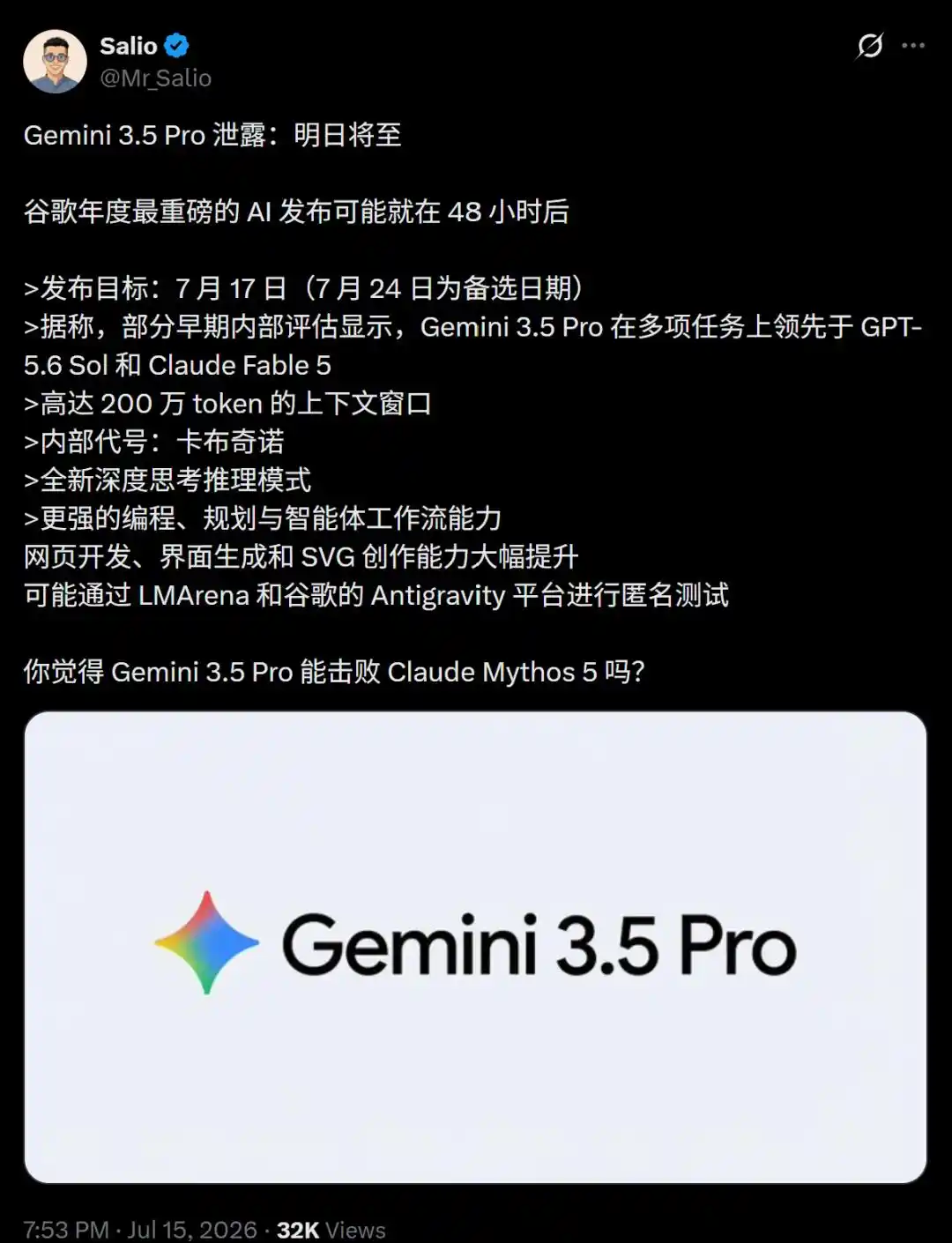
A flood of leaks came pouring in: Google's ultimate weapon – Gemini 3.5 Pro, codenamed 'Cappuccino', would officially launch within 48 hours!

A massive 2-million-token context window, a brand new 'Deep Think' reasoning mode, reportedly outperforming GPT-5.6 Sol and Claude Fable 5 in internal evaluations.
Clearly, this was a blockbuster product poised to disrupt the AI landscape.

Everyone was excitedly counting down, rolling up their sleeves, ready to witness history.

However, after waking up this morning, the mood suddenly shifted.

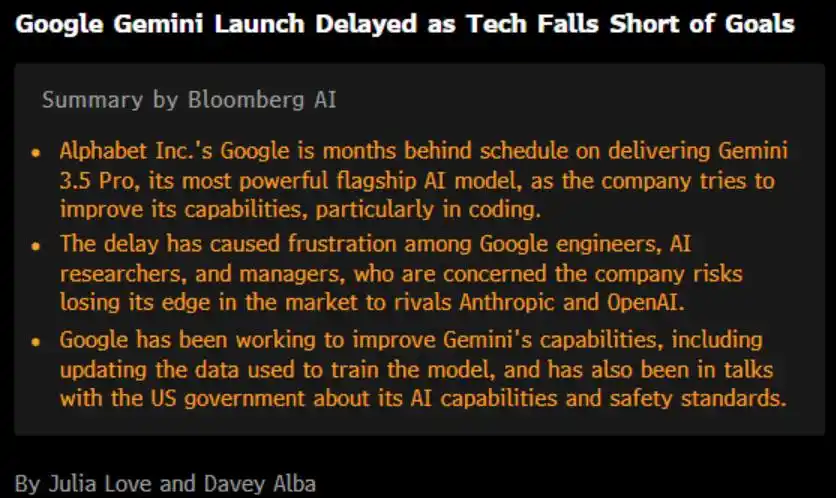
A Bloomberg exclusive report poured cold water on everyone's enthusiasm like a bucket of ice: the launch of Gemini 3.5 Pro is delayed, and not by a few days, but by a delay of months!

A launch that should have been recorded in history was put on hold by Google itself.

Why exactly?

48-Hour Frenzy and an Emergency Brake

Just yesterday, social platforms were flooded with spoilers about Gemini 3.5 Pro.

Codenamed: Cappuccino.

Super long context: 2 million tokens.

Deep Thinking: The new 'Deep Think' mode brings it to unprecedented heights in mathematics, programming, and logical reasoning.

Comprehensive evolution: Significant improvements in code writing, agent workflows, front-end UI design, and SVG graphic generation.

Insiders predicted this would be Google's 'ultimate weapon' for a full-scale counterattack against OpenAI and Anthropic.

The reaction was extreme. Everyone was looking forward to the rumored launch date of July 17th.

However, this morning, a report by a Bloomberg journalist instantly plunged everyone into disappointment.
Insiders say the development of Gemini 3.5 Pro has fallen months behind schedule. The core problem is that the model's performance in key capabilities, especially AI coding, failed to meet stringent internal standards.

Just at the end of last month, Google urgently updated the training data in a final sprint to boost coding capabilities, but the results were 'disappointing'.

Two words declared the end of this 48-hour frenzy.

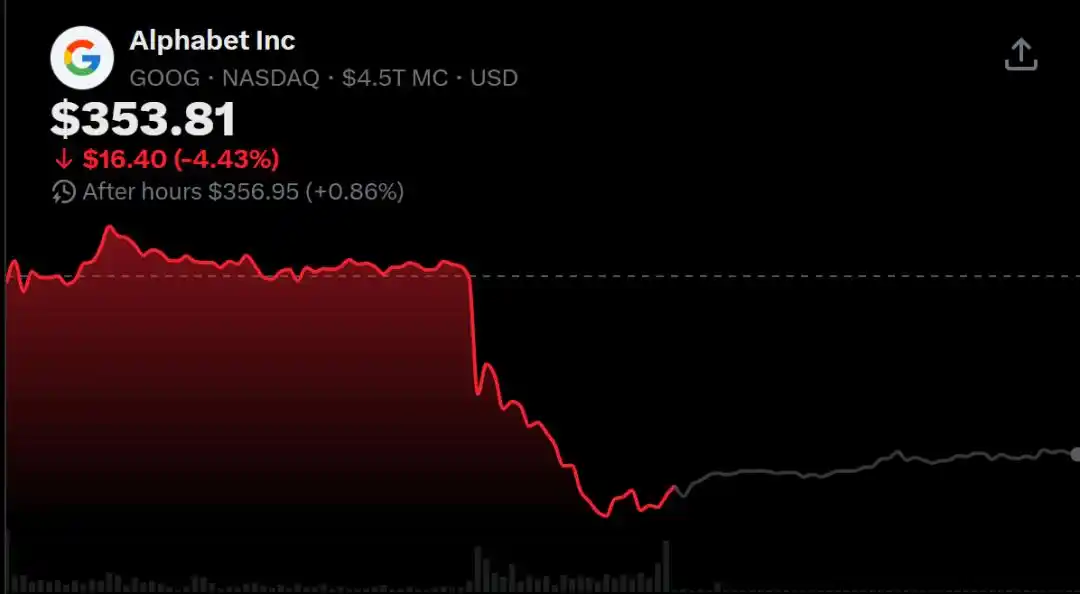
Google's stock price fell immediately after the news broke, at one point dropping by 4.43%.
While OpenAI and Meta's new models race ahead in coding capabilities, the difficulties with Gemini 3.5 Pro have directly caused severe anxiety within Google.

Engineers, AI researchers, and executives feel deeply frustrated. They are increasingly worried that Google is losing what was already a not-so-wide moat.

Google's 'Tacitus Trap': Why Can't an Entire Company Build the Best AI?

Why did the highly anticipated trump card fizzle?

This report reveals the multiple layers of internal struggles at Google. It's a microcosm of a colossal empire during a transitional era.
Innovation Speed 'Dragged Down' by Bureaucracy

The report mentions a crucial detail: Google's internal hierarchy is complex, with numerous stakeholders.

The launch of a model must consider the needs of massive product lines like Search, Maps, and YouTube.

This 'wanting it all' decision-making model leads to dispersed resources and sluggish decisions.

A former employee gave a vivid analogy: "Getting all department leadership to pull in the same direction is like trying to boil the entire ocean."

The result is frequent changes in directives, multiple departments reinventing the wheel, making it difficult to form a concerted effort.

While OpenAI and Anthropic sprint forward at startup speed, Google's 'giant ship' is stalled by internal coordination.

One netizen commented incisively: "Google needs to cut its bloated bureaucracy to make progress in this field."

The Waterloo of AI Coding: Engineers' 'Pure-Blood' Complex and Compute Hunger

Moreover, why did coding capability specifically fall short? This hides a deeper conflict within Google.

On one hand, Google has a top-tier engineering culture globally, which also fosters a 'pure-blood' complex.

Many old-school engineers believe that 'all important code should be written by hand.' This distrust of AI-generated code limits engineers from using Gemini to assist in development, fearing proprietary code could leak into training data.

When Google finally recognized the importance of AI coding and decided to mandate its use, a new problem arose – insufficient compute power.

The report points out that when engineers tried to use internal AI tools, they frequently encountered compute capacity limits.

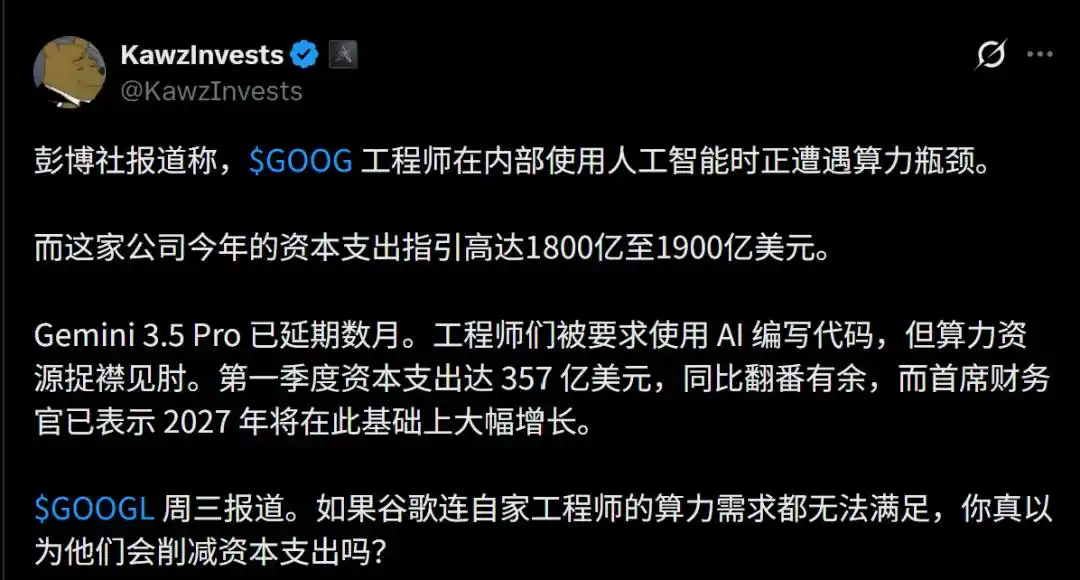
The most ironic detail in the entire report: In a company expected to spend $180 to $190 billion in capital expenditures this year, its own engineers can't get access to GPUs!

Wall Street data shows Google's Q1 capital expenditure this year reached a staggering $35.7 billion, more than double year-over-year. So much money poured into buying chips and building data centers, and the result?

Faced with this chaos, Google is trying to mend the fold after the sheep are lost.

The Chief AI Architect is consolidating departmental AI programming tools under the Google Antigravity foundational architecture and has established a dedicated AI programming team within DeepMind, but it might be too late.

Internal Horse Race, A Vicious Cycle of Talent Drain

Google isn't unaware of the problems. It has top research labs like Google DeepMind, the Google Cloud division, the Android team, and has even formed multiple internal groups to tackle AI coding.

But this 'horse race' mechanism also means internal friction.

Different teams operate independently, products overlap, strategies waver. Worse, this confusion and sense of frustration directly lead to the loss of top talent.

The report states that a large number of researchers, disappointed by Google's lagging position, have jumped ship to Anthropic and OpenAI.

This forms a terrifying closed loop: Bureaucracy leads to inefficiency -> Inefficiency leads to product delays -> Product delays lead to talent drain -> Talent drain exacerbates technological lag.

The delay of Gemini 3.5 Pro is the inevitable outcome of this loop.

Alarm Sounds Across the Industry, Giants Collectively Fall into the 'Next-Gen Giant Model Disappointment Trap'

Wharton's Ethan Mollick, while sharing the report, raised a thought-provoking point –

This is not just Google's tragedy, but a 'periodic tech winter' that the entire Silicon Valley is experiencing.

Mollick pointedly noted that Google's current setbacks perfectly replicate the pains previously experienced by Meta's Llama 4 and xAI's Grok 4.

He named this phenomenon the 'Next-Gen Giant Model Disappointment Trap.'

Investing huge sums of money and compute to train the next-generation model, only for the actual performance gains to fall far short of expectations, leading to a noticeable decline in market leadership.

In the past, the industry believed in Scaling Law. However, when model scale expands to a certain point, the 'brute force' approach of merely piling on compute and data begins to fail.

Data bottleneck: High-quality human text data has almost been 'squeezed dry,' and the effectiveness of synthetic data remains to be proven.

Algorithm bottleneck: The existing Transformer architecture and its variants may be approaching their performance ceiling.

Diminishing returns: To achieve tiny performance gains, an exponentially increasing compute cost is required.

In this giants' game, only OpenAI has temporarily escaped this trap with Orion/GPT-4.5, avoiding a major setback.

What is certain is that as model sizes approach physical and engineering limits, the difficulty of iterating on frontier models is rising sharply.

The delay of Gemini 3.5 Pro is a wake-up call for everyone –

We are in a plateau period. The era of breakneck advancement where 'AI moves a year in a day' is coming to a pause.

For the entire industry, this might be a good thing. When the hype subsides, people will truly contemplate the value of AI.

As for Google, the time and patience the market has left for it may truly be running out.

References:

https://x.com/Mr_Salio/status/207736089707741624811

https://x.com/emollick/status/2077849021150888408

https://www.bloomberg.com/news/articles/2026-07-16/google-gemini-launch-delayed-as-tech-falls-short-of-internal-goals

This article is from the WeChat public account "New Zhiyuan", author: ASI Apocalypse

Трендовые криптовалюты

Связанные с этим вопросы

QWhat was the reason for the delay in the release of Google's Gemini 3.5 Pro model?

AThe release was delayed because the model failed to meet Google's internal, stringent standards for key capabilities, specifically in AI coding.

QAccording to the article, what is a major internal challenge hindering Google's AI innovation speed?

AA major challenge is Google's complex bureaucracy and hierarchical structure, which leads to resource dispersion, slow decision-making, and difficulties in aligning multiple product divisions.

QWhat ironic situation regarding resources did Google engineers face while working on AI code generation?

ADespite Google's massive capital expenditure on GPUs and data centers, its own engineers frequently encountered compute capacity limits and couldn't get access to sufficient GPU resources for using internal AI coding tools.

QWhat is the "Next-Generation Giant Model Disappointment Trap" as described by Ethan Mollick in the article?

AIt's a phenomenon where tech companies invest huge resources in training next-generation AI models, but the actual performance improvements are much lower than expected, leading to a significant loss of market leadership position.

QWhat fundamental bottlenecks are contributing to the slowdown in AI model advancement mentioned at the end of the article?

AThe article mentions several bottlenecks: the depletion of high-quality human text data, the potential performance ceiling of the Transformer architecture, and the law of diminishing returns where exponentially more compute is needed for minor performance gains.

Похожее

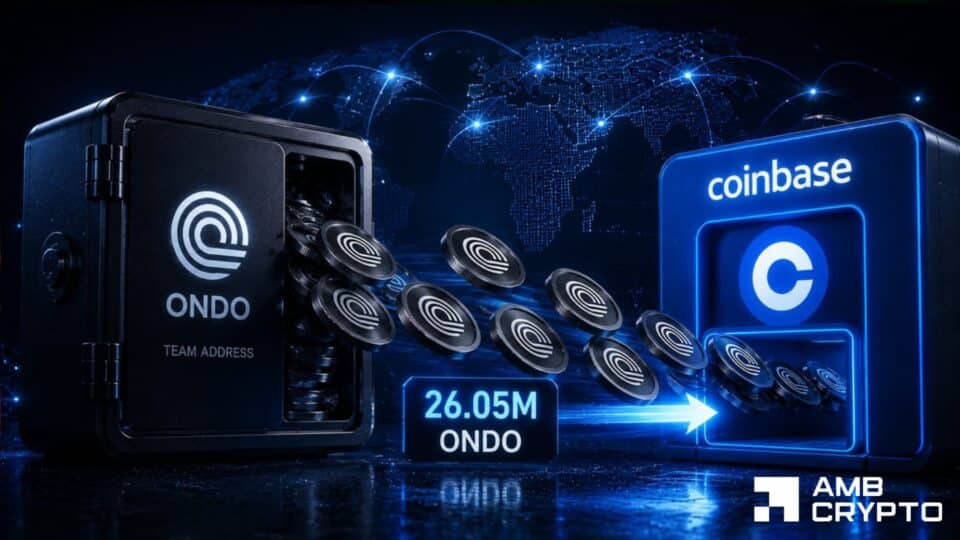
Кошелек, связанный с командой Ondo, перевел 26 млн токенов на Coinbase – Ждет ли продажа?

Кошелек, связанный с командой Ondo, перевел 26,05 млн токенов ONDO (около $9,79 млн) на биржу Coinbase. Согласно данным Arkham, этот адрес ранее получил 150 млн токенов, и аналогичные переводы в прошлом заканчивались продажей. Хотя прямой продажи пока не подтверждено, эта активность создает риски для цены в ближайшей перспективе. Несмотря на перевод, ONDO демонстрировал сильный восходящий тренд, достигнув локального максимума в $0,38, а затем скорректировавшись до $0,36. На момент публикации токен торговался около $0,37. Индикаторы, такие как RSI (около 64) и положительный Buy-Sell Delta, указывали на устойчивый спрос и контроль покупателей. Это может помочь удержать поддержку на уровне 200-дневной скользящей средней ($0,37) и потенциально пробить сопротивление в $0,40. Однако активность китов (крупных держателей) вызывает опасения. Данные показывают возвращение крупных ордеров на продажу в диапазоне $0,36–$0,37, а индикатор Spot Taker CVD остается отрицательным, сигнализируя о доминировании продавцов. Если продажи китов продолжатся, это может ослабить рыночную структуру и привести к более глубокой коррекции в сторону 20-дневной скользящей средней ($0,33). Итог: несмотря на сильный спрос со стороны спотового рынка, значительный перевод токенов на биржу и сохраняющаяся активность китов-продавцов создают риски для цены ONDO в краткосрочной перспективе.

ambcrypto1 ч. назад

Кошелек, связанный с командой Ondo, перевел 26 млн токенов на Coinbase – Ждет ли продажа?

ambcrypto1 ч. назад

На WAIC впервые подумал, что ИИ не обязательно быть таким умным

Автор делится впечатлениями от посещения WAIC (Всемирной конференции по искусственному интеллекту), выделяя контраст между шумной основной выставкой и тихим пространством музыкальной терапии на основе ИИ от команды Шанхайской консерватории. На фоне демонстраций мощных моделей, роботов, агентов и новых устройств (очки, телефоны), главным трендом видится переход от соревнования моделей к системной интеграции ИИ в инфраструктуру и конечные устройства. Все направлено на повышение эффективности. Однако автор задается вопросом о конечной цели. Эффективность не равна счастью, а ускоренный технологиями мир порождает тревогу и перегрузку. Музыкальная терапия, не предлагая повышения эффективности, дала 20 минут покоя, что стало ключевым впечатлением. Делается вывод, что по мере того, как базовые возможности ИИ становятся товаром массового спроса, следующей важной задачей станет создание «эмоциональной инфраструктуры» — технологий, которые понимают, сопровождают и заботятся о человеке, отвечая на потребности в понимании, утешении и психическом благополучии. Будущее ИИ требует не только интеллекта, но и глубокого понимания человека.

marsbit1 ч. назад

На WAIC впервые подумал, что ИИ не обязательно быть таким умным

marsbit1 ч. назад

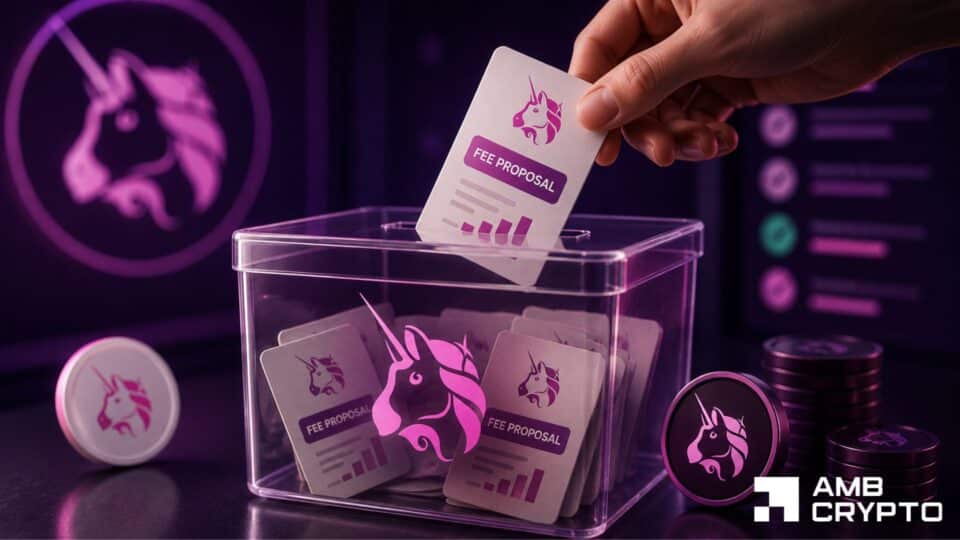
Стимулируют ли новые предложения по комиссиям протокола Uniswap ‘существенное сжигание UNI’?

Uniswap представил три предложения по активации протокольных комиссий в различных версиях (V2, V3, V4) на блокчейнах Ethereum, Base, Arbitrum, Robinhood, BNB Chain, Polygon и Optimism. Все новые сборы будут направляться в механизм сжигания токенов UNI. Генеральный директор Хейден Адамс ожидает «существенного» увеличения объема сжигания, особенно учитывая высокий торговый оборот на новой сети Robinhood L2. Однако предложения встретили сопротивление со стороны некоторых поставщиков ликвидности (LP), например Gamma Strategies. Они утверждают, что комиссии снизят их доходы и сделают Uniswap V4 менее конкурентоспособным на фоне других DEX. В настоящее время львиная доля сборов (более $5 млрд с 2018 года) идет LP, в то время как сам протокол заработал лишь $25 млн. Если предложения будут приняты и грамотно сбалансированы, это может значительно ускорить сжигание UNI. На прошлой неделе темпы сжигания уже выросли втрое. Цена UNI в июле выросла на 41%, но сейчас столкнулась с сопротивлением. Дальнейший рост может зависеть от сохранения импульса на Robinhood и эффекта от новых комиссионных предложений.

ambcrypto3 ч. назад

Стимулируют ли новые предложения по комиссиям протокола Uniswap ‘существенное сжигание UNI’?

ambcrypto3 ч. назад

Прогноз цены SHIB на 2026 год — вот что говорят эти модели ИИ!

Согласно прогнозам трех моделей искусственного интеллекта (Shiba Inu, Claude и Grok), цена мемкоина Shiba Inu (SHIB) к концу 2026 года может продемонстрировать умеренный рост. Модели ожидают не взрывного ралли, а скорее скромные или средние прибыли. Ключевыми факторами роста называют большое и растущее сообщество SHIB, а также возможный рост цен под влиянием Bitcoin и притока капитала в мемкоины. Однако, по мнению Claude и Grok, слабое внедрение в экосистеме Shibarium и общие настроения на крипторынке могут ограничить потенциал роста. Технический анализ показывает, что в краткосрочной перспективе цена SHIB консолидируется выше уровня поддержки $0.00000412, при этом объем торгов и RSI снижаются, что указывает на активность продаж. Для достижения уровня $0.00000510 необходимо преодолеть сопротивление на отметке $0.0000045. На дневном графике наблюдается накопление монет покупателями, а индикатор MACD подтверждает контроль быков, хотя их импульс остается минимальным. Эти данные согласуются с прогнозами ИИ о вероятных, но не взрывных, ростах.

ambcrypto5 ч. назад

Прогноз цены SHIB на 2026 год — вот что говорят эти модели ИИ!

ambcrypto5 ч. назад

Торговля

Спот

Популярные статьи

Неделя обучения по популярным токенам (2): 2026 может стать годом приложений реального времени, сектор AI продолжает оставаться в тренде

2025 год — год институциональных инвесторов, в будущем он будет доминировать в приложениях реального времени.

1.9k просмотров всегоОпубликовано 2025.12.16Обновлено 2025.12.16

Неделя обучения по популярным токенам (2): 2026 может стать годом приложений реального времени, сектор AI продолжает оставаться в тренде

Обсуждения

Добро пожаловать в Сообщество HTX. Здесь вы сможете быть в курсе последних новостей о развитии платформы и получить доступ к профессиональной аналитической информации о рынке. Мнения пользователей о цене на AI (AI) представлены ниже.

活动图片