GPT-5.6 Sol Suddenly Gets Dumber Overnight? Thinking Budget Slashed from 960 to 128, No More Fixed-Intelligence Models?

marsbitОпубликовано 2026-07-15Обновлено 2026-07-15

Введение

The article discusses widespread user reports that OpenAI's GPT-5.6 Sol model, specifically its "Max" reasoning tier, has become less capable at complex, deep reasoning tasks. Users noted faster but shallower responses. Community investigation revealed an unpublicized internal parameter called "juice value," representing computational budget for reasoning. Observations indicated this value for the Max tier dropped dramatically from 960 to 128. In response, OpenAI's Thibault Sottiaux stated there was no intentional reduction in model capability ("nerf"). He explained the changes were part of an experiment to investigate unexpected high token usage following GPT-5.6's launch, which introduced features like longer reasoning and larger context windows. The experiment temporarily adjusted the "juice" parameter and rolled back the context window from 372k to 272k tokens to diagnose the usage spike. Sottiaux asserted these settings have been reverted and highlighted ongoing optimizations. The controversy highlights a tension between AI as a reliable, fixed-capability tool and its reality as a cloud service where providers can adjust performance parameters. The article argues that for AI to be trusted enterprise infrastructure, providers need clearer, transparent guarantees about the specific performance boundaries associated with service tiers.

Everyone online says GPT-5.6 Sol's Max tier has become dumber. OpenAI insists there's no nerf, just an "experiment." The knob turned during that experiment slashed the Max tier's budget from 960 down to 128, invisible to users.

Woke up to find GPT-5.6 Sol had become dumber!

A Japanese market research team, not long after starting work in the morning, discovered something off with their Codex Sol MAX. The team leader wrote a long post about the morning's ordeal and posted it on Reddit's r/codex.
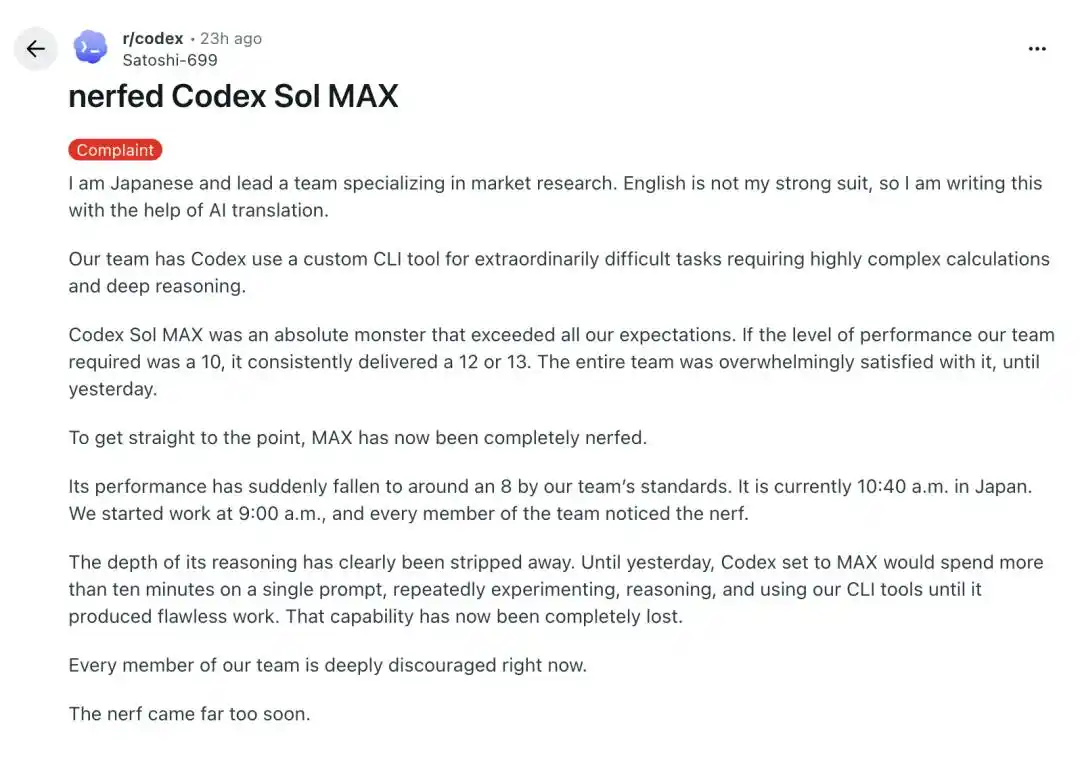
9 AM, the team started work as usual. By 10:40 AM, every single member had noticed the same thing.

They had Codex Sol MAX connected to a self-developed CLI tool, specifically for chewing through jobs requiring extremely complex calculations and deep reasoning.

Initially, Codex Sol MAX lived up to expectations, delivering 12 or 13 points out of a 10-point requirement. It was a "monster that far exceeded expectations," and "everyone was overwhelmingly satisfied with it."

But on this morning, that "monster's" performance suddenly slumped to 8 points.

The depth of reasoning had clearly been stripped away.

Before this, when faced with a prompt, Codex Sol MAX would take over ten minutes, repeatedly trying, reasoning, and calling their tools until the job was done flawlessly.

That capability had "completely vanished" on this very morning.

The Whole Internet Feels It's "Dumber"

The Japanese team's experience was just one example among many in the Codex community these past few days.

The complaints were highly consistent: the model indeed got faster, answers came more briskly, but it was unwilling to dig deep. That old drive to research first, then act, constantly revising itself, was gone.

A user on X summed up everyone's gut feeling:

Everyone's reasoning tier has been collectively downgraded by one level—if you used to run on Extra High, now you have to crank it to Max to get back the same level of effort.
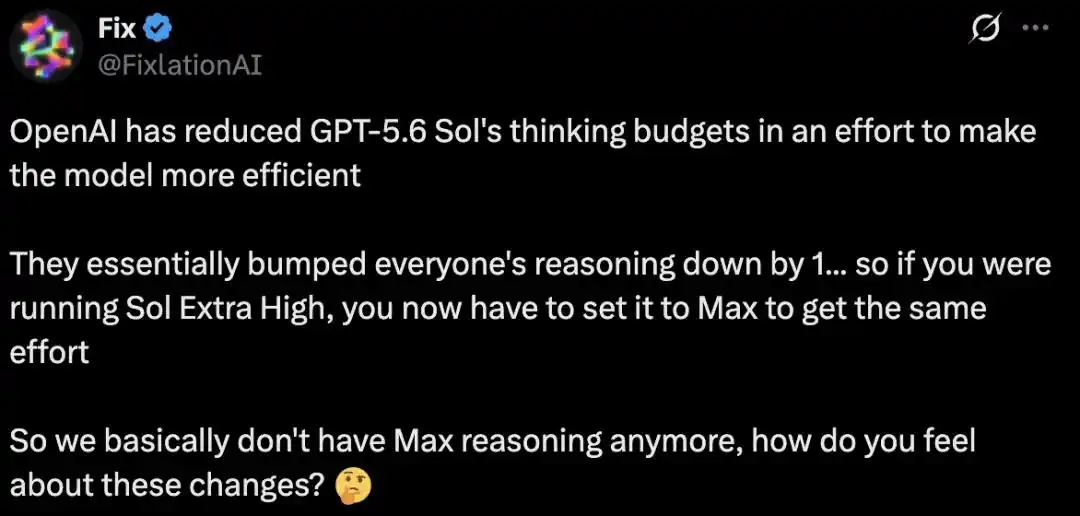
This kind of change is impossible for ordinary users to prove.

You can't see if the model weights were swapped, nor how much computing power the server allocated to you.

All you can perceive are four things: how fast it replies, how long it thinks, whether it reviews itself, and whether it calls upon other agents to help.

These are all indirect signals; none are written on a model card.

So, community users dug into it themselves and unearthed an internal parameter OpenAI never publicly disclosed: the juice value.

A Number Never Mentioned Officially

What OpenAI has publicly talked about are only the reasoning tiers.

At the GPT-5.6 launch on July 9th, the official line was the first-time introduction of max reasoning effort, "giving Sol the most ample time for deep reasoning." There's even an ultra tier above, which by default engages four agents to work in parallel.

In ChatGPT, these translate to those few options in the model selector: Medium, High, Extra High—all running Sol underneath, with the Pro tier running Sol Pro.

The juice value is the layer beneath these tiers: the internal reasoning compute budget. Users can't see it, and OpenAI has never published its values.

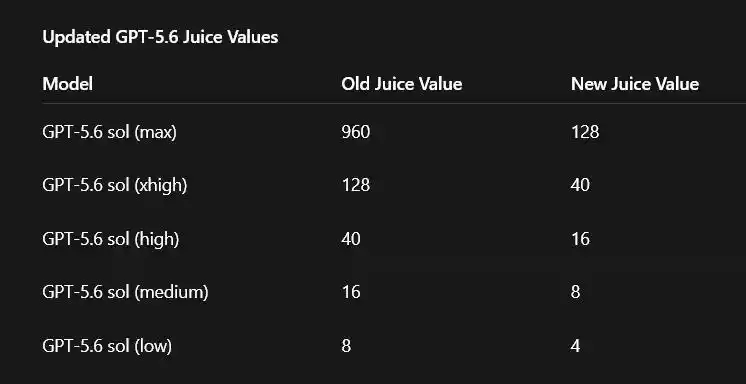
A community user, ns123abc, used a piece of hidden prompt text known as a "model fingerprint" to read a value from the system configuration: juice.

The community had previously observed that Sol's max tier corresponded to 960. This time, the screen showed 128—a drop of nearly 87%.
Almost simultaneously, another set of screenshots began circulating: the usable context for users in the Codex client had dropped from around 372k back to 272k.
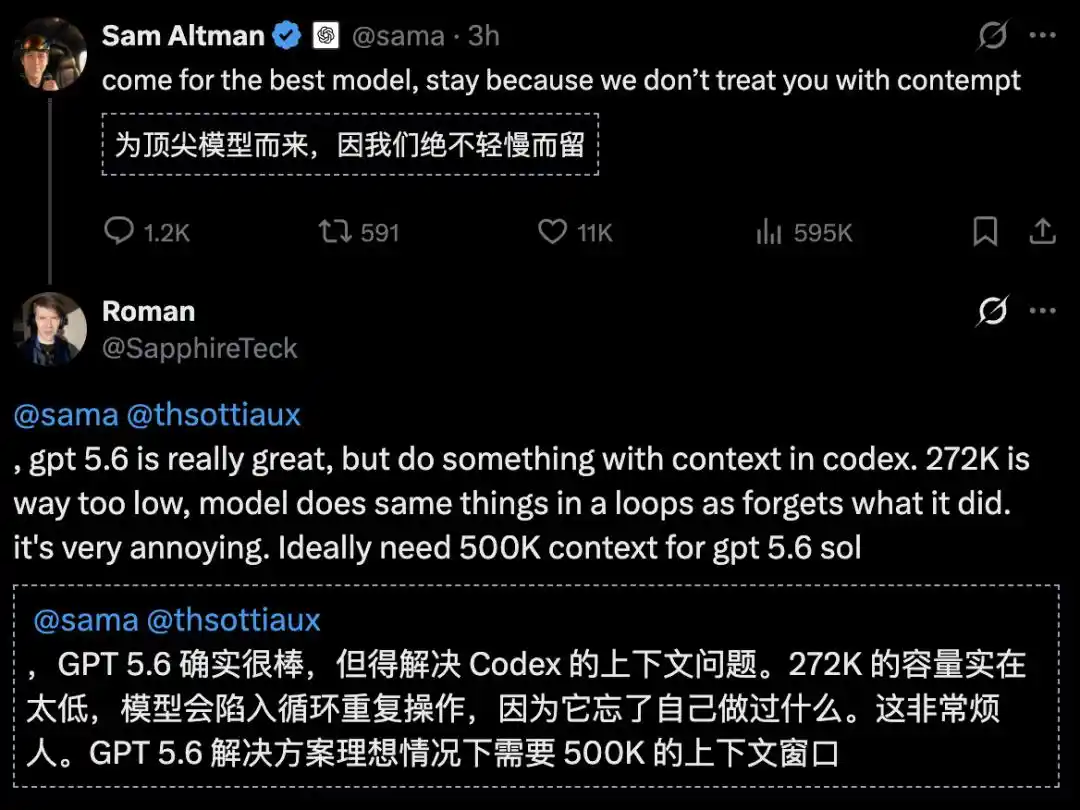
These two numbers quickly ignited the entire community.

Tibo: No Nerf, We're Investigating Usage

That same night, Tibo (Thibault Sottiaux), who leads Codex and ChatGPT Work at OpenAI, stepped up to speak.

Tibo posted an update on X, starting with: No nerf, only good things.
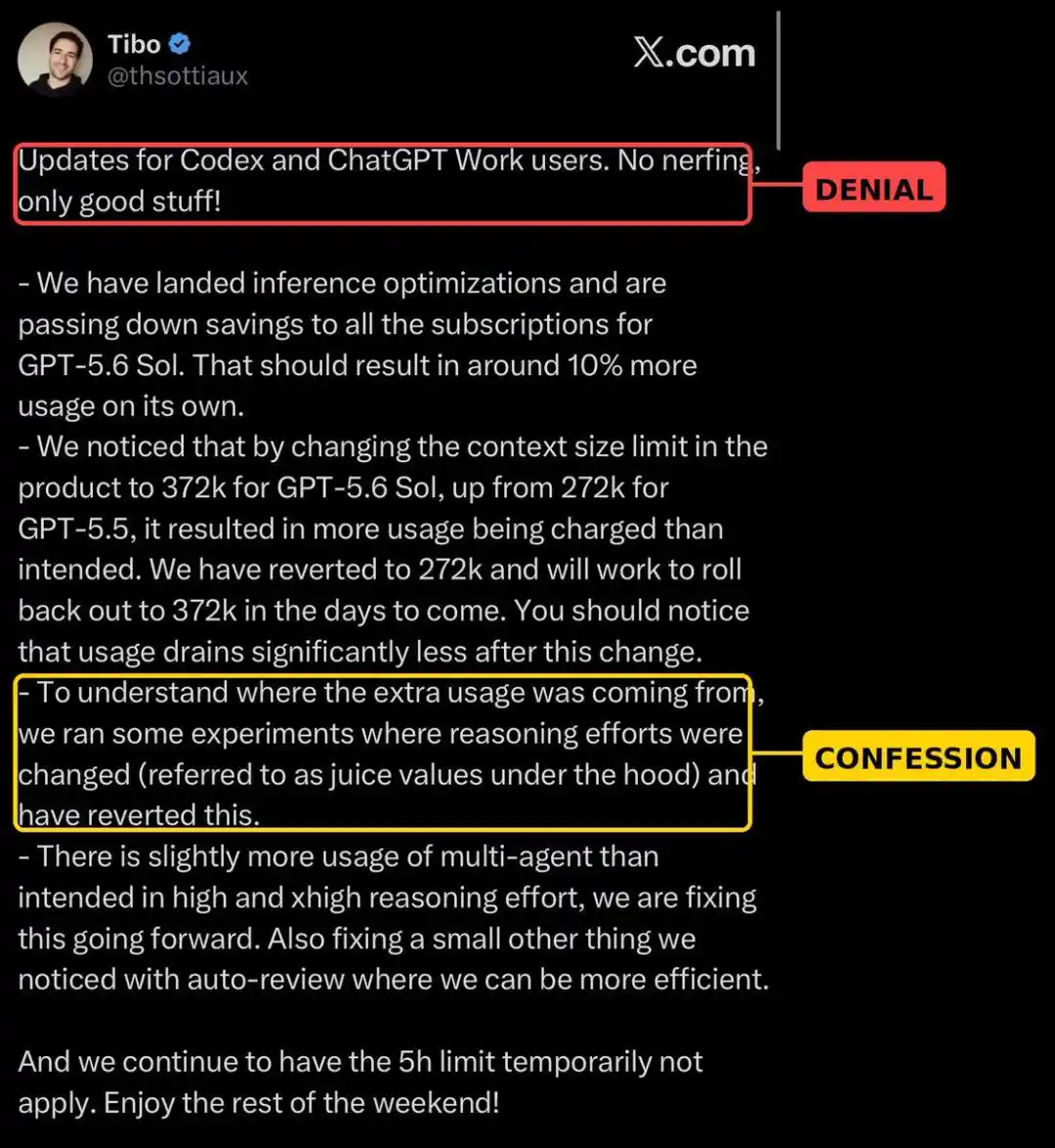
He then emphasized four points in one breath.

First, reasoning efficiency optimizations have already rolled out. The compute savings are being returned to all subscribers, which alone adds roughly 10% more usage.

Second, Sol's context window was raised from GPT-5.5's 272k to 372k, which resulted in higher-than-expected billing deductions. It has now been rolled back to 272k, with 372k being reintroduced in the coming days.

Third, to figure out where the extra usage was coming from, the team ran some experiments where they tweaked the reasoning effort—internally called "juice values."

This has now been reverted.

Fourth, the invocation of multi-agent for high and xhigh tiers was higher than expected, and there was waste on the auto-review side—both are being fixed.

Tibo's post essentially said: It's not a "nerf," it's "parameter tuning."

He didn't mention whether model weights were touched. But he did admit that the configurations users actually received had indeed been changed.

So what exactly is "juice"? Based on publicly available information, it appears closer to an internal system marker for reasoning resource allocation—roughly speaking, how much reasoning resource the system allows the model to invest in a single task.

While lowering the budget doesn't necessarily mean "the model weakened," it can quietly change many things:

How many paths can be explored in a long-horizon task, how many rounds of comparison between multiple solutions, whether code generation is actively tested after being produced, how many times it's willing to roll back after failure, and the "long-tail capabilities" in extremely difficult tasks that determine success or failure.

Ultimately, it represents how much thought the model is willing to put into a task.

To end this debate requires a strictly controlled experiment: the same model snapshot, the same batch of tasks, the same set of tool environments, changing only the juice variable.

See how much performance drops in complex coding, long-horizon agent tasks, mathematical reasoning, and error recovery.

This evidence remains absent to this day.

Every Token the Vendor Saves, the User Feels

Returning to the experiment Tibo mentioned. How did it come about?

After GPT-5.6 launched, demand surged immediately.

OpenAI temporarily lifted the five-hour usage limit window to handle the overwhelming volume of calls.
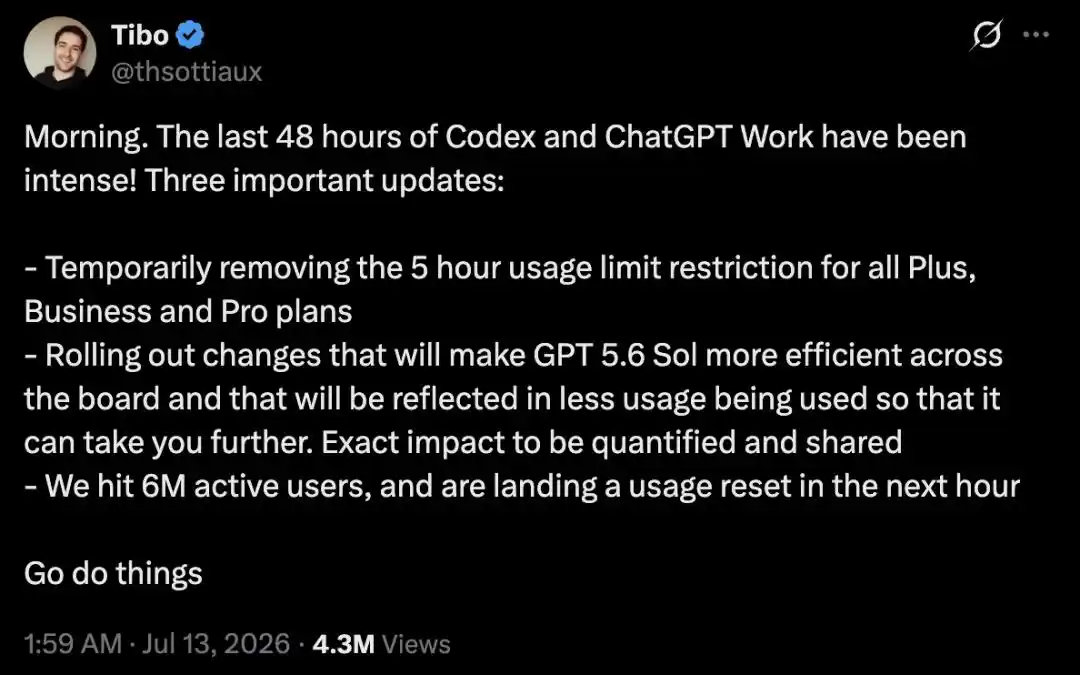
And GPT-5.6's most eye-catching new features—the longer thinking in max tier, ultra defaulting to four parallel agents, the larger context window—are precisely the token-hungry beasts.

The extra usage emerged exactly from here.

Hence, the experiment. To audit the bill, first lower the budget variable to see exactly where the usage goes—this makes perfect engineering sense.

But the problem lies exactly here: when the vendor saves tokens, users perceive it, most directly as the model "unwilling to think."

The variable that was adjusted happens to be the one users can feel.

AI Stops "Performing Miracles," Starts Punching the Clock

Over the past few years, large model companies have fostered a near-religious imagination.

People treated models like oracles, hoping they'd spit out an answer humans hadn't thought of in the dead of night, tolerating slowness, higher costs, occasional craziness.

But lab miracles can afford to ignore costs; once in production as industrial infrastructure, they cannot.

Thus, frontier models like Sol are transitioning from lab prophets who occasionally "perform miracles" into engines that keep running within daily workflows.

This resembles a process of intelligence domestication, and this controversy publicly exposed the process. Simultaneously, users' illusion of "fixed intelligence" is about to end.

Subscribing to a model is more like buying a light bulb: the model is fixed, but the brightness dial has always been in the platform's hands.

This might be the correct commercial choice, but it shouldn't forever remain in a black box.

If AI is truly to become enterprise infrastructure, vendors must provide boundaries more concrete than model names, letting users understand what exactly their paid "Max" tier guarantees.

Otherwise, it's just a price tag.

References:

https://x.com/thsottiaux/status/2076495156757577895

https://x.com/FixlationAI/status/2076469274441380349

https://www.reddit.com/r/codex/comments/1uuy5eq/nerfed_codex_sol_max/

This article is from the WeChat public account "新智元" (New AI Era), author: 元宇 (Yuan Yu)

Трендовые криптовалюты

Связанные с этим вопросы

QWhat is the main change users noticed about GPT-5.6 Sol's performance according to the article?

AUsers noticed that GPT-5.6 Sol, particularly the Max tier, seemed to have become less capable at deep reasoning and complex problem-solving, delivering shallower answers more quickly instead of its previous thorough, iterative approach.

QWhat is the 'juice value' mentioned in the context of the controversy?

AThe 'juice value' is an internal, unpublicized OpenAI parameter representing the computational budget or reasoning effort allocated for a task. The community discovered its value for the Sol Max tier had reportedly dropped from 960 to 128.

QHow did OpenAI's Thibault Sottiaux (Tibo) explain the observed performance changes?

AThibault Sottiaux stated there was no 'nerf' (reduction in intelligence). He explained that the changes resulted from an experiment to investigate unexpected usage spikes after GPT-5.6's launch, during which the internal 'juice values' (reasoning effort) were temporarily adjusted. He asserted the settings had been reverted.

QWhat practical consequence did the temporary reduction in 'juice value' have for users?

AThe reduction in the internal reasoning budget meant the model spent less computational effort on tasks. Users perceived this as the model becoming 'lazy'—providing faster but shallower responses, exploring fewer solution paths, and performing less self-review and error recovery.

QWhat broader implication does the article suggest this incident has for AI as a service?

AThe incident reveals that a user's subscription buys a variable level of service, where key performance parameters like 'reasoning effort' are controlled by the provider and can be adjusted. The article argues that for AI to be trusted enterprise infrastructure, providers must offer clearer, more specific guarantees about what performance tiers actually entail, moving beyond just model names.

Похожее

Свадебное дело Чхве Тхэвона закрыто: раскрывая скрытые линии наследования за триллионной империей SK Hynix

Дело о разводе главы SK Group Чхве Тхэвона завершилось, раскрывая сложные сценарии наследования в конгломерате, стоящем за SK Hynix, чья капитализация превысила 1000 трлн вон. В отличие от традиционных сценариев наследования в чеблях, где ключевую роль играют первенец, доли, брачные связи и отцовское признание, трое детей Чхве Тхэвона от бывшей жены Но Соён — дочь Чхве Юнджон (1989 г.р.), дочь Чхве Минджон (1991 г.р.) и сын Чхве Ингын (1995 г.р.) — следуют разными путями. Чхве Юнджон, названная СМИ «наиболее очевидным кандидатом», занимает руководящую должность в SK Inc. и работает над стратегией развития в области биотехнологий и точной медицины, сочетая научную подготовку с бизнес-опытом. Её брак с основателем ИИ-стартапа символизирует новый тип элитных союзов. Чхве Минджон, добровольно служившая в ВМС Республики Корея и работавшая в сфере международной политики в SK Hynix в США, сейчас является основателем ИИ-стартапа в сфере здравоохранения. Её брак с бывшим офицером морской пехоты США подчёркивает связь с геополитическим контекстом, в котором теперь существует полупроводниковый гигант. Чхве Ингын, единственный сын и, казалось бы, естественный наследник по старой логике, сохраняет молчание. Имея образование в области физики, он покинул SK E&S, чтобы присоединиться к McKinsey, что рассматривается как стандартная внешняя стажировка, но без явных сигналов о наследовании. Громкое судебное разбирательство по разводу родителей, связанное с разделом активов на триллионы вон, стало фоном для их путей. По мере того как SK Hynix становится глобальным геополитическим активом в эпоху ИИ, наследование в SK перестаёт быть семейным делом, превращаясь в публичный экзамен на легитимность в новой, сложной реальности. Наследникам предстоит найти свои собственные ответы на вызовы эпохи.

marsbit2 дня назад 09:08

Свадебное дело Чхве Тхэвона закрыто: раскрывая скрытые линии наследования за триллионной империей SK Hynix

marsbit2 дня назад 09:08

Банки выступают против компромисса по доходности стейблкоинов – Найдёт ли закон CLARITY 60 голосов?

Американский Банковский институт политики выступил против нового проекта закона CLARITY Act, указав на пробелы в регулировании доходности стейблкоинов и мерах по борьбе с незаконными финансами. Банковский сектор добивается полного запрета любых форм вознаграждений по стейблкоинам и лоббирует сенаторов, что снижает поддержку со стороны республиканцев. Из-за смерти сенатора Грэма и болезни Макконнелла у республиканцев стало 51 голос. Если сенаторы Кёртис и Корнин откажут в поддержке, эта цифра упадет до 49, а для принятия закона потребуется 60 голосов. Необходимость заручиться поддержкой 11 демократов осложняется тем, что некоторые про-крипто демократы также выступают против законопроекта. Сроки ограничены: до августовских каникул Сената осталось две недели. Лидер большинства Джон Тюн сомневается в успехе до перерыва. Советник Белого дома по криптовалютам Патрик Уитт призывает провести голосование, утверждая, что новые этические нормы устраняют возражения демократов. Вероятность принятия закона в 2026 году, по рыночным оценкам, упала до 32%.

ambcrypto2 дня назад 09:03

Банки выступают против компромисса по доходности стейблкоинов – Найдёт ли закон CLARITY 60 голосов?

ambcrypto2 дня назад 09:03

За 2 месяца оценка выросла с 8,8 до 68 млрд юаней! Крупнейший AI-хаб OpenRouter может быть куплен

Stripe ведет переговоры о приобретении стартапа OpenRouter, агрегатора API крупных языковых моделей, за сумму около 100 миллиардов долларов. Это представляет собой семикратный рост по сравнению с оценкой OpenRouter в 13 миллиардов долларов двумя месяцами ранее. OpenRouter выступает в качестве «маршрутизатора» или агрегатора для более чем 400 AI-моделей (таких как GPT, Claude и множество открытых), позволяя разработчикам через единый API выбирать наиболее подходящую модель для каждой задачи на основе стоимости, скорости и сложности. Это помогает приложениям снижать расходы, автоматически направляя простые запросы к более дешевым моделям. Компания, основанная соучредителем OpenSea Алексом Аталлой, демонстрирует быстрый рост: ее ежегодный доход достиг 50 миллионов долларов, увеличившись в пять раз за полгода. Для Stripe, крупнейшего процессора онлайн-платежей, это вторая крупная сделка в сфере AI-инфраструктуры после приобретения платформы биллинга Metronome в 2025 году. Стратегия Stripe заключается в создании комплексного предложения для AI-экономики: OpenRouter будет «выбирать модель», Metronome — «подсчитывать потребление», а существующие платежные сервисы Stripe — «обрабатывать оплату». Таким образом, Stripe стремится контролировать ключевой уровень инфраструктуры, который определяет распределение трафика между моделями и формирует счета для конечных предприятий. Сделка подчеркивает растущую важность промежуточного слоя, который управляет стоимостью и выбором моделей для миллионов пользователей AI-приложений.

链捕手2 дня назад 09:00

За 2 месяца оценка выросла с 8,8 до 68 млрд юаней! Крупнейший AI-хаб OpenRouter может быть куплен

链捕手2 дня назад 09:00

От OpenSea до OpenRouter: Алекс Аталлах повторяет сценарий «ухода на пике»?

Автор: Нэнси, PANews Алекс Аталла, соучредитель NFT-платформы OpenSea, покинул компанию на пике пузыря NFT четыре года назад. Сейчас он снова оказывается в центре внимания на волне бума ИИ, готовясь продать созданную им агрегирующую платформу AI-моделей OpenRouter по высокой цене. По данным The Wall Street Journal от 23 июля, платежный гигант Stripe ведет переговоры о приобретении OpenRouter, при этом потенциальная оценка сделки может приблизиться к 100 миллиардам долларов. Если сделка состоится, это станет еще одним успехом Аталлы в создании компании на уровне ста миллиардов долларов после OpenSea. Ранее в этом месяце появились сообщения о том, что OpenRouter получил предложения о покупке от нескольких крупных технологических компаний. Потенциальная сделка со Stripe рассматривается как важный шаг для инфраструктурного гиганта в сфере платежей по расширению своего присутствия в области инфраструктуры ИИ. По данным информированных источников, если сделка будет заключена, оценка OpenRouter может приблизиться к 100 миллиардам долларов, что значительно превышает его предыдущие оценки при финансировании. Всего за три года компания добилась быстрого роста благодаря буму больших моделей. Это не первая компания Аталлы стоимостью в сто миллиардов. Ранее он был соучредителем OpenSea, ведущей мировой платформы для торговли NFT, пиковая оценка которой превысила 130 миллиардов долларов. Его уход с OpenSea до серьезного спада на рынке NFT рассматривался как знаковый сигнал. OpenRouter стала крупнейшим хабом в эпоху ИИ, подключившись к более чем 400 AI-моделям, имея около 10 миллионов пользователей и обрабатывая более 200 триллионов токенов в месяц. Однако, несмотря на быстрый рост, это бизнес с большими объемами, но ограниченной рентабельностью. Его основная бизнес-модель заключается в взимании комиссии за платформу (около 5-5,5%) при вызове разработчиками AI-моделей. Конкуренция на рынке агрегации AI-моделей также обостряется. Высокая оценка OpenRouter, возможно, больше отражает его будущий потенциал, чем текущую прибыльность. Для потенциальных покупателей наиболее ценным активом могут быть не текущие доходы, а накопленные реальные данные об использовании ИИ, которые трудно быстро воспроизвести. От NFT к ИИ Алекс Аталла дважды поймал волну технологического бума. Если продажа OpenRouter состоится с оценкой в 100 миллиардов долларов, это может означать либо переоценку стоимости инфраструктуры ИИ, либо сигнал о новом пике цикла. Ответ на этот вопрос даст только время.

链捕手2 дня назад 08:44

От OpenSea до OpenRouter: Алекс Аталлах повторяет сценарий «ухода на пике»?

链捕手2 дня назад 08:44

Приближается ли Биткойн к очередной зоне накопления? ЭТОТ сигнал говорит «да»

Аналитики отмечают, что Bitcoin (BTC) переживает один из самых длительных медвежьих периодов, охватывающий три квартала и два календарных года, при этом его динамика отклонилась от рынка акций. Однако сохраняется корреляция с акциями Apple (AAPL). График соотношения BTC/AAPL с 2017 года движется в восходящем канале, где его нижняя граница традиционно сигнализирует о зоне недооценки (накопления) для Bitcoin, а верхняя — о перекупленности. В настоящее время соотношение приближается к линии поддержки, что, по историческим данным, может предшествовать новой фазе роста BTC. При этом в 2025 году нарушилась многолетняя корреляция годовой доходности Bitcoin с индексами S&P 500 и Nasdaq 100, что объясняется его более резкой реакцией на макроэкономические потрясения. В качестве подтверждающего сигнала для разворота рассматриваются поступления стейблкоинов на криптобиржи, которые указывают на готовность капитала к реинвестированию. За последние семь дней чистый приток составил $1,42 млрд, что значительно меньше оттока в $10 млрд за предыдущие 30 дней и пока недостаточно для уверенного старта ралли. Таким образом, соотношение BTC/AAPL указывает на возможное приближение к зоне накопления, но для подтверждения тренда необходимы более значительные притоки стейблкоинов.

ambcrypto2 дня назад 08:24

Приближается ли Биткойн к очередной зоне накопления? ЭТОТ сигнал говорит «да»

ambcrypto2 дня назад 08:24

Торговля

Спот

Популярные статьи

Обсуждения

Добро пожаловать в Сообщество HTX. Здесь вы сможете быть в курсе последних новостей о развитии платформы и получить доступ к профессиональной аналитической информации о рынке. Мнения пользователей о цене на SOL (SOL) представлены ниже.

活动图片