Strategy's Accounting Gimmick: The Cap on BTC Sales Far Exceeds $1.25 Billion

Odaily星球日报Опубликовано 2026-07-10Обновлено 2026-07-10

Введение

The article, originally from Bankless, discusses how MicroStrategy's (MSTR) recent Bitcoin (BTC) sales reveal a much larger potential selling capacity than the widely reported $1.25 billion "reserve-building" cap. On July 7, MicroStrategy disclosed a sale of 3,588 BTC (~$216M) to pay dividends for its STRAT (STRC) preferred shares and replenish its USD Reserve. Crucially, the company stated this sale did not count against its stated $1.25 billion "reserve-building capacity." The analysis explains that MicroStrategy's "BTC Monetization Plan," part of its broader "Digital Credit Capital Framework," actually outlines three main purposes for selling BTC, only one of which has the $1.25B cap: 1. **Building the USD Reserve** (capped at $1.25B). 2. **Covering preferred share/ debt costs** (replenishing the reserve after payments). 3. **Funding buybacks** (up to $10B for preferred shares and $10B for MSTR common stock). The key nuance is the accounting distinction between "building" the reserve (selling BTC before making payments) and "replenishing" it (selling BTC after using reserve funds for payments). While functionally the same—converting BTC to cash for obligations—only "building" counts against the publicized $1.25B limit. This means sales for "replenishing" and the $20B+ buyback pool allow for total potential sales exceeding $30B. The article frames this as part of MicroStrategy's shift from a simple "buy and hold" Bitcoin narrative to an "active capital management" mo...

This article is from:Bankless

Compiled by|Odaily Planet Daily (@OdailyChina); Translator|Azuma (@azuma_eth)

On July 7th, Strategy disclosed that the company sold 3,588 BTC between June 29th and July 5th, worth approximately $216 million.

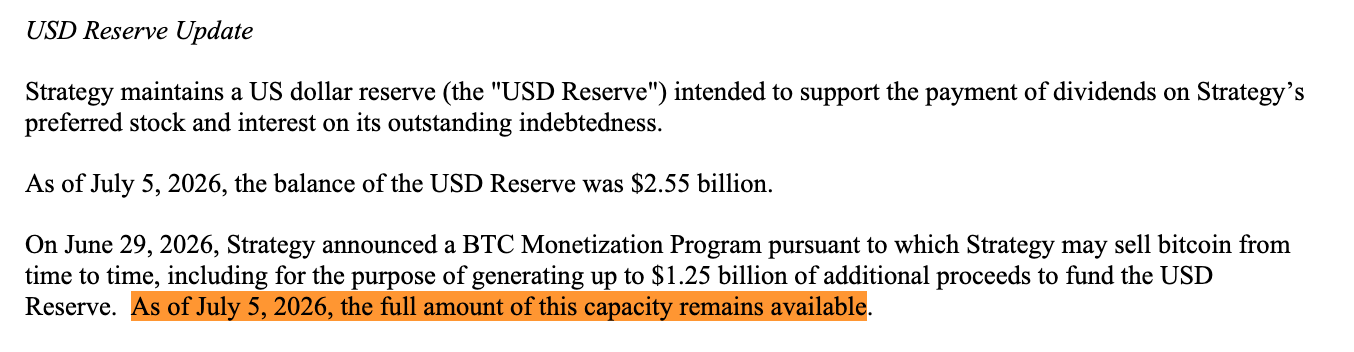
These funds were used to pay STR C dividends and replenish the USD Reserve previously used for dividend payments. Despite completing this sale, Strategy stated that its full $1.25 billion reserve-building capacity remains intact.

  • Odaily Note: In the "self-help plan" announced last week, Strategy had indicated it authorized the company to sell BTC to build a USD reserve of up to $1.25 billion.

In other words, the $216 million worth of BTC sold to replenish the reserve is not counted against the previously disclosed reserve-building capacity.

Strictly speaking, there is a technical distinction: one is "replenishing," and the other is "building." However, in practice, both types of sales ultimately flow into the same reserve pool for the same purpose, just categorized for different uses.

From another perspective, the previously disclosed "BTC Monetization Program" never limited Strategy to selling only $1.25 billion worth of Bitcoin in total; it only capped one specific funding pool — the sale of BTC to "build" the USD reserve.

The plan also permits Strategy to sell BTC for other purposes, which is exactly what we are seeing now.
Three Funding Pools

On June 29th, after weeks of pressure on MSTR and STR C, Strategy launched the aforementioned BTC "Monetization Program" as part of its broader "Digital Credit Capital Framework."

This plan allows Strategy to sell Bitcoin and actually mentions three primary uses:

  • First, to Build the reserve: Sell up to $1.25 billion worth of BTC to establish a USD Reserve.
  • Second, to Cover the preferreds: Sell BTC to cover Strategy's fixed dividend and interest obligations on its preferred shares and debt. If management deems it "more advantageous to sell BTC than issue common stock," they may also sell BTC to replenish reserve funds previously used to cover these obligations.
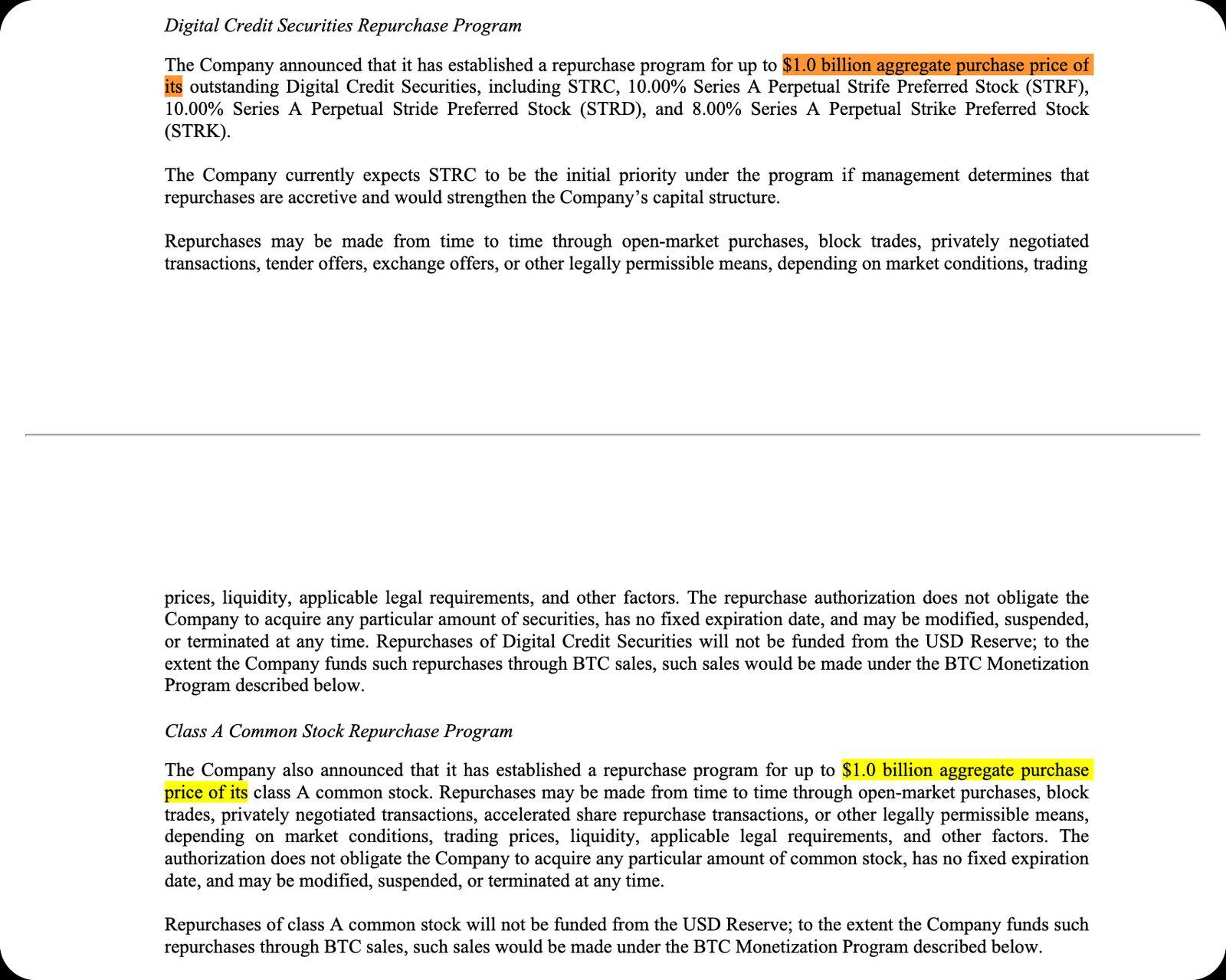
  • Third, to Fund buybacks: Sell BTC to repurchase up to $1 billion worth of preferred shares and up to $1 billion worth of MSTR common stock. Additionally, proceeds from BTC sales may also cover related taxes, fees, and other expenses.

At the time, the entire market discussion focused on the $1.25 billion cap for the first funding pool, but the reality is far more complex.

Looking solely at the third pool, it adds an additional $2 billion in potential sales. Therefore, even calculating only the parts with explicit caps, Strategy's currently designed BTC sale plan already exceeds $3 billion. This does not include the funding pool for paying dividends, interest, and replenishing the reserve — for which there is no disclosed cap.
Building vs. Replenishing

This is where it gets truly subtle.

The purpose of the USD Reserve is to pay these preferred share dividends and debt interest obligations. Under the current policy framework, it cannot be used for stock buybacks.

As of June 28th, Strategy's USD Reserve stood at $2.55 billion, sufficient to cover the company's annual obligations of approximately $1.76 billion for debt and preferred shares, providing about 17 months of coverage. The board has set a minimum requirement to maintain 12 months of coverage unless board-approved reductions occur.

This is why the distinction between "building" and "replenishing" the reserve is noteworthy.

  • Selling BTC before paying dividends to add cash to the reserve: This is defined as "building."
  • Using the reserve to pay dividends, then selling BTC to refill the reserve: This is defined as "replenishing."

The plan treats these as different categories, but they essentially accomplish the same thing — converting BTC into cash to cover preferred share dividends and interest payments.

These details were already disclosed in the documents, but the recent sale made this categorical distinction more apparent. Strategy sold $216 million worth of BTC, using the funds to pay dividends and replenish the reserve, while simultaneously announcing that its $1.25 billion reserve-building capacity remains intact.

Now, the market needs to start understanding Strategy's "proprietary language": "Building" and "replenishing" are essentially accounting classifications, but they determine whether Strategy's BTC sales count against the "public cap" the market sees.

From Hoarding to Active Capital Management

In the June 29th announcement, Michael Saylor stated that this framework reflects Strategy's need for "liquidity, discipline, and active capital management."

Strategy CEO Phong Le was more direct: "Strategy is shifting from a one-way capital issuance model to an active capital management model."

As Matt Walsh and Jeff Dorman from Castle Island explained in a podcast last week, Strategy has essentially evolved into an actively managed hedge fund.

The past Strategy narrative was simple: sell MSTR stock → buy Bitcoin → provide investors with leveraged BTC exposure. But the logic has now changed.

Today, Strategy is buying and selling different components within its own capital structure to manage the pressures between common stock (MSTR), preferred shares, the USD Reserve, and Bitcoin assets (BTC).

This dynamic also introduces new conflicts of interest. Walsh and Dorman pointed out:

  • Selling common stock can support preferred share dividends but depress MSTR's premium relative to its underlying BTC holdings.
  • Selling Bitcoin can extend the cash runway but further erode the core "never sell" narrative.
  • Supporting the preferred share system can maintain market confidence but depletes cash reserves.
  • Cutting preferred share dividends can protect liquidity but may cause preferred share prices to crash.

The so-called "reserve loophole" is an embodiment of this shift. Bitcoin is no longer just an asset for Strategy to accumulate; it is becoming a balance-sheet lever used to keep the preferred share system operational.

What We Will Ultimately See

Now, investors must assess Saylor's ability to operate this "machine" — each adjustment to one lever in the capital structure helps one part while potentially threatening another.

This is the most significant takeaway following the July 6th filing disclosure. Strategy is not out of options. It likely has more room to maneuver than what is apparent on the surface.

Don't continue to mistakenly believe that the $1.25 billion cap represents the total ceiling for Strategy's Bitcoin sales.

Today, Strategy has become an institution that the market must relearn to understand. Now, every proprietary term matters more:

  • Build
  • Replenish
  • Issue
  • Repurchase
  • Defend

Just as Fed watchers parse every punctuation mark in policy statements, the market must also deconstruct every term Strategy uses to gauge what it implies for future BTC sales.

By rolling out this plan, Strategy has secured greater flexibility for itself, but the underlying contradictions persist. This is no longer a simple "leveraged Bitcoin play." It has now become a bet on active capital management prowess.

Can Strategy consistently manage to "sell BTC," "replenish reserves," "issue securities," "repurchase stock," and "maintain the capital structure" without any one action undermining the others?

Personally, I wouldn't want to bet on it.

Трендовые криптовалюты

Связанные с этим вопросы

QWhat are the three main purposes for which MicroStrategy's BTC Monetization Program allows the company to sell Bitcoin, according to the article?

AAccording to the article, MicroStrategy's BTC Monetization Program allows the company to sell Bitcoin for three main purposes: 1) To build a USD reserve (up to $1.25 billion). 2) To cover the costs of preferred shares and debt (covering fixed dividend and interest obligations). 3) To fund buyback programs (up to $1 billion for preferred shares and up to $1 billion for MSTR common stock).

QWhat is the key difference between 'building' and 'replenishing' the USD reserve, and why is this distinction important in understanding MicroStrategy's potential Bitcoin sales?

AThe key difference is an accounting classification. 'Building' refers to selling BTC and adding cash to the USD reserve *before* using it to pay obligations. 'Replenishing' refers to using the reserve cash to pay obligations (like dividends) first and *then* selling BTC to refill the reserve. This distinction is crucial because the publicly announced $1.25 billion cap applies only to 'building' the reserve. Sales for 'replenishing' do not count against this public limit, meaning the total potential BTC sales for reserve purposes is effectively uncapped.

QAccording to the article, what is the new narrative for MicroStrategy, shifting away from its previous simple model?

AThe article states that MicroStrategy's narrative has shifted from a simple model of 'selling MSTR stock → buying Bitcoin → providing leveraged BTC exposure' to becoming an 'actively managed hedge fund.' It is now actively buying and selling different components of its capital structure (common stock, preferred shares, USD reserve, Bitcoin assets) to manage the pressure and conflicts between them.

QWhat core conflict or dilemma does the article highlight regarding MicroStrategy's use of Bitcoin as a 'balance-sheet lever'?

AThe article highlights that Bitcoin is no longer just an asset for perpetual accumulation but has become a 'balance-sheet lever' used to maintain the preferred share system. This creates a core conflict: selling Bitcoin can extend cash flow and support the preferred share system, but it simultaneously weakens the foundational 'never sell' narrative that was central to the company's original investment thesis.

QWhat is the main conclusion or warning the article provides to investors regarding the $1.25 billion reserve-building capacity?

AThe main conclusion and warning is that investors should not mistake the $1.25 billion reserve-building capacity as the total upper limit for MicroStrategy's Bitcoin sales. When including the other authorized purposes (like funding buybacks and covering obligations without a stated cap), the designed potential sales exceed $3 billion, and sales for 'replenishing' the reserve are effectively unlimited within the framework. The company has given itself far more flexibility to sell BTC than the headline $1.25 billion figure suggests.

Похожее

Свадебное дело Чхве Тхэвона закрыто: раскрывая скрытые линии наследования за триллионной империей SK Hynix

Дело о разводе главы SK Group Чхве Тхэвона завершилось, раскрывая сложные сценарии наследования в конгломерате, стоящем за SK Hynix, чья капитализация превысила 1000 трлн вон. В отличие от традиционных сценариев наследования в чеблях, где ключевую роль играют первенец, доли, брачные связи и отцовское признание, трое детей Чхве Тхэвона от бывшей жены Но Соён — дочь Чхве Юнджон (1989 г.р.), дочь Чхве Минджон (1991 г.р.) и сын Чхве Ингын (1995 г.р.) — следуют разными путями. Чхве Юнджон, названная СМИ «наиболее очевидным кандидатом», занимает руководящую должность в SK Inc. и работает над стратегией развития в области биотехнологий и точной медицины, сочетая научную подготовку с бизнес-опытом. Её брак с основателем ИИ-стартапа символизирует новый тип элитных союзов. Чхве Минджон, добровольно служившая в ВМС Республики Корея и работавшая в сфере международной политики в SK Hynix в США, сейчас является основателем ИИ-стартапа в сфере здравоохранения. Её брак с бывшим офицером морской пехоты США подчёркивает связь с геополитическим контекстом, в котором теперь существует полупроводниковый гигант. Чхве Ингын, единственный сын и, казалось бы, естественный наследник по старой логике, сохраняет молчание. Имея образование в области физики, он покинул SK E&S, чтобы присоединиться к McKinsey, что рассматривается как стандартная внешняя стажировка, но без явных сигналов о наследовании. Громкое судебное разбирательство по разводу родителей, связанное с разделом активов на триллионы вон, стало фоном для их путей. По мере того как SK Hynix становится глобальным геополитическим активом в эпоху ИИ, наследование в SK перестаёт быть семейным делом, превращаясь в публичный экзамен на легитимность в новой, сложной реальности. Наследникам предстоит найти свои собственные ответы на вызовы эпохи.

marsbit2 дня назад 09:08

Свадебное дело Чхве Тхэвона закрыто: раскрывая скрытые линии наследования за триллионной империей SK Hynix

marsbit2 дня назад 09:08

Банки выступают против компромисса по доходности стейблкоинов – Найдёт ли закон CLARITY 60 голосов?

Американский Банковский институт политики выступил против нового проекта закона CLARITY Act, указав на пробелы в регулировании доходности стейблкоинов и мерах по борьбе с незаконными финансами. Банковский сектор добивается полного запрета любых форм вознаграждений по стейблкоинам и лоббирует сенаторов, что снижает поддержку со стороны республиканцев. Из-за смерти сенатора Грэма и болезни Макконнелла у республиканцев стало 51 голос. Если сенаторы Кёртис и Корнин откажут в поддержке, эта цифра упадет до 49, а для принятия закона потребуется 60 голосов. Необходимость заручиться поддержкой 11 демократов осложняется тем, что некоторые про-крипто демократы также выступают против законопроекта. Сроки ограничены: до августовских каникул Сената осталось две недели. Лидер большинства Джон Тюн сомневается в успехе до перерыва. Советник Белого дома по криптовалютам Патрик Уитт призывает провести голосование, утверждая, что новые этические нормы устраняют возражения демократов. Вероятность принятия закона в 2026 году, по рыночным оценкам, упала до 32%.

ambcrypto2 дня назад 09:03

Банки выступают против компромисса по доходности стейблкоинов – Найдёт ли закон CLARITY 60 голосов?

ambcrypto2 дня назад 09:03

За 2 месяца оценка выросла с 8,8 до 68 млрд юаней! Крупнейший AI-хаб OpenRouter может быть куплен

Stripe ведет переговоры о приобретении стартапа OpenRouter, агрегатора API крупных языковых моделей, за сумму около 100 миллиардов долларов. Это представляет собой семикратный рост по сравнению с оценкой OpenRouter в 13 миллиардов долларов двумя месяцами ранее. OpenRouter выступает в качестве «маршрутизатора» или агрегатора для более чем 400 AI-моделей (таких как GPT, Claude и множество открытых), позволяя разработчикам через единый API выбирать наиболее подходящую модель для каждой задачи на основе стоимости, скорости и сложности. Это помогает приложениям снижать расходы, автоматически направляя простые запросы к более дешевым моделям. Компания, основанная соучредителем OpenSea Алексом Аталлой, демонстрирует быстрый рост: ее ежегодный доход достиг 50 миллионов долларов, увеличившись в пять раз за полгода. Для Stripe, крупнейшего процессора онлайн-платежей, это вторая крупная сделка в сфере AI-инфраструктуры после приобретения платформы биллинга Metronome в 2025 году. Стратегия Stripe заключается в создании комплексного предложения для AI-экономики: OpenRouter будет «выбирать модель», Metronome — «подсчитывать потребление», а существующие платежные сервисы Stripe — «обрабатывать оплату». Таким образом, Stripe стремится контролировать ключевой уровень инфраструктуры, который определяет распределение трафика между моделями и формирует счета для конечных предприятий. Сделка подчеркивает растущую важность промежуточного слоя, который управляет стоимостью и выбором моделей для миллионов пользователей AI-приложений.

链捕手2 дня назад 09:00

За 2 месяца оценка выросла с 8,8 до 68 млрд юаней! Крупнейший AI-хаб OpenRouter может быть куплен

链捕手2 дня назад 09:00

От OpenSea до OpenRouter: Алекс Аталлах повторяет сценарий «ухода на пике»?

Автор: Нэнси, PANews Алекс Аталла, соучредитель NFT-платформы OpenSea, покинул компанию на пике пузыря NFT четыре года назад. Сейчас он снова оказывается в центре внимания на волне бума ИИ, готовясь продать созданную им агрегирующую платформу AI-моделей OpenRouter по высокой цене. По данным The Wall Street Journal от 23 июля, платежный гигант Stripe ведет переговоры о приобретении OpenRouter, при этом потенциальная оценка сделки может приблизиться к 100 миллиардам долларов. Если сделка состоится, это станет еще одним успехом Аталлы в создании компании на уровне ста миллиардов долларов после OpenSea. Ранее в этом месяце появились сообщения о том, что OpenRouter получил предложения о покупке от нескольких крупных технологических компаний. Потенциальная сделка со Stripe рассматривается как важный шаг для инфраструктурного гиганта в сфере платежей по расширению своего присутствия в области инфраструктуры ИИ. По данным информированных источников, если сделка будет заключена, оценка OpenRouter может приблизиться к 100 миллиардам долларов, что значительно превышает его предыдущие оценки при финансировании. Всего за три года компания добилась быстрого роста благодаря буму больших моделей. Это не первая компания Аталлы стоимостью в сто миллиардов. Ранее он был соучредителем OpenSea, ведущей мировой платформы для торговли NFT, пиковая оценка которой превысила 130 миллиардов долларов. Его уход с OpenSea до серьезного спада на рынке NFT рассматривался как знаковый сигнал. OpenRouter стала крупнейшим хабом в эпоху ИИ, подключившись к более чем 400 AI-моделям, имея около 10 миллионов пользователей и обрабатывая более 200 триллионов токенов в месяц. Однако, несмотря на быстрый рост, это бизнес с большими объемами, но ограниченной рентабельностью. Его основная бизнес-модель заключается в взимании комиссии за платформу (около 5-5,5%) при вызове разработчиками AI-моделей. Конкуренция на рынке агрегации AI-моделей также обостряется. Высокая оценка OpenRouter, возможно, больше отражает его будущий потенциал, чем текущую прибыльность. Для потенциальных покупателей наиболее ценным активом могут быть не текущие доходы, а накопленные реальные данные об использовании ИИ, которые трудно быстро воспроизвести. От NFT к ИИ Алекс Аталла дважды поймал волну технологического бума. Если продажа OpenRouter состоится с оценкой в 100 миллиардов долларов, это может означать либо переоценку стоимости инфраструктуры ИИ, либо сигнал о новом пике цикла. Ответ на этот вопрос даст только время.

链捕手2 дня назад 08:44

От OpenSea до OpenRouter: Алекс Аталлах повторяет сценарий «ухода на пике»?

链捕手2 дня назад 08:44

Приближается ли Биткойн к очередной зоне накопления? ЭТОТ сигнал говорит «да»

Аналитики отмечают, что Bitcoin (BTC) переживает один из самых длительных медвежьих периодов, охватывающий три квартала и два календарных года, при этом его динамика отклонилась от рынка акций. Однако сохраняется корреляция с акциями Apple (AAPL). График соотношения BTC/AAPL с 2017 года движется в восходящем канале, где его нижняя граница традиционно сигнализирует о зоне недооценки (накопления) для Bitcoin, а верхняя — о перекупленности. В настоящее время соотношение приближается к линии поддержки, что, по историческим данным, может предшествовать новой фазе роста BTC. При этом в 2025 году нарушилась многолетняя корреляция годовой доходности Bitcoin с индексами S&P 500 и Nasdaq 100, что объясняется его более резкой реакцией на макроэкономические потрясения. В качестве подтверждающего сигнала для разворота рассматриваются поступления стейблкоинов на криптобиржи, которые указывают на готовность капитала к реинвестированию. За последние семь дней чистый приток составил $1,42 млрд, что значительно меньше оттока в $10 млрд за предыдущие 30 дней и пока недостаточно для уверенного старта ралли. Таким образом, соотношение BTC/AAPL указывает на возможное приближение к зоне накопления, но для подтверждения тренда необходимы более значительные притоки стейблкоинов.

ambcrypto2 дня назад 08:24

Приближается ли Биткойн к очередной зоне накопления? ЭТОТ сигнал говорит «да»

ambcrypto2 дня назад 08:24

Торговля

Спот

Популярные статьи

Как купить CAP

Добро пожаловать на HTX.com! Мы сделали приобретение Cap (CAP) простым и удобным. Следуйте нашему пошаговому руководству и отправляйтесь в свое крипто-путешествие.Шаг 1: Создайте аккаунт на HTXИспользуйте свой адрес электронной почты или номер телефона, чтобы зарегистрироваться и бесплатно создать аккаунт на HTX. Пройдите удобную регистрацию и откройте для себя весь функционал.Создать аккаунтШаг 2: Перейдите в Купить криптовалюту и выберите свой способ оплатыКредитная/Дебетовая Карта: Используйте свою карту Visa или Mastercard для мгновенной покупки Cap (CAP).Баланс: Используйте средства с баланса вашего аккаунта HTX для простой торговли.Третьи Лица: Мы добавили популярные способы оплаты, такие как Google Pay и Apple Pay, для повышения удобства.P2P: Торгуйте напрямую с другими пользователями на HTX.Внебиржевая Торговля (OTC): Мы предлагаем индивидуальные услуги и конкурентоспособные обменные курсы для трейдеров.Шаг 3: Хранение Cap (CAP)После приобретения вами Cap (CAP) храните их в своем аккаунте на HTX. В качестве альтернативы вы можете отправить их куда-либо с помощью перевода в блокчейне или использовать для торговли с другими криптовалютами.Шаг 4: Торговля Cap (CAP)С легкостью торгуйте Cap (CAP) на спотовом рынке HTX. Просто зайдите в свой аккаунт, выберите торговую пару, совершайте сделки и следите за ними в режиме реального времени. Мы предлагаем удобный интерфейс как для начинающих, так и для опытных трейдеров.

216 просмотров всегоОпубликовано 2026.06.26Обновлено 2026.06.26

Как купить CAP

Обсуждения

Добро пожаловать в Сообщество HTX. Здесь вы сможете быть в курсе последних новостей о развитии платформы и получить доступ к профессиональной аналитической информации о рынке. Мнения пользователей о цене на CAP (CAP) представлены ниже.

活动图片