AI Folding: Fable 5 and GPT-5.6 Are Becoming the Privilege of a Few

marsbitОпубликовано 2026-07-06Обновлено 2026-07-06

Введение

【AI Accessibility Gap Widens: Elite Tools Like Fable 5 and GPT-5.6 Are Becoming Privileged】 We are witnessing a growing "AI divide." A stark reality is emerging: a tiny fraction of elites, primarily in tech, are using powerful next-generation models like Fable 5 or the upcoming GPT-5.6, while the vast majority of the public only has access to "toys" - free, limited models equivalent to ChatGPT's basic versions (8B to 30B parameters). This creates a massive experiential chasm and cognitive dissonance. Industry outsiders see AI as overhyped and ineffective, unable to grasp its transformative potential, while insiders leverage these advanced models for a decisive competitive edge. The gap isn't just about model quality but product functionality. Free users get a simple chatbot. Paying elites get integrated workflow systems—capable of creating specialized agents, processing complex data, and handling real-world tasks like management, coding, and planning. Demos showcasing AI planning weddings or building apps feel disconnected from everyday needs like managing bills, groceries, or health. The cost barrier is immense, with reports of engineers spending $1000 daily on Fable 5 inference. Elite users employ sophisticated multi-model workflows, combining different AIs for ideation, architecture, execution, and review, completing complex projects in minutes instead of weeks. This divide extends to critical areas like healthcare, where free models are dangerously unreliable for medical ...

【Introduction】 This statement from the LMArena lead has been trending recently: The masses only get to play with AI toys, while a select few are using GPT-5.6 and Fable 5 to sweep everything before them. A vast experience gap is forming a new chasm. Have you been quietly "folded" too?

We are living in a world of AI folding.

Just yesterday, Altman was up to new antics on X again.
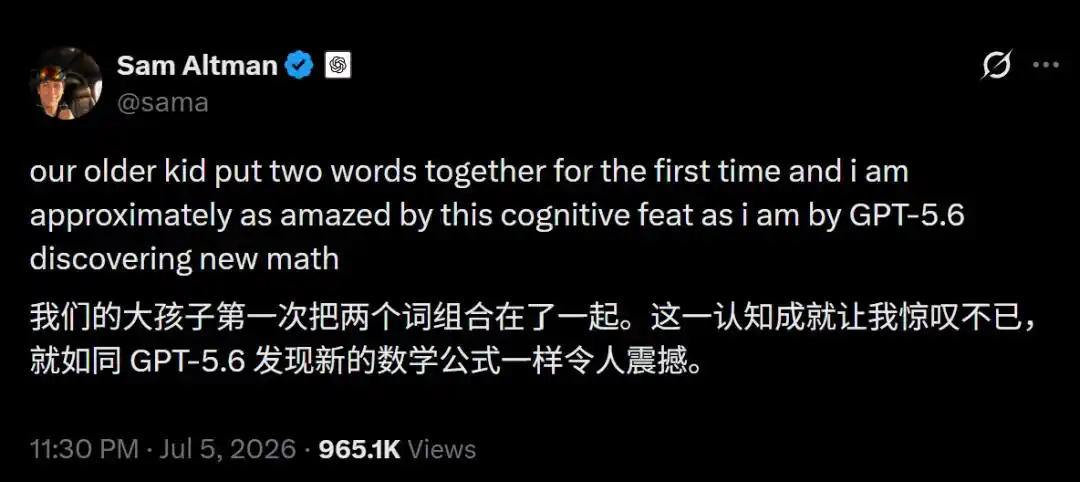
He posted this X.

Our eldest child combined two words for the first time. This cognitive achievement left me in awe, just as astonishing as GPT-5.6 discovering a new mathematical formula.

Same old formula, familiar taste.

Under this X, there were all sorts of comments.

However, behind this seemingly heartwarming X lies a harsh reality—

The current AI experience has seen a severe "class folding."

A very small number of people are using top-tier large models like Fable or the upcoming GPT-5.6, while the vast majority of the general public only has access to mediocre products with 8B to 30B parameters.

The benefits of technology are becoming the exclusive domain of a few, while the masses only feel the clamor of the bubble. Inside and outside the tech circle, we are in two completely different parallel universes.

A survey shows that 84% of the global population has never interacted with AI, 16% stubbornly use free chatbots, and only 0.3% pay for premium services.
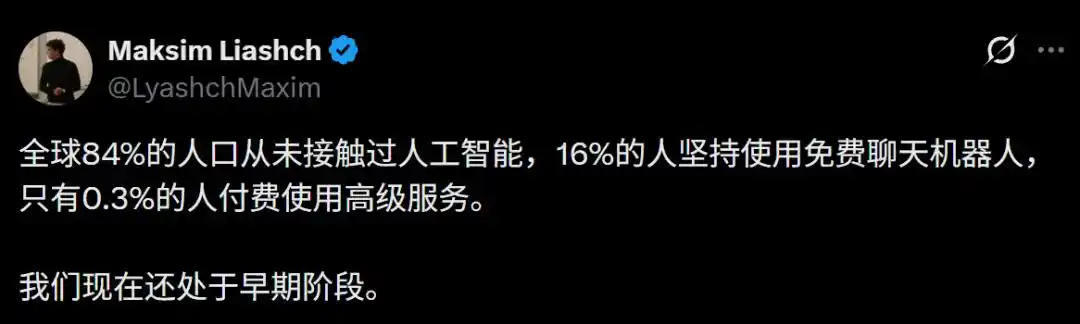
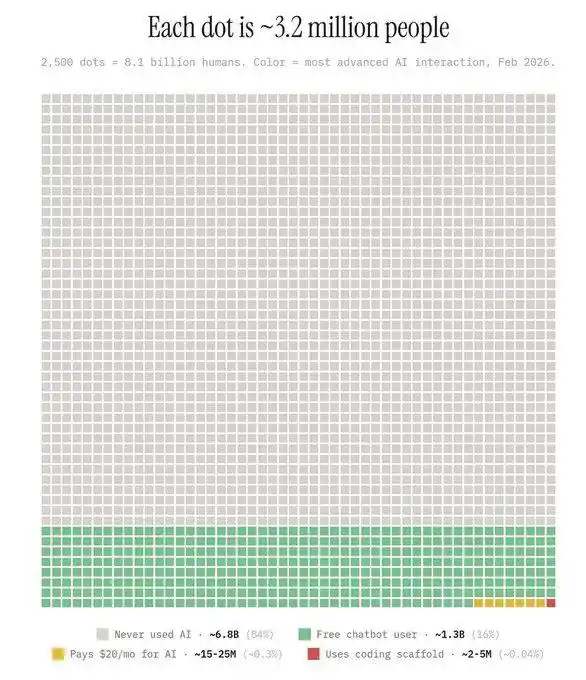
Fable 5 and GPT-5.6: The Chasm Between the Masses and the Elite

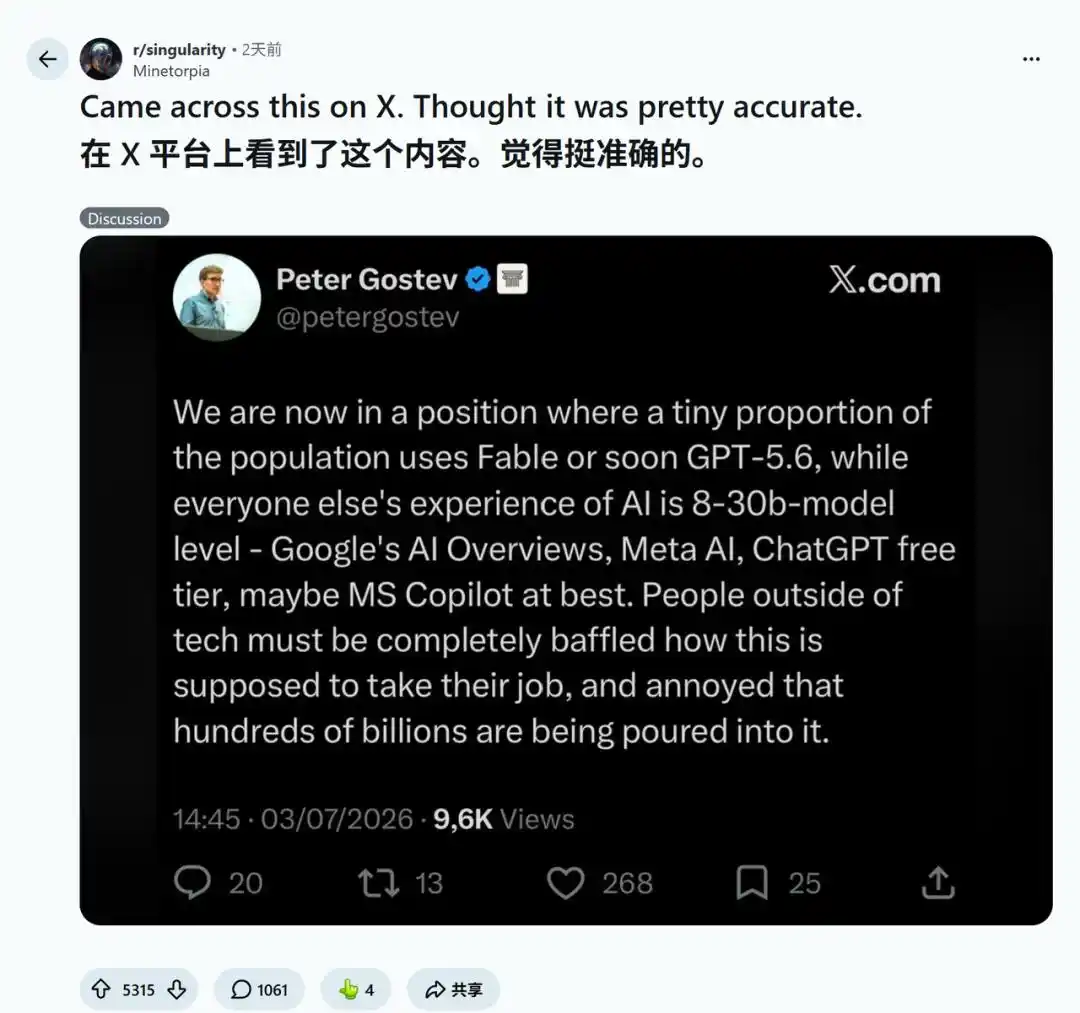
The above viewpoint comes from Peter Gostev, core lead at LMArena.

He stated: Fable 5 and GPT-5.6 are becoming the privilege of a few!
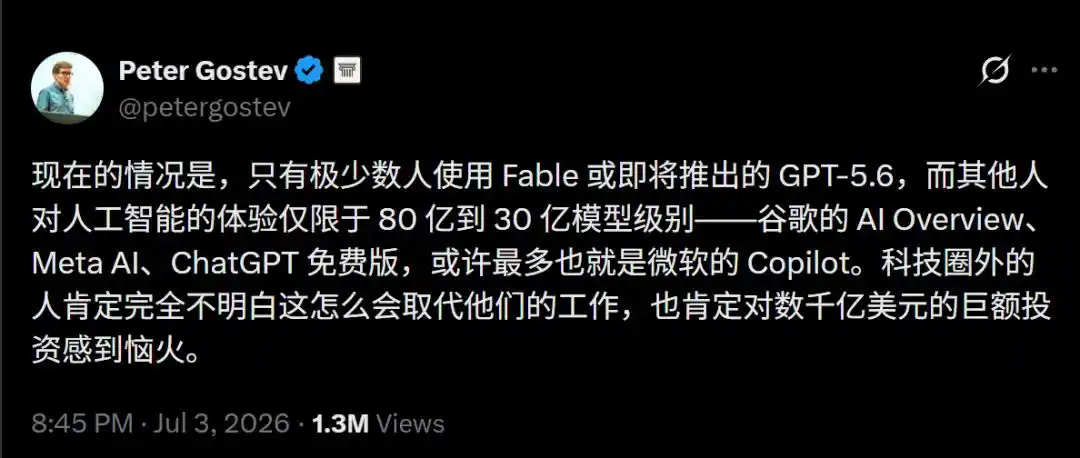
This perspective, once raised, sparked widespread discussion among netizens and has become a hot topic recently.
If you are an ordinary person outside the tech industry, you might be puzzled—

The news is filled with tech giants burning through hundreds of billions of dollars investing in large models, experts constantly warn that "AI will steal jobs," but why are free models like ChatGPT so underwhelming to use?

The answer is simple: because you are using a castrated, inferior product.

Peter Gostev pointed out bluntly:

We are now in a situation where a tiny fraction of the population is using top-tier models like Fable or the upcoming GPT-5.6, while the AI experience for everyone else is stuck at the level of 8B to 30B (8 billion to 30 billion) parameter models—at best, that's the free version of ChatGPT or basic Microsoft Copilot.

This vast experience gap leads to a strong cognitive divide.

The general public outside the circle completely fails to understand how AI can replace some human jobs. They are confused or even angry about the tech industry's insane spending.

On the other side, the privileged tech elite are enjoying a dimension-lowering strike.

The dividends of technology are quietly becoming the exclusive property of a few.

Current AI is Too Far from Ordinary People

Why do ordinary people think AI is useless?

AI influencer Kol Tregaskes used his brother, a park groundskeeper, as an example.
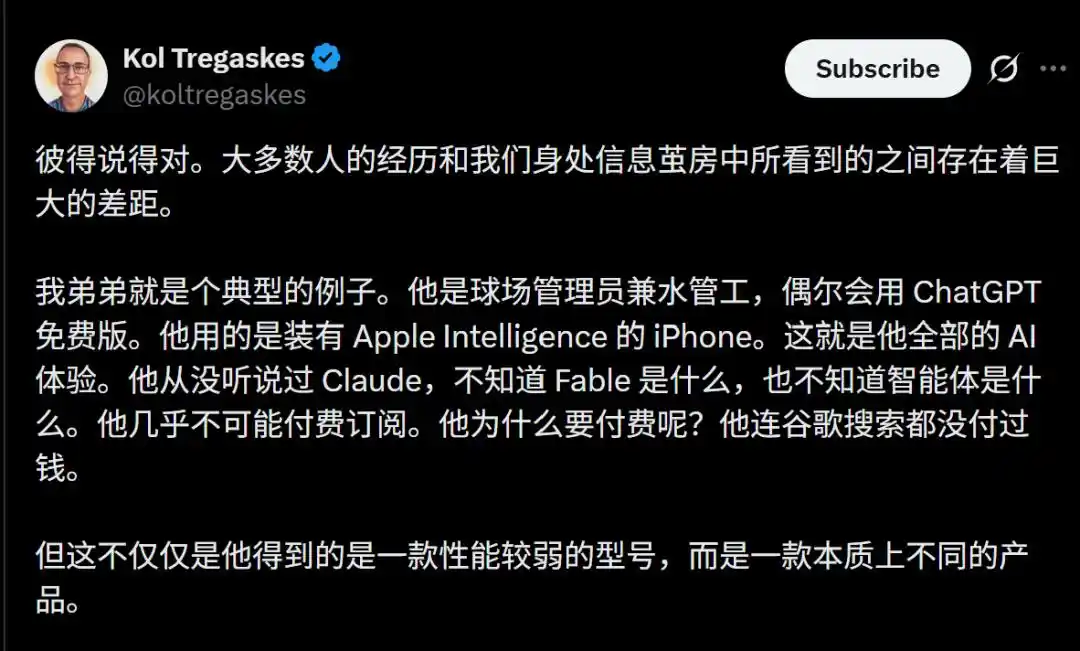
His brother occasionally uses the free ChatGPT and has an iPhone with basic Apple Intelligence. That's his entire "AI experience."

He hasn't heard of Anthropic's Claude, doesn't know what Fable is, and has no idea what an Agent is. He would never pay for an AI subscription, just as he would never pay to use Google Search.

This isn't just about "model quality"; they are using two completely different product forms.

Free users get a chatbot. You can ask it quick questions, upload a file, or do some shallow internet research.

But the paying elite get a complete work system.
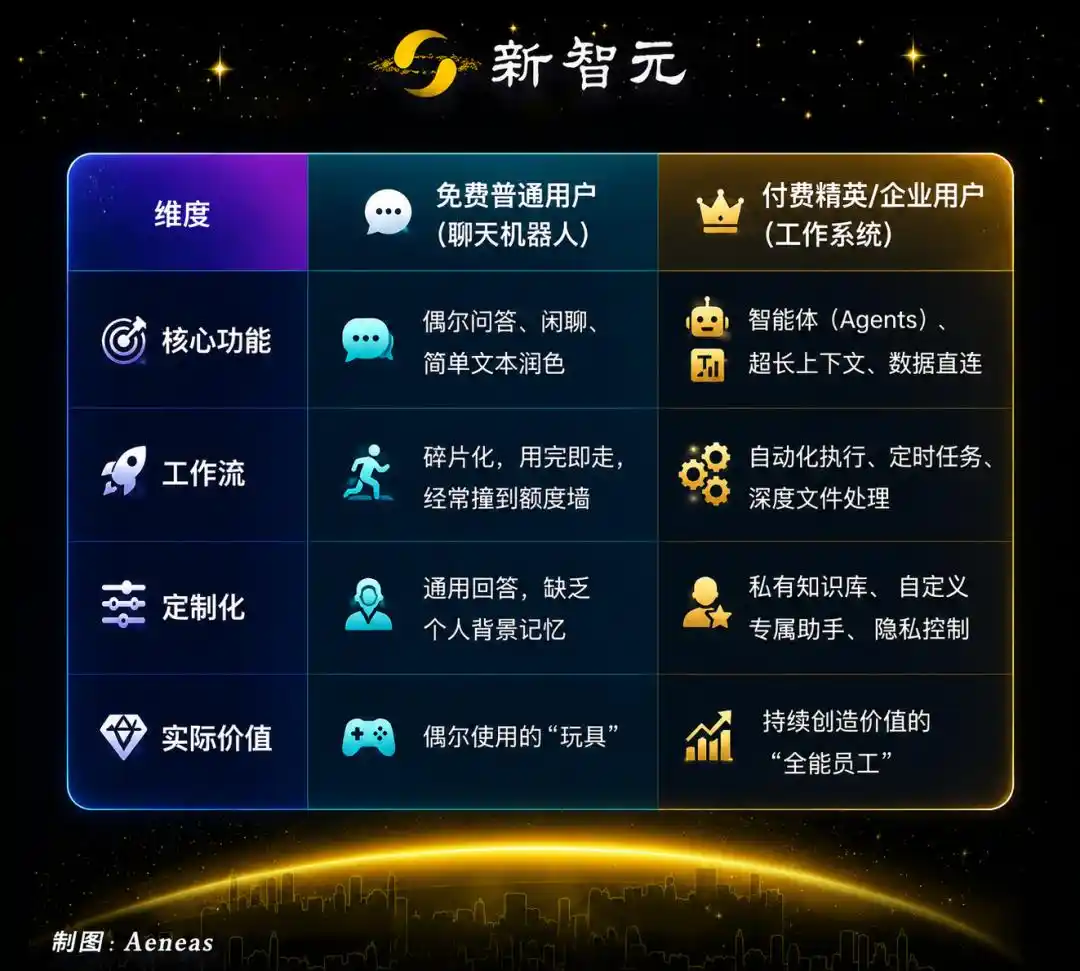
Kol pointed out that his brother cannot create a specialized "Lawn Management GPT" for UK turf species, common diseases, and seasonal maintenance schedules; he cannot throw a thick equipment manual at AI and expect it to get it right; he doesn't have Agent mode, no connected data, and cannot turn AI into a real assistant that handles quotes, supplier emails, and maintenance plans.

This is also the biggest deficiency in the current AI product layer: a severe disconnect between the lab and real life.
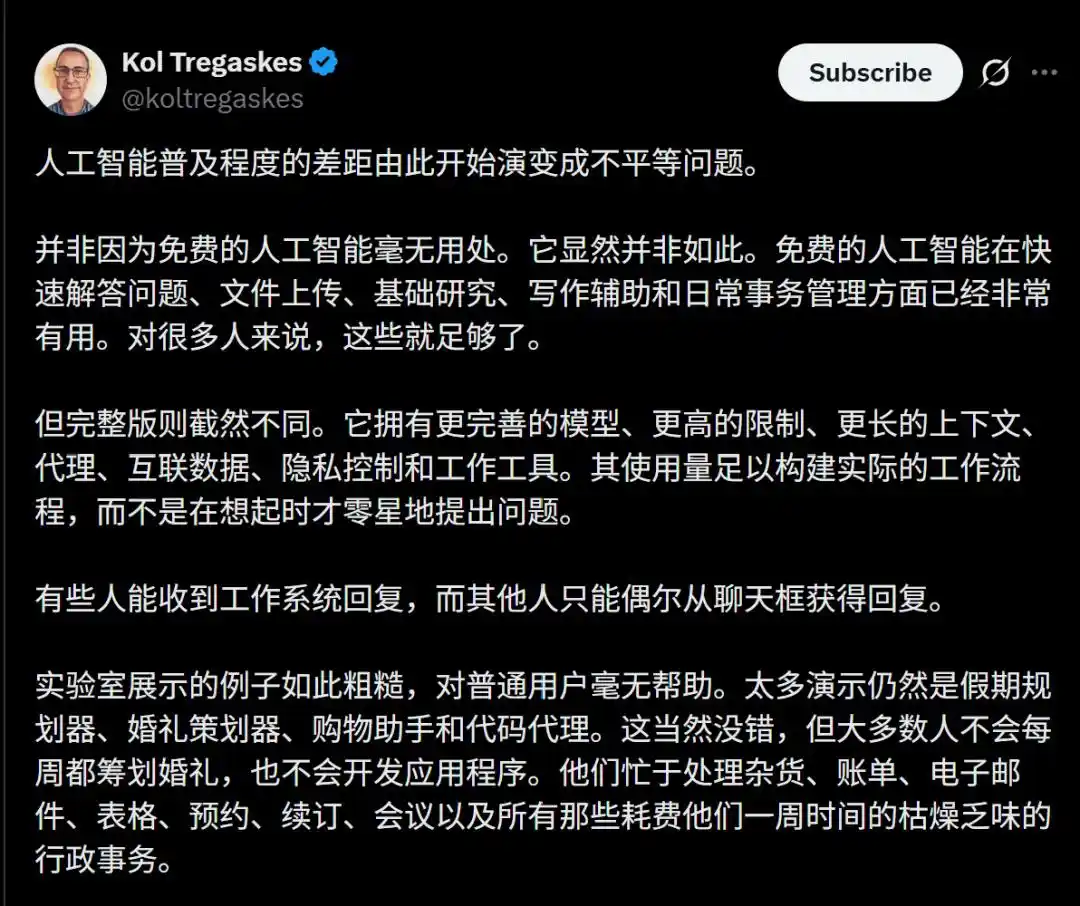
The demos at tech giant launch events mostly involve AI helping you plan a luxurious wedding or AI developing a cool app from scratch.

But what does that have to do with ordinary people?

What ordinary people actually face are the daily headaches: weekly grocery shopping, complicated bills, endless emails, forms to fill out, medical appointments, and car insurance renewals.

A true AI assistant should understand your living habits, your family's allergies, your budget, supermarket sales, and even what's left in your fridge.

It should automatically compare prices, generate lists, warn you when the total cost exceeds your budget, and ultimately turn into an automation program on your phone that silently handles all of this for you every week.

As long as AI stays in a dialog box answering questions, what the masses see will always be demos, not life-changing products.


What Does a $1000-a-Day AI Look Like?

Meanwhile, what best illustrates the fold is how top engineers on Reddit use super AI.

First, what most distinguishes the elite from ordinary people is the staggering cost of computing power.

A netizen revealed a figure that would stun ordinary people: "Yesterday, I spent $1000 on a Fable inference project. Even in large corporations, only a handful have such freedom. Things will only get worse."
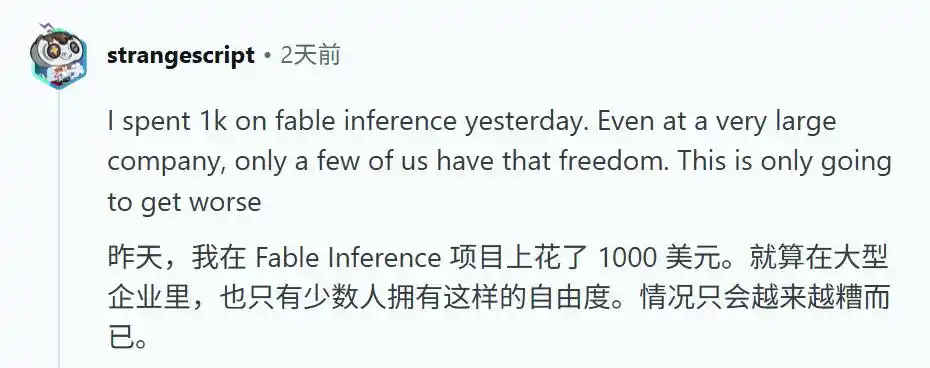
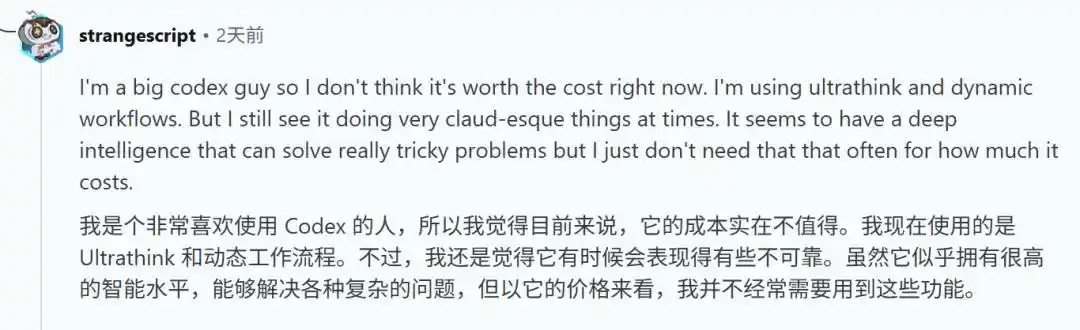
This exorbitant cost is like a chasm separating ordinary people from top-tier AI.

And Fable 5's power is indeed awe-inspiring for those in the industry.

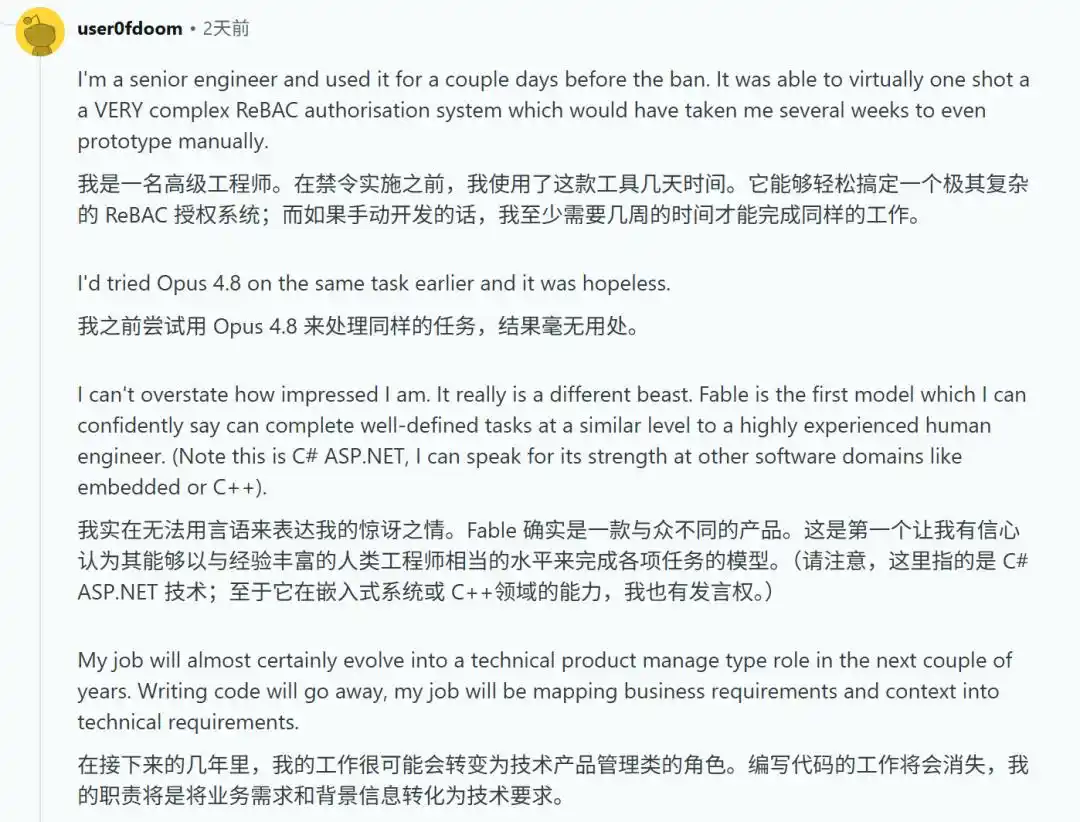
A senior engineer shared his震撼 experience before Fable was restricted.

Faced with an extremely complex ReBAC authorization system, manually developing a prototype would take him weeks. But Fable almost perfectly handled it all in one go.

He described it: "I genuinely lack the words to express my shock. Fable is indeed a completely different beast. It's the first model that convinced me AI can reach the level of an experienced, senior human engineer."
Most impressively, the top elite no longer rely on a single model but have built a multi-model collaborative matrix.

Based on the practical experience of several netizens, the current cutting-edge workflow looks like this.

Creativity & Requirements Layer (ChatGPT 5.5): Acts as the product manager, responsible for brainstorming, providing ideas, and writing complex prompt instructions.

Architecture & Planning Layer (Fable): Acts as the architect. Doesn't write low-level code directly, but designs the macro architecture of the entire system, plans specific operational steps, and verifies logic (because it's extremely smart, but costly to use and occasionally unstable).

Heavy Execution Layer (Opus 4.8): Acts as the senior programmer. Executes medium-to-high difficulty coding tasks under Fable's strict process orchestration.

Finalization & Review Layer (Sonnet 5): Acts as the code reviewer and junior programmer. Handles repetitive, pattern-fixed code writing and performs final reviews.

Another developer working on native mobile apps was even more blunt: "Hand a complex feature that would take an expert a week to this system, and it can run through it in 30 minutes."

In his view, "Many people online say they can't see the difference in AI. Sometimes I really wonder what kind of incompetent people I'm talking to. Our traditional work might be completely over within a year."

The Invisible Barrier in Healthcare and Wellness

This divide isn't just about programmers writing code; it's even more evident in healthcare and wellness, a field crucial to everyone.

A netizen mentioned, "Any elderly person (or young person with serious health issues) should at least have a Pro subscription to answer their medical questions. But unfortunately, the elderly use AI the least."

Ordinary people, unwilling to pay, can only use the free GPT to inquire about symptoms. But this netizen revealed a brutal statistic: "Asking medical questions with the free GPT is like flipping a coin. Actually worse than a coin flip, because it's wrong 51% of the time."
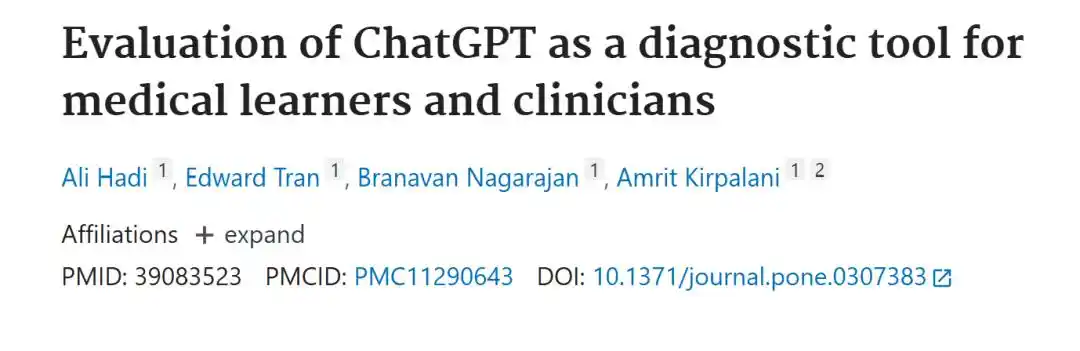

In fields requiring absolute trust, data privacy, and deep contextual support—like health, finance, and private contracts—free AI is often incompetent or even dangerous.

Only those who can afford Pro subscriptions or have employers providing enterprise-level Copilot support can let AI touch high-value, real work data.

Opposing Voices: Does Your Job Really Need Fable?

Of course, amid this fervor, there were also sober voices of opposition.

Netizen [Name redacted for privacy, placeholder used] proposed a classic argument: "Most ordinary corporate business logic doesn't involve incredibly complex algorithms. It's situationally complex, not intellectually complex.

In their view, for 90% of corporate employees and ordinary white-collar workers, their jobs simply don't require god-tier models like Fable or GPT-5.6 that can "discover new mathematics."

ChatGPT 5.4/5.5 has reached the perfect sweet spot—reasonably priced and good enough.

Often, when you feel AI can't solve your problem, it's not because AI isn't smart enough, but because you haven't provided enough context.

You haven't fed it your historical data, connected it to your company's API, or embedded it into your workflow, which is why it seems useless.

The Folded Future: Which Side Are You On?

In this summer of 2026, access to different AIs is becoming a profound crisis of inequality.

It's not happening in a storm, but quietly.

When giants demonstrate how AI can reconstruct the entire logic of human society, please don't laugh at AI being an idiot just because a free chatbot miscalculated an addition or subtraction.

Because in this new folded world, AI hasn't gotten dumber; it's just that the truly powerful ASI is moving further and further away from ordinary people.

References:

https://x.com/sama/status/2073791666553844074

https://x.com/koltregaskes/status/2073381804736926116

https://x.com/petergostev/status/2073025360749355049

This article is from the WeChat public account "Xinzhiyuan," author: ASI Apocalypse; editor: Aeneas


Связанные с этим вопросы

QAccording to the article, what is the 'AI folding' phenomenon, and what does it mean for the general public?

AThe 'AI folding' phenomenon refers to the severe stratification in AI experience, where a tiny elite has access to and uses top-tier models like Fable 5 and GPT-5.6, while the vast majority of the public is limited to much less powerful, often free, 'AI toys' like basic chatbots. This creates a significant 'experience gap' or chasm, meaning the general public is excluded from the real power and productivity gains of advanced AI, seeing only the hype and superficial applications.

QWhat key limitation of current mainstream (free/accessible) AI products does the article highlight as causing a disconnect with ordinary people's lives?

AThe article highlights that current mainstream AI products are severely disconnected from the practical, mundane needs of ordinary people. They are presented as tools for creating apps or planning weddings, while people's real daily challenges involve tedious tasks like grocery shopping, managing bills, scheduling appointments, and handling forms. The missing element is a true 'AI butler' integrated with personal data, habits, and local context to automate these routine aspects of life.

QWhat staggering cost example is given to illustrate the financial barrier preventing most people from using top-tier AI like Fable 5?

AThe article cites a Reddit user's example of spending $1,000 in a single day on a Fable inference project. This exorbitant cost represents a massive financial barrier, making such powerful AI tools accessible only to a privileged few within large corporations or with significant personal resources, thereby creating an 'unbridgeable chasm' between elites and the public.

QDescribe the multi-model 'collaboration matrix' workflow used by elite engineers as outlined in the article.

AElite engineers use a sophisticated multi-model workflow: 1) ChatGPT 5.5 acts as the 'Product Manager' for brainstorming and creating complex prompts. 2) Fable acts as the 'Architect,' designing the overall system architecture and planning steps. 3) Claude Opus 4.8 acts as the 'Senior Programmer,' executing medium to high-difficulty coding tasks under Fable's guidance. 4) Claude Sonnet 5 acts as the 'Code Reviewer/Junior Programmer,' handling repetitive coding and final reviews. This system allows complex projects to be completed in drastically reduced time.

QWhat serious risk does the article associate with using free AI models for critical areas like healthcare advice?

AThe article warns that using free AI models for healthcare advice is highly dangerous. It references data suggesting such models are wrong more than 51% of the time on medical questions—worse than a coin flip. This creates a significant hidden barrier where only those who can afford paid Pro subscriptions or have enterprise access can leverage reliable, context-aware AI for high-stakes areas like health, finance, and legal matters, potentially exacerbating inequalities in critical life outcomes.

Похожее

Обратный отсчет Q-Day: Положит ли квантовые вычисления конец криптовалютам?

**Резюме: Отсчет до Q-Day — уничтожит ли квантовые вычисления криптовалюты?** Квантовые вычисления представляют системный вызов для криптографии с открытым ключом, лежащей в основе блокчейна. Основная угроза исходит от алгоритма Шора, который теоретически способен взломать ECDSA/ECC, подорвав безопасность подписей Bitcoin и Ethereum. **Суть угрозы:** Критический момент («Q-Day») наступит с появлением крупномасштабных, устойчивых к ошибкам квантовых компьютеров. Главная проблема — не отсутствие постквантовых криптографических алгоритмов (PQC, таких как ML-DSA, SLH-DSA), а колоссальная задача по скоординированному обновлению всей экосистемы до этого момента. Риск распределен неравномерно: в первую очередь под угрозой находятся активы, чьи открытые ключи уже раскрыты в блокчейне (например, старые BTC UTXO). **Подходы к решению:** * **Постквантовая криптография (PQC):** NIST стандартизировал алгоритмы на основе решеток (ML-KEM, ML-DSA) и хэшей (SLH-DSA). Их интеграция сталкивается с проблемами увеличения размера подписи и сложностью обновления. * **Bitcoin:** Главный вызов — социальный консенсус и управление. Необходимо решить, как поступить с «унаследованными» активами (legacy UTXO), чьи ключи уязвимы. Миграция, вероятно, будет происходить через мягкое форкирование, но это вызовет ожесточенные споры о неизменности и правах собственности. * **Ethereum:** Проблема носит более технический, инженерный характер. План включает обновление учетных записей (через абстракцию счетов), консенсусного уровня (замена BLS) и слоя данных. Ethereum Foundation активно работает над повышением «криптографической гибкости» сети. **Вывод:** Квантовые вычисления не являются мгновенным «концом» криптовалют. Это долгосрочный структурный риск, запускающий обратный отсчет для масштабной, сложной миграции. «Инженерное окно» для подготовки оценивается в 5-8 лет. Успех зависит от способности сообществ Bitcoin (социальное управление) и Ethereum (техническая сложность) скоординировать обновление всей экосистемы — от протоколов до кошельков и бирж.

marsbit43 мин. назад

Обратный отсчет Q-Day: Положит ли квантовые вычисления конец криптовалютам?

marsbit43 мин. назад

Трамп – самый искусный инвестор среди президентов США

Согласно отчету Управления по этике правительства США, бывший президент Дональд Трамп в 2025 году заработал рекордные 2,2 миллиарда долларов, что сделало его самым высокооплачиваемым президентом в истории США. Основными источниками дохода стали криптовалюта (примерно 1,4 млрд долларов, включая его мем-монету $TRUMP) и операции с недвижимостью (около 575 млн долларов), особенно в его курортных клубах, таких как Мар-а-Лаго. Также сообщается о более чем 22 000 операций с акциями за год, что вызвало споры о возможных конфликтах интересов, поскольку многие сделки совпадали по времени с важными политическими заявлениями. Трамп и его семья активно монетизировали президентское влияние через брендированные криптовалютные проекты и премиальный доступ к своим объектам. Критики утверждают, что такая деятельность размывает границы между государственной должностью и частным бизнесом, в то время как сторонники видят в этом успешную коммерческую деятельность. Отчет поднял новые вопросы о необходимости этических реформ для высших должностных лиц.

marsbit55 мин. назад

Трамп – самый искусный инвестор среди президентов США

marsbit55 мин. назад

Обратный отсчёт Q-Day: Покончит ли квантовый вычисление с криптовалютой?

**Квантовые вычисления и криптовалюты: обратный отсчет до Q-Day** Квантовые компьютеры, основанные на принципах квантовой механики (суперпозиция, запутанность), представляют собой экзистенциальную угрозу для блокчейн-индустрии, поскольку способны взломать используемую в ней криптографию с открытым ключом (ECC, RSA) за счет алгоритма Шора. Момент, когда это станет возможным (Q-Day), по оценкам, может наступить в 2035-2045 гг. Основной удар придется на публичные ключи, уже находящиеся в блокчейне (например, старые UTXO в Bitcoin), из которых можно будет восстановить приватные ключи и подделать транзакции. Это ставит под угрозу сам принцип "необратимости" активов. **Антиквантовая защита:** * **PQC (Постквантовая криптография):** Использование алгоритмов, устойчивых к квантовым атакам (на основе решеток, хэшей), например, стандарты NIST FIPS 203-205. * **Гибридные схемы:** Совместное использование классической и постквантовой криптографии для плавного перехода. **Практические вызовы для блокчейнов:** 1. **Bitcoin:** Главная проблема — социальный консенсус и управление. Необходимо решить судьбу уязвимых устаревших UTXO, не нарушая принцип "неизменности". Технически переход возможен через софт-форк, но новые подписи PQC значительно больше по размеру, что увеличивает нагрузку на сеть. 2. **Ethereum:** Проблема — сложность полного обновления стека (аккаунты, консенсус, доказательства с нулевым разглашением). Стратегия основана на повышении "криптографической гибкости" сети и использовании решений второго уровня (L2) для тестирования. **Вывод:** Угроза реальна, но это не "конец света". Индустрия имеет 5-8-летнее окно для скоординированного перехода всей экосистемы (протоколы, кошельки, биржи). Ключевым барьером для Bitcoin станут вопросы управления и права собственности, а для Ethereum — инженерная сложность полномасштабного обновления. Отсчет до Q-Day уже начался.

链捕手57 мин. назад

Обратный отсчёт Q-Day: Покончит ли квантовый вычисление с криптовалютой?

链捕手57 мин. назад

Strategy провела первую продажу биткоинов в рамках новой казначейской политики для выплаты дивидендов

Компания Strategy продала 3 588 биткойнов на сумму около 216 миллионов долларов США для выплаты дивидендов по своим ценным бумагам Digital Credit. Это первая заявленная сделка в рамках новой казначейской политики — Digital Credit Capital Framework, которая разрешает ограниченные продажи биткойнов для пополнения долларовых резервов, выплаты дивидендов и выкупа акций, при сохранении долгосрочной экспозиции компании к криптовалюте. После продажи резервы Strategy сократились до 843 775 BTC, при этом компания также располагает 2,55 миллиардами долларов наличных средств. Ранее, неделей до этого, компания приостановила закупки биткойнов и представила новый фреймворк. Эта сделка не означает резкого изменения стратегии, а демонстрирует эволюцию управления казначейством: биткойн теперь является не только активом для накопления, но и источником ликвидности для конкретных корпоративных целей в установленных рамках.

ambcrypto1 ч. назад

Strategy провела первую продажу биткоинов в рамках новой казначейской политики для выплаты дивидендов

ambcrypto1 ч. назад

Стратгия вынуждена продавать биткоины с убытком в $55 млн: вера должна платить проценты

7 июля Майкл Сейлор сообщил, что компания MicroStrategy продала 3588 BTC примерно за 216 миллионов долларов для выплаты дивидендов по своим привилегированным акциям. Продажа, осуществлённая по средней цене 60 197 долларов за BTC, привела к убытку около 55 миллионов долларов, так как средняя цена покупки компании составляла 75 651 долларов. Это первая существенная продажа с 2022 года и отход от предыдущей стратегии «никогда не продавать». Продажа стала результатом закрытия каналов финансирования компании. Рыночная цена её привилегированных акций (STRC) упала ниже номинала, что заблокировало возможность выпуска новых акций по выгодной цене. В условиях низкой премии к чистой стоимости активов (mNAV) и при наличии жёстких ежегодных обязательств по выплате дивидендов (около 1,76 млрд долларов) продажа части биткоинов стала, согласно собственной модели компании, оптимальным решением для защиты интересов акционеров. Это событие меняет восприятие MicroStrategy как «якоря веры» на рынке: из крупнейшего бессрочного покупателя она превращается в потенциального регулярного продавца. Чтобы покрыть годовые обязательства за счёт продажи BTC, компании может потребоваться продавать около 2400 BTC в месяц. У MicroStrategy есть резерв в 2,55 млрд долларов для покрытия расходов на 17 месяцев, поэтому непосредственного кризиса ликвидности нет. Однако её будущее теперь жёстко привязано к цене биткоина: восстановление и рост рынка необходимы для возобновления её прежней бизнес-модели.

链捕手1 ч. назад

Стратгия вынуждена продавать биткоины с убытком в $55 млн: вера должна платить проценты

链捕手1 ч. назад

Торговля

Спот
活动图片