One Year After the Crash of Crypto Treasury Companies, Copycats Are Already Making a Comeback

marsbitОпубликовано 2026-06-29Обновлено 2026-06-29

Введение

One year after the collapse of digital asset treasury (DAT) companies, which wiped out up to 99% for early investors, the scheme has returned in a new guise. Recently, Triller Group announced it would become a "SpaceX treasury company," causing its market cap to surge. This follows the rebranding of another firm, LGHL, now targeting a token called HYPE. The original model, popularized by MicroStrategy (MSTR) and its "Bitcoin yield" narrative, saw companies trading at massive premiums to their underlying crypto holdings. However, most followers like TwentyOne, Metaplanet, and Nakamoto have crashed 80-95%+ from their peaks, erasing nearly all value for late investors. The author argues these structures have no fundamental reason to trade at premiums when low-fee Bitcoin ETFs or direct ownership exist. The cycle persists due to speculative demand driven by FOMO, gamification, and a belief the system is rigged, met by insiders and promoters who profit from the pump-and-dump dynamics. Drawing a parallel to the 1637 Tulip Mania, the piece concludes that such frenzies are not a bug but a recurring product of markets, where greater fools provide demand and insiders supply the schemes. Despite holding Bitcoin personally, the author condemns this specific packaging of assets into leveraged corporate vehicles marketed as innovation, a cycle seemingly unstoppable until a major crash.

Author: Rasheed Saleuddin

Compiled by: Deep Tide TechFlow

Deep Tide Guide: Last summer, the frenzy for Digital Asset Treasury (DAT) companies ended in a spectacular crash, with early investors losing up to 99%. One year later, the same scam is back under a new guise—this time packaged with SpaceX stock and the HYPE token. The cycle of greed and fear never ends, as retail investors continue to foot the bill for insiders' feasts.

Last Tuesday, the Triller Group (who?) announced it would become the world's first SpaceX treasury company. That is, it will use newly raised funds to buy and hold SpaceX stock. That's its business model: holding SpaceX. This news sent Triller's market cap soaring from $15 million to $63 million.

Matt Levine noticed this, and it caught my attention too. This announcement closely followed the rebranding of an "established" treasury company, LGHL—they previously bought crypto assets like SOL and SUI, and now they're buying the HYPE token. Because, well, hype.

We've seen this movie before. Just last summer. The ending was so bad you'd think it would never happen again. Worse, it was blatantly one of the most obvious scams, one I could see coming from a mile away.

The sequel is already showing. Because global speculators need their "spiritual opium," and pump-and-dump insiders are happy to supply it. Supply meets demand. When will they ever learn?

The Pioneer Made the Wrong Headlines

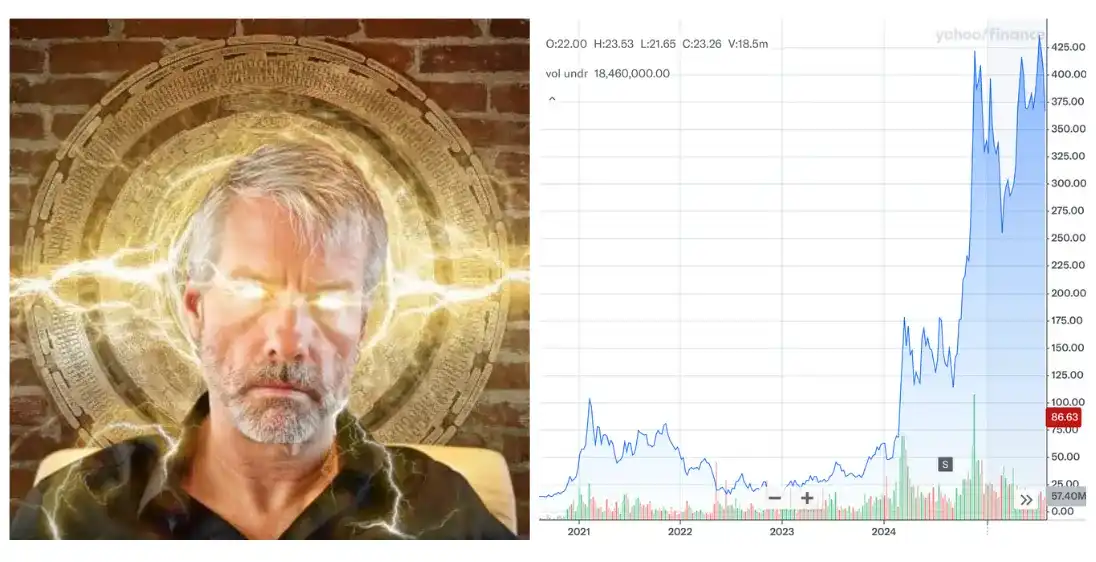
MicroStrategy/Strategy (MSTR) CEO Michael Saylor pioneered the concept of "Bitcoin yield." Through alchemy, a bitcoin held by a corporation somehow became worth more than a bitcoin held by someone not named Michael Saylor.

For a long and awkward period, the market agreed with him.

Not long ago, MSTR traded at 200% of the value of the Bitcoin on its balance sheet (Net Asset Value, NAV). You paid two dollars for one dollar's worth of Bitcoin. The sage Saylor, hailed as Satoshi Nakamoto reincarnated, frantically bought up all the Bitcoin he could, issuing expensive stock and even more complex financial instruments to new believers. The stock price looked like it would rise to infinity.
The Copycats

The premium on Strategy's stock attracted competitors, just as premiums always do. I documented this last May:

SPACs became Bitcoin buyers. Unprofitable operating companies ditched their original businesses to raise funds and buy BTC, ETH, or even more obscure crypto assets.

Spoiler alert: None performed as well as MSTR. And MSTR itself wasn't exactly a success story.

One year later, here's the situation:

Strategy (MSTR): Down 79% from its peak. This is the combined result of BTC falling 45% over the same period and the NAV premium compressing from 2x to 1x. Leverage magnifies gains and losses—that's how leverage works.

TwentyOne (XXI): Reached 5x NAV at its peak. Credit where it's due, it still trades above 1x NAV, though it's down 85% from its peak. Even some insiders got caught.

Metaplanet: Down 87% from a year ago, and down another 50% since the crash.

Nakamoto (NAKA) (formerly KindlyMD): Down 87% since October, after already falling 95% from its all-time high. If you put $100,000 into this stock a year ago, you'd have $650 left.
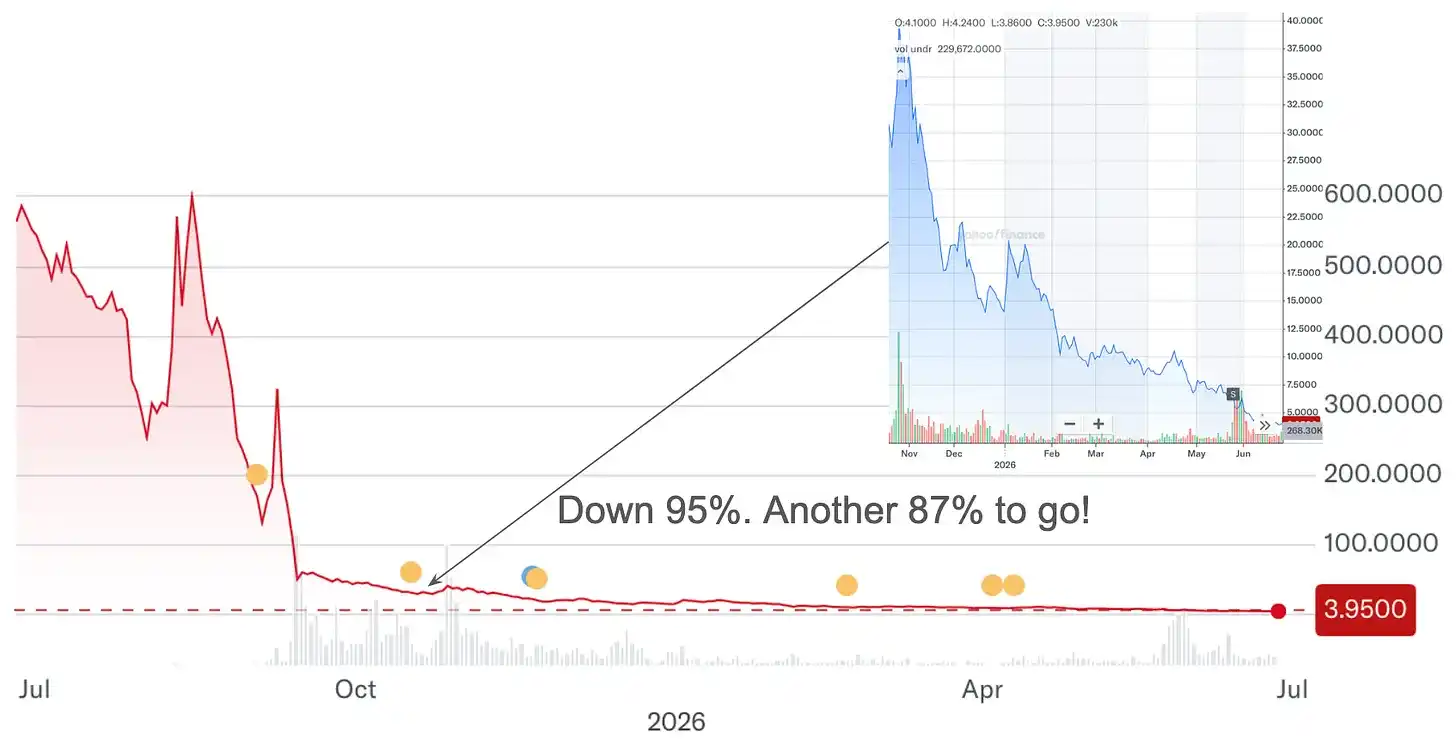
From $100,000 to $650. Enough for a (very) nice dinner. Speculators who "bought the dip," thinking "how much lower can it go," didn't fare much better than the original believers. The answer to "how much lower can it go" is often "quite a bit."

Why This Was Bound to Happen

Bitcoin ETFs exist. They charge only 9 basis points. Bitcoin itself exists. You can hold it yourself. There is no structural reason for DATs to trade at a premium—only greater fool theory, momentum trading, and a particular brand of financial nihilism where retail speculators, convinced the system is rigged, conclude they might as well play the rigged game with maximum aggression.

If you believe the traditional investment system doesn't work for you, the expected value of speculation looks different. FOMO plus dopamine plus gamification plus GameStop: Each alone is a manageable psychological condition. Together, they become a significant part of today's market structure.

Needless to say, insiders are always incentivized to meet the demand. They profit no matter which way the stock moves—another thing worth remembering.

About Tulips

The sad conclusion here is that no one cares when the market is irrational. This is a shame because the DAT crash is a perfect fable for the consequences of fear and greed. It should be a central case study for all bubble reporting. This is the Tulip Mania, only real and recent.

The 1637 dialogue "Waermondt and Gaergoedt" depicts two fictional Dutch weavers watching tulip prices collapse in real-time. One passage, spanning nearly four centuries, reads as if it were written last month:

"Things had gotten to the point that what used to be thrown into the dung heap to kill weeds in baskets was now selling for high prices. I thought I was rich enough. I thought I'd never have to weave again."

Polishing turds didn't work back then either. A flower that sold for 22 ducats in 1637 was trading at 400 ducats at its peak the year before. Then the liquidation came:

"I wish this country had never had flowers!"

I wonder how many retail investors, like those who turned an initial $100,000 into $650, wish they had never heard of Metaplanet, Nakamoto, or the phrase "Bitcoin yield."

One More Thing

I hold some Bitcoin. My venture fund holds crypto investments. I'm not against digital assets. I'm against this specific frenzy of packaging digital assets into companies, charging privileged fees, issuing debt for leverage, and then marketing the result as financial innovation.

I thought this frenzy was killed by the 2025 DAT crash. But the Golden Age of scams continues (with thanks to Shrubstack).

History repeats itself. Always. The pump-and-dump isn't a bug in the system; for those operating it, it's the product. Speculators provide the demand, insiders provide the product. Until we get the mother of all tulip crashes.

The pump-and-dump is the end in itself.

Трендовые криптовалюты

Связанные с этим вопросы

QWhat is a 'vault company' in the context of this article, and how did the first wave of such companies end?

AA 'vault company' in this article refers to a firm whose business model is to raise funds and use them primarily to buy and hold a specific asset, like Bitcoin (e.g., MicroStrategy) or other cryptocurrencies. The first wave of such companies, following the model of MicroStrategy's 'Bitcoin yield,' saw their stocks trade at huge premiums over the net asset value (NAV) of the crypto they held. This ended in a 'catastrophic crash' in the summer of 2025, where early investors in many Digital Asset Treasury (DAT) companies lost up to 99% of their money.

QAccording to the author, why did DAT companies trade at a large premium over the value of their underlying assets, and what eventually happened to that premium?

AThe author argues that DAT companies traded at a large premium to their Net Asset Value (NAV) not for any structural reason, but due to 'greater fool theory, momentum trading,' and a form of financial nihilism where retail speculators, believing the system is rigged, try to play the 'rigged game' aggressively. This premium eventually collapsed as the bubble burst, with stocks like MSTR seeing their premium compress from 200% to around 100%, contributing to their massive decline from peak prices.

QWhat are the two new examples of 'vault company' schemes mentioned in the article, and what assets do they plan to hold?

AThe article mentions two new 'vault company' schemes: 1) Triller Group announced it would become the world's first 'SpaceX vault company,' using newly raised funds to buy and hold SpaceX stock. 2) LGHL (a previously established vault company) rebranded to focus on buying HYPE tokens instead of its previous crypto assets (SOL and SUI).

QWhat historical event does the author compare the DAT crash to, and what is the key similarity?

AThe author compares the DAT crash to the 17th-century Dutch Tulip Mania. The key similarity is the extreme and irrational speculation on an asset (tulip bulbs then, shares of companies holding crypto now), where prices soared based on hype and greed before collapsing catastrophically, leaving investors with massive losses. The author cites a 1637 dialogue about the tulip crash that sounds 'like it was written last month.'

QWhat is the author's main argument about the relationship between retail speculators and insiders in these schemes?

AThe author's main argument is that a symbiotic cycle exists between retail speculators and insiders/promoters. Retail speculators, driven by FOMO and a belief the system is unfair, provide the demand for highly speculative products. Insiders and 'pump-and-dump' traders then meet this demand by creating and promoting these schemes (like vault companies), from which they profit regardless of the outcome for retail investors. The author concludes that for those running it, 'the pump-and-dump is the product itself.'

Похожее

Аналитики предсказывают, что XRP и BNB могут достичь капитализации в $100 млрд к концу 2026 года

Аналитики предполагают, что рыночная капитализация XRP и BNB может достичь отметки в 100 миллиардов долларов во второй половине 2026 года. Эта информация, основанная на отчете Finbold от 29 июня 2026 года и данных CoinMarketCap, носит спекулятивный характер и основана на историческом анализе графиков и фундаментальных показателях проектов, а не является гарантированным прогнозом. Для трейдеров данный прогноз важен как индикатор сдвигов в аппетитах к риску и движения ликвидности на рынке криптовалют, который все еще зависит от потоков ETF, решений казначейств и ротации капитала между альткойнами. Обсуждение столь высокой капитализации для XRP и BNB, хотя и выглядит амбициозно, считается достижимым при благоприятных рыночных условиях и наличии специфических катализаторов для каждого актива. Ключевой вывод заключается в том, что подобные сигналы следует воспринимать в более широком контексте. Они влияют на сопутствующие активы и общие рыночные настроения, особенно в периоды низкой ликвидности, когда второстепенные эффекты могут быть значительными. Важно отслеживать, подтвердятся ли эти предположения последующими данными о потоках средств, ончейн-метриках и позиционировании, или же они останутся краткосрочным рыночным шумом.

bitcoinist12 мин. назад

Аналитики предсказывают, что XRP и BNB могут достичь капитализации в $100 млрд к концу 2026 года

bitcoinist12 мин. назад

Капитализация рынка альткойнов вернулась к уровню почти 900-дневной давности, аналитик указывает на ключевую зону поддержки

Аналитик Михаэль ван де Поппе отметил, что общая капитализация рынка альткоинов откатилась к уровням конца 2023 года, потеряв примерно 900 дней роста. Такая динамика объясняет, почему рыночные настроения настолько негативны: широкий класс альткоинов в целом не показывал прогресса почти три года. Ключевой момент сейчас — бывшая зона прорыва, которая теперь стала критической областью поддержки. Если рынок удержит этот уровень, здесь может сформироваться основа для следующего роста и зона накопления. Если же поддержка не сработает, это будет сигналом о провале прошлого бычьего движения. Для формирования устойчивого восстановления необходима не единичная активность, а широкое участие разных секторов: L1-протоколов, DeFi, инфраструктурных и AI-токенов, а также качественных проектов средней капитализации. Текущая ситуация является переломной точкой для всего рынка альткоинов, который должен доказать свою жизнеспособность на этом уровне.

bitcoinist12 мин. назад

Капитализация рынка альткойнов вернулась к уровню почти 900-дневной давности, аналитик указывает на ключевую зону поддержки

bitcoinist12 мин. назад

Chainlink увеличил число держателей на 8000 – Сможет ли LINK развернуть нисходящий тренд?

Chainlink (LINK) за последние пять дней привлек более 8000 новых держателей, увеличив общее количество непустых кошельков до 892,8 тыс. Несмотря на сохраняющуюся слабость цены и торговлю в нисходящем канале, это указывает на устойчивое расширение сети. Активность на биржах демонстрирует чистый отток средств (-$479,49 тыс.), что сигнализирует о накоплении токенов в частных кошельках, а не о распродажах. Цене удается удерживать ключевую зону поддержки около $7,00, однако для прорыва выше сопротивления $8,31 не хватает объема покупок. Индикатор RSI (34,6) остается ниже нейтрального уровня, отражая слабую покупательскую активность. При этом позиции на фьючерсном рынке остаются оптимистичными: положительное финансирование (0,0077%) показывает, что трейдеры сохраняют уверенность в будущем росте. В итоге, сочетание растущей базы держателей, оттока с бирж и уверенности на деривативах создает фундамент для возможного разворота нисходящего тренда, если вернется более сильный спрос на спотовом рынке.

ambcrypto16 мин. назад

Chainlink увеличил число держателей на 8000 – Сможет ли LINK развернуть нисходящий тренд?

ambcrypto16 мин. назад

Chainlink добавил 6100 кошельков за два дня в самом сильном всплеске роста за 2026 год

Chainlink продемонстрировал самый значительный всплеск роста числа кошельков в 2026 году, добавив 6100 новых адресов за два дня. Это произошло на фоне сложной рыночной ситуации для альткойнов, включая LINK, и указывает на сохраняющийся интерес пользователей и инвесторов, даже когда динамика цены остается слабой. Рост числа кошельков является важным индикатором реального участия в сети, в отличие от спекулятивных ценовых движений. Для Chainlink, как инфраструктурного проекта в сфере оракулов, данных и реальных активов, это особенно актуально. Однако тип новых адресов (мелкие держатели, новые пользователи, кошельки бирж) неизвестен, поэтому данные следует считать конструктивным, но не окончательным сигналом. В целом, этот всплеск активности показывает, что экосистема Chainlink продолжает привлекать внимание. Для быков это позитивный сигнал об адаптации, но он не гарантирует роста цены токена. Ключевым для LINK будет последующее подтверждение в виде увеличения транзакционной активности, накопления токенов и улучшения ценовой динамики на фоне общего поведения рынка.

bitcoinist58 мин. назад

Chainlink добавил 6100 кошельков за два дня в самом сильном всплеске роста за 2026 год

bitcoinist58 мин. назад

Открытый интерес по Dogecoin колеблется около $959 млн, поскольку трейдеры ждут сигнала к восстановлению

Открытый интерес по деривативам Dogecoin сохраняется на уровне около 959 миллионов долларов, что привлекает внимание трейдеров на фоне спокойных выходных на спотовом рынке. Этот показатель отражает значительный объем активных контрактов, что может усилить волатильность при резком движении цены. Важно отметить, что сам по себе высокий открытый интерес не указывает на направление тренда. Он лишь сигнализирует о наличии существенных позиций. Для понимания контекста необходимо учитывать динамику цены, объемы торгов и уровни ликвидации. Рост цены на фоне увеличения открытого интереса может указывать на приток новых leveraged-позиций, в то время как падение цены при высоком OI может говорить о «застрявших» позициях. Dogecoin остается активом, сильно зависящим от настроений рынка. Текущая ситуация характеризуется вовлеченностью деривативного рынка при отсутствии четкого сигнала к восстановлению. Устойчивый рост DOGE потребует поддержки со стороны реального спроса на спотовом рынке, а не только активности в деривативах. Таким образом, текущие данные служат скорее сигналом для внимательного наблюдения, чем основанием для торгового решения, и требуют подтверждения в виде последующей динамики цены и общего поведения рынка.

bitcoinist1 ч. назад

Открытый интерес по Dogecoin колеблется около $959 млн, поскольку трейдеры ждут сигнала к восстановлению

bitcoinist1 ч. назад

Торговля

Спот

Популярные статьи

Как купить ONE

Добро пожаловать на HTX.com! Мы сделали приобретение Harmony (ONE) простым и удобным. Следуйте нашему пошаговому руководству и отправляйтесь в свое крипто-путешествие.Шаг 1: Создайте аккаунт на HTXИспользуйте свой адрес электронной почты или номер телефона, чтобы зарегистрироваться и бесплатно создать аккаунт на HTX. Пройдите удобную регистрацию и откройте для себя весь функционал.Создать аккаунтШаг 2: Перейдите в Купить криптовалюту и выберите свой способ оплатыКредитная/Дебетовая Карта: Используйте свою карту Visa или Mastercard для мгновенной покупки Harmony (ONE).Баланс: Используйте средства с баланса вашего аккаунта HTX для простой торговли.Третьи Лица: Мы добавили популярные способы оплаты, такие как Google Pay и Apple Pay, для повышения удобства.P2P: Торгуйте напрямую с другими пользователями на HTX.Внебиржевая Торговля (OTC): Мы предлагаем индивидуальные услуги и конкурентоспособные обменные курсы для трейдеров.Шаг 3: Хранение Harmony (ONE)После приобретения вами Harmony (ONE) храните их в своем аккаунте на HTX. В качестве альтернативы вы можете отправить их куда-либо с помощью перевода в блокчейне или использовать для торговли с другими криптовалютами.Шаг 4: Торговля Harmony (ONE)С легкостью торгуйте Harmony (ONE) на спотовом рынке HTX. Просто зайдите в свой аккаунт, выберите торговую пару, совершайте сделки и следите за ними в режиме реального времени. Мы предлагаем удобный интерфейс как для начинающих, так и для опытных трейдеров.

793 просмотров всегоОпубликовано 2024.04.12Обновлено 2026.06.02

Как купить ONE

Обсуждения

Добро пожаловать в Сообщество HTX. Здесь вы сможете быть в курсе последних новостей о развитии платформы и получить доступ к профессиональной аналитической информации о рынке. Мнения пользователей о цене на ONE (ONE) представлены ниже.

活动图片