Behind the AI Report Card, Lies a Chinese 'Exam Setter'

marsbitОпубликовано 2026-06-20Обновлено 2026-06-20

Введение

Beyond the familiar performance charts like MMLU-Pro and MMMU, which major AI models strive to ace, stands a key "examiner": Chinese-Canadian researcher Wenhu Chen. An assistant professor at the University of Waterloo and founder of TIGERLab, Chen addresses the crucial need for more rigorous AI evaluation. As models like GPT-4 began scoring near-perfect results on older benchmarks like MMLU, it became difficult to distinguish their true capabilities. In response, Chen introduced MMLU-Pro in 2024, featuring harder, more reasoning-focused questions with more answer choices, successfully reintroducing meaningful performance gaps. His work extends to multi-modal evaluation with MMMU and its enhanced version, MMMU-Pro. These benchmarks test a model's ability to understand and reason with complex information from images, charts, and text across diverse academic subjects, exposing the significant challenges even top models face in genuine comprehension. Chen's background in complex QA, table reasoning, and his experience at Google DeepMind on projects like Gemini inform his approach. He understands that effective benchmarks must anticipate how models might "cheat" by memorizing data or avoiding visual analysis. His lab also actively researches video understanding and generation models (e.g., UniVideo, Vamba), ensuring his evaluation work is grounded in practical model-building challenges. Now at Meta's Super Intelligence Lab, Chen continues his focus on multi-modal data and evalua...

Each time a cutting-edge model is released, the AI community focuses on a few familiar report cards.

MMLU-Pro, MMMU, MMMU-Pro... These names might sound foreign to ordinary users, but for model companies and researchers, they have almost become the "standard subjects." GPT, Claude, Gemini, Llama, Qwen, DeepSeek continuously submit their answers on these benchmarks.

"The proof is in the pudding." How good a model is often needs to be proven by these scores.
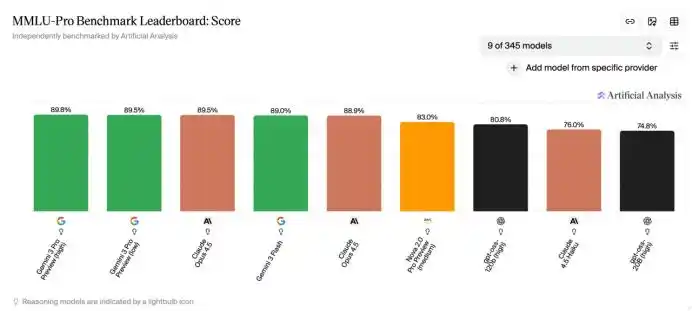
Many performance comparison charts in model launch presentations rely on them; some leaderboards on HuggingFace are also built upon these evaluation systems. It could even be said that today, when the AI industry discusses model capabilities, they are already using a common language defined by these benchmarks.

But interestingly, almost everyone focuses on the scores, yet few know who sets the questions. Behind MMLU-Pro, MMMU, and MMMU-Pro, the same name can be seen—Wenhu Chen.
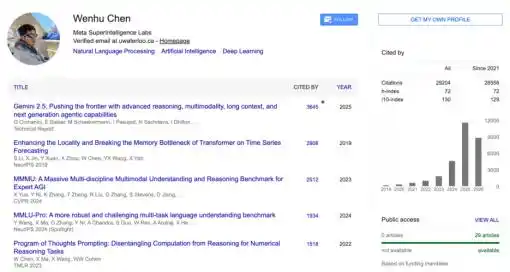
He is an Assistant Professor in the Department of Computer Science at the University of Waterloo in Canada. On Google Scholar, his papers have been cited over 30,000 times.

He is also the founder of TIGERLab. The English full name of this lab is Text and Image GEnerative Research Lab. Because the Chinese word for "tiger" is in his name, Wenhu Chen gave it a very distinctive Chinese name—Hutou Bang (Tiger Head Gang).

01

After the Old Exam Papers Lost Their Effectiveness

Wenhu Chen first caught wider attention because of MMLU-Pro.

MMLU was once one of the most commonly used benchmark evaluations for assessing the capabilities of large language models. It was like a comprehensive test paper, covering multiple subjects, used to measure a model's performance in knowledge understanding and reasoning tasks.

Early on, this paper was very useful. It could distinguish between models through scores, and the industry could also use it to observe whether large language models were truly improving.

But problems soon emerged.

As model capabilities continuously improved, MMLU gradually became "insufficiently challenging." The scores of cutting-edge models got higher and higher, and the gaps between them became smaller and smaller.
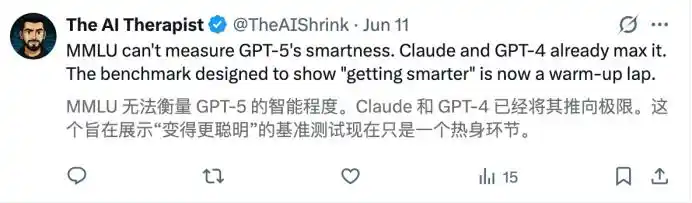
After OpenAI released o3, this problem became even more apparent. The accuracy of o3 on MMLU was already close to 100%, and other cutting-edge models also successively submitted scores approaching full marks.

This might sound like good news, but for evaluation, it actually meant trouble.

If everyone can get close to full marks on an exam paper, it becomes very difficult to continue judging who is stronger and where their strengths lie. It can still prove that models possess certain capabilities, but it is no longer suitable for measuring new progress.

The AI industry needed a harder, less easily "fooled" exam paper.

In 2024, Wenhu Chen and his team launched MMLU-Pro.

MMLU-Pro revamped this exam paper rather than simply expanding the question bank.
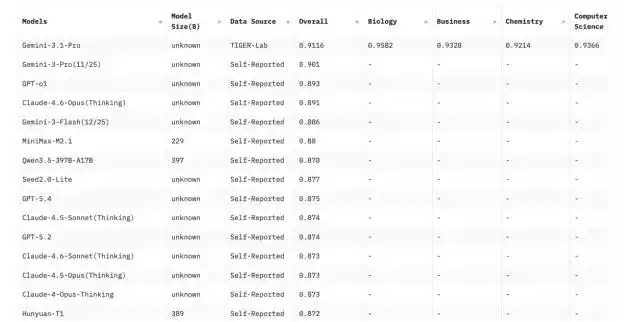
It contains 12,032 questions, covering 14 fields including mathematics, physics, chemistry, law, engineering, psychology, and health. Compared to the original MMLU, it expands the options from 4 to 10, reducing the probability of models guessing correctly. It also incorporates more reasoning-oriented questions and cleans up the original question bank of questions that were relatively simple, ambiguous, or lacked sufficient discriminative power.

The effect was direct.

The paper's results showed that model accuracy on MMLU-Pro decreased by 16% to 33% compared to the original MMLU. When the same model was tested under 24 different prompt styles, the score variation also decreased from 4% to 5% in the original MMLU to about 2%.

In other words, this new paper is not only harder but also more stable.

It reopened the gaps between models that all seemed excellent on the old exam paper. It also became easier to tell whether a model truly understands reasoning or is just better at handling old-style questions.

02

Usable Benchmark Evaluations

MMLU-Pro was quickly adopted by the industry.

MMLU-Pro later entered the NeurIPS 2024 Datasets and Benchmarks track and was also integrated into EleutherAI's lm-evaluation-harness framework. For the open-source model community, this meant it was no longer just a dataset in a paper but had entered the common evaluation toolchain.

Many models began reporting MMLU-Pro scores upon release. Some leaderboards on HuggingFace also incorporated it into their evaluation systems.

If MMLU-Pro solved the problem of the "old exam paper losing effectiveness" in language model evaluation, then MMMU pushed Wenhu Chen and TIGERLab to the center of multimodal evaluation.

The problems with multimodal models are more complex.

Language models answer questions, mainly processing text. Multimodal models, however, have to simultaneously process information in different forms like images, charts, diagrams, maps, tables, musical scores, chemical structures, etc. They not only need to understand the question stem but also truly comprehend the content in the images, and reason by integrating visual information, textual information, and domain knowledge.

The MMMU benchmark contains 11,500 multimodal questions sourced from university exams, quizzes, and textbooks, covering six major domains: Arts & Design, Business, Science, Health & Medicine, Humanities & Social Science, and Technology & Engineering, further subdivided into 30 subjects and 183 subfields.

These questions are not simply asking the model "what's in the picture." They require the model to combine image information with domain knowledge, much like a student tackling a professional problem.

When MMMU was released, the research team tested 14 open-source multimodal models, as well as representative closed-source models like GPT-4V and Gemini Ultra. Even the strongest closed-source models at the time, GPT-4V and Gemini Ultra, only achieved accuracy rates of 56% and 59% respectively.

These numbers indicate that while multimodal models appear to be progressing rapidly, they still have significant room for improvement when it comes to problems requiring genuine professional understanding and reasoning.

Later, Wenhu Chen's team released MMMU-Pro, further plugging the gaps that allowed models to bypass visual information. It filters out questions that could be answered by text-only models, expands answer choices, and introduces a vision-only setting where questions are embedded within images, requiring the model to perform both visual reading and text comprehension simultaneously.

Simply put, it prevents the model from "guessing the answer just by looking at the text."

This kind of work might sound somewhat tedious, but it is crucial. Because future multimodal models need to enter scenarios like healthcare, education, scientific research, design, and engineering; merely being able to describe a picture is not enough. They must be able to judge, reason, explain, and find the truly useful parts within complex visual information.

03

The People Behind the "Exam Papers"

Wenhu Chen's later work on MMLU-Pro and MMMU stems from his long-standing research direction.

His research interests have always been related to complex information understanding, knowledge question answering, and reasoning.

He earned his bachelor's degree from Huazhong University of Science and Technology, then pursued a master's at RWTH Aachen University in Germany, followed by a Ph.D. in Computer Science from the University of California, Santa Barbara. During his Ph.D., he had already begun research in areas like complex question answering, table reasoning, and knowledge evidence localization.

These tasks share a common characteristic: the answer often does not lie within a single piece of text.

It might be hidden in a table, require combining a piece of text and an image, or might need the model to first retrieve information, then integrate, calculate, and reason. The model cannot just be good at reciting existing knowledge.

Projects Wenhu Chen participated in, such as HybridQA, TabFact, Program of Thoughts, and MAmmoTH, are all related to this line of work.

This also explains his sensitivity to loopholes in model evaluation.

A good benchmark evaluation is not simply about making questions increasingly difficult, but about anticipating where models are most likely to "guess correctly" or "appear competent."

A model might memorize the question bank, guess answers based on options, or use text to bypass visual information... Good evaluation needs to patch these loopholes well.

After his Ph.D., Wenhu Chen joined Google Research and later participated in the development and evaluation of Google DeepMind's Gemini multimodal model from 2021 to 2025. This experience was also important. Long-term exposure to cutting-edge model development gave him a clearer understanding of how model capabilities grow and made it easier to see potential biases and blind spots in evaluation.

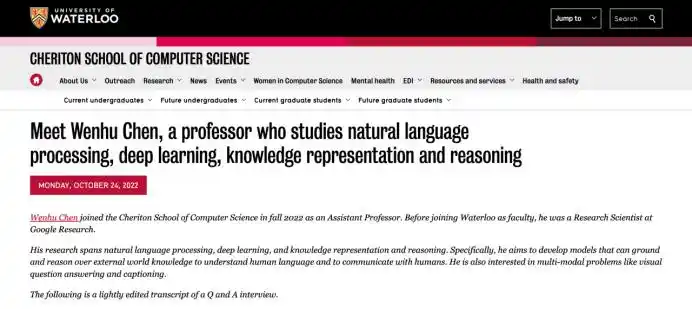
In the fall of 2022, Wenhu Chen joined the David R. Cheriton School of Computer Science at the University of Waterloo as an Assistant Professor. The same year, he was selected as a Canada CIFAR AI Chair. Subsequently, he founded "TIGERLab" (aka Hutou Bang), continuing research focused on foundation models, multimodal capabilities, and benchmark evaluations.
Hutou Bang doesn't just work on benchmark evaluations; they also conduct model and system research.

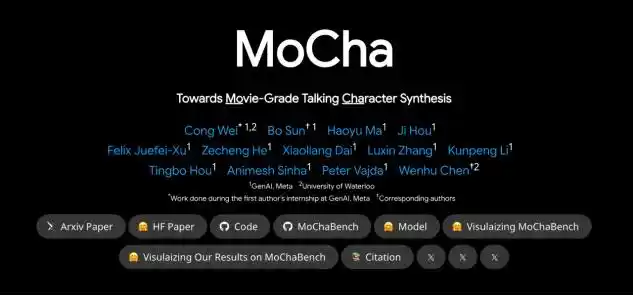
In the video direction, UniVideo attempts to place video understanding, generation, and editing within the same framework, allowing the model not only to generate a sequence of frames but also to understand content, respond to instructions, and complete edits. Vamba targets long video understanding, addressing the memory, computation, and training efficiency challenges posed by hour-long videos. MoCha, a collaboration with Meta's Generative AI team, focuses on talking virtual character generation, producing high-quality character videos from voice and text descriptions.
An exam setter who never takes tests themselves cannot set good questions. Building models themselves, in turn, makes them more suitable for evaluation.

Because truly good evaluation often comes from an understanding of model capability boundaries. Only by knowing how models are built and what problems they encounter in real tasks can one more easily design questions that can differentiate performance and expose weaknesses.

Now, Wenhu Chen has joined Meta's Superalignment Lab, where his work continues to focus on multimodal pretraining data and evaluation, serving Meta's foundation models.

The AI industry does not lack visible figures. Typically, the spotlight falls on entrepreneurs, star researchers, and heads of large model companies. New product launches, funding news, open-source models, and team adjustments often attract the most external attention, making these names more visible to the public.

But today, the participation of Chinese talent in the AI field extends far beyond these most conspicuous positions.

This article is from the WeChat public account "Letters AI", author: Jin Ya

Трендовые криптовалюты

Связанные с этим вопросы

QWho is the key person behind AI benchmark evaluations like MMLU-Pro and MMLU, and what is his background?

AThe key person behind AI benchmarks such as MMLU-Pro and MMLU is Wenhu Chen, an assistant professor in the Computer Science department at the University of Waterloo. He previously worked at Google Research and Google DeepMind on projects like the Gemini multimodal model. He is also the founder of TIGERLab (also known as the 'Tiger Gang'), which focuses on generative AI research for text and images.

QWhy was MMLU-Pro created, and how does it differ from the original MMLU benchmark?

AMMLU-Pro was created because the original MMLU benchmark became less effective as advanced AI models started achieving near-perfect scores, making it difficult to differentiate their capabilities. MMLU-Pro differs by expanding the number of answer choices from 4 to 10, reducing guesswork, and incorporating more reasoning-focused questions. It also removes simpler or ambiguous questions, resulting in a more challenging and stable evaluation that better distinguishes model performance.

QWhat is the MMLU benchmark designed to evaluate, and what challenges did it face over time?

AThe MMLU (Massive Multitask Language Understanding) benchmark is designed to evaluate large language models' knowledge comprehension and reasoning abilities across multiple academic subjects. Over time, as models like OpenAI's o3 achieved near-100% accuracy, MMLU became less effective at distinguishing between top-performing models, leading to the need for a more advanced benchmark like MMLU-Pro.

QWhat is the MMLU benchmark, and how does it assess multimodal AI models?

AThe MMLU (Massive Multidisciplinary Multimodal Understanding) benchmark is designed to assess multimodal AI models by testing their ability to integrate and reason with information from both text and visual inputs (e.g., images, charts, diagrams). It includes 11,500 questions from university exams and textbooks across six major fields, requiring models to combine visual understanding with domain knowledge to solve complex problems.

QHow does Wenhu Chen's work on AI benchmarks relate to his broader research interests and projects?

AWenhu Chen's work on AI benchmarks is closely tied to his broader research focus on complex information understanding, knowledge-based reasoning, and multimodal AI. His involvement in projects like HybridQA, TabFact, and UniVideo reflects his interest in tasks requiring integration of diverse data sources. By developing models himself, he gains insights into their limitations, enabling him to design more effective benchmarks that accurately assess true model capabilities.

Похожее

XRP: Формируется настройка на разворот вокруг гармонической модели и ключевой зоны поддержки

Криптовалюта XRP находится на технически важном уровне, который может определить её дальнейшее движение. Аналитик The_Alchemist_Trader_ указывает, что цена находится в критической зоне поддержки, подкреплённой несколькими факторами: уровнем коррекции Фибоначчи 0.618 и точкой контроля текущего торгового диапазона. Сочетание этих элементов усиливает значимость данной зоны, превращая её в потенциальную точку разворота. На графике формируется гармоническая модель разворота. Хотя такие модели не являются гарантией, они предоставляют трейдерам чёткую структуру для определения возможных точек разворота, уровней стоп-лосса и целей. Ключевой вопрос заключается в том, вызовет ли поддержка сильную реакцию покупателей или лишь замедлит падение. Для подтверждения разворота быкам необходимо не просто краткосрочное отскок от поддержки, а устойчивый рост с высоким объёмом торгов и закреплением выше ближайшего сопротивления. Без этого рынок может расценить ситуацию как очередную неудачную попытку восстановления. Таким образом, текущая ситуация представляет собой наблюдаемую торговую установку, а не прогноз, и её реализация зависит от последующего ценового действия.

bitcoinist1 ч. назад

XRP: Формируется настройка на разворот вокруг гармонической модели и ключевой зоны поддержки

bitcoinist1 ч. назад

Идея Виталика об алгоритмических стейблкоинах: механизм и вызовы с точки зрения опционов

Виталик Бутерин предложил новый механизм алгоритмического стейблкоина, основанный на концепции опционов. В его модели единица ETH разделяется на две части: стабильную (P) и восходящую (N). Стабильная часть P функционирует как синтетический покрытый колл-опцион, обеспечивая ценовую устойчивость до определенного ценового уровня, в то время как часть N получает весь доход от роста выше этого уровня. Поскольку оба компонента в сумме всегда равны одному ETH, система не требует залога, долга и процедуры ликвидации, что решает ключевую проблему традиционных CDP-стейблкоинов. Основная трудность заключается в том, что для поддержания стабильности актив P должен непрерывно пролонгироваться как глубокий опцион в деньгах, что создает риски проскальзывания цен, проблем с ликвидностью и возможных фронтранов. Кроме того, для каждого выпуска стабильного актива P должен существовать контрагент, готовый постоянно удерживать соответствующую восходящую часть N — по сути, рычаговую длинную позицию по ETH без комиссий финансирования и риска ликвидации. Устойчивый спрос на такую позицию является обязательным условием для масштабирования системы. Автор, основываясь на опыте Rysk, отмечает, что опционы в DeFi редко находят массовое применение как самостоятельный торговый инструмент. Однако в качестве базового финансового модуля для более сложных продуктов — таких как стейблкоины, структурированные доходные продукты или индексы — они могут стать эффективной инфраструктурой для распределения рисков и ценообразования. Таким образом, предложение Виталика подтверждает перспективность подхода, при котором опционы служат не конечным продуктом, а строительным блоком для следующего поколения децентрализованных финансовых приложений.

marsbit1 ч. назад

Идея Виталика об алгоритмических стейблкоинах: механизм и вызовы с точки зрения опционов

marsbit1 ч. назад

SpaceX, ИИ и XRP: Почему следующий перенос богатства может быть другим?

Финансовый мир вступает в фазу, ориентированную не на спекулятивные циклы, а на строительство новой экономической инфраструктуры. Ожидания публичного размещения акций SpaceX отражают поиск капиталом новых рубежей, таких как космическая инфраструктура, спутниковые сети и центры обработки данных. Это, наряду с развитием искусственного интеллекта (ИИ), формирует повышенный структурный спрос на промышленные товары. Блокчейн-технологии могут занять ключевую роль в этой новой системе не как спекулятивные активы, а как слой для расчетов в реальном времени. Активы, ориентированные на платежи и межсетевое взаимодействие, такие как XRP и XLM, могут стать важными для трансграничных расчетов и машинных платежей, что подчеркивается связями между их создателями и космической отраслью (например, Vast и SpaceX). Ключевой становится конвергенция ИИ и блокчейна. По мере того как автономные ИИ-агенты начинают совершать транзакции, растет потребность в инфраструктуре для мгновенных расчетов и управления идентификацией, которую могут обеспечить распределенные реестры. Четкое регулирование цифровых активов ускоряет институциональное внедрение. Таким образом, формируется картина структурного перехода: капитал направляется в космическую и ИИ-инфраструктуру, что стимулирует спрос на товары, а блокчейн-сети позиционируются как финансовый слой для расчетов между этими новыми системами.

marsbit2 ч. назад

SpaceX, ИИ и XRP: Почему следующий перенос богатства может быть другим?

marsbit2 ч. назад

Обратный отсчет до GPT-5.6: Прощай с иллюзией единого API, итерации вычислительной мощности не сравнятся с одним согласованием

В середине июня 2026 года ряд событий, включая ограничения для модели Fable 5, открытый исходный код GLM-5.2 и утечку информации о GPT-5.6, указывают на переломный момент в индустрии ИИ. Логика развития отрасли претерпевает существенные изменения: во-первых, «пригодность к использованию» становится важнее «передовых технологий», формируется «двухколейная» система сосуществования контролируемых закрытых и локальных открытых моделей; во-вторых, конкуренция смещается от «языкового интеллекта» к «пространственному интеллекту (моделям мира)», требующему огромных вычислительных мощностей; в-третьих, «независимость от модели» становится критически важной для разработчиков приложений для обеспечения непрерывности бизнеса в условиях транснациональных регуляторных рисков. Инцидент с Fable 5 (Anthropic), доступ к которой для неамериканских пользователей был ограничен через 72 часа после запуска, демонстрирует, что технологическое лидерство может быть ограничено нормативными требованиями. В ответ открытое сообщество, как показывает выпуск GLM-5.2 с лицензией MIT, предлагает стабильные, экономичные и локально развертываемые альтернативы, сокращающие затраты и снижающие зависимость. В свою очередь, OpenAI, судя по утечкам, фокусирует GPT-5.6 на развитии «пространственного интеллекта» и «моделей мира», пытаясь создать новое технологическое преимущество в областях, требующих высокой вычислительной мощности, таких как 3D-моделирование и робототехника. Ключевой вывод: в новой эре оценивать инфраструктуру ИИ необходимо не только по техническим показателям, но и по устойчивости к нормативным требованиям. Для разработчиков жизненно важно создавать архитектуры, не зависящие от конкретной модели, чтобы обеспечить быстрый переход между поставщиками и поддержание непрерывности бизнеса.

marsbit4 ч. назад

Обратный отсчет до GPT-5.6: Прощай с иллюзией единого API, итерации вычислительной мощности не сравнятся с одним согласованием

marsbit4 ч. назад

Закончится ли скоро «битва субсидий на токены» между ИИ-гигантами?

Токены ИИ, используемые в подписках, на самом деле сильно субсидируются: в дорогих тарифах стоимость потреблённых токенов может в 70 раз превышать абонентскую плату. Основные игроки, такие как OpenAI и Anthropic, активно привлекают инвестиции и готовятся к IPO, но их бизнес-модель сталкивается с фундаментальной проблемой — отсутствием «эффекта привязки» (lock-in) пользователей. В отличие от интернет-сервисов, таких как такси или доставка еды, токены легко заменяемы, и пользователи могут быстро переключиться на более дешёвый аналог. Билл Марис, основатель Google Ventures, отмечает, что Google, обладая огромной прибылью от рекламы, может снизить цену токенов на 80%, оказывая давление на конкурентов, которые зависят от внешнего финансирования. Это делает ценовую войну не средством достижения монополии, а скорее бесконечной «игрой на выживание», где цель — остаться за игровым столом. Вероятный сценарий — превращение токенов в стандартизированную инфраструктуру, подобную электричеству или интернет-трафику, где цены стремятся к себестоимости, а прибыль становится минимальной. Это означает, что эпоха крупных субсидий может продлиться, и пользователи продолжат получать мощные ИИ-сервисы по относительно низкой цене, но сами компании-разработчики вряд ли достигнут сверхвысокой прибыльности в долгосрочной перспективе.

marsbit4 ч. назад

Закончится ли скоро «битва субсидий на токены» между ИИ-гигантами?

marsbit4 ч. назад

Торговля

Спот
Фьючерсы

Популярные статьи

Как купить EDGE

Добро пожаловать на HTX.com! Мы сделали приобретение edgeX (EDGE) простым и удобным. Следуйте нашему пошаговому руководству и отправляйтесь в свое крипто-путешествие.Шаг 1: Создайте аккаунт на HTXИспользуйте свой адрес электронной почты или номер телефона, чтобы зарегистрироваться и бесплатно создать аккаунт на HTX. Пройдите удобную регистрацию и откройте для себя весь функционал.Создать аккаунтШаг 2: Перейдите в Купить криптовалюту и выберите свой способ оплатыКредитная/Дебетовая Карта: Используйте свою карту Visa или Mastercard для мгновенной покупки edgeX (EDGE).Баланс: Используйте средства с баланса вашего аккаунта HTX для простой торговли.Третьи Лица: Мы добавили популярные способы оплаты, такие как Google Pay и Apple Pay, для повышения удобства.P2P: Торгуйте напрямую с другими пользователями на HTX.Внебиржевая Торговля (OTC): Мы предлагаем индивидуальные услуги и конкурентоспособные обменные курсы для трейдеров.Шаг 3: Хранение edgeX (EDGE)После приобретения вами edgeX (EDGE) храните их в своем аккаунте на HTX. В качестве альтернативы вы можете отправить их куда-либо с помощью перевода в блокчейне или использовать для торговли с другими криптовалютами.Шаг 4: Торговля edgeX (EDGE)С легкостью торгуйте edgeX (EDGE) на спотовом рынке HTX. Просто зайдите в свой аккаунт, выберите торговую пару, совершайте сделки и следите за ними в режиме реального времени. Мы предлагаем удобный интерфейс как для начинающих, так и для опытных трейдеров.

732 просмотров всегоОпубликовано 2026.03.31Обновлено 2026.06.02

Как купить EDGE

Обсуждения

Добро пожаловать в Сообщество HTX. Здесь вы сможете быть в курсе последних новостей о развитии платформы и получить доступ к профессиональной аналитической информации о рынке. Мнения пользователей о цене на EDGE (EDGE) представлены ниже.

活动图片