Bernstein Report: Agentic AI Will Transform CPU from Supporting Role to Leading Role, Bullish on Hygon Information

marsbitОпубликовано 2026-06-17Обновлено 2026-06-17

Введение

Bernstein research report: Agentic AI will turn CPUs from supporting players to leading roles, bullish on Hygon Information. Analysts led by David Dai argue that AI is transitioning from the chatbot era to the agentic AI era. Unlike simple query-response models, agentic AI involves complex workflows including retrieval, planning, tool calling, and multi-step reasoning. This shift dramatically increases the demand for CPU compute to orchestrate these tasks, manage memory, and prevent expensive GPU idling. The report forecasts that the GPU-to-CPU ratio in inference clusters will reverse from 8:1 in 2025 to 1:1 by 2029. In agentic AI workloads, CPUs could account for 50% of the compute, on par with GPUs. Consequently, the server CPU Total Addressable Market (TAM) is projected to surge from $37 billion in 2025 to $223 billion by 2030, representing a 6x expansion. Arm is identified as a key beneficiary due to its superior performance-per-watt and a strategic shift from IP licensing to designing its own chips, targeting $15 billion in chip revenue by 2030. Bernstein raises Arm's price target to $500. For x86 vendors, the report is Overweight on AMD (target $600) and Hygon Information (target CNY 450), citing leadership and strong growth in the Chinese market respectively. Intel's target is raised to $100, reflecting upgraded earnings assumptions. The analysis acknowledges significant supply-side risks, questioning whether foundry and memory capacity can support such rapid CPU ...

Written by: Tide Research

When an AI agent is awakened, it is not waiting for an answer. It needs to retrieve information, plan steps, invoke tools, reason about intermediate results, call the model again, and finally execute actions. The entire workflow requires far more CPU computing power than ChatGPT popping up a single response.

The team led by Bernstein analyst David Dai released a report titled "Global Semiconductors: CPU Renaissance?" on June 17th. Its core thesis is: AI is transitioning from the chatbot era to the agentic AI era, and the CPU's role in the data center is shifting from a supporting role for the GPU to a leading role. This will drive the server CPU Total Addressable Market (TAM) to reach $223 billion by 2030, six times the $37 billion in 2025.

Reasoning is No Longer "One Q&A", CPU is Making a Comeback

Since the rise of large language models, GPUs/AI accelerators have been the core of AI computing. In custom inference clusters like Google TPU v6e and Meta Grand Teton, the GPU-to-CPU ratio was once 8:1.

But Bernstein believes that as agentic AI becomes mainstream, this ratio is reversing.

The core characteristic of Agentic AI is "looped reasoning": a single request may trigger retrieval, planning, tool calling, intermediate reasoning, another model invocation, and action execution. The GPU handles dense mathematical operations, but the CPU determines whether the entire system can efficiently orchestrate the workflow, schedule tasks, manage memory, and prevent accelerator idling. If the CPU is too weak, expensive GPUs are forced to wait idle, significantly reducing overall system efficiency.

Bernstein predicts that the GPU:CPU ratio in CSP inference clusters will drop from 8:1 in 2025 to 1:1 by 2029. In agentic AI workloads, the CPU's computational share will leap from 14% in traditional LLMs to 50%, on par with the GPU.

The report specifically points out that hardware roadmaps already corroborate this direction. AMD's next-generation Venice compute tray pairs each CPU with 4 MI455X GPUs. Nvidia's Vera superchip pairs each Vera CPU with 2 Rubin GPUs. Google's TPU v7x expansion unit pairs each CPU with 4 TPUs. The physical ratio of CPUs is already increasing; this is not a prediction but a current reality.

How is the $223 Billion Market Calculated?

Bernstein has significantly raised its 2030 server CPU TAM forecast from the previous $137 billion to $223 billion, based on the following core assumptions:

  • 2030 AI capital expenditure reaches $3.5 trillion, corresponding to 70GW of AI data center deployment.
  • AI accelerator market size is $1.6 trillion, accounting for 45% of AI DC capital expenditure.
  • Inference share rises from 35% to 70%, with a CPU:GPU ratio of 1:1 in inference scenarios and 0.5:1 in training scenarios.
  • CPU price is equivalent to 13% of GPU price.

Under this framework, the $223 billion TAM includes $174 billion from agentic AI workloads and $49 billion from non-AI traditional server CPUs. Compared to current levels, the entire server CPU market in 2025 is only $37 billion, with only $6 billion AI-related. This means that in Bernstein's forecast, the CPU market will undergo a six-fold expansion over the next five years, with a compound annual growth rate of 43%, almost unprecedented in semiconductor industry history. Bernstein also provided bull-case ($330 billion, assuming $4 trillion AI capital expenditure + 1.5:1 inference ratio) and bear-case ($137 billion, assuming $3 trillion capital expenditure + 0.5:1 inference ratio) ranges.

An interesting cross-verification comes from server CPU core counts: Arm data shows that agentic AI requires 120 million CPU cores per GW, four times that of traditional data centers. Calculated accordingly, 70GW of AI deployment in 2030 would require 8.4 billion CPU cores, corresponding to $168 billion in AI CPU TAM, highly consistent with the aforementioned model.

Why is Arm the Biggest Winner? Not Just IP, It's Making Chips Now

Arm is listed by Bernstein as a structural beneficiary of the CPU renaissance. The Arm architecture is becoming increasingly attractive in AI data centers due to its performance per watt. AWS Graviton offers 40% better price-performance and 60% lower power consumption compared to x86 instances.

More critically, in March 2026, Arm announced a strategic shift: from solely providing IP licensing to independently manufacturing CPUs, aiming for $15 billion in chip revenue by 2030. The Arm AGI CPU has already secured Meta as its first customer and co-developer, with partners including OpenAI, Cerebras, and Cloudflare. Based on this, Bernstein raised Arm's FY2030 EPS forecast to $11.79 (previously $9.83) and believes its chip revenue forecast could reach $22 billion, exceeding Arm's own target. Using a 42x P/E ratio, they set a price target of $500 (previously $300).

This also drove up the price target for SoftBank (which holds about 90% of Arm) from ¥8,200 to ¥11,200, implying 58% upside. Bernstein's valuation for SoftBank is based on a 30% discount to the Net Asset Value (NAV) of its holdings, with the discount narrowing from before, reflecting the increased value of Arm's stake and improvements in SoftBank's own business.

AMD, Intel, Hygon: Who Benefits?

AMD (Outperform, target price $600): Its products remain leading within the x86 camp and are expected to continue gaining market share. Its existing model already embeds strong CPU assumptions. After rolling valuations to CY27/28 averages, the target price is raised to $600.

Intel (Market-Perform, target price $100): Benefits from stronger, more sustained server CPU demand, leading to significant upward revisions in profit forecasts. Bernstein adjusted Intel's model from conservative assumptions to align with the industry, raising the target price from $65 to $100.

Hygon Information Hygon (Outperform, target price 450 RMB): Bernstein believes China's x86 CPU demand will grow faster than the global rate. Hygon's share in China's server CPU market will continue expanding from current levels, exceeding 35% by 2030, reaching not only government and state-owned enterprise clients but also penetrating CSPs. The target price is significantly raised from 280 RMB to 450 RMB.
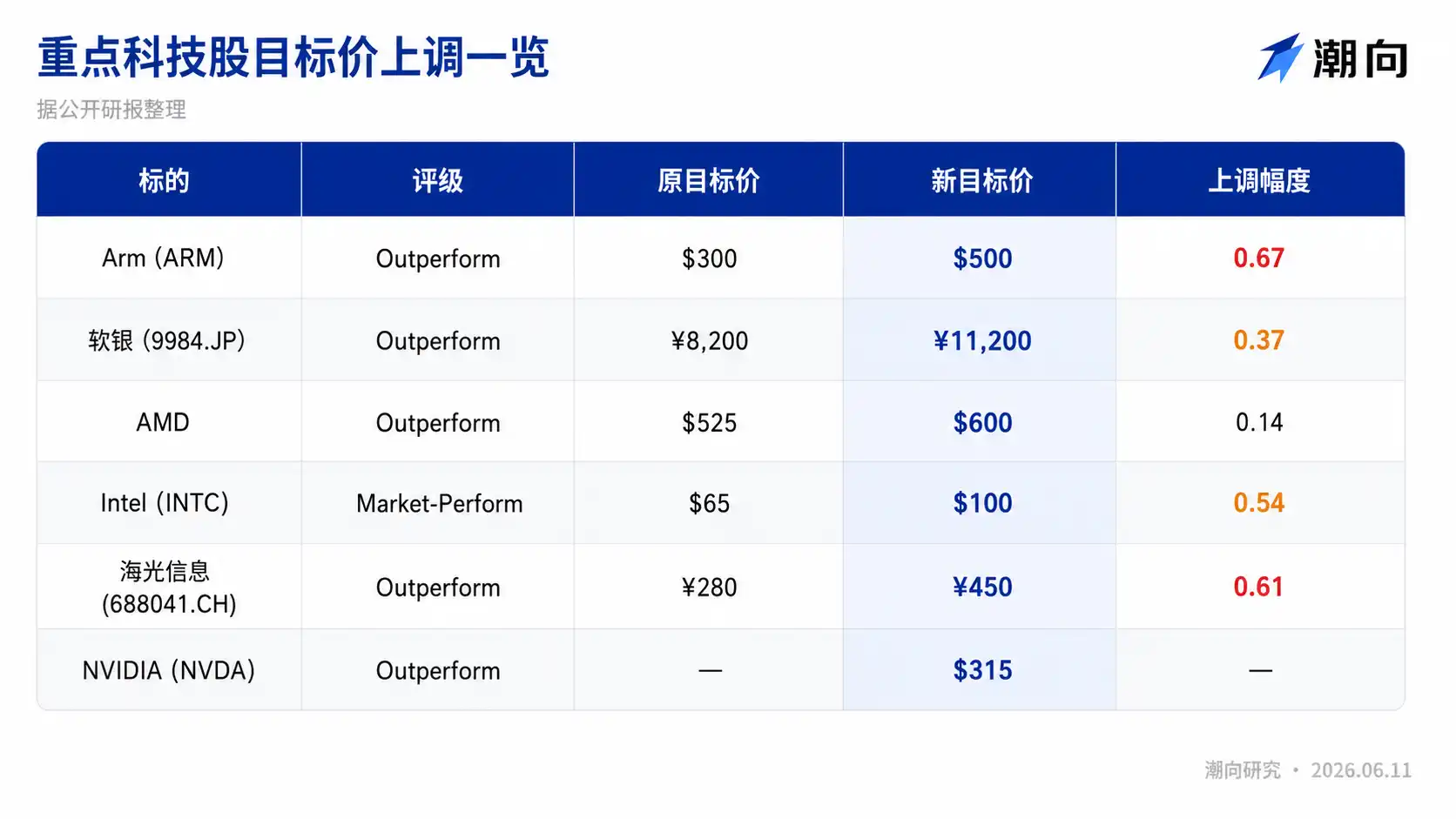
Source: Bernstein

Tide Research's Interpretation

Within Bernstein's thesis, the weakest link may not be on the demand side, but the supply side.

The report acknowledges in a footnote that it is "still assessing whether foundry and memory capacity is sufficient to support CPU growth," marking the greatest uncertainty in the entire report. Pulling CPU TAM from $37 billion to $223 billion implies needing roughly an additional $30 billion in annual CPU capacity by 2030.

TSMC's 3nm/5nm capacity is currently being occupied by AI accelerators and smartphone chips. Whether there is enough flexibility in foundry capacity allocated to server CPUs is not definitively mapped out in the report. Additionally, the report's core assumptions are built upon Nvidia's guidance of "AI infrastructure annual spending exceeding $1 trillion by 2027," which itself is among the most optimistic sell-side forecasts. Using this as the demand starting point for another research report carries the risk of expectation stacking.

Another noteworthy signal is that Nvidia's Vera CPU uses a self-developed Arm architecture. This means Nvidia could play the role of both partner and competitor to Arm in the CPU field, posing a subtle influence on whether Arm's long-term market share can reach 54%.

For investors, the most valuable aspect of this report is not just a specific price target. It provides a clear analytical framework: If you believe agentic AI is the genuine next phase, then CPU allocation must be repriced from "just enough" to a strategic priority. This implies that the entire semiconductor investment landscape needs to shift from GPU dominance towards a more balanced CPU+GPU narrative.

Risk Disclosure

This article is Tide Research's compilation and interpretation of a third-party brokerage research report. The ratings, target prices, profit forecasts, and related judgments cited herein represent the views of that brokerage's analysts, reflecting only the stance of their respective institutions. They do not represent Tide Research's views and do not constitute any investment advice.


Трендовые криптовалюты

Связанные с этим вопросы

QAccording to the Bernstein report, what is the core reason for a potential 'CPU renaissance' in data centers?

AThe core reason is the shift from simple chatbot-style AI to 'agentic AI.' Unlike single-turn Q&A, agentic AI involves complex, multi-step reasoning cycles requiring retrieval, planning, tool calling, and execution. This process demands significant orchestration, task scheduling, and memory management, workloads where the CPU is critical. A weak CPU becomes a bottleneck for the entire system, causing expensive GPUs to idle. Therefore, CPU importance increases dramatically to manage these complex workflows efficiently.

QWhat is Bernstein's forecast for the Server CPU Total Addressable Market (TAM) by 2030, and what key assumptions drive this prediction?

ABernstein forecasts the server CPU TAM to reach $223 billion by 2030, a significant increase from $37 billion in 2025. The key assumptions driving this prediction are: 1) AI capital expenditure reaching $3.5 trillion, corresponding to 70GW of AI data center deployment. 2) AI accelerators making up 45% of this spend ($1.6 trillion market). 3) The inference share of AI workloads rising from 35% to 70%. 4) A CPU-to-GPU ratio in inference clusters reaching 1:1 (and 0.5:1 in training). 5) A CPU unit price equivalent to 13% of a GPU's price.

QWhy does Bernstein identify Arm as a major structural winner from the agentic AI trend?

ABernstein identifies Arm as a major winner for two key reasons. First, its architecture offers superior performance per watt, making it highly attractive for power-constrained AI data centers (e.g., AWS Graviton offers 40% better price-performance). Second, and more importantly, Arm has strategically shifted from being just an IP licensor to designing and manufacturing its own chips (AGI CPU), with Meta as a lead partner. This move directly positions Arm to capture a larger share of the growing CPU TAM, with Bernstein projecting its chip revenue could reach $22 billion by 2030.

QWhat are the key investment rating changes for semiconductor companies mentioned in the report?

AThe report maintains or issues favorable ratings for several companies: 1) Arm: Target price raised to $500 (from $300), EPS estimates increased. 2) AMD: Maintains 'Outperform' rating, target price raised to $600. 3) Intel: Rating raised to 'Market-Perform', target price significantly increased to $100 (from $65). 4) Hygon (Haiguang Information): Issued an 'Outperform' rating for the Chinese market, with a target price of 450 RMB (up from 280 RMB), expecting its share in China's server CPU market to exceed 35% by 2030.

QWhat are the primary risks or uncertainties identified in the Bernstein report's bullish CPU thesis?

AThe report highlights two major uncertainties. First, on the supply side: it questions whether foundry (like TSMC) and memory capacity will be sufficient to support the projected massive growth in CPU production, requiring an additional ~$30 billion in annual CPU capacity by 2030. Second, on the demand side: the entire forecast is built upon the optimistic assumption (from Nvidia's guidance) of AI infrastructure spending exceeding $1 trillion annually by 2027. Using this optimistic forecast as a baseline introduces a 'stacking' risk if the underlying demand materializes slower. Additionally, Nvidia's Vera CPU using its own Arm design makes it both a partner and potential competitor to Arm.

Похожее

От Corning до Ciena: 10-кратные возможности на цепочке оптической связи для ИИ

Переход от меди к оптическим технологиям в дата-центрах ИИ создает инвестиционные возможности не только для известных компаний-производителей чипов, но и для ключевых поставщиков по всей цепочке создания стоимости в фотонике. Основной тезис: по мере перехода от 800G к 1.6T и далее к 3.2T, наибольшую выгоду получат компании, поставляющие критически важные компоненты, которые необходимы всем крупным игрокам, а не только самые разрекламированные бренды. **Ключевые компании и их роль:** * **Corning:** Лидер в производстве оптического волокна. Имеет долгосрочные контракты на миллиарды долларов с такими гигантами, как Meta, Amazon, Microsoft и другими. Высокая рентабельность и эффект масштаба. * **Amphenol:** Крупный производитель высокоскоростных соединителей и кабелей (как медных, так и оптических) для стоек ИИ-серверов. Эффективно интегрирует приобретения, демонстрируя высокий рост и прибыльность. * **Credo Technology:** Предоставляет решения для передачи данных (как по меди, так и по оптике), выступая "мостом" между старыми и новыми технологиями. Имеет высокие темпы роста, но также высокие риски из-за концентрации клиентов. * **Ciena:** Лидер в области когерентной оптики, чьи решения позволяют увеличить пропускную способность существующих волокон без их замены. Имеет значительный портфель заказов. * **AXT и VEO Solutions:** Компании "верхнего уровня" цепочки поставок. AXT производит ключевые материалы для оптических лазеров, но сталкивается с рисками экспортного регулирования. VEO Solutions предоставляет тестовое оборудование, необходимое всем участникам рынка ("лопаты для золотой лихорадки"). Также существуют специализированные ETF, такие как FOTO, для диверсифицированного инвестирования в фотонику. **Вывод:** Физические ограничения меди достигнуты. Переход на оптические технологии в дата-центрах ИИ неизбежен, а выгоды будут распределяться среди ключевых игроков по всей цепочке поставок — от материалов и компонентов до систем и тестирования.

marsbit12 мин. назад

От Corning до Ciena: 10-кратные возможности на цепочке оптической связи для ИИ

marsbit12 мин. назад

Collector Crypt с DAU всего 800 человек уже стал одним из самых прибыльных проектов в криптосфере?

**Collector Crypt (CARDS)**: Высокодоходный проект на Solana, оцифровывающий физические коллекционные карточки (в основном Pokémon). Он создает полную финансовую инфраструктуру вокруг этого актива. **Ключевая бизнес-модель**: Основная прибыль генерируется через систему «Гача» (цифровые кейсы). Платформа покупает карты оптом со скидкой 5-15%, пользователи открывают кейсы и могут либо оставить карты, либо немедленно продать их обратно платформе с дисконтом 7-15%. Средний выигрыш пользователя (EV) составляет около +2%, а платформа захватывает около 4.5% прибыли. **Революция рынка**: Проект бросает вызов таким гигантам, как eBay, где комиссии продавца достигают 16-20%. Collector Crypt взимает всего 2% за сделки, предлагая мгновенные расчеты, застрахованное хранение и удобную торговлю, кардинально улучшая пользовательский опыт. **Финансовые показатели**: В мае годовая прибыль оценивалась в ~53 млн долларов, а в июне темпы роста достигли ~109 млн долларов. При текущей полностью разводненной стоимости (FDV) ~550 млн долларов проект демонстрирует исключительную рентабельность. Помимо «Гачи», будущие источники дохода включают комиссии на вторичном рынке, партнерские доли и инструменты для участия в аукционах eBay. **Токеномика**: Общее предложение токенов — 20 млрд, но реальное циркулирующее предложение к 2027 году, вероятно, будет значительно меньше (около 13 млрд в самых агрессивных предположениях), что делает текущую оценку привлекательной. Команда уже начала выкуп токенов на открытом рынке. **Потенциал**: При всего около 800 ежедневных активных пользователей проект генерирует значительную прибыль. Он позиционирует себя не просто как торговая площадка для карточек, а как финансовая инфраструктура для нового класса активов — коллекционных предметов, открывая этот рынок для институциональных инвесторов. Расширение на спортивные карты и другие категории коллекционирования только начинается.

Foresight News25 мин. назад

Collector Crypt с DAU всего 800 человек уже стал одним из самых прибыльных проектов в криптосфере?

Foresight News25 мин. назад

Сенат США нацелен на осень 2026 года для выпуска законопроекта о налогообложении криптовалют на фоне продвижения закона CLARITY Act

Сенат США планирует представить законопроект о налогообложении криптовалют к осени 2026 года, параллельно продвигая закон CLARITY Act. Сенатор Стив Дэйнс сообщил, что республиканцы уже разработали основу законопроекта, схожую с недавними предложениями Палаты представителей. Растущий интерес Конгресса к четким налоговым правилам для цифровых активов стимулировал эту работу, при этом Комитет по финансам Сената ранее уже обсуждал такие вопросы, как стейкинг и майнинг. В то же время законодатели продолжают работу над всеобъемлющим законом CLARITY Act, который определяет правила регулирования криптовалютного рынка и разграничивает полномочия федеральных органов. Этот законопроект был одобрен Комитетом по банковским делам Сената, и его поддержали более 200 компаний отрасли, считающих, что четкое регулирование стимулирует инновации и инвестиции. Оба проекта — налоговый законопроект Сената и CLARITY Act — рассматриваются как взаимодополняющие шаги по созданию комплексной правовой базы для цифровых активов в США. Активность Конгресса указывает на ускорение процесса разработки соответствующего законодательства.

TheNewsCrypto28 мин. назад

Сенат США нацелен на осень 2026 года для выпуска законопроекта о налогообложении криптовалют на фоне продвижения закона CLARITY Act

TheNewsCrypto28 мин. назад

Новый председатель, старый инфляция, сверхожидаемая занятость: как глобальные активы переоцениваются после дебюта Ваша?

Новый председатель ФРС Кевин Уорш представил свой первый монетарный отчёт. Комитет по открытым рынкам оставил целевую ставку без изменений (3.50%—3.75%). Ключевым сигналом стало упрощение заявления ФРС и отказ от «форвардного руководства». Уорш подчеркнул, что Федрезерв должен сосредоточиться на данных, а не на предварительных обещаниях рынку. Хотя Уорш пытался снизить значимость «точечного графика» прогнозов, он показал сдвиг в сторону более жёсткой позиции: медианный прогноз по ставке на конец года вырос, а прогнозы по инфляции PCE на 2026 год были существенно повышены. Это указывает, что вопрос сейчас не о снижении, а о возможном повышении ставок. Уорш сталкивается со сложной дилеммой: инфляция остаётся высокой, а рынок труда неожиданно силён (безработица 4.3%, добавлено 172 тыс. рабочих мест в мае). Сильные экономические данные сейчас воспринимаются рынком негативно, повышая опасения по поводу политики ФРС. Внутри Федрезерва сохраняются разногласия между «голубями» и «ястребами». На рынках активы переоцениваются. Доллар укрепился, доходность гособлигаций остаётся под давлением. Акции технологического и AI-сектора, такие как полупроводники и облачная инфраструктура, столкнулись с давлением на оценку из-за высоких ставок, хотя их фундаментальный спрос остаётся стабильным. Золото и серебро находятся в подвешенном состоянии между высокими ставками и геополитическими рисками. Оборонные акции могут проявлять относительную устойчивость благодаря долгосрочным госзаказам. В будущем внимание рынка будет приковано к ключевым данным: отчёту по занятости за июнь (2 июля) и индексу потребительских цен (середина июля). Следующее заседание FOMC 28-29 июля станет первым по-настоящему значимым решением Уорша и задаст тон. Политическое давление в преддверии промежуточных выборов также будет проверять заявленную независимость ФРС.

marsbit38 мин. назад

Новый председатель, старый инфляция, сверхожидаемая занятость: как глобальные активы переоцениваются после дебюта Ваша?

marsbit38 мин. назад

Стабильные монеты как зарплата: почему они становятся предпочтительным выбором для международных работников?

**Стабильные монеты в зарплатах: почему они становятся предпочтительным выбором для международных работников?** Современная глобальная система оплаты труда скрывает валютные риски. Фрилансеры из Индии, Аргентины, Турции, работающие на компании США, получают доход в долларах, но тратят его в местной валюте. Принудительная конвертация зарплаты при получении ведет к потере покупательной способности, если местная валюта девальвирует. Например, за последний год индийский дизайнер, конвертировавший всю зарплату в рупии, потерял более 10% покупательной способности. В Аргентине потери могли составить 25%. Решение — сохранять часть дохода в долларах или стейблкоинах, привязанных к доллару. Однако обычным людям сложно открыть долларовый счет за рубежом из-за высоких комиссий (в среднем 6,5% за трансфер) и банковских ограничений. Стейблкоины устраняют эти барьеры: переводы почти мгновенны и стоят несколько долларов, а самохранимые кошельки (например, на платформе Altitude) позволяют напрямую владеть долларовыми активами без разрешения банков. Таким образом, работник может хранить сбережения в стейблкоинах, избегая инфляции, конвертируя в местную валюту только для текущих расходов, и даже получать доход через DeFi-протоколы. Хотя риски остаются (потеря приватного ключа, неясное регулирование), тренд набирает силу. Отчеты показывают, что в странах с высокой инфлацией большинство фрилансеров предпочитают зарплату в долларах или стейблкоинах. Это обеспечивает финансовый суверенитет: низкие издержки, контроль над активами и защита от девальвации. Даже МВФ признает потенциал стейблкоинов, предлагая регулировать, а не запрещать их. Стабильные монеты перестраивают зарплатную экосистему, делая деньги более свободными и гибкими.

Foresight News53 мин. назад

Стабильные монеты как зарплата: почему они становятся предпочтительным выбором для международных работников?

Foresight News53 мин. назад

Торговля

Спот
Фьючерсы

Популярные статьи

Неделя обучения по популярным токенам (2): 2026 может стать годом приложений реального времени, сектор AI продолжает оставаться в тренде

2025 год — год институциональных инвесторов, в будущем он будет доминировать в приложениях реального времени.

1.9k просмотров всегоОпубликовано 2025.12.16Обновлено 2025.12.16

Неделя обучения по популярным токенам (2): 2026 может стать годом приложений реального времени, сектор AI продолжает оставаться в тренде

Обсуждения

Добро пожаловать в Сообщество HTX. Здесь вы сможете быть в курсе последних новостей о развитии платформы и получить доступ к профессиональной аналитической информации о рынке. Мнения пользователей о цене на AI (AI) представлены ниже.

活动图片