HIP-3's Watershed Moment: After Trade.XYZ Swallows 90% of the Market, Multiple Players Exit One After Another

marsbitОпубликовано 2026-06-16Обновлено 2026-06-16

Введение

HIP-3 on Hyperliquid, enabling permissionless market creation, has fueled rapid growth with over $300 billion in cumulative trading volume. However, the ecosystem is undergoing a sharp consolidation. Trade.XYZ has captured a dominant market share, exceeding 90% of trading volume and 97% of open interest, driven by its first-mover advantage, use of USDC, and rapid asset expansion. This has created a significant liquidity flywheel effect, leaving other projects struggling. Several have recently shut down, including Felix and Ventuals, citing unsustainable competition and the high costs of market deployment. The initial 500,000 HYPE staking requirement (worth ~$35.9M) and subsequent auction costs for new assets present a high barrier to entry. Analysis shows most deployers face low annual yields and multi-year cost recovery periods, unlike Trade.XYZ's estimated 74% yield and 5-month payback. This centralization risks stifling innovation and limiting Hyperliquid's ecosystem diversity beyond perpetual contracts. Proposed solutions include a tiered exchange model with lower entry barriers and adjustments to the fee-sharing model for new markets to improve sustainability for smaller players.

Author: Nancy, PANews

Hyperliquid's battle has "spread to" Wall Street, while the internal dynamics of its ecosystem are also rapidly diverging.

Thanks to the permissionless market deployment capability brought by HIP-3 and the continuous enrichment of tradable asset types, Hyperliquid has rapidly broken through this year, becoming a new battleground for "weekend warriors."

While the HIP-3 market scale is expanding at high speed, its ecosystem is undergoing a brutal reshuffle. Trade.XYZ has almost monopolized the market by leveraging its first-mover advantage, holding over 90% of the market share. In contrast, the survival space for other ecosystem projects is constantly being squeezed. Several projects, including Feilx and Ventuals, have successively announced their closure.

HIP-3 Secures Over $300 Billion in Trading Volume, Trade.XYZ Monopolizes 90% of the Market

The rise of HIP-3 has unlocked a new growth curve for Hyperliquid.

Hyperscreener dashboard data shows that in the past 24 hours, Hyperliquid's full-platform Perp trading volume reached $8.77 billion, with the HIP-3 market contributing about $3.5 billion, accounting for 39.9% of the total trading volume. In other words, for every approximately $10 of perpetual contract trading volume generated on Hyperliquid, nearly $4 comes from HIP-3.

In fact, since its launch last October, HIP-3 has accumulated a trading volume exceeding $319.8 billion in just over half a year, far exceeding market expectations in terms of growth speed. However, what expanded alongside the trading scale was not a blossoming ecosystem but an increasingly obvious head effect, with Trade.XYZ devouring almost the entire market's incremental cake.

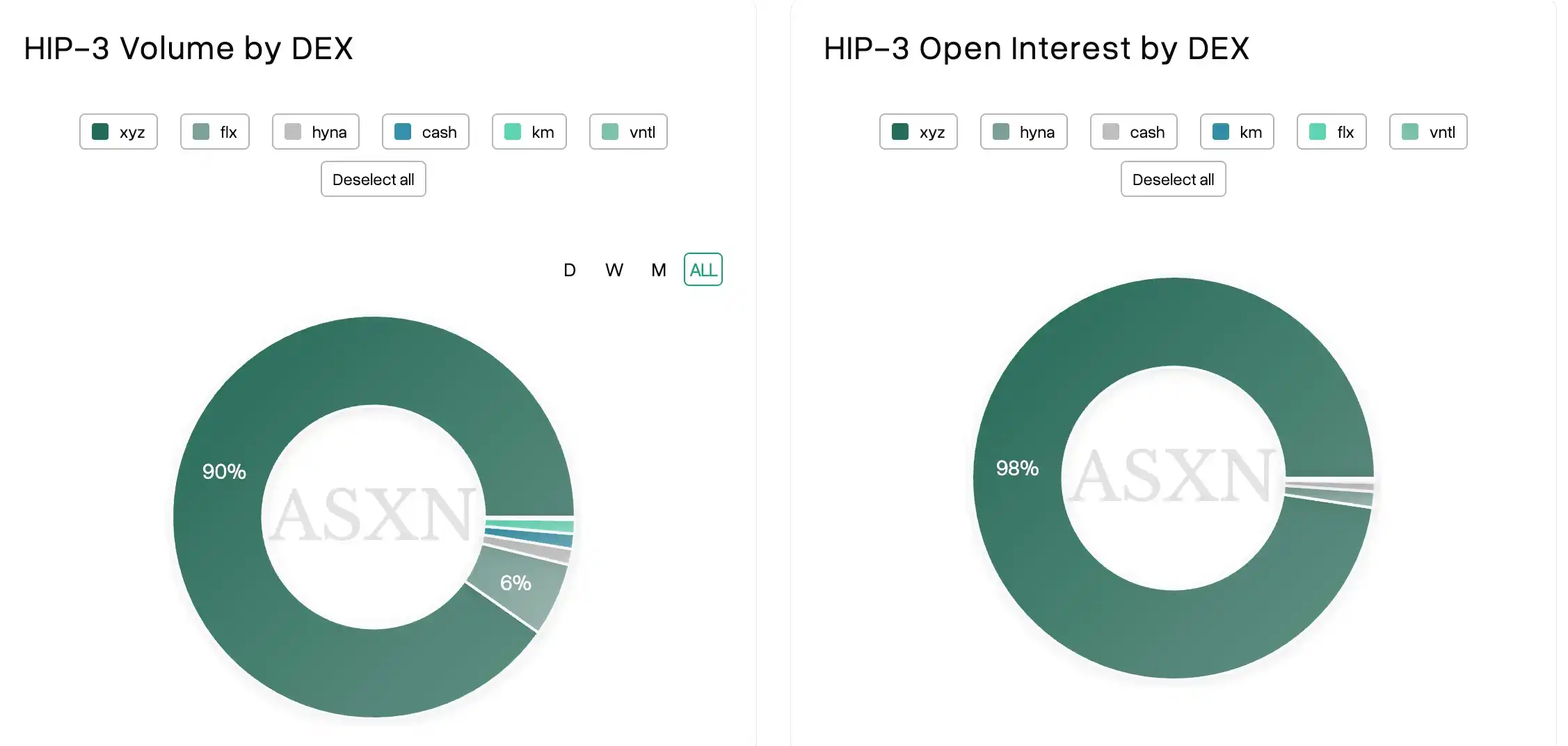
Looking at open interest, Hyperscreener data shows that as of June 16, the cumulative open interest in the HIP-3 market was approximately $29.4 billion. Trade.XYZ alone contributed $28.7 billion, accounting for a staggering 97.6% market share. In contrast, other projects like DreamCash, HyENA, Ventuals, and Felix mostly account for less than 1%, almost negligible.
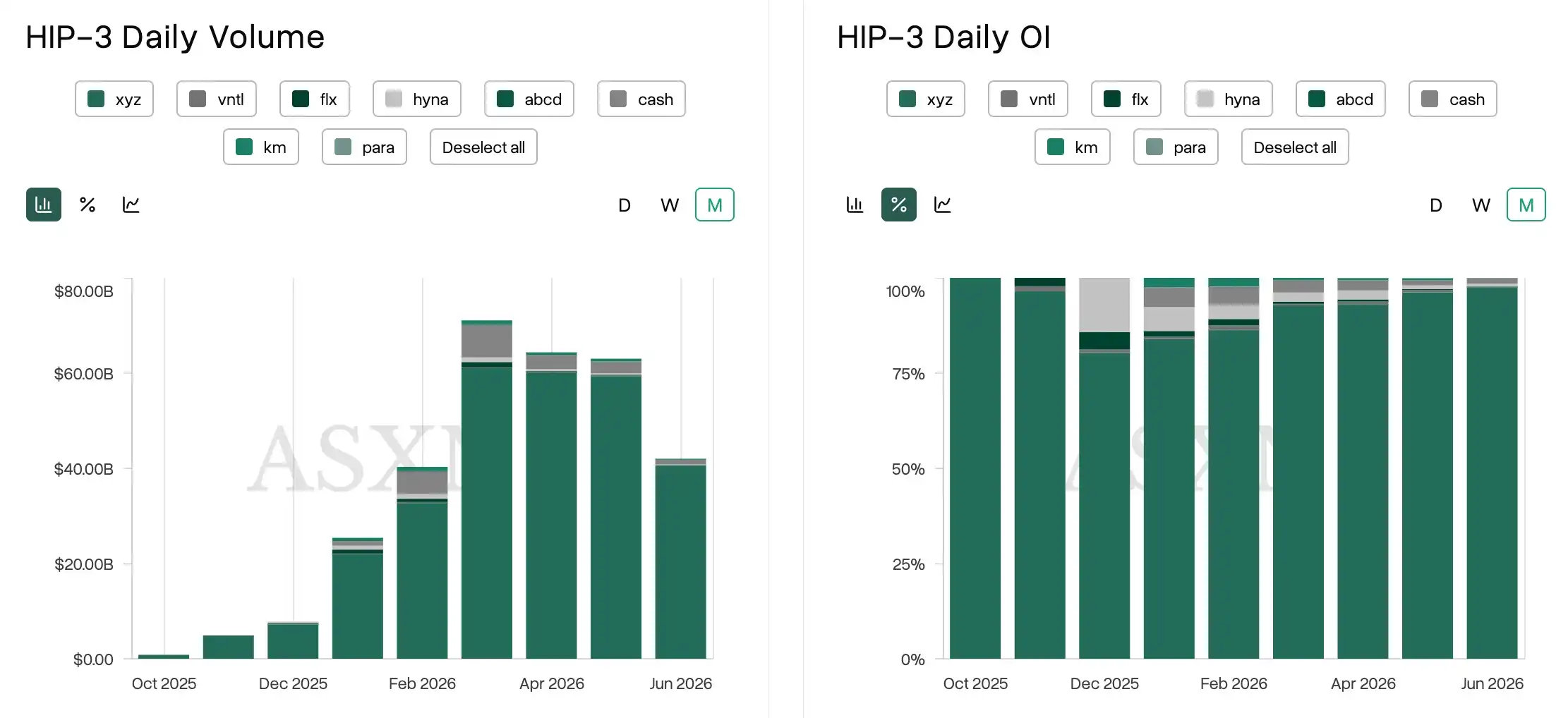
The trading volume dimension confirms this trend. In terms of cumulative historical trading volume, Trade.XYZ firmly holds about 90% market share, with DreamCash second at about 6%. The remaining projects jointly vie for less than 5% of the market space. In June alone, the head effect intensified further, with Trade.XYZ's market share climbing to 96.65%. The other seven markets, including Felix Exchange, Ventuals, and HyENA, collectively accounted for only 3.35%, with some projects even holding less than 0.1%.

Looking further at the trading activity of assets, this gap becomes even more apparent. This month, the cumulative trading volume of all assets on HIP-3 reached $11.21 billion. The core product on Trade.XYZ, XYZ100 (an index tracking the top 100 companies), contributed $10.64 billion alone, meaning a single asset supports most of the trading activity in the entire HIP-3 market.
The divergence in user activity is equally significant. Data shows that this month, Trade.XYZ attracted over 46,000 unique trading addresses to participate in trading, while other markets mostly had only a few hundred unique traders, some even fewer than a hundred. In terms of transaction frequency, Trade.XYZ has accumulated over 22.03 million trades this month, while most other markets had only tens of thousands to over a hundred thousand trades, a stark contrast to the leading platform.

To some extent, the growth story of HIP-3 at this stage can almost be seen as the growth story of Trade.XYZ alone.

HIP-3 Starts an Elimination Race, Ecosystem Projects Exit Successively

As Trade.XYZ continuously siphons market liquidity, HIP-3 is transforming from an open innovation arena into an elimination race dominated by top players, making it increasingly difficult for newcomers to get a piece of the pie.

Recently, several HIP-3 projects have been shutting down. Last week, Charlie, co-founder of the Hyperliquid lending protocol Felix, posted an announcement stating that Felix's HIP-3 DEX and all spot markets would begin shutting down on June 19, with full deactivation completed by June 20. All traders need to close their positions before then. This adjustment will not affect Felix's lending and spot stock businesses. The future focus will be on core products, and they do not rule out returning as a HIP-3 deployer once a new user growth path is found.

In his review, Charlie frankly admitted that although Felix, leveraging its first-mover advantage in markets like crude oil, gold, and silver, had accumulated approximately $3 billion in trading volume and earned substantial fee revenue, its market share was gradually overtaken after Trade.XYZ launched similar markets denominated in USDC.

In his view, Trade.XYZ's ability to quickly establish a moat was key: choosing the more liquid USDC over USDH, seizing the HIP-3 launch window, rapidly expanding the number of markets, and the brand effect and liquidity flywheel created by airdrop expectations. With USDH gradually fading out, continuing to maintain HIP-3 deployment can hardly form a differentiated competitive edge, hence the team's decision to scale back related operations.

Felix is not an isolated case. Shortly after, Ventuals, one of the largest participants offering private company stock trading on Hyperliquid, also announced it would gradually cease operations, with the team joining another building team within the Hyperliquid ecosystem. The platform will successively close markets for OpenAI, Anthropic, commodities, indices, etc. vHYPE holders can redeem HYPE at a 1:1 ratio and claim staking rewards. Ventuals is also terminating its points and referral programs and confirmed it will not issue a token.

Ventuals disclosed that during its operation, the project raised over 500,000 HYPE and achieved over $650 million in trading volume, once becoming one of the most representative innovative applications in the Hyperliquid HIP-3 ecosystem.

Although the team did not publicly explain the reason for the closure, the market generally believes that Trade.XYZ's siphoning of liquidity for popular assets, coupled with the inherent liquidity and pricing challenges of Pre-IPO assets themselves, were significant reasons for the project's eventual exit.

Most Deployers Need Four Years to Break Even, Pressure on HIP-3 Ecosystem Intensifies

Beyond the competitive pressure from the head effect, HIP-3's own deployment mechanism is further squeezing the survival space for latecomers.

According to HIP-3 rules, any team wanting to create a DEX must first stake 500,000 HYPE as a security deposit. Calculated at the current price, this capital outlay amounts to approximately $35.89 million, and must be locked for at least 183 days after deployment. Meanwhile, only the first three assets for each deployer do not require an auction. Any subsequent new assets must acquire deployment rights through a Dutch auction, with a minimum starting bid of 500 HYPE (currently worth about $36,000, though significantly lower than the 1,750 HYPE in January). The HYPE paid for the auction will be directly burned by the protocol.

For new entrants, under the condition of liquidity highly concentrated towards top players, the high upfront investment, continuously increasing expansion costs, and lengthy payback period are becoming increasingly burdensome to bear. It's worth noting that Hyperliquid disclosed in May of this year that it would gradually lower the 500,000 HYPE staking threshold.
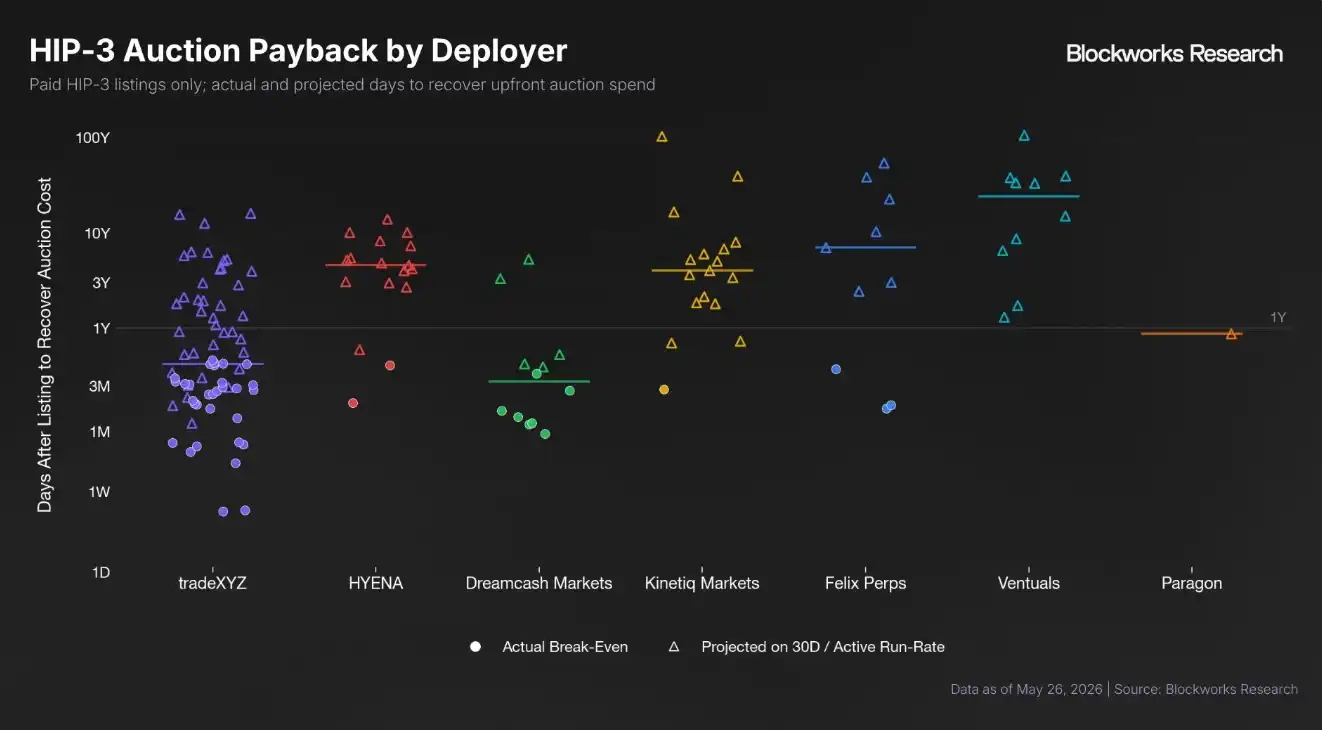
According to Blockworks Research analyst shaunda devens, except for Trade.XYZ, most HIP-3 deployers have an annualized yield based on their staked HYPE close to or even below 1%, with a median recovery period for market auction costs as long as four years. In stark contrast, Trade.XYZ is a clear exception, with an estimated yield on its staked HYPE as high as 74% and a median recovery period for auction costs of only 5 months.
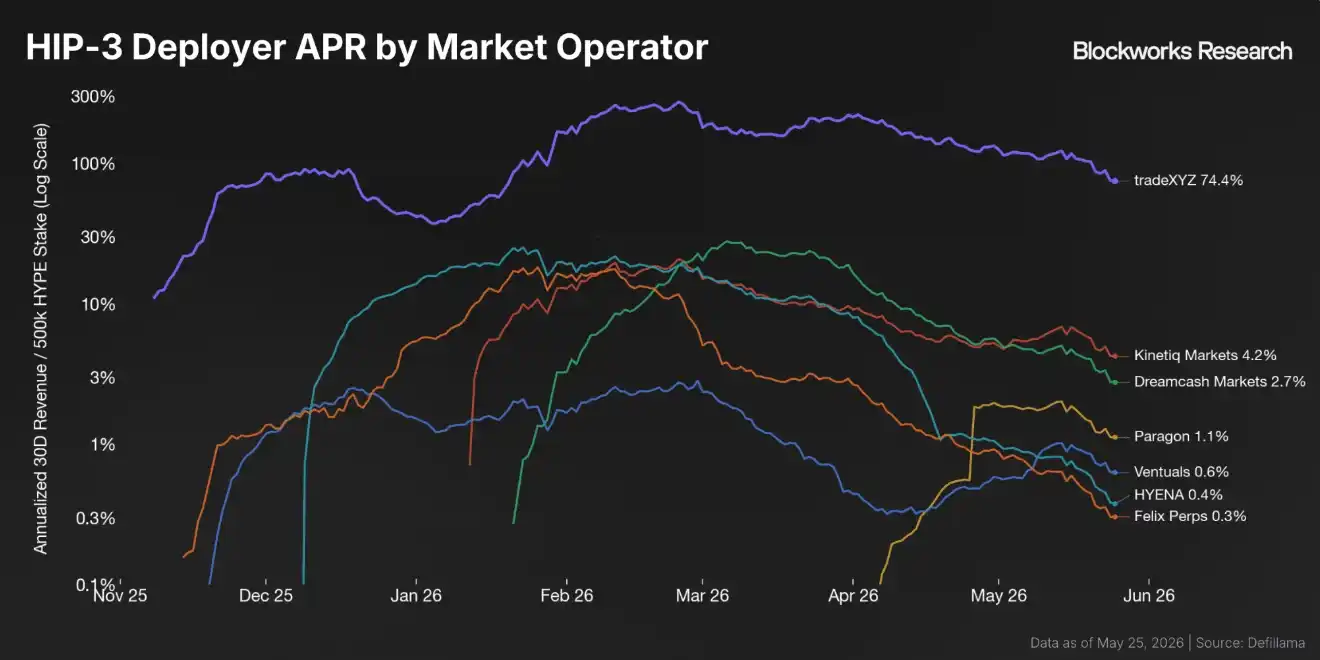
In other words, Trade.XYZ's success stems not only from the product itself but also from a self-reinforcing network effect. More users bring stronger liquidity, stronger liquidity attracts more assets to be listed, and more high-quality assets further consolidate its market position. Meanwhile, marginal deployers lack the incentive to expand further due to low returns, which also dampens demand for new HYPE staking and participation in market auctions.

For Hyperliquid, this situation is not without its concerns.

Undeniably, Trade.XYZ has brought huge incremental space for Hyperliquid, even becoming the most successful showcase case for HIP-3. However, if the listing rights and liquidity for the vast majority of popular assets are concentrated in the hands of a single deployer, then HIP-3 competition will remain top-heavy, struggling to evolve into an open and diverse ecosystem competition.

In the long run, this will not only compress the survival space for innovative projects but may also trap Hyperliquid in the single narrative of perpetual contracts. Especially as competition in the Perp DEX track intensifies, relying solely on perpetual contract trading makes it difficult to build a sufficiently rich on-chain application ecosystem and sustainable network effects. It is noteworthy that Hyperliquid has already ventured into the currently hot prediction market via HIP-4, attempting to further diversify its business portfolio.

Addressing the current dilemma, shaunda devens proposes two mechanism optimization suggestions to enhance the sustainability of market creation and strengthen HYPE's value capture capability.

First, introduce a tiered exchange mechanism. Allow new deployers to launch a HIP-3 DEX with a threshold lower than the current 500,000 HYPE, but with correspondingly restricted permissions, such as lower open interest caps, lower leverage multiples, and stricter risk control rules. As the deployer increases their HYPE stake size, gradually unlock higher-level functionalities.

Second, adjust the HIP-3 market auction economic model. Before a new market recovers its auction costs, allow the deployer to receive up to 100% of trading fee revenue; or, before the cumulative revenue of the entire DEX covers auction costs, prioritize returning transaction fees to the deployer, and revert to the standard 50:50 split between protocol and deployer only after reaching breakeven.

For Hyperliquid, HIP-3 has proven that decentralized market creation is a viable path. Trade.XYZ's success has not only validated product demand but has also become Hyperliquid's significant growth engine at this stage.

However, compared to relying on a single super-app to continuously siphon liquidity, a more resilient, healthier, and open ecosystem perhaps needs to ensure that innovators of different stages and types can all find a space to survive, allowing new assets, new play styles, and new business models to continuously emerge.


Связанные с этим вопросы

QWhat is the main reason behind the dominance of Trade.XYZ in the Hyperliquid HIP-3 market?

AThe main reasons for Trade.XYZ's dominance include its first-mover advantage in the HIP-3 launch window, its use of USDC (which has stronger liquidity) instead of USDH for settlements, rapid expansion of the number of markets it offers, and the brand effect and liquidity flywheel created by airdrop expectations.

QWhy are other HIP-3 projects like Felix and Ventuals shutting down?

AProjects like Felix and Ventuals are shutting down primarily due to intense competitive pressure from Trade.XYZ, which has siphoned away market liquidity. Felix acknowledged that after Trade.XYZ launched competing markets settled in USDC, its market share eroded. For Ventuals, the reasons are believed to be a combination of Trade.XYZ's liquidity absorption and the inherent challenges of liquidity and pricing for its pre-IPO asset market.

QWhat are the significant economic challenges for new HIP-3 deployers, according to the article?

ANew HIP-3 deployers face significant economic challenges: a high upfront requirement to stake 500,000 HYPE as a security deposit (worth ~$35.89 million), the need to win Dutch auctions to list new assets after the first three, and a very long return on investment period. Analysis shows most deployers have an annualized return of less than 1% on staked HYPE, with a median cost recovery period of 4 years.

QWhat potential long-term risk for Hyperliquid's HIP-3 ecosystem does the article identify?

AThe article identifies a potential long-term risk where the overwhelming dominance of a single deployer like Trade.XYZ could stifle competition and innovation within the HIP-3 ecosystem. If most popular assets and liquidity are concentrated with one player, HIP-3 risks becoming a top-heavy competition rather than a truly open and diverse ecosystem. This could also trap Hyperliquid in a single narrative centered on perpetual contracts, hindering the development of a richer on-chain application ecosystem.

QWhat are the two mechanism optimization suggestions proposed in the article to improve the HIP-3 ecosystem?

AThe two suggested optimizations are: 1) Introduce a tiered DEX mechanism allowing new deployers to start with a lower HYPE stake but with limited permissions (e.g., lower open interest caps, leverage), which increase as they stake more. 2) Adjust the market auction economic model so that deployers can receive up to 100% of trading fees until a new market's auction costs are recovered, or until the entire DEX's cumulative income covers its total auction costs, before reverting to the standard 50/50 split with the protocol.

Похожее

M&A Deals Are Exceptionally Active in the Crypto Market

Mergers and acquisitions (M&A) activity in the cryptocurrency primary market has reached a historic high, accounting for approximately 42% of total deals in the current month, nearly matching the number of financing rounds. This shift does not signal a new boom cycle but rather reflects a severe contraction in the venture capital funding environment. As financing dwindles, established industry giants—including major exchanges, payment firms, and infrastructure providers—are seizing the opportunity to acquire strategic assets at lower valuations. Key drivers behind the surge in M&A include depressed project valuations, the need to quickly acquire talent and technology to capture short market windows, the pursuit of crucial regulatory licenses, and the strategic expansion into adjacent business verticals such as derivatives, payments, stablecoins, and real-world asset (RWA) issuance. Major acquisitions, like Coinbase's purchase of Deribit and Kraken's acquisition of NinjaTrader, exemplify the push to expand into high-margin areas like derivatives and multi-asset trading. This trend is reshaping the industry's exit landscape, offering an alternative to token-based exits and incentivizing startups to build tangible products and revenue streams with inherent strategic value for acquisition. However, it also points toward increasing centralization, as critical functions—trading, custody, payments, compliance—become concentrated within a few large, well-capitalized platforms, potentially raising barriers to entry for new ventures.

marsbit1 мин. назад

M&A Deals Are Exceptionally Active in the Crypto Market

marsbit1 мин. назад

Solana Privacy Ecosystem Panorama: A Complete Privacy Stack from Compute to AI

**Title: The Solana Privacy Ecosystem: A Full-Stack View from Compute to AI** **Summary:** This article provides a comprehensive overview of the emerging privacy landscape on the Solana blockchain, characterizing it as still in early development. It identifies two primary verticals—Neobanks and Private DeFi—as key drivers, while noting gaps in tooling and user experience. The discussion centers on two main approaches to private computation: Arcium, which utilizes Multi-Party Computation (MPC) networks (Multi-Party eXecution Environments) to process encrypted data with final settlement on Solana; and Magic Block, which leverages Trusted Execution Environments (TEEs) via its Private Ephemeral Rollup (PER). Both enable confidential applications like dark pools and private DeFi with minimal code changes. Building on this infrastructure, projects are creating privacy-focused applications. Umbra, built on Arcium, offers Encrypted Token Accounts (ETAs) for private balances, transfers, and selective disclosure for compliance. Other wallets like Privacy Cash and Hush provide mixer-like functionality for SOL. For private trading, encifherio uses TEEs to encrypt swap details routed through Jupiter, while VanishTrade and Darklake focus on shielding transaction intent and liquidity routing, with Darklake introducing a "blind slippage pool" to prevent front-running. Further applications include private prediction markets (e.g., Melee Markets using Arcium's encrypted order books) and private AI. Loyal exemplifies the latter, using both Magic Block and Arcium to enable decentralized AI agents that store user data, conversations, and transactions confidentially on-chain. The article concludes by framing privacy not as a single technology but as an evolving "ultimate privacy stack," with experts like Helius's Mert envisioning a future combination of Fully Homomorphic Encryption (FHE) and Zero-Knowledge proofs (ZK). Helius Privacy itself is developing a ZK-based UTXO privacy layer for Solana.

Foresight News7 мин. назад

Solana Privacy Ecosystem Panorama: A Complete Privacy Stack from Compute to AI

Foresight News7 мин. назад

7 Key Questions Regarding 'DeepSeek Completes Over 50 Billion Yuan in Financing'

DeepSeek, the prominent Chinese AI company, has reportedly completed its first external funding round, raising over 50 billion RMB (approximately $6.9 billion USD), according to foreign media reports. This financing values the company at over $50 billion USD, a significant increase from a $10 billion valuation when the round began in April 2026. Founder Liang Wenfeng personally contributed 20 billion RMB, with other investors including Tencent, CATL (Contemporary Amperex Technology), JD.com, NetEase, and IDG Capital. Notably, the National Artificial Intelligence Industry Investment Fund also participated with a direct investment of 1 billion RMB. The funding round is distinctive for its structure. Most investors' capital is channeled into a limited partnership controlled by CEO Liang Wenfeng, rather than directly into DeepSeek. These investors face a five-year lock-up period, have no voting rights, but receive priority financial information and future investment rights. This arrangement is seen as a measure to ensure Liang's absolute control over the company's direction, aligning with its stated principles of prioritizing groundbreaking AGI (Artificial General Intelligence) research over short-term profitability. The report highlights strategic reasons for key investors. Tencent's involvement is viewed as a strategic alignment, building on existing collaborations. CATL's investment is linked to the critical energy and power infrastructure needed for AI data centers, a key growth area for the battery giant. The participation of a state-backed fund underscores the national strategic importance of AI development. Post-funding, DeepSeek is expected to accelerate infrastructure development, including building its own data centers, hire more talent, and release new model versions with enhanced capabilities like image and audio support. While this marks a major step, the company's long-term journey towards AGI remains a challenging path that will require balancing its foundational ideals with the expectations of its new investors.

marsbit52 мин. назад

7 Key Questions Regarding 'DeepSeek Completes Over 50 Billion Yuan in Financing'

marsbit52 мин. назад

The World Cup is Here: The Battle for Entry into Prediction Markets Has Begun

The 2026 FIFA World Cup has begun, and alongside the on-field competition, a new off-field battleground is emerging: prediction markets. These blockchain-based platforms, which convert crowd wisdom into tradable probabilities, are gaining significant traction. However, their complexity—involving wallets, gas fees, and smart contracts—has historically limited participation to crypto-native users. Centralized exchanges (CEXs), like Gate, are tackling this adoption barrier. By integrating with leading prediction market protocol Polymarket, Gate simplifies the user experience. Users can participate directly with their exchange account and USDT, bypassing complex Web3 steps. Gate offers a streamlined "Prediction Mode" for casual users and a professional "Trading Mode" with advanced tools. Key features include two-way trading (allowing users to buy or sell positions before event resolution), support for diverse markets (sports, crypto, macroeconomics), and a suite of information tools like a "Smart Money" leaderboard, wallet tracking, and AI-powered insights. For the World Cup, Gate launched a dedicated hub aggregating schedules, standings, and relevant markets. This allows fans to seamlessly follow games and trade on outcomes, transforming passive viewing into active participation where they can monetize their predictions and trade on shifting consensus throughout a match. The article argues that prediction markets have proven their value in event forecasting. The next challenge is mass adoption. The competition is shifting from building effective protocols to creating accessible user entry points. By lowering technical barriers and building a complete ecosystem for information and trading, platforms like Gate aim to transition prediction markets from a niche crypto tool to a mainstream platform for expressing and trading on collective intelligence.

Odaily星球日报1 ч. назад

The World Cup is Here: The Battle for Entry into Prediction Markets Has Begun

Odaily星球日报1 ч. назад

Торговля

Спот
Фьючерсы

Популярные статьи

Как купить S

Добро пожаловать на HTX.com! Мы сделали приобретение Sonic (S) простым и удобным. Следуйте нашему пошаговому руководству и отправляйтесь в свое крипто-путешествие.Шаг 1: Создайте аккаунт на HTXИспользуйте свой адрес электронной почты или номер телефона, чтобы зарегистрироваться и бесплатно создать аккаунт на HTX. Пройдите удобную регистрацию и откройте для себя весь функционал.Создать аккаунтШаг 2: Перейдите в Купить криптовалюту и выберите свой способ оплатыКредитная/Дебетовая Карта: Используйте свою карту Visa или Mastercard для мгновенной покупки Sonic (S).Баланс: Используйте средства с баланса вашего аккаунта HTX для простой торговли.Третьи Лица: Мы добавили популярные способы оплаты, такие как Google Pay и Apple Pay, для повышения удобства.P2P: Торгуйте напрямую с другими пользователями на HTX.Внебиржевая Торговля (OTC): Мы предлагаем индивидуальные услуги и конкурентоспособные обменные курсы для трейдеров.Шаг 3: Хранение Sonic (S)После приобретения вами Sonic (S) храните их в своем аккаунте на HTX. В качестве альтернативы вы можете отправить их куда-либо с помощью перевода в блокчейне или использовать для торговли с другими криптовалютами.Шаг 4: Торговля Sonic (S)С легкостью торгуйте Sonic (S) на спотовом рынке HTX. Просто зайдите в свой аккаунт, выберите торговую пару, совершайте сделки и следите за ними в режиме реального времени. Мы предлагаем удобный интерфейс как для начинающих, так и для опытных трейдеров.

1.5k просмотров всегоОпубликовано 2025.01.15Обновлено 2026.06.02

Как купить S

Sonic: Обновления под руководством Андре Кронье – новая звезда Layer-1 на фоне спада рынка

Он решает проблемы масштабируемости, совместимости между блокчейнами и стимулов для разработчиков с помощью технологических инноваций.

2.3k просмотров всегоОпубликовано 2025.04.09Обновлено 2025.04.09

Sonic: Обновления под руководством Андре Кронье – новая звезда Layer-1 на фоне спада рынка

HTX Learn: Пройдите обучение по "Sonic" и разделите 1000 USDT

HTX Learn — ваш проводник в мир перспективных проектов, и мы запускаем специальное мероприятие "Учитесь и Зарабатывайте", посвящённое этим проектам. Наше новое направление .

1.8k просмотров всегоОпубликовано 2025.04.10Обновлено 2025.04.10

HTX Learn: Пройдите обучение по "Sonic" и разделите 1000 USDT

Обсуждения

Добро пожаловать в Сообщество HTX. Здесь вы сможете быть в курсе последних новостей о развитии платформы и получить доступ к профессиональной аналитической информации о рынке. Мнения пользователей о цене на S (S) представлены ниже.

活动图片