Super-Rich Hoarded Record Cash in February, Stock Market Hit New Highs Four Months Later: Who's Getting Fooled?

marsbitОпубликовано 2026-06-15Обновлено 2026-06-15

Введение

In February, the total assets in US money market funds reached a record high of approximately $8.25 trillion, a trend highlighted by high-net-worth individuals increasing their cash holdings. Notably, Warren Buffett's Berkshire Hathaway amassed a $381.7 billion cash pile ahead of his 2025 retirement, while other prominent figures like Peter Thiel sold tech stocks, fueling narratives of wealthy investors seeking safety. However, by June, the trend reversed. Money market fund assets fell to around $7.87 trillion, indicating a flow of capital back into equities. Concurrently, the S&P 500 and Nasdaq reached all-time highs, with the S&P 500 surpassing 7600 points. This market surge occurred despite the earlier defensive moves, highlighting a potential opportunity cost for those who retreated to cash. Analysis shows that since early 2022, the S&P 500's total return significantly outpaced that of prime money market funds. The capital shifted from equities appears to have been partly reallocated into alternative investments like real estate, art, and private credit, especially among ultra-high-net-worth individuals. Meanwhile, major investment banks like Goldman Sachs and Morgan Stanley have raised their year-end targets for the S&P 500, citing AI-driven earnings growth, while also cautioning about risks including market concentration and economic fragility beneath the surface rally.

Author: Claude, Deep Tide TechFlow

Deep Tide Introduction: In February of this year, US money market funds surged to a historical peak of about $8.25 trillion. Buffett left behind $381.7 billion in cash before retirement, and rumors swirled that the super-rich were fleeing the stock market.

But now in June, the plot has reversed: the S&P 500 repeatedly hits new highs, breaching the 7600-point level for the first time on June 2nd, while money market fund assets have fallen back to $7.87 trillion as of June 10th. Money is flowing from cash back into stocks. The safe-haven bet placed by the wealthiest group is now being proven wrong by the market.

The Story in February: Cash in the Hands of the Rich Piled Up to a Record High

Let's rewind to the beginning of the year.

According to a Goldman Sachs survey from October 2025, high-net-worth individuals with over $1 million in investable assets held, on average, about 20% of their net worth in cash and cash equivalents—a proportion considered high for traditional allocation.

The most symbolic figure was Buffett.

As reported by Bloomberg, before his retirement on December 31, 2025, the former CEO of Berkshire Hathaway had built the company's cash reserves to approximately $381.7 billion as of the end of the third quarter of 2025. This cash pile even ended up making money—despite market turmoil, Buffett's personal net worth still grew by about $21 billion last year.

He wasn't the only one reducing holdings. According to Reuters' disclosures of holdings documents, PayPal co-founder Peter Thiel, through his hedge fund Thiel Macro, sold about $100 million worth of Nvidia stock in Q3 2025. Nvidia rose nearly 35% in 2025; Thiel exiting at a high point added fuel to concerns about an "AI bubble."

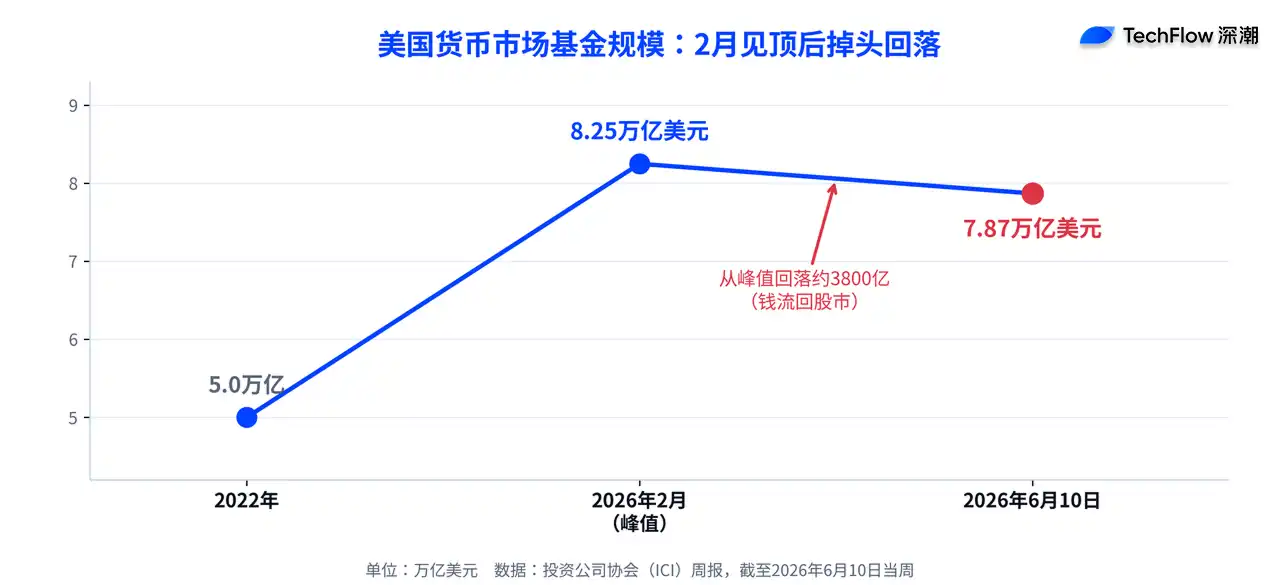
The market direction was the same. According to data from the Investment Company Institute (ICI), US money market fund assets surged to a historical peak of about $8.25 trillion at the end of February this year, a 65% increase from about $5 trillion in 2022. The narrative back then was clear: smart money was hiding in cash.
The June Reversal: Money is Flowing from Cash Back into Stocks

The problem is, it's June now, and the story has flipped.

According to official ICI data, as of the week ending June 10th, money market fund assets dropped to $7.87 trillion, with a single-week outflow of $21.48 billion; the previous week, June 4th, it was $7.89 trillion. From the February peak of $8.25 trillion, assets have shrunk by about $380 billion. Money is flowing *out* of cash, not in.

Where is it going? Stocks. According to CNBC, the S&P 500 closed at 7609.78 points on June 2nd, breaking above the 7600-point level for the first time in history, marking its ninth consecutive day of gains; the Nasdaq also hit new highs. Nvidia surged over 6% in a single day after releasing its new generation of PC chips, boosting Dell and HP. In short, the money that hid in cash back in February is now watching the market hit new highs without them.

There was an early signal behind this. According to investingLive reports, Bank of America (BofA) warned as early as late May that as the market surged to new highs and bullish sentiment peaked, cash levels were actually declining. The $8.25 trillion record was old news from February; by June, the market landscape was a different story.

The Cost of Hoarding Cash: Lagging Stocks by More Than Double

Why is the wealthy's safe-haven move being proven wrong? Look at the return gap.

According to calculations by The Motley Fool, if one had held from the point before the 2022 bear market when cash was flowing into money market funds all the way to the present, the total return for the S&P 500 would be about 42%, while the Vanguard Federal Money Market Fund returned only 18% over the same period—a gap of more than double. Hiding in cash seems safe, but the cost is missing a big chunk of the rally.

This is also why many analysts remain skeptical of the "pile into cash at the first sign of trouble" approach:

Historically, events like geopolitical conflicts are often short-term and can instead be buying opportunities at low points, not reasons to sell out.

Those Who Moved Money Out of Stocks Went into Real Estate and Art

The money freed up by those who did reduce stock holdings hasn't been idle. The Goldman Sachs survey shows that among those with $1 million to $5 million in investable assets, nearly 40% hold alternative investments; among those with over $10 million, this proportion reaches 80%. The greater the assets, the more they move beyond traditional stocks.

Art is one destination. According to UBS's 2025 Art Market Report, high-net-worth collectors allocated an average of about 20% of their wealth to art in 2025. Real estate, private credit, and hedge funds are also absorbing funds flowing out of the stock market. The logic is that in an environment of sticky inflation, high interest rates, and uncertain tariff prospects, these asset classes resemble safer harbors. But even safe harbors have a cost, as the earlier set of return numbers demonstrates.

Major Banks Are Still Doubling Down: Goldman Sachs, Morgan Stanley Raise Price Targets

If the wealthy's moves in February leaned defensive, Wall Street banks' stance in June is the opposite.

According to Bloomberg, Goldman Sachs' strategy team (led by Ben Snider) raised its year-end target for the S&P 500 from 7600 points to 8000 points in late May, citing AI-driven earnings growth. Goldman increased its 2026 S&P 500 earnings-per-share forecast to $340, representing a 24% year-on-year growth, and believes AI infrastructure beneficiaries will contribute about half of this year's index earnings growth. However, Goldman also cautioned: "AI sentiment and interest rates present risks in both directions."

Morgan Stanley is even more bullish. Chief Investment Officer for Wealth Management Lisa Shalett, in an outlook on May 20th, set a one-year target of 8300 points for the S&P 500, implying about 11% to 12% upside. But she also listed five risks: gains excessively concentrated in a few large-cap AI stocks, deteriorating US consumer finances, corporate profits reliant on price hikes rather than productivity, pressure on long-term interest rates, and better performance outside the US (Japan and some emerging markets). Shalett's core judgment is that the market's surface is stronger than the underlying economy.


Трендовые криптовалюты

Связанные с этим вопросы

QAccording to the article, what significant record did U.S. money market funds reach in February, and what was the narrative at that time?

AIn February, U.S. money market funds surged to a historical peak of approximately $8.25 trillion. The prevailing narrative at that time was that smart money was seeking shelter in cash, with super-wealthy individuals appearing to withdraw from the stock market.

QHow has the situation changed by June, specifically regarding the flow of funds and stock market performance?

ABy June, the situation reversed. Money market fund assets had decreased to $7.87 trillion by June 10, indicating an outflow of cash. Conversely, the stock market reached new highs, with the S&P 500 closing above 7600 points for the first time on June 2, marking a nine-day winning streak.

QWhat was the performance gap between holding cash (in a money market fund) and holding stocks (the S&P 500) from the start of the 2022 bear market to the present, as cited in the article?

AFrom the start of the 2022 bear market to the present, the S&P 500 delivered a total return of approximately 42%, while the Vanguard Federal Money Market Fund returned only about 18%. Holding cash thus resulted in missing more than double the returns of the stock market over that period.

QWhere are wealthy individuals, who reduced their stock holdings, reallocating their capital according to the Goldman Sachs survey mentioned in the article?

AAccording to the Goldman Sachs survey, wealthy individuals who reduced stock holdings are reallocating capital into alternative investments. This includes areas such as real estate, art, private credit, and hedge funds. Nearly 40% of those with $1-5 million in investable assets and 80% of those with over $10 million hold such alternative investments.

QWhat are the updated year-end price targets for the S&P 500 from Goldman Sachs and Morgan Stanley, and what are their primary reasons for these bullish forecasts?

AGoldman Sachs, led by strategist Ben Snider, raised its year-end target for the S&P 500 to 8000 points from 7600, citing AI-driven earnings growth. Morgan Stanley's Chief Investment Officer Lisa Shalett set a one-year target of 8300 points, forecasting about 11-12% upside, based on continued market strength, though she also listed several underlying economic risks.

Похожее

По мере перетока капитала из криптовалют в ИИ, у трейдеров Zoomex уже есть доступ к обоим

Поскольку институциональный капитал перетекает с криптовалютных рынков на акции искусственного интеллекта и полупроводников, криптобиржа Zoomex представляет решение Zoomex Stocks. Оно предлагает токенизированные акции и ETF (включая TSLAx, NVDAx, QQQx и другие), позволяя трейдерам получить доступ к обоим классам активов из единого счета. Товар работает на базе модели xStocks, обеспеченной активами 1:1, соответствует стандартам MiFID II и торгуется 24/7 за USDT с комиссией 0,50%. Это устраняет необходимость в отдельном брокерском счете, конвертации валюты и привязке к рыночным часам, обеспечивая мгновенное расчеты на блокчейне. Для существующих пользователей Zoomex это возможность диверсифицировать портфель, хеджируя волатильность крипторынка, без вывода средств и прохождения новых процедур KYC. Платформа Zoomex, имеющая более 3 миллионов пользователей и регулируемые лицензии, фокусируется на простоте, скорости и безопасности торговли.

TheNewsCrypto12 мин. назад

По мере перетока капитала из криптовалют в ИИ, у трейдеров Zoomex уже есть доступ к обоим

TheNewsCrypto12 мин. назад

Суровая правда о FDV 535 миллионов долларов CARDS: чистая выручка всего 43 миллиона, маржа прибыли упала вдвое

Коллектор Крипт (CARDS) продемонстрировал значительный оборот в $635 млн, однако 90,6% этой суммы немедленно возвращается пользователям через автоматический выкуп карт, оставляя чистыми лишь $43 млн (коэффициент удержания 6,7%). Активность сосредоточена среди небольшой группы крупных игроков, а не коллекционеров: вторичные продажи на eBay и внутри платформы составляют менее $5 млн, а их доля падает шесть кварталов подряд. С ростом объемов чистая прибыльность платформы сократилась вдвое — с 11,2% до 5,8%. Финансовая модель напоминает казино: ежедневно около 420 активных пользователей генерируют высокие обороты при низкой марже. Захват стоимости токеном CARDS минимален: сжигание и выкупы составили лишь $1,4 млн (3,4% от чистой выручки). При этом операционные кошельки вывели $45,7 млн USDC. Текущая полная разводненная стоимость (FDV) в $535 млн в 7,3 раза превышает годовую чистую выручку. Доля инсайдеров составляет 72% от предложения токенов, а 79,5% эмиссии заблокировано до ноября 2027 года, что создает значительный потенциал для продажного давления в будущем.

Foresight News26 мин. назад

Суровая правда о FDV 535 миллионов долларов CARDS: чистая выручка всего 43 миллиона, маржа прибыли упала вдвое

Foresight News26 мин. назад

Обновление Van Rossem для Cardano приближается к Mainnet по мере продвижения фазы управления

Обновление Van Rossem в сети Cardano переходит на более глубокую стадию управления и готовности, привлекая внимание трейдеров ADA к способности сети обеспечить плавный переход к активации в основной сети. Ключевые моменты: * **Van Rossem** — следующий крупный путь обновления протокола Cardano. * Последние обновления от **Intersect** показывают прогресс в тестовой сети **PreProd** и активность в управлении основной сетью, но окончательное внедрение еще требует подтверждения. * Обновление важно, так как тестирует процесс ончейн-управления Cardano после фазы **Voltaire**. Обновление проходит финальные этапы валидации и утверждения. Успешное развертывание может укрепить доверие к дорожной карте блокчейна, в то время как задержки или неясности могут негативно повлиять на настроения рынка. Основная задача Cardano — продемонстрировать, что его децентрализованная модель управления способна координировать значимые технические изменения без сбоев. Хотя успех в тестовой сети PreProd является важным шагом, ключевым рубежом остается активация в основной сети. Реакция цены ADA может зависеть как от условий общего рынка, так и от четкости процесса обновления. Для Cardano оптимальным исходом является «скучное» исполнение: плавное обновление инфраструктуры, подтверждение со стороны управления и бирж, а также отсутствие серьезных сбоев для пользователей. Доказательство работоспособности этого процесса является главным катализатором для сети, сделавшей управление центральной частью своей идентичности.

bitcoinist34 мин. назад

Обновление Van Rossem для Cardano приближается к Mainnet по мере продвижения фазы управления

bitcoinist34 мин. назад

BitTorrent запускает BTTInferGrid: децентрализованный инфраструктурный слой для масштабируемого вывода AI

BitTorrent запускает BTTInferGrid: децентрализованный сетевой уровень для масштабируемого AI-инференса. BTTInferGrid — это децентрализованная сеть GPU-вычислений, созданная специально для задач инференса искусственного интеллекта. Платформа объединяет разрозненные и неиспользуемые глобальные GPU-ресурсы, предлагая разработчикам ИИ доступную, проверяемую и оплачиваемую по факту использования вычислительную инфраструктуру. Запуск платформы происходит в момент, когда до 70% вычислительных нагрузок ИИ смещаются от обучения моделей к их инференсу — фазе промышленной эксплуатации, на которую приходится до 95% затрат. BTTInferGrid решает ключевые проблемы централизованных облачных провайдеров: неэластичность при пиковых нагрузках, высокие цены на аренду GPU и наличие изолированных, простаивающих вычислительных мощностей по всему миру. Архитектура BTTInferGrid основана на модели DePIN. Со стороны предложения она агрегирует неиспользуемые GPU в общую сеть, позволяя владельцам монетизировать свои ресурсы. Со стороны спроса предоставляет разработчикам масштабируемые и экономичные инференс-услуги с проверкой результатов в блокчейне. Ключевыми преимуществами заявлены: беспрепятственный доступ для поставщиков ресурсов, проверяемое качество услуг через криптографические проверки и экономика, основанная на реальном спросе, а не на спекулятивных токенных эмиссиях. Платформа будет развиваться поэтапно: от начальной стадии запуска сети (2026) через диверсификацию поддерживаемых моделей ИИ (2027) к становлению в качестве фундаментального инфраструктурного уровня Web3 для крупномасштабных AI-приложений (2028 и далее). BTTInferGrid создается на базе проверенной архитектуры BitTorrent File System (BTFS), что обеспечивает ей преимущество в оркестрации ресурсов и децентрализованном управлении.

TheNewsCrypto1 ч. назад

BitTorrent запускает BTTInferGrid: децентрализованный инфраструктурный слой для масштабируемого вывода AI

TheNewsCrypto1 ч. назад

Годовая доходность 15–25%: ETF на биткойн от BlackRock — возможность или ловушка?

Компания BlackRock запускает биткоин-ETF BITA, целью которого является получение годового дохода в 15-25% при сохранении не менее 70% потенциального роста биткоина. Этот продукт, основанный на фонде IBIT, генерирует прибыль за счет продажи покрытых колл-опционов, предлагая инвесторам стабильный денежный поток, но ограничивая участие в резком росте цены биткоина. Сторонники продукта считают, что он привлечет новый капитал и будет способствовать росту цены биткоина, ссылаясь на устойчивый приток средств в IBIT и оптимистичные прогнозы крупных банков. Опытные инвесторы, такие как Майкл Терпин, видят возможности в текущем рыночном цикле и предсказывают значительный долгосрочный рост. Критики, включая технического директора Bitfinex Паоло Ардоино, предупреждают, что концентрация биткоина в ETF противоречит принципам децентрализации и может представлять собой «ловушку доходности». Они отмечают, что продукт не создает новый спрос, а лишь перераспределяет существующий, ограничивая прибыль при росте, но оставляя полные риски при падении. Влияние BITA на рынок станет ясно по динамике потоков средств. Устойчивое поглощение биткоина фондами поддержит бычий сценарий, в то время как простое перераспределение капитала подтвердит опасения критиков. Текущая цена около $65 000 многими рассматривается не как пик, а как потенциальная основа для нового цикла.

Foresight News1 ч. назад

Годовая доходность 15–25%: ETF на биткойн от BlackRock — возможность или ловушка?

Foresight News1 ч. назад

Торговля

Спот
Фьючерсы

Популярные статьи

Как купить SUPER

Добро пожаловать на HTX.com! Мы сделали приобретение Super Bitcoin (SUPER) простым и удобным. Следуйте нашему пошаговому руководству и отправляйтесь в свое крипто-путешествие.Шаг 1: Создайте аккаунт на HTXИспользуйте свой адрес электронной почты или номер телефона, чтобы зарегистрироваться и бесплатно создать аккаунт на HTX. Пройдите удобную регистрацию и откройте для себя весь функционал.Создать аккаунтШаг 2: Перейдите в Купить криптовалюту и выберите свой способ оплатыКредитная/Дебетовая Карта: Используйте свою карту Visa или Mastercard для мгновенной покупки Super Bitcoin (SUPER).Баланс: Используйте средства с баланса вашего аккаунта HTX для простой торговли.Третьи Лица: Мы добавили популярные способы оплаты, такие как Google Pay и Apple Pay, для повышения удобства.P2P: Торгуйте напрямую с другими пользователями на HTX.Внебиржевая Торговля (OTC): Мы предлагаем индивидуальные услуги и конкурентоспособные обменные курсы для трейдеров.Шаг 3: Хранение Super Bitcoin (SUPER)После приобретения вами Super Bitcoin (SUPER) храните их в своем аккаунте на HTX. В качестве альтернативы вы можете отправить их куда-либо с помощью перевода в блокчейне или использовать для торговли с другими криптовалютами.Шаг 4: Торговля Super Bitcoin (SUPER)С легкостью торгуйте Super Bitcoin (SUPER) на спотовом рынке HTX. Просто зайдите в свой аккаунт, выберите торговую пару, совершайте сделки и следите за ними в режиме реального времени. Мы предлагаем удобный интерфейс как для начинающих, так и для опытных трейдеров.

368 просмотров всегоОпубликовано 2024.03.29Обновлено 2026.06.02

Как купить SUPER

Обсуждения

Добро пожаловать в Сообщество HTX. Здесь вы сможете быть в курсе последних новостей о развитии платформы и получить доступ к профессиональной аналитической информации о рынке. Мнения пользователей о цене на SUPER (SUPER) представлены ниже.

活动图片












