Editor's Note: Anthropic is often imagined by outsiders as an AI lab composed of PhDs, researchers, and frontier model experts. However, this analysis of 1,680 engineer profiles offers a more realistic answer: the core of Anthropic is not just "research," but "building."
By analyzing 5,306 LinkedIn profiles listing Anthropic as the current employer and further filtering down to 1,680 engineer profiles, this article reaches a counter-intuitive conclusion: the most core talent profile at Anthropic is not the "researcher" imagined by the outside world, but a group of experienced "builders" (people who can truly set up, run, and scale large-scale systems).
Data shows that Anthropic's engineering team was largely formed rapidly in the past 18 months: over half of current engineers joined less than a year ago. However, the new hires are generally very senior, with a median of 12.2 years of work experience before joining. A significant number came from companies renowned for engineering prowess and infrastructure, such as Google, Meta, Amazon, Microsoft, Stripe, Databricks, Snowflake, and Palantir.
This also explains the real focus of Anthropic's engineering organization: compared to the model research that outsiders focus on, it operates more like a highly engineered infrastructure company. Its engineers' backgrounds are concentrated in areas like infrastructure, backend, distributed systems, databases, and security. Only 13.7% hold PhDs; the majority are senior engineers with bachelor's or master's degrees.
Opportunities for early-career talent are not nonexistent, but the bar is equally high: top tech company internships, competition achievements, publications, or experience in AI safety/alignment projects often serve as screening signals in place of years of experience.
The author's final advice is straightforward: if you want to join Anthropic, don't write your resume as if applying to a research lab. Instead, highlight the large-scale systems you have actually built, scaled, and maintained. At its foundation, the competition in frontier AI is increasingly becoming a competition of engineering capability and infrastructure capability.
The original text is below:
Builders, Not Researchers
I scraped all LinkedIn profiles listing Anthropic as the current employer, totaling 5,306 people. I then filtered for the 1,680 individuals in genuine engineering roles and further examined the 7,986 records in their past job descriptions to analyze what they were doing before joining Anthropic.
Here are the results.
The Organization Was Scaled Up Almost Overnight
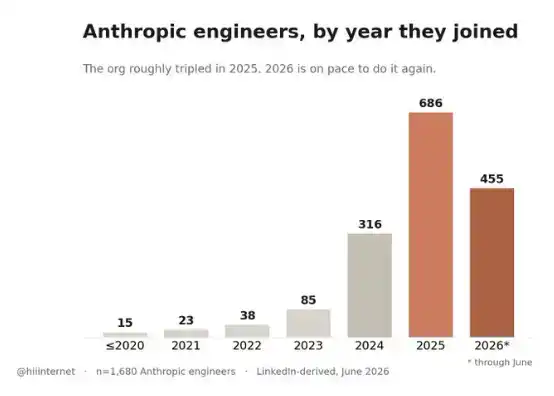
Only 15 engineers who joined Anthropic before 2021 are still employed there today. In 2025, this organization's engineering team nearly tripled in size, adding 686 engineers that year; the hiring pace for 2026 is projected to be similar, with 455 added by June.
Currently, half of the engineering team has been at Anthropic for less than a year. 53% joined within the past 12 months. Median tenure: 10 months.
This is a large-scale organization that was essentially built up in about 18 months.
They Almost Exclusively Hire Senior Engineers
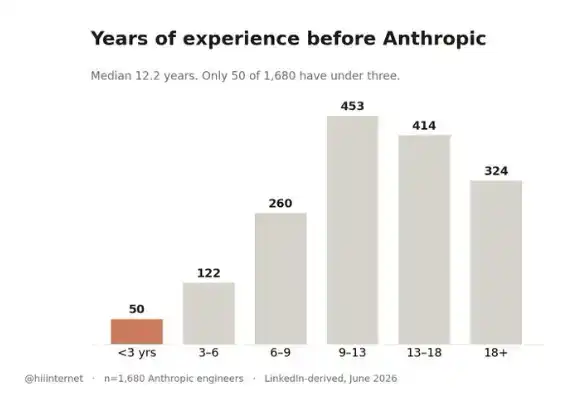
The median years of work experience before joining Anthropic is 12.2 years. The middle 50% have between 8.8 and 16.5 years of experience. Among these 1,680 people, only 50 have less than 3 years of experience. 44% have 13 or more years of experience. New graduate hiring is virtually nonexistent.
In other words, the typical new hire at Anthropic is an engineer with 12 years of experience who has only been at Anthropic for 10 months.
Clear Bias Towards Infrastructure Over Traditional Research
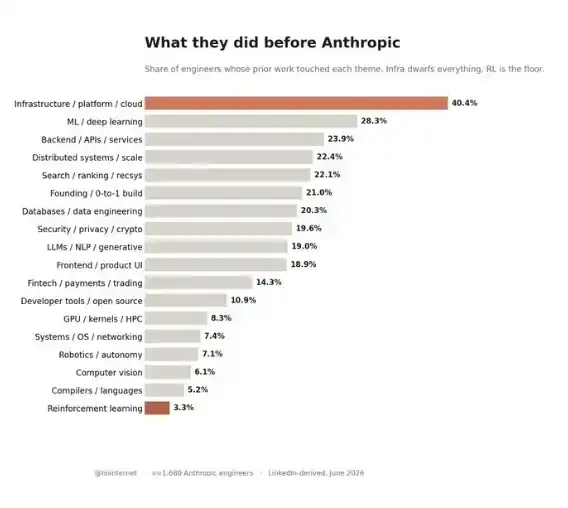
Infrastructure background appears in 40% of the engineers' profiles. Backend, distributed systems, databases, and security each appear in about 20% of profiles. Reinforcement learning, the "RL" in RLHF, appears in only 3.3%.
The typical Anthropic engineer spent the past decade building large-scale production systems at either a hyperscale cloud provider or an infrastructure-heavy startup.
Their self-listed skills tell the same story: Python (585 people), Java (566), C++ (443), JavaScript (376), SQL (302), Linux (230), Distributed Systems (189), AWS (154). The more "sexy"-sounding model training work certainly exists, but it's a low percentage.
The Largest Talent Source Is Not a Lab, It's Google
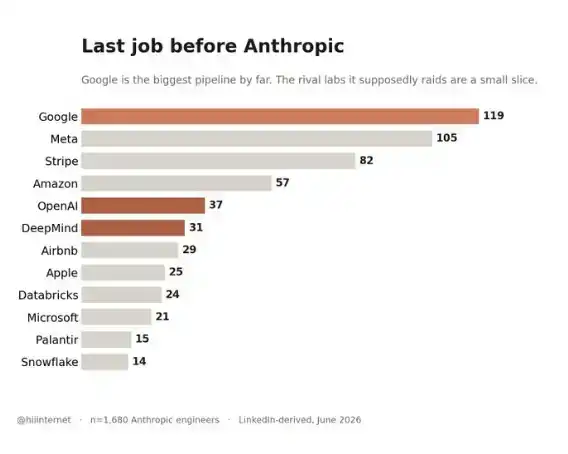
Everyone thinks Anthropic mainly hires from OpenAI and DeepMind. But its largest talent pipeline, by far, is Google. Those competitor labs are just two small bars in the middle of the chart.
Anthropic clearly prefers companies known for engineering rigor: Stripe, Databricks, Snowflake, Palantir, Airbnb.
Looking at where these engineers have worked historically, the ranking is: Google (405 people), Meta (273), Amazon (197), Microsoft (171), Stripe (124), Apple (87), Stanford (68), DeepMind (62), Airbnb (51), OpenAI (48). Half of the current engineering team, 50%, have at least one FAANG company in their career history.
Of course, they also hire from other AI labs. OpenAI is a top-five direct source, and DeepMind is a top-six direct source. About 94 engineers moved directly from other frontier AI labs to Anthropic.
The Myth of the PhD
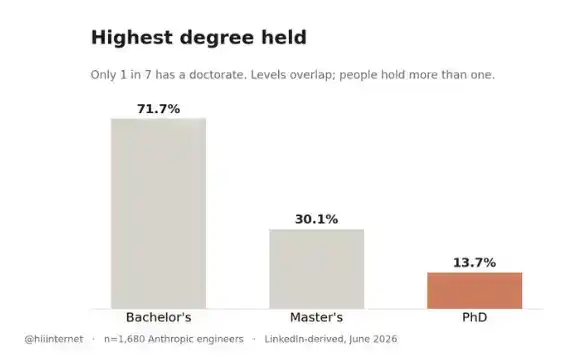
Only 13.7% hold a doctoral degree. That's roughly one in seven people.
The typical Anthropic recruitment target is not a research scientist, but a senior engineer with a bachelor's or master's degree. The image of a "lab full of PhDs" is largely incorrect at the engineering team level.
The distribution of academic majors also perfectly fits the profile of a "building organization": Computer Science (819 people), followed by Mathematics (78), Physics (70), Computer Engineering (69). Philosophy also makes the top 20, with 13 people, likely related to safety.
Stanford Is Clearly the Leading Source by University
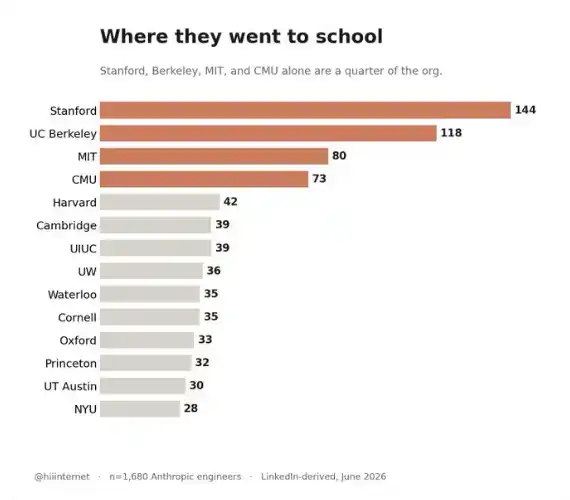
Looking at universities, the historical cumulative ranking is: Stanford (144 people), Berkeley (118), MIT (80), CMU (73), Harvard (42), Cambridge (39), UW (36), Waterloo and Cornell (35 each), Oxford (33), Princeton (32). The top four schools combined account for a quarter of the entire engineering team.
80% of people share the same job title.
"Member of Technical Staff."
A former Instagram CTO, a few former Adept founders, and Stanford faculty at Anthropic all share the title "MoTS." This flattening of job titles is clearly intentional. Seniority and specific function are, by design, hidden.
Where is the One Entry Point for Early-Career People into Anthropic?
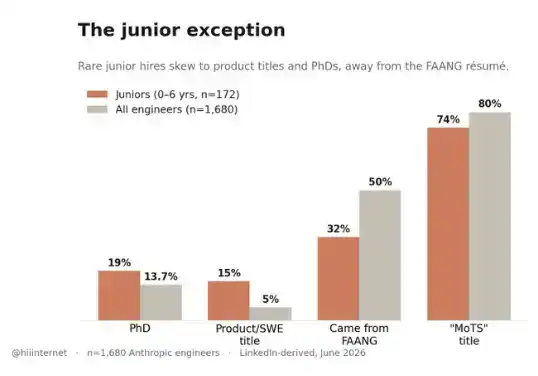
There are 172 engineers with less than 6 years of experience, and 50 of them have less than 3 years. But they are not typical new graduates. They roughly fall into two categories, with almost no ordinary mid-level engineers in between.
Compared to the entire engineering team, they show distinctly different characteristics: a higher PhD rate of 19% vs. 13.7% overall; product/SWE titles are three times more common, at 15% vs. 5% overall; they are also far less likely to have FAANG experience, only 32% vs. 50% overall.
In place of years of experience, they possess a different form of prestige capital:
The Internship Pipeline. 50% of them list internships at these companies: Meta (16 people), Google (10), DeepMind (6), Microsoft (5), Amazon (5), plus Jane Street, Two Sigma, HRT, Optiver, Nvidia.
From Quant Trading to AI Labs. 9% had stints at top trading firms, including Jane Street, Two Sigma, Five Rings, HRT, Optiver, Citadel. This is a group of young math/coding competition talent entering AI labs via the high-frequency trading industry.
Alignment Fellowships. 6% had exposure to MATS, SERI, Redwood, or ARC. This is an entry point that is almost exclusively for early-career talent and virtually absent among the senior cohort.
A very clear profile emerges: MIT, IOI Silver Medalist, Codeforces rating 2900+, entered reinforcement learning and safety directly after four years of work. Their screening criteria aren't years of experience, but competition rankings and publications.
These young engineers are also more international than their senior counterparts. School sources for low-seniority engineers include: Berkeley (15), Stanford (14), Cambridge (10), MIT (7), Tsinghua (7), Oxford (6), plus Imperial, NUS, Shanghai Jiao Tong University, ETH Zürich.
So, How Should You Interpret This?
If you want to join Anthropic as an engineer, don't write your resume as if applying to a research lab. Write it as if applying to an infrastructure company. Show the systems you've actually built and scaled. That's the resume getting hired.
The early-career stage is the only exception. At this stage, the barrier isn't regular work experience, but top internships, competition rankings, or publications.
If you're competing with Anthropic for talent, your target isn't "PhDs" or "lab background" per se, but those senior Builders from hyperscale cloud providers or companies with stellar engineering reputations: they have about 12 years of experience, likely from Stripe, Databricks, Snowflake, Palantir. Anthropic is already fishing heavily in this talent pool.