VVV Surges Over 10x This Year, Is the Base Ecosystem the Last Hope for Crypto AI?

marsbitОпубликовано 2026-05-29Обновлено 2026-05-29

Введение

The article highlights the surge of AI concepts within the Base blockchain ecosystem, positioning it as a focal point for crypto-AI activity. It spotlights several key projects driving this trend. Venice AI's token VVV is noted as a leader, having surged over 10x year-to-date, supported by its dual-token model with DIEM and real business revenue for buybacks. Other significant projects include Virtual, a major AI agent launchpad; Clanker, an AI token launch platform originating from Farcaster; Freysa AI, experimenting with sovereign AI agents; Elsa, an AI-powered DeFi execution layer; and Warden Protocol, a modular L1 for an "agent internet." The piece observes that Base has become a rare active hub for crypto-AI, fueled by the growth of AI agents and related payment ecosystems. While mentioning the volatility of AI-themed meme coins on Base, the article concludes that the ecosystem's potential to realize a fully "on-chain AI world" remains an open question.

Original|Odaily Planet Daily(@OdailyChina)

Author|Wenser(@wenser 2010 )
The AI boom continues to surge, and in the crypto field, the Base ecosystem has become the "last hope for the village" for AI concepts.

Aside from VVV rising 1076% this year, Virtual and Clanker are also steadily building; the x402 protocol related to AI Agent payments is still developing steadily; L1s, operating systems, wallets, social platforms, and others based on real business related to AI Agents are constantly emerging.

Odaily Planet Daily has compiled information on several AI-related tokens in the Base ecosystem, including VVV, for readers' reference.

VVV: The Unquestionable AI King of the Base Ecosystem

Odaily Planet Daily has previously conducted multiple follow-up introductions to VVV, including the article "What is VVV (Venice), Which Quickly Reached a $2 Billion Market Cap Upon Listing on Coinbase?" released when the token launched in January, and the article "OpenClaw Backs Venice.ai, VVV Token Surges Over 500% in a Month" when the price surged over 500% in March.

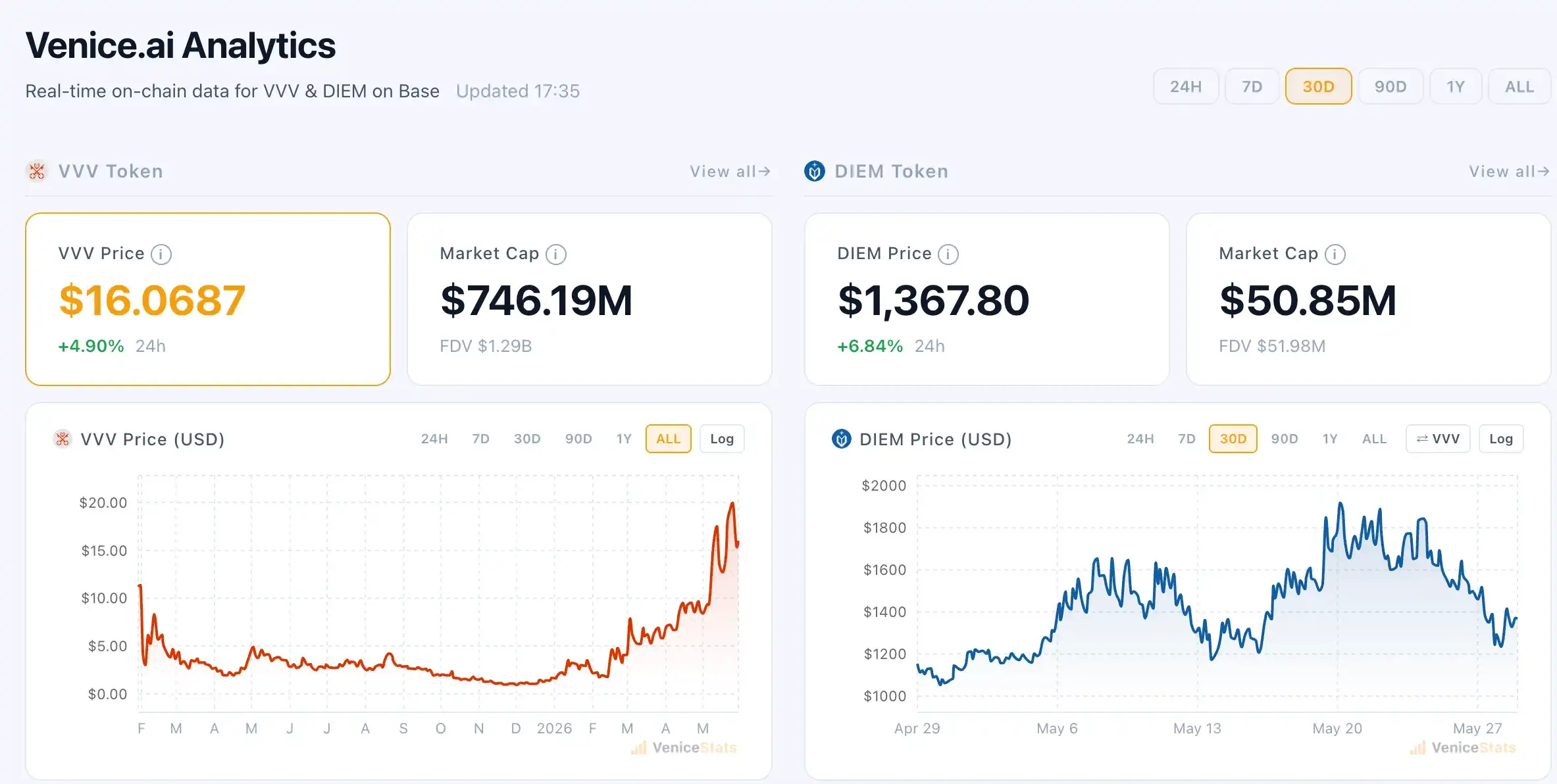
Since then, the dual-token asset model composed of "VVV & computing power token DIEM" paired with the real business revenue of Venice AI (used for token buyback and burn), which focuses on the "privacy AI" concept, has propelled the VVV token to continue rising, reaching around $18. Previously, Venice.ai officially updated the Agentic Chat feature on the 22nd; it also synchronized and launched an update after the Claude 4.8 opus model was released.

According to GMGN data, VVV is currently trading around $16.

According to Venice data website information, VVV's current circulating market cap is approximately $740 million, with an FDV of about $1.3 billion; DIEM is currently priced around $1367, with a circulating market cap of about $50 million and an FDV of approximately $52 million.
VIRTUAL: A Top Launchpad in the Base Ecosystem

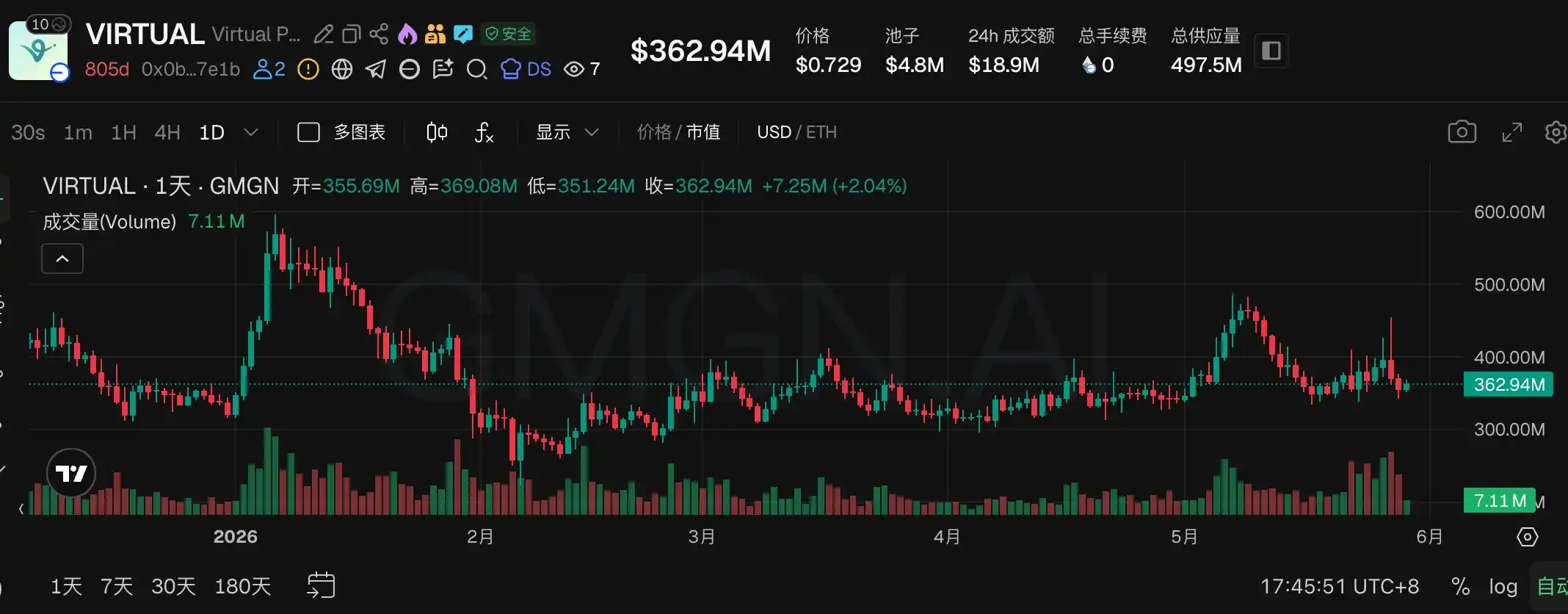
As a top launchpad in the Base ecosystem, Virtual's platform token VIRTUAL remains one of the leading projects in the AI track. Currently, the main positioning of the Virtual platform is an "AI Agent Co-ownership Layer + Launchpad," supporting token creation, asset tokenization, and monetization of autonomous AI Agents. Each Agent has its own independent token, trades in pools like Uniswap V3, and generates real revenue through inference calls and social/gaming/DeFi activities. Currently, the platform supports over 15,800 AI projects, with an aGDP (AI Agent economic output) scale of $477 million.

According to GMGN data, VIRTUAL is currently priced around $0.7, with a market cap of about $360 million.
Clanker: An AI Launchpad Originating from Farcaster

This AI launch platform initially emerged from the Farcaster ecosystem and later expanded to the Base ecosystem. Its main mechanism is AI Agent token launches, where just one Farcaster/X message can prompt Clanker to deploy a new token directly on Uniswap V3, with permanently locked token liquidity; 60% of the 1% trading fee is used for automatic buyback and burning of CLANKER tokens.

The platform previously achieved a record of launching 21,870 new tokens in a single day, after which activity declined somewhat.

Official account: https://x.com/clanker_world

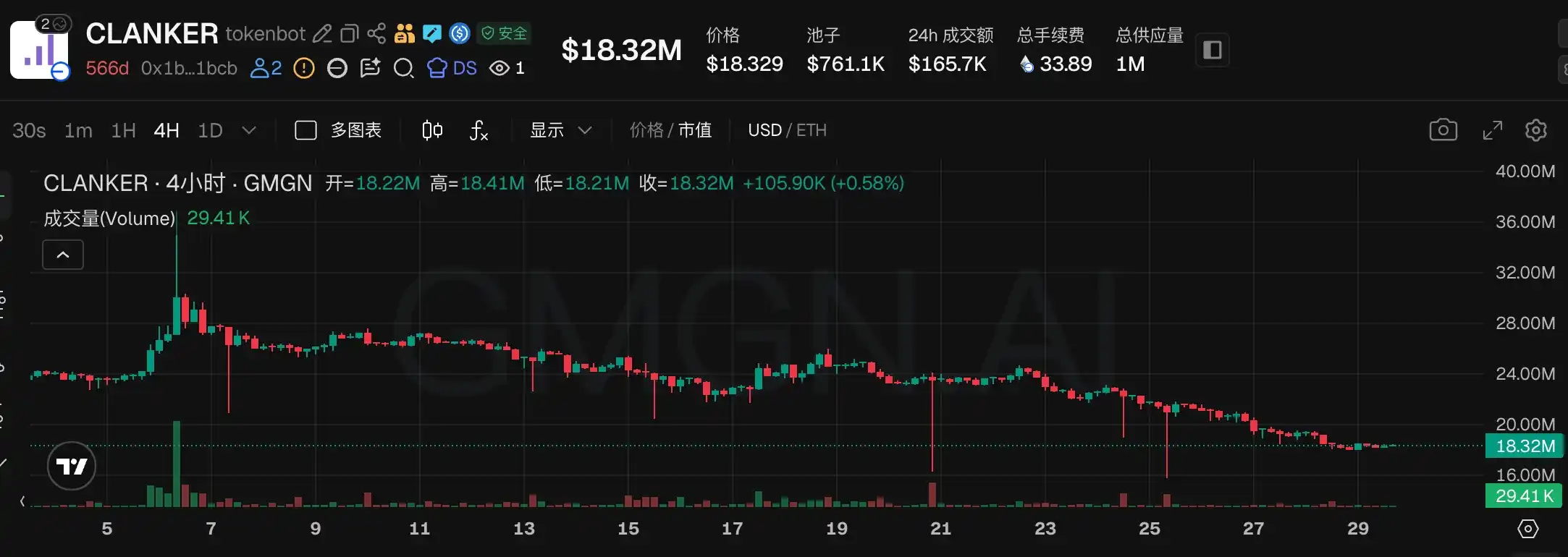
According to GMGN data, the CLANKER token is currently priced around $18, with its market cap falling to around $18 million.
FAI: Sovereign AI Agent Concept Project

Freysa AI, the first experimental project for an "evolving Sovereign AI Agent" on the Base chain. The core idea is to create a truly autonomous AI agent without human-controlled keys and memory: the AI autonomously controls crypto wallets, assets, and decisions, constantly evolving through interaction with global users via the Sovereign Agent Framework (SAF). The project is positioned as a personal AI product suite, emphasizing human agency, liquid democracy, and decentralized ownership. Previously, the project's market cap once soared past $660 million and even received a reply tweet from Musk, but it is now in a quiet phase.

Official account: https://x.com/freysa_ai

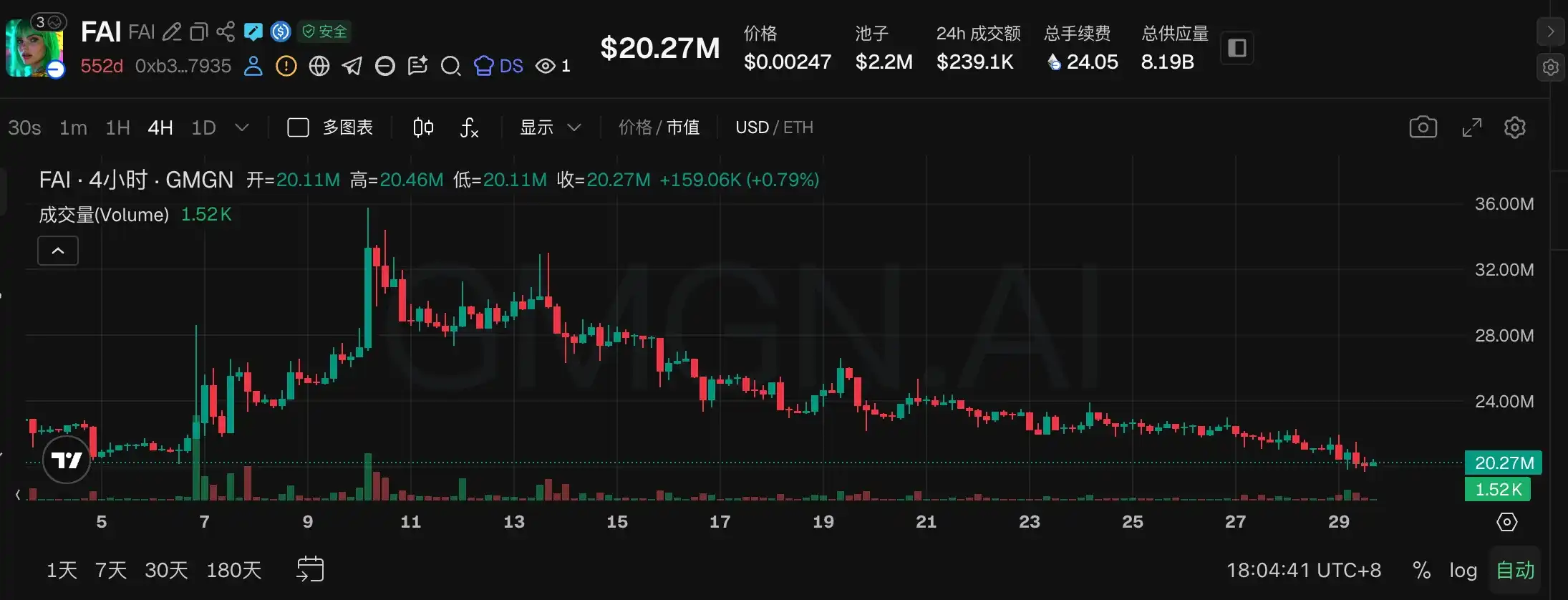
According to GMGN data, FAI is currently priced around $0.002, with a market cap of approximately $20 million.
ELSA: AI Agent Execution Layer in the Base Ecosystem

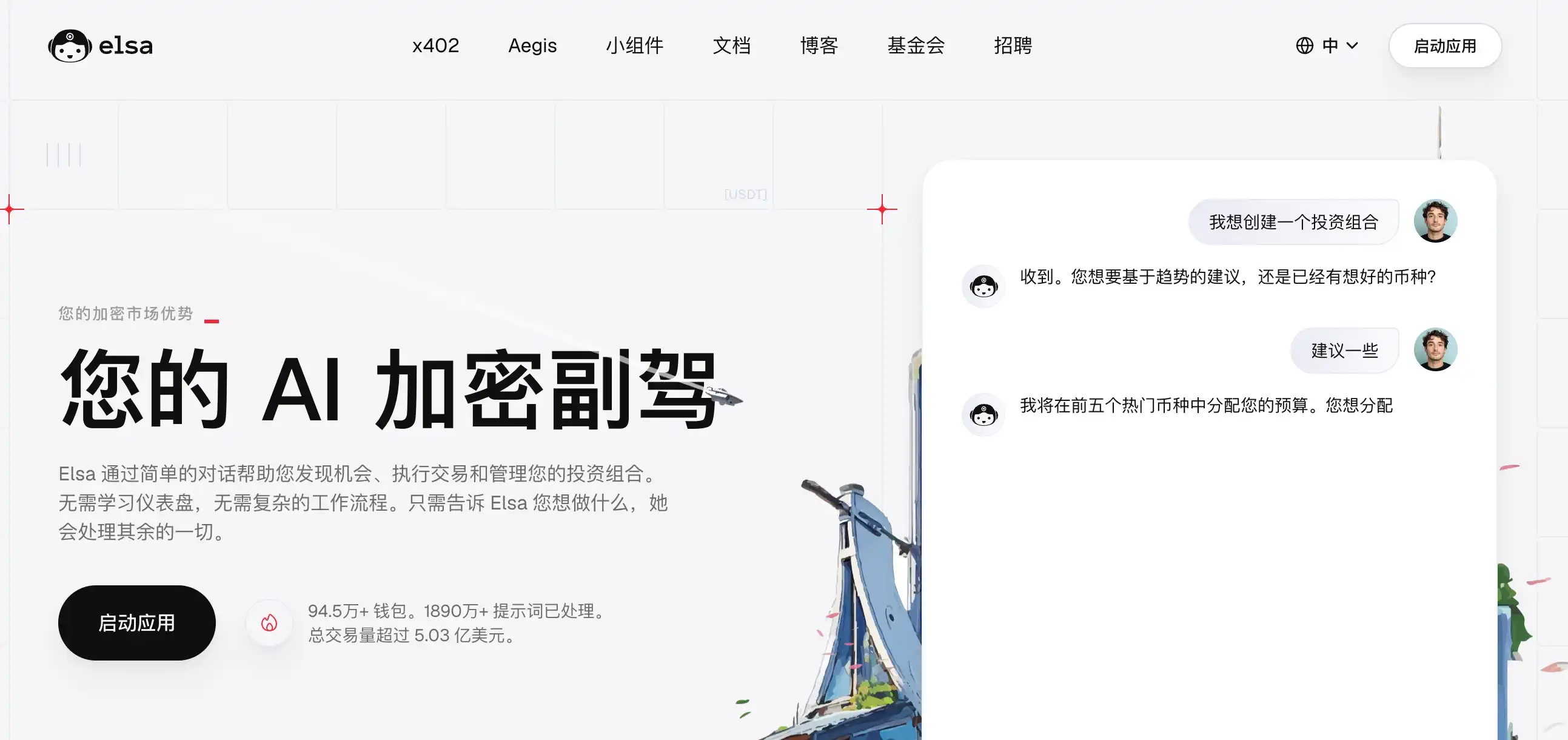
The project is positioned as an "AI-powered DeFi Super Assistant + On-chain Agent Infrastructure." Its core function is to directly convert natural language instructions into secure, autonomous on-chain operations, allowing users to implement various DeFi management and application operations without needing to understand complex on-chain concepts. In June last year, the project completed a $3 million seed funding round led by M31 Capital, with participation from Coinbase Ventures' Base ecosystem fund. Currently, according to official data, the Elsa ecosystem covers nearly 95 wallets, with a total transaction volume exceeding $500 million.

Official account: https://x.com/HeyElsaAI

According to GMGN data, ELSA is currently priced around $0.06; its market cap is about $63 million.
WARD: Modular L1/OS for the Agentic Internet

Warden Protocol, primarily focusing on decentralized AI, supports functions such as Warden Studio (creating an Agent in <60 seconds), SPEx verifiable AI execution, cross-chain intent execution, and AI Agent wallets. According to official statements, it has served 20 million users and processed over 60 million tasks. It previously received $4 million in strategic funding from projects like Messari and Venice.AI.

Official account: https://x.com/wardenprotocol

According to GMGN data, the WARD token price has fallen to around $0.006, with the Base ecosystem token market cap only about $128,000; the BSC ecosystem token market cap is approximately $2.4 million.
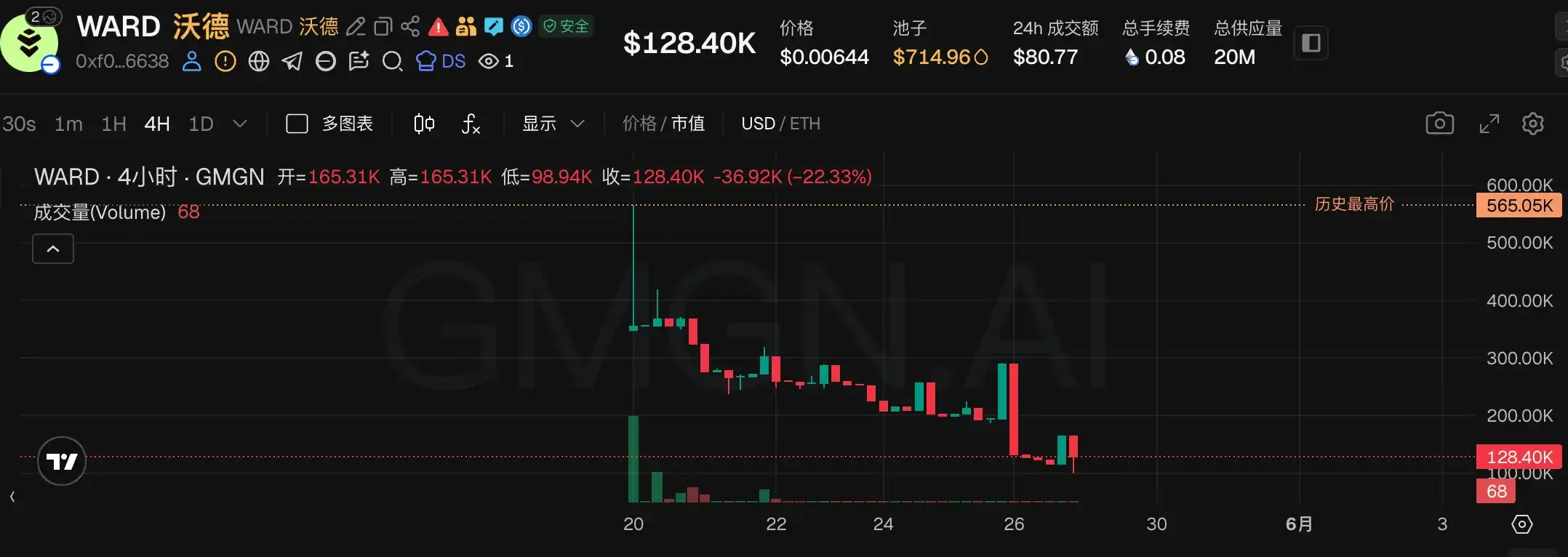
In addition to the above projects, AI concept meme coins in the Base ecosystem are also quite hot. Recently, Base ecosystem tokens like KellyClaude and GITLAWB saw their market caps surge several times in a short period, but as the hype shifted or celebrity effects faded, they quickly fell into a death spiral again, so they will not be elaborated on here.

In summary, thanks to the development of AI Agents and the prosperity of the AI Agent payment ecosystem, the Base ecosystem has become one of the few active ecosystems for crypto AI. However, whether it can truly achieve the "on-chain AI world" mentioned by the Base team remains an unknown.


Связанные с этим вопросы

QAccording to the article, why is the Base ecosystem considered the 'last hope' for the AI concept in crypto?

AThe article states that due to the development of AI Agents and the prosperity of the AI Agent payment ecosystem, the Base ecosystem has become one of the few active ecosystems for crypto AI, making it a focal point or 'last hope' for the concept.

QWhat is the primary function or role of the VIRTUAL platform as described in the article?

AThe VIRTUAL platform is described as a top launchpad on Base, with its main positioning being an 'AI agent co-ownership layer + launch platform'. It supports token creation, asset tokenization, and monetizing autonomous AI Agents, where each Agent has its own token.

QWhat are the two tokens mentioned that constitute Venice AI's dual-token asset model, and what is the real-world business concept for Venice AI?

AThe two tokens are VVV and the computing power token DIEM. Venice AI's real-world business concept focuses on 'privacy AI', and the revenue from this business is used for token buybacks and burns.

QWhich Base ecosystem AI project received a $300 million seed round funding led by M31 Capital and backed by Coinbase Ventures, and what is its core function?

AThe project is ELSA. It completed a $300 million seed round led by M31 Capital with Coinbase Ventures' Base Ecosystem Fund participating. Its core function is transforming natural language instructions directly into secure, autonomous on-chain operations, acting as an AI-driven DeFi super assistant and on-chain Agent infrastructure.

QWhat was the main reason mentioned in the article for the brief surge and subsequent decline of AI meme coins like KellyClaude and GITLAWB in the Base ecosystem?

AThe article suggests these meme coins saw rapid price surges primarily due to hype or celebrity effects. However, they quickly declined into a 'death spiral' once the hype faded or the celebrity influence waned.

Похожее

Trend in US Stocks: Jensen Huang's One Sentence Triggers $47 Billion Surge; Google Raises Funds for First Time in 20 Years

U.S. markets reached record highs on June 2nd, but the real story was the intensifying AI arms race, now pivoting from chip supremacy to a scramble for capital to fund compute infrastructure. The day highlighted two stark realities: Nvidia CEO Jensen Huang's endorsement of Marvell Technology as the "next trillion-dollar company" at Computex fueled a historic 32.5% surge, adding $47 billion to its value. Conversely, Alphabet announced its first equity raise in two decades—an $80 billion plan—signaling that even its massive cash flow can't keep pace with soaring AI capital expenditures, forecast to exceed $180 billion in 2026. While the S&P 500 closed above 7,600 for the first time, led by tech and semiconductor stocks (SOXX +5.79%), sector performance was mixed. Alphabet's 4% drop dragged down communications services, illustrating market anxiety over the unsustainable cost of the AI buildout. Hewlett Packard Enterprise soared 25% on stellar earnings, proving AI's benefits extend beyond chip designers to infrastructure providers. Beneath the index highs, concerns linger over extreme concentration in a few AI stocks and geopolitical tensions. The focus now shifts to upcoming economic data, particularly Friday's nonfarm payrolls, which could challenge the market's current "ignore rates, chase AI" mentality.

marsbit9 мин. назад

Trend in US Stocks: Jensen Huang's One Sentence Triggers $47 Billion Surge; Google Raises Funds for First Time in 20 Years

marsbit9 мин. назад

Can DeepSeek Save China One Trillion Dollars?

"DeepSeek and the $1 Trillion Infrastructure Question" The article examines whether DeepSeek's AI optimization breakthroughs could potentially save China $1 trillion in future AI infrastructure costs. The analysis begins with Nvidia's upcoming Vera Rubin AI platform, costing ~$7.8 million, where memory (HBM4/LPDDR5X) constitutes $2 million—a 435% cost increase in one year, highlighting how AI hardware spending is shifting toward expensive memory components. DeepSeek's approach works in the opposite direction. Through three key technical innovations showcased in DeepSeek V4, the company dramatically improves hardware efficiency: 1. **Memory Compression (MLA)**: Re-engineers the attention mechanism to compress long-context memory (KV Cache) by over 90%, drastically reducing expensive HBM usage. 2. **Selective Activation (MoE)**: Employs Mixture-of-Experts architecture where only a small fraction of parameters (e.g., 49B out of 1.6T in V4-Pro) are activated per token, allowing most parameters to reside in cheaper memory/SSD. 3. **Computation Caching**: Reuses previously computed results via cache hits, replacing expensive GPU computations with cheap memory reads. Combined, these optimizations allow the same hardware to produce approximately 4x more tokens, effectively reducing required hardware investment by 75%. DeepSeek's pricing reflects this: a 10-billion token workload costs ~$522 monthly versus ~$9,000-$10,000 for competitors. The $1 trillion savings projection stems from McKinsey's estimate that global AI infrastructure will require ~$5.2 trillion investment by 2030. As China's daily token consumption grows toward quadrillions, even marginal efficiency gains scale massively. With a conservative 4x throughput improvement, China could avoid building tens of thousands of AI data centers equivalent to ~7 trillion RMB ($1 trillion) in saved investment. Critically, this strategy shifts dependency from scarce, expensive GPU/HBM—where China lags—toward more accessible storage, caching, and systems engineering where domestic suppliers like CXMT are gaining strength. Rather than "replacing Nvidia," DeepSeek rebalances AI's value chain away from monolithic hardware dependency. Ultimately, DeepSeek's technical breakthroughs could lower the barrier to AI adoption across Chinese industries by making advanced capabilities affordable at scale—transforming who can access next-generation AI.

marsbit52 мин. назад

Can DeepSeek Save China One Trillion Dollars?

marsbit52 мин. назад

Overturning the Mainstream Approach to Hallucinations: Metacognition is the New Solution for Large Models to Break the Hallucination Barrier

This paper, "Hallucinations Undermine Trust; Metacognition is a Way Forward," proposes a paradigm shift in combating AI hallucination. It argues that the current mainstream approaches—striving for omniscience by scaling data/models or having AI abstain from uncertain answers—are fundamentally flawed. The former has inevitable knowledge gaps, while the latter imposes a crippling "utility tax," requiring the rejection of many correct answers to achieve high accuracy, due to models' poor "discrimination" (the ability to distinguish correct from incorrect answers internally). The core contribution is redefining hallucination not as "being wrong," but as "expressing false information with unwarranted certainty." The proposed solution is **Faithful Uncertainty** or **Metacognition**: enabling AI to accurately perceive its internal uncertainty and honestly express it in its language (e.g., using hedging phrases when unsure). This creates a more reliable assistant that provides useful information while signaling its confidence, minimizing harm from errors. The paper emphasizes that metacognition is critical for the era of AI Agents. Without it, Agents cannot intelligently decide when to use tools like search engines, leading to inefficiency and misuse. Key implementation challenges are highlighted: the "bootstrapping paradox" of training with static uncertainty data, the "alignment distortion signal" where human preference training suppresses internal uncertainty cues, and the difficulty of causally evaluating true metacognition vs. its superficial imitation. The paper concludes that the goal should not be an infallible AI, but one that is honest about the limits of its knowledge, thereby building user trust through transparent communication of its certainty.

marsbit57 мин. назад

Overturning the Mainstream Approach to Hallucinations: Metacognition is the New Solution for Large Models to Break the Hallucination Barrier

marsbit57 мин. назад

Hedge by Buying Gold and Oil, Chase Soaring Returns with AI. ‘Dated’ Bitcoin Enters a Bear Market

Bitcoin has recently declined, hitting a two-month low near $66,123, while Ethereum fell to a three-month low around $1,837. Analysts suggest the drop is not merely due to factors like ETF outflows or MicroStrategy's selling but reflects a deeper issue: Bitcoin is losing a broader asset competition. In a near-zero interest rate environment, Bitcoin previously thrived as an outlet for investor dissatisfaction with inflation and limited options. However, the market landscape has shifted. Bitcoin now occupies an "awkward middle ground," facing competition on three fronts. For inflation hedging, investors prefer gold, energy stocks, and commodity producers—assets with tangible backing and clearer pricing power. For growth exposure, AI-related companies with actual revenues and profits are more attractive. Even within crypto, investors can choose stablecoins, exchanges, or infrastructure firms tied directly to adoption, offering clearer business models and leverage. Thus, Bitcoin is no longer the top choice for hedging, growth, or crypto exposure. This shift is evident in market reactions: despite recent warnings about persistent inflation from a Fed official, Bitcoin did not rally as it might have in the past. Instead, capital flowed to assets with direct commodity or energy exposure. The recent ETF outflows and MicroStrategy sales are symptoms, not causes, of this new reality. Investors are becoming more selective, demanding clearer value propositions beyond mere scarcity. The emerging bear case for Bitcoin is not about it being a bubble or failed technology, but that scarcity alone is no longer sufficient.

华尔街日报1 ч. назад

Hedge by Buying Gold and Oil, Chase Soaring Returns with AI. ‘Dated’ Bitcoin Enters a Bear Market

华尔街日报1 ч. назад

Торговля

Спот
Фьючерсы

Популярные статьи

Неделя обучения по популярным токенам (2): 2026 может стать годом приложений реального времени, сектор AI продолжает оставаться в тренде

2025 год — год институциональных инвесторов, в будущем он будет доминировать в приложениях реального времени.

1.8k просмотров всегоОпубликовано 2025.12.16Обновлено 2025.12.16

Неделя обучения по популярным токенам (2): 2026 может стать годом приложений реального времени, сектор AI продолжает оставаться в тренде

Обсуждения

Добро пожаловать в Сообщество HTX. Здесь вы сможете быть в курсе последних новостей о развитии платформы и получить доступ к профессиональной аналитической информации о рынке. Мнения пользователей о цене на AI (AI) представлены ниже.

活动图片