Los aliados de las criptomonedas ganan terreno en el Congreso tras la victoria en las primarias de Indiana

bitcoinistОпубликовано 2026-05-08Обновлено 2026-05-08

Введение

Un comité de acción política (PAC) respaldado por la industria de las criptomonedas, Fairshake, está utilizando su considerable arsenal financiero para influir en las elecciones estadounidenses. Tras reportar $193 millones en enero, gastó alrededor de $514,000 a través de un Super PAC afín para apoyar la victoria en las primarias republicanas de Indiana del congresista James Baird, quien cuenta también con el respaldo del expresidente Donald Trump. Baird es considerado un voto confiable para el sector, ya que ha apoyado proyectos de ley clave sobre stablecoins y estructura del mercado de criptoactivos. Su victoria coincide con un momento de impulso legislativo en Washington, donde se está avanzando en un compromiso sobre el rendimiento de las stablecoins dentro de la propuesta Ley CLARITY. No obstante, algunos senadores exigen la inclusión de salvaguardias éticas para apoyar la legislación, lo que refleja el creciente escrutinio político sobre la industria.

Un arsenal de 193 millones de dólares. Eso es lo que Fairshake, el comité de acción política más poderoso de la industria cripto, reportó tener a enero, y está gastando ese dinero rápidamente.

El dinero detrás de la victoria

El republicano James Baird de Indiana se impuso fácilmente el martes en las primarias de su partido para el 4º distrito congresional del estado, obteniendo más del 60% de los votos frente al retador Craig Haggard y un puñado de otros.

Baird también contó con el respaldo del presidente de EE. UU., Donald Trump. Pero otra fuerza trabajaba a su favor: Defend American Jobs, un Super PAC vinculado a Fairshake, invirtió aproximadamente 514,000 dólares en compras de medios para apoyarlo antes de la votación, según registros de la Comisión Federal Electoral.

El propio Fairshake está financiado por algunos de los nombres más importantes en cripto, incluidos Coinbase y Ripple Labs. El comité gastó más de 130 millones de dólares intentando influir en el resultado de las elecciones de 2024. En 2026, ya está en ello de nuevo; hasta ahora se han destinado unos 10 millones de dólares a carreras en Illinois y Texas.
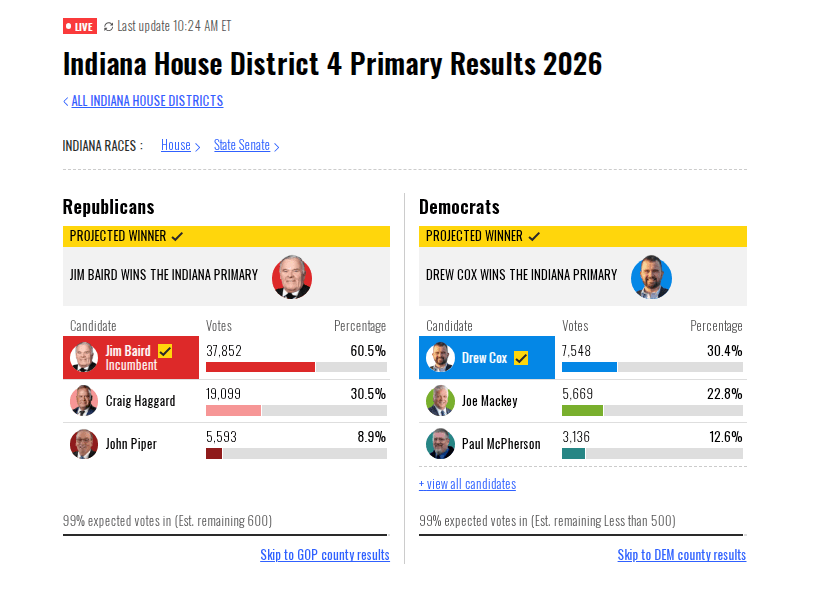
Fuente: NBC News

Un voto confiable para la industria

Baird ha estado en el Congreso desde enero de 2019 y ha construido un historial que los defensores de las criptomonedas consideran confiable. Apoyó la Ley GENIUS, que trata la regulación de las stablecoins, y la Ley CLARITY, un proyecto de ley centrado en la estructura del mercado cripto. Para Fairshake, valía la pena protegerlo.

“El representante Baird ha sido un líder probado en políticas pro-empleo, pro-consumidor y pro-innovación en el Congreso”, dijo un portavoz de Fairshake.

"Estamos orgullosos de apoyar a líderes comprometidos con una regulación responsable que garantice que EE. UU. siga siendo el líder mundial en innovación."

Según informes, Baird agradeció públicamente a Trump tras su victoria.

BTCUSD cotizando a $80,137 en el gráfico de 24 horas: TradingView

La legislación avanza

El resultado en Indiana se produce mientras la legislación relacionada con las criptomonedas gana impulso en Washington. La semana pasada, los senadores Thom Tillis y Angela Alsobrooks dijeron que habían finalizado la redacción de la Ley CLARITY para incluir un compromiso sobre el rendimiento de las stablecoins, un punto de conflicto que había mantenido bloqueado el proyecto de ley durante meses.

El Comité Bancario del Senado aún no había programado una sesión de marcado hasta el miércoles, pero muchos observadores esperan que el acuerdo sobre stablecoins impulse la legislación más amplia sobre estructura de mercado.

La relación de Trump con la industria cripto ha atraído escrutinio junto con estos desarrollos. Varios senadores han dicho que no apoyarán la Ley CLARITY sin disposiciones éticas adjuntas.

El senador Tillis fue uno de los que declaró públicamente que no respaldaría el proyecto de ley sin tales salvaguardias en su lugar.

Imagen destacada de MetaAI, gráfico de TradingView

Связанные с этим вопросы

Q¿Cuánto dinero reportó tener Fairshake, el principal comité de acción política de la industria cripto, en enero?

AFairshake reportó tener una tesorería de 193 millones de dólares en enero.

Q¿Qué candidato ganó la primaria republicana en el distrito 4 de Indiana y qué apoyo significativo recibió?

AEl republicano James Baird ganó la primaria con más del 60% de los votos. Además del respaldo del expresidente Donald Trump, recibió el apoyo del Super PAC Defend American Jobs, vinculado a Fairshake, que invirtió aproximadamente 514.000 dólares en campañas mediáticas a su favor.

Q¿Qué dos proyectos de ley relacionados con las criptomonedas ha apoyado el congresista James Baird, según el artículo?

AJames Baird ha apoyado el GENIUS Act, que trata la regulación de las stablecoins, y el CLARITY Act, un proyecto de ley centrado en la estructura del mercado de criptomonedas.

Q¿Qué progreso reciente se menciona en el artículo sobre la legislación relacionada con criptomonedas en el Senado de EE.UU.?

ALos senadores Thom Tillis y Angela Alsobrooks finalizaron el lenguaje del CLARITY Act para incluir un compromiso sobre el rendimiento de las stablecoins, un punto de desacuerdo que había retrasado el proyecto de ley durante meses.

Q¿Por qué algunos senadores, como Thom Tillis, se muestran reacios a apoyar el CLARITY Act sin modificaciones?

AVarios senadores, incluido Thom Tillis, han declarado que no apoyarán el CLARITY Act a menos que se le añadan disposiciones éticas como salvaguardas.

Похожее

Sharplink CEO: One Million Ethereum Developers, Who Can Compete?

Etherean Ecosystem: One Million Developers and a Formidable Moat The Ethereum network has surpassed a significant milestone: over one million unique lifetime developers, with approximately 232,000 active in the past year. This vast and growing talent pool is Ethereum's core advantage, far more critical than transient metrics like speed or transaction fees. The central question is not which blockchain is fastest, but where the best builders choose to build long-term. Ethereum's answer lies in a decade-long accumulation of infrastructure, standards, tools, liquidity, and collaborative culture that is exceptionally difficult to replicate. It has become the default operating system for programmable finance. This massive developer base is actively working on complex, high-risk challenges that deepen Ethereum's strategic moat: * **Glamsterdam Upgrade (2026):** Focused on core protocol scalability (ePBS, parallel execution) while preserving core values like credible neutrality. * **Synchronous Composability:** Aims to make numerous Rollups interoperate like a single chain, directly addressing fragmentation concerns. * **Quantum Resistance:** Ethereum leads mainstream ecosystems in coordinated preparation for post-quantum cryptography, with a targeted migration plan around 2029. This developer advantage is self-reinforcing, fueled by: * **Deep Composability:** Applications interact like interoperable financial Lego bricks via shared standards (e.g., EVM, Solidity). * **Credible Neutrality:** Secured by over 900,000 validators, making it trusted by major institutions. * **Modularity:** Rollups (Base, Arbitrium, etc.) expand, rather than fracture, the ecosystem into a tightly connected modular internet economy. * **Culture:** Attracts top-tier researchers and standard-setters who guide the entire industry. In essence, while other chains generate activity, Ethereum is consolidating as the trusted, long-term coordination layer for internet-native finance. Its future is being built now by the architects of the next-generation financial infrastructure.

Odaily星球日报32 мин. назад

Sharplink CEO: One Million Ethereum Developers, Who Can Compete?

Odaily星球日报32 мин. назад

Ethereum Reaches the Milestone of One Million Developers, Sharplink CEO Delves Deep into Ethereum's Future Possibilities

Ethereum Surpasses One Million Developers Milestone: A Look at Its Unshakeable Dominance and Future Joseph Chalom, CEO of Sharplink, reflects on his recent Asia trip where he engaged deeply with Ethereum developers and ecosystem leaders. The most striking takeaway was not just the industry's vibrancy, but the rigorous, long-term vision of local builders. This context brings to life a pivotal statistic: Ethereum has now surpassed one million cumulative developers (1,012,824), with approximately 232,000 remaining active in the past year—a talent pool unmatched by any other crypto ecosystem. The critical question isn't which blockchain is fastest, but where top developers choose to build long-term. Ethereum's answer is unequivocal. Its decade-long lead stems from a unique convergence of technology, institutional culture, economic systems, and composability, cementing its role as the foundational operating system for programmable finance. This massive developer base is tackling the industry's hardest problems, continuously strengthening Ethereum's moat. Key initiatives include: * **The Glamsterdam Upgrade (planned 2026):** Introducing ePBS and Block-level Access Lists for parallel execution and higher throughput while preserving core values like credible neutrality and fair MEV distribution. * **Synchronous Composability:** Projects are working to enable atomic transactions across dozens of Rollups, making them function as one unified chain and eliminating ecosystem fragmentation. * **Post-Quantum Security:** Ethereum is far ahead in preparing for quantum computing threats, with a dedicated foundation working group and testnets targeting a full migration by ~2029—a crucial factor for institutional adoption. Beyond developers, Ethereum's core network effects are its unparalleled composability and unified standards (like EVM and Solidity), which create a powerful flywheel: more developers → better tools → greater liquidity → more institutional participation. Its other decisive advantages include credible neutrality (over 900k validators), a secure modular architecture with interconnected Rollups, and a deeply entrenched culture shaped by top-tier researchers. Ultimately, there's a vast difference between generating short-term activity and becoming the trusted, long-term coordination layer for global native finance. Major institutions prioritize security, trust, and liquidity—areas where Ethereum holds dominant mindshare. The industry's trajectory shows resources consolidating around unified standards, deep liquidity, and developer consensus. After meeting the builders in Seoul and Hong Kong, Chalom is more convinced than ever: Ethereum's unshakeable future is being built right now.

Foresight News43 мин. назад

Ethereum Reaches the Milestone of One Million Developers, Sharplink CEO Delves Deep into Ethereum's Future Possibilities

Foresight News43 мин. назад

Saylor's Latest Long Read: Bitcoin is Not Money, It's Digital Capital, and Money is Built Upon It

Michael Saylor presents his "Digital Asset Stack" theory, positioning Bitcoin as the foundational layer of digital capital. He argues Bitcoin itself should remain unchanged—no staking, inflation, or protocol alterations. Instead, a five-layer financial architecture should be built atop it: Digital Capital (BTC), Digital Credit (e.g., yield instruments like STRC), Digital Currency (stable, yield-bearing instruments pegged to fiat), Digital Yield (leveraged/structured products), and Digital Equity (e.g., MSTR stock, absorbing residual volatility). Saylor asserts this stack transforms Bitcoin's high-volatility, high-energy capital into tailored products: stable currencies for payments/savings, yield instruments for income seekers, and equity for growth investors. This approach meets diverse needs—corporate treasuries, banks, retirees, emerging market users—without compromising Bitcoin's core properties (scarcity, decentralization). The "killer use case" is rebuilding global money, credit, and capital markets on Bitcoin, bridging the fiat world with a superior digital asset foundation. The system leverages traditional finance principles (risk layering, structured products) while using Bitcoin as the ultimate collateral. This expands Bitcoin's utility, drives adoption, and offers a better monetary experience: digital, yield-bearing, stable-value tools for everyday use.

marsbit56 мин. назад

Saylor's Latest Long Read: Bitcoin is Not Money, It's Digital Capital, and Money is Built Upon It

marsbit56 мин. назад

Can SK Hynix's Stock Double Again in This Rally?

The article discusses the highly optimistic price target of approximately $3,500 for SK Hynix stock, set by Aletheia Capital. This target is significantly above the consensus range of $2,000-$2,520 from major brokerages. The core debate is whether SK Hynix deserves a fundamental re-rating beyond its traditional cyclical discount, based on the long-term impact of AI-driven demand. The $3,500 target hinges on three key assumptions holding simultaneously until at least 2027: 1) Continued shortage and high pricing for HBM (High Bandwidth Memory), a critical component for AI chips; 2) Sustained high prices for standard DRAM, as HBM production consumes capacity and constrains general supply; and 3) Strong AI server demand generating substantial, above-expectation free cash flow. SK Hynix's leading ~58% market share in HBM and its early certification with key clients like Nvidia provide a competitive advantage, allowing it to capture significant supply chain premiums. The HBM shortage is seen not just as a niche growth driver but as a catalyst that amplifies profitability across the entire memory business by tightening overall DRAM supply. However, the article cautions that this target represents an optimistic "tail scenario." Key risks include potential supply increases from competitors (Samsung, Micron) by 2027, a possible slowdown in HBM price growth, and high capital expenditures that could erode the projected free cash flow. The divergence in analyst targets reflects the market's uncertainty over whether the current AI-driven boom will temporarily elevate earnings or permanently raise the memory industry's profit baseline.

marsbit59 мин. назад

Can SK Hynix's Stock Double Again in This Rally?

marsbit59 мин. назад

Торговля

Спот
Фьючерсы

Популярные статьи

Как купить WIN

Добро пожаловать на HTX.com! Мы сделали приобретение WINkLink (WIN) простым и удобным. Следуйте нашему пошаговому руководству и отправляйтесь в свое крипто-путешествие.Шаг 1: Создайте аккаунт на HTXИспользуйте свой адрес электронной почты или номер телефона, чтобы зарегистрироваться и бесплатно создать аккаунт на HTX. Пройдите удобную регистрацию и откройте для себя весь функционал.Создать аккаунтШаг 2: Перейдите в Купить криптовалюту и выберите свой способ оплатыКредитная/Дебетовая Карта: Используйте свою карту Visa или Mastercard для мгновенной покупки WINkLink (WIN).Баланс: Используйте средства с баланса вашего аккаунта HTX для простой торговли.Третьи Лица: Мы добавили популярные способы оплаты, такие как Google Pay и Apple Pay, для повышения удобства.P2P: Торгуйте напрямую с другими пользователями на HTX.Внебиржевая Торговля (OTC): Мы предлагаем индивидуальные услуги и конкурентоспособные обменные курсы для трейдеров.Шаг 3: Хранение WINkLink (WIN)После приобретения вами WINkLink (WIN) храните их в своем аккаунте на HTX. В качестве альтернативы вы можете отправить их куда-либо с помощью перевода в блокчейне или использовать для торговли с другими криптовалютами.Шаг 4: Торговля WINkLink (WIN)С легкостью торгуйте WINkLink (WIN) на спотовом рынке HTX. Просто зайдите в свой аккаунт, выберите торговую пару, совершайте сделки и следите за ними в режиме реального времени. Мы предлагаем удобный интерфейс как для начинающих, так и для опытных трейдеров.

650 просмотров всегоОпубликовано 2024.04.17Обновлено 2026.06.02

Как купить WIN

Обсуждения

Добро пожаловать в Сообщество HTX. Здесь вы сможете быть в курсе последних новостей о развитии платформы и получить доступ к профессиональной аналитической информации о рынке. Мнения пользователей о цене на WIN (WIN) представлены ниже.

活动图片