汇丰银行与Anchorpoint Financial赢得香港首批稳定币牌照 – 详情

ambcryptoОпубликовано 2026-04-10Обновлено 2026-04-10

Введение

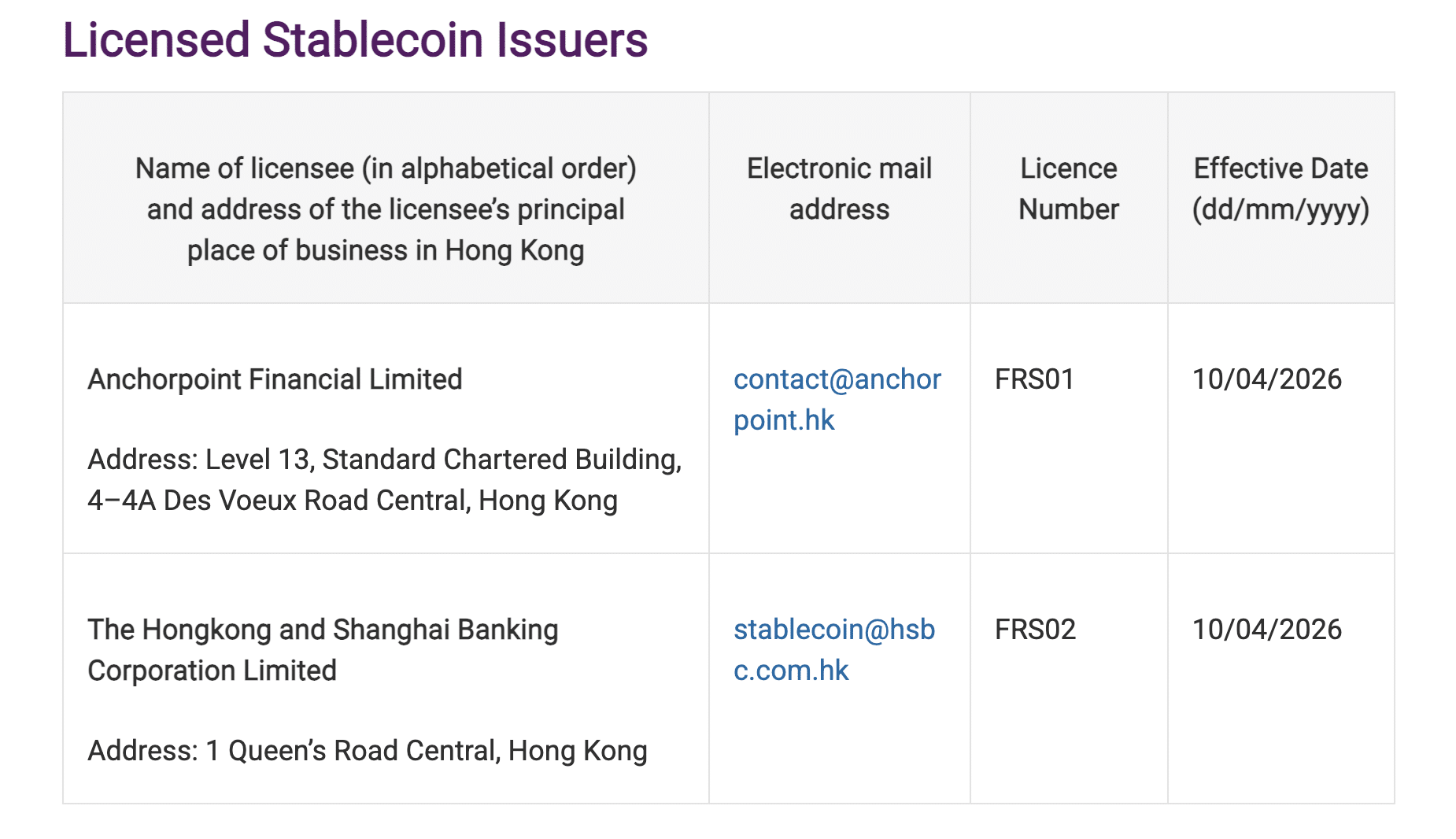
香港首次颁发稳定币发行商牌照,汇丰银行和Anchorpoint Financial成为首批获准机构。此次审批谨慎且偏向传统金融机构,两家公司均具备强大合规体系、资本支持和良好监管记录。Anchorpoint由渣打银行、Animoca Brands和香港电讯支持。新规由香港金管局主导,于2025年8月生效,要求严格储备金、赎回机制及反洗钱控制。初期市场可能由机构主导,严格的合规门槛或限制加密原生企业参与,但有助于提升公众信任。金管局未来是否会扩大准入范围仍是关键问题。

香港已颁发首批稳定币发行商牌照。首批获牌机构数量少且均为金融机构,这奠定了审慎的监管基调。

以下是您需要了解的关键信息。

银行背景发行商主导首批获批名单

首批稳定币牌照由Anchorpoint Financial和汇丰香港银行子公司获得,两者均为知名传统金融(TradFi)机构。Anchorpoint本身由渣打银行Animoca Brands及香港电讯(HKT)支持。

该计划由香港金融管理局(HKMA)主导的新框架推行。两家机构均将于未来数月内启动运营。

这些批准标志着香港于2025年8月生效的稳定币监管制度正式启动。

来源:香港金管局

监管机构优先考虑具备成熟合规体系、资本背书及受监管认可的实体。

香港金管局总裁余伟文表示,该制度将提供——

有序的运营环境...同时确保坚实的用户保护与有效的风险管理。

AMBCrypto此前报道,香港已将牌照制度扩展至涵盖加密货币交易商和托管商,使交易与资产存储处于同一监管范围内。

公告于延迟时间表后发布

香港金管局此前曾表示首批牌照最早可能于3月发放,但最终于4月才完成审批。

这与该制度本身严格的要求相符,包括储备金支持、赎回机制、治理及反洗钱控制等方面。框架还明确了执法权力,包括罚款和吊销牌照。

机构先行,后续开放大众市场?

短期内,香港稳定币市场很可能仍由机构主导。有限的牌照数量与严格的合规门槛将延缓原生加密企业的参与。

这无疑将提升大众市场的信任度与稳定性,但早期创新受阻值得关注。关键问题在于香港金管局未来会扩大准入范围,还是维持银行主导模式。


最终总结

  • 香港首批稳定币牌照花落银行背景机构。
  • 严格规管与有限审批可能延缓创新步伐,但有助于提升信任度。

Связанные с этим вопросы

Q香港首批稳定币发行牌照授予了哪两家机构?

A香港首批稳定币发行牌照授予了汇丰银行(HSBC)的香港银行分支和Anchorpoint Financial公司。

QAnchorpoint Financial背后有哪些主要支持者?

AAnchorpoint Financial由渣打银行(Standard Chartered)、Animoca Brands和香港电讯(HKT)支持。

Q香港稳定币监管制度由哪个机构主导?何时正式生效?

A香港稳定币监管制度由香港金融管理局(HKMA)主导,于2025年8月正式生效。

Q香港金管局对稳定币发行机构有哪些核心要求?

A香港金管局优先考虑具备完善合规体系、充足资本支持和良好监管声誉的机构,并要求严格的储备金支持、赎回机制、公司治理和反洗钱控制。

Q当前香港稳定币市场的准入特点可能带来哪些影响?

A有限的牌照数量和严格的合规门槛可能延缓加密原生企业的参与,短期内市场将由机构主导。这会增强大众信任和稳定性,但可能抑制早期创新。

Похожее

Has the Cryptocurrency Market Hit Bottom? Here's What Institutions Think

"Has the crypto market bottomed out? Major institutions are divided on the outlook, according to a recent analysis by Matt Hougan, Chief Investment Officer of Bitwise. Three prominent research firms published in-depth reports on the topic with differing conclusions. Galaxy Digital argues Bitcoin has not yet found its bottom, pointing to only 4 out of 13 historical bottoming indicators being met. Their analysis suggests a potential bottom range of $30,000 to $54,000. NYDIG adopts a more cautious stance, noting that while metrics are close to historical bear market lows, a classic panic-selling capitulation event is missing. They acknowledge the possibility of a bottom but consider it unlikely, citing structural changes from institutional adoption. In contrast, Standard Chartered Bank asserts the bottom is already in at around $59,000. Their revised bullish view, predicting a year-end target of $100,000, hinges on anticipated reductions in ETF selling pressure linked to events like a potential SpaceX IPO. Despite the surface-level disagreement on the exact price floor, the reports share significant common ground crucial for long-term investors. All three institutions agree that a market bottom will likely form within the current year, that current prices are closer to the bottom than to previous cycle highs, and that Bitcoin is poised for another major bull cycle in the future. The core takeaway is that while the precise bottom level remains debated, the long-term value proposition for Bitcoin remains strong and may even be strengthening. Key supportive trends include rising global debt, persistent inflation, declining trust in traditional institutions, accelerating digitization, and improving market infrastructure. Therefore, for investors with a long-term horizon, the focus should shift from pinpointing the exact bottom to recognizing that the cycle's peak is likely still ahead, making current levels an attractive entry point for substantial potential upside."

Foresight News14 мин. назад

Has the Cryptocurrency Market Hit Bottom? Here's What Institutions Think

Foresight News14 мин. назад

2029 Finale Prediction: When Cryptocurrency Completely "Vanishes", Who Can Remain in This Financial Upheaval?

By 2029, the crypto industry will have transformed into a largely invisible but foundational layer for traditional finance. This timeline outlines the key shifts from now until then. By mid-2026, the most sought-after assets on-chain will not be traditional tokens, but synthetic perpetual contracts for private, high-growth companies (like SpaceX, OpenAI). These become primary price discovery tools, highlighting the market's craving for real-world asset value. Most altcoins enter a sustained bear market as their fundamental lack of asset-backed value is exposed. In late 2026, the "AI + Crypto" narrative largely fades as AI giants prove they don't need crypto infrastructure, except for prediction markets betting on model performance. Simultaneously, a quiet but significant wave of tokenization for institutional assets (money market funds, private credit) begins. The industry splits into a noisy speculative economy and a silent institutional one. Throughout 2027, major public blockchain foundations pivot decisively to serve institutional clients, building compliance toolkits and sales teams. However, key sectors hit growth ceilings: private perpetual contracts are legally restricted from public promotion, stable币 growth is capped by looming political uncertainty, and tokenization projects remain cautious. In 2028, following a U.S. election assumed to maintain a regulatory (not prohibitive) stance, a pivotal change occurs. After a major liquidation crisis exposes the flaws of synthetic contracts lacking a real-asset anchor, new regulations allow the *public solicitation* of private security sales (secondary market shares) to accredited investors. This creates a legitimate, direct on-ramp for retail capital into previously illiquid private equity. By 2029, the resulting bull market is driven by trading in real, innovative company shares (biotech, robotics, AI labs), not speculative tokens. "Crypto" as a distinct asset class recedes; it becomes the mundane, unseen plumbing for this new global private markets infrastructure. Tokens that survive are those capturing real cash flows from this infrastructure. Speculation persists but is marginalized. The core questions posed at the start are answered: token value is tied to legally enforceable claims on real assets, frontier tech adoption happens via private market channels, and crypto's absorption into traditional finance is marked by its becoming boring and invisible. The key validation for this entire thesis is whether, by late 2028, a legal pathway exists for ordinary accredited investors to access private assets directly.

marsbit58 мин. назад

2029 Finale Prediction: When Cryptocurrency Completely "Vanishes", Who Can Remain in This Financial Upheaval?

marsbit58 мин. назад

After the U.S. Banned Fable 5, Zhipu's Stock Soared 47%

On June 15, Chinese AI company Zhipu's stock surged up to 47.6% in Hong Kong, closing with a 32.82% gain. This sharp rise followed two key industry events. On June 12, Anthropic was compelled by a U.S. government export control order to suspend global access to its latest flagship models, Claude Fable 5 and Claude Mythos 5, impacting developers and businesses reliant on them. The next day, Zhipu announced it was opening access to its new open-source flagship model, GLM-5.2, for all Coding Plan users, with API and model weights (under the MIT license) to follow. The Anthropic incident highlighted a critical shift in the AI industry: beyond raw capability, the stability, continuous accessibility, and control over AI models are becoming equally vital, especially as AI integrates deeper into business workflows. Zhipu's move, emphasizing that "frontier intelligence should not belong to a few nor be subject to arbitrary revocation," positioned its open, accessible model as an alternative. GLM-5.2 focuses on "Long Horizon Tasks" with a 1M context window, aiming for consistency in complex, extended projects. Market analysts suggest this event exposes the risk of dependency on closed-source models subject to single jurisdiction policies, potentially accelerating a shift toward domestic base models and localized deployments. The investment response indicates a new valuation metric is emerging—prioritizing which companies can provide AI capabilities that are not only advanced but also reliably and sustainably accessible.

marsbit59 мин. назад

After the U.S. Banned Fable 5, Zhipu's Stock Soared 47%

marsbit59 мин. назад

Торговля

Спот
Фьючерсы

Популярные статьи

Как купить WIN

Добро пожаловать на HTX.com! Мы сделали приобретение WINkLink (WIN) простым и удобным. Следуйте нашему пошаговому руководству и отправляйтесь в свое крипто-путешествие.Шаг 1: Создайте аккаунт на HTXИспользуйте свой адрес электронной почты или номер телефона, чтобы зарегистрироваться и бесплатно создать аккаунт на HTX. Пройдите удобную регистрацию и откройте для себя весь функционал.Создать аккаунтШаг 2: Перейдите в Купить криптовалюту и выберите свой способ оплатыКредитная/Дебетовая Карта: Используйте свою карту Visa или Mastercard для мгновенной покупки WINkLink (WIN).Баланс: Используйте средства с баланса вашего аккаунта HTX для простой торговли.Третьи Лица: Мы добавили популярные способы оплаты, такие как Google Pay и Apple Pay, для повышения удобства.P2P: Торгуйте напрямую с другими пользователями на HTX.Внебиржевая Торговля (OTC): Мы предлагаем индивидуальные услуги и конкурентоспособные обменные курсы для трейдеров.Шаг 3: Хранение WINkLink (WIN)После приобретения вами WINkLink (WIN) храните их в своем аккаунте на HTX. В качестве альтернативы вы можете отправить их куда-либо с помощью перевода в блокчейне или использовать для торговли с другими криптовалютами.Шаг 4: Торговля WINkLink (WIN)С легкостью торгуйте WINkLink (WIN) на спотовом рынке HTX. Просто зайдите в свой аккаунт, выберите торговую пару, совершайте сделки и следите за ними в режиме реального времени. Мы предлагаем удобный интерфейс как для начинающих, так и для опытных трейдеров.

650 просмотров всегоОпубликовано 2024.04.17Обновлено 2026.06.02

Как купить WIN

Обсуждения

Добро пожаловать в Сообщество HTX. Здесь вы сможете быть в курсе последних новостей о развитии платформы и получить доступ к профессиональной аналитической информации о рынке. Мнения пользователей о цене на WIN (WIN) представлены ниже.

活动图片