Số lượng người nắm giữ RWA trên Solana tăng 440% so với cùng kỳ – Liệu nó có thể thu hẹp khoảng cách với XAUT của Ethereum?

ambcryptoОпубликовано 2026-04-06Обновлено 2026-04-06

Введение

Tổng quan: Thị trường Tài sản Thế giới Thực (RWA) trên blockchain đã đạt vốn hóa kỷ lục 24 tỷ USD, với Tether Gold (XAUT) dẫn đầu. Số lượng người nắm giữ RWA trên Solana đã tăng 440% trong năm, lên 218.000, cho thấy xu hướng chuyển vốn mạnh mẽ sang mạng lưới này. Mặc dù XAUT hiện chỉ giao dịch trên Ethereum, Solana đang định vị là trung tâm cho trái phiếu kho bạc Hoa Kỳ được token hóa, một phân khúc chiếm hơn 50% thị trường RWA. Dòng vốn mạnh vào các tài sản này có thể củng cố các kho bạc số (DATs) và thúc đẩy tăng trưởng dài hạn cho mạng lưới Solana, biến nó thành đối thủ tiềm năng của Ethereum trong lĩnh vực RWA.

Khi Quỹ Tiền tệ Quốc tế (IMF) lên tiếng báo động, điều đó báo hiệu mối đe dọa là có thật.

Gần đây, IMF đã chỉ ra tốc độ tăng trưởng nhanh chóng của thị trường Tài sản Thế giới Thực (RWA) trên chuỗi, đồng thời cảnh báo rằng các đối thủ TradFi có thể bị tụt lại phía sau nếu tình trạng này tiếp diễn.

Logic rất đơn giản: Ngày càng nhiều vốn từ thế giới thực đang chuyển lên blockchain, điều này có thể thay đổi cách các ngân hàng trung ương quản lý tiền tệ và sự ổn định tài chính.

Đáng chú ý, các con số đã chứng minh điều đó.

Vốn hóa thị trường trên chuỗi của tổng số RWA vừa đạt mức cao kỷ lục mới là 24 tỷ USD, với Tether Gold [XAUT] dẫn đầu với 3,3 tỷ USD. Điều thực sự thú vị là cách thị trường phản ứng ngay lập tức, với phần lớn động lực đổ dồn về Solana [SOL] khi ngày càng nhiều nhà đầu tư tìm cách tận dụng hệ sinh thái RWA đang phát triển của nó.
Nguồn: Token Terminal

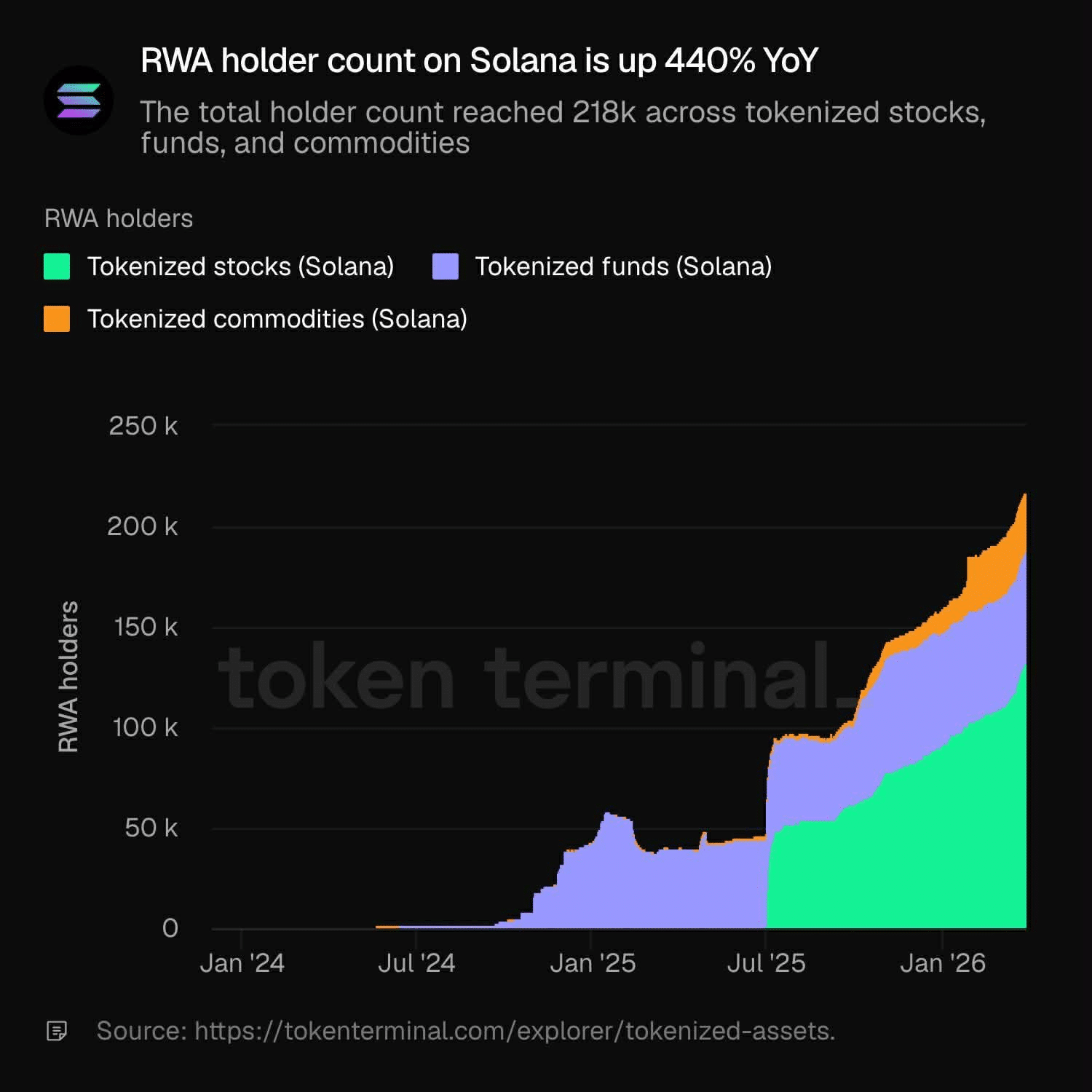
Câu chuyện thực sự? Là số lượng người nắm giữ RWA của Solana.

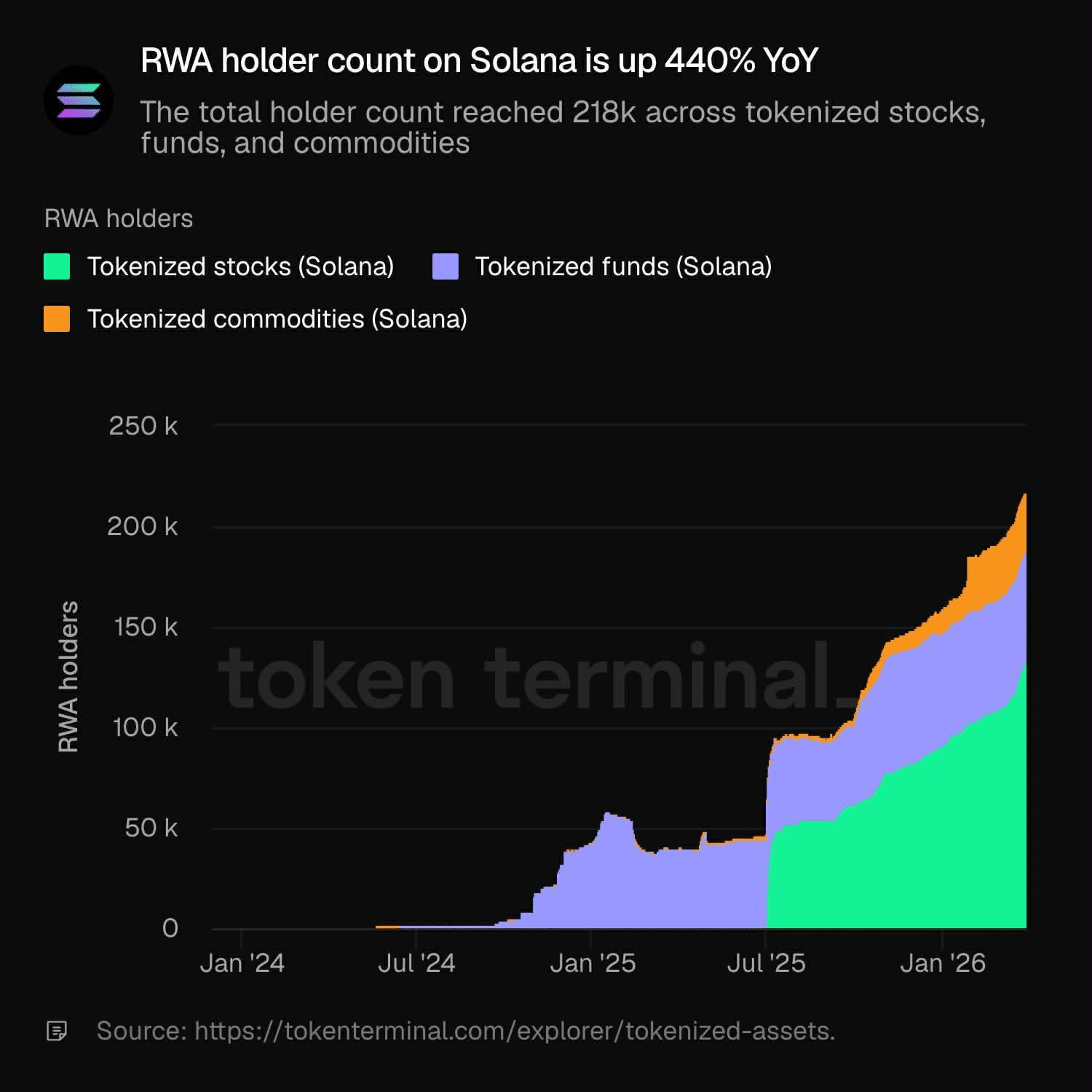
Như biểu đồ cho thấy, số lượng người nắm giữ RWA trên Solana đã tăng 440% so với cùng kỳ năm ngoái, tổng cộng là 218.000 người trên các cổ phiếu, quỹ và hàng hóa được mã hóa.

Sự tăng vọt này báo hiệu nhiều hơn là sự cường điệu.

Thay vào đó, đó là một dấu hiệu rõ ràng cho thấy Solana đang trở thành một mạng lưới được ưa chuộng cho các tài sản thế giới thực được mã hóa.

Trong bối cảnh này, việc IMF đưa ra cảnh báo bắt đầu có lý.

Vị thế dẫn đầu của XAUT trong lĩnh vực RWA đặc biệt đáng chú ý. Sự tăng trưởng của nó diễn ra trong thời điểm căng thẳng địa chính trị leo thang, điều thường thúc đẩy dòng vốn chảy vào các thiên đường an toàn truyền thống.

Nhưng thay vì bám theo lối chơi cũ, các nhà đầu tư đang đổ xô vào phiên bản vàng được mã hóa, cho thấy cách RWA đang thay đổi phương thức di chuyển của dòng vốn.

Tuy nhiên, điều này cũng làm phức tạp thêm câu chuyện xung quanh Solana với tư cách là mạng lưới được ưa chuộng cho RWA.

XAUT hiện chỉ được giao dịch trên Ethereum [ETH], đặt ra câu hỏi: Solana có thể nắm bắt gián tiếp động lực này không, hay nó cần các lựa chọn vàng được mã hóa riêng để thực sự củng cố vị thế của mình trong lĩnh vực RWA?

Chặng đường dài của Solana để thống trị các tài sản thế giới thực được mã hóa

Ở cấp độ tổng thể, thị trường RWA có hơn 50% là tài sản Kho bạc Hoa Kỳ.

Rõ ràng Solana đang định vị mình để nắm bắt một phần động lực này.

Theo RWA.xyz, sau stablecoin, RWA tập trung nhiều nhất của Solana là Kho bạc Hoa Kỳ, về cơ bản là các phiên bản được mã hóa của nợ chính phủ, cho phép các nhà đầu tư nắm giữ nợ Hoa Kỳ trên chuỗi và kiếm lãi định kỳ.

Điều này có ý nghĩa vì một vài lý do. Các công ty quỹ của Solana đang cho thấy động thái giá yếu. Mỗi đợt bơm nhỏ đều bị điều chỉnh lại, báo hiệu rằng sự tự tin của thị trường vào các quỹ này vẫn chưa theo kịp với sự tăng trưởng trên chuỗi.

Lấy công ty DAT lớn nhất của SOL, Forward Industries (NASDAQ: FWDI) làm ví dụ. Nó vẫn thấp hơn hơn 80% so với mức trước khi sụp đổ vào tháng Mười.
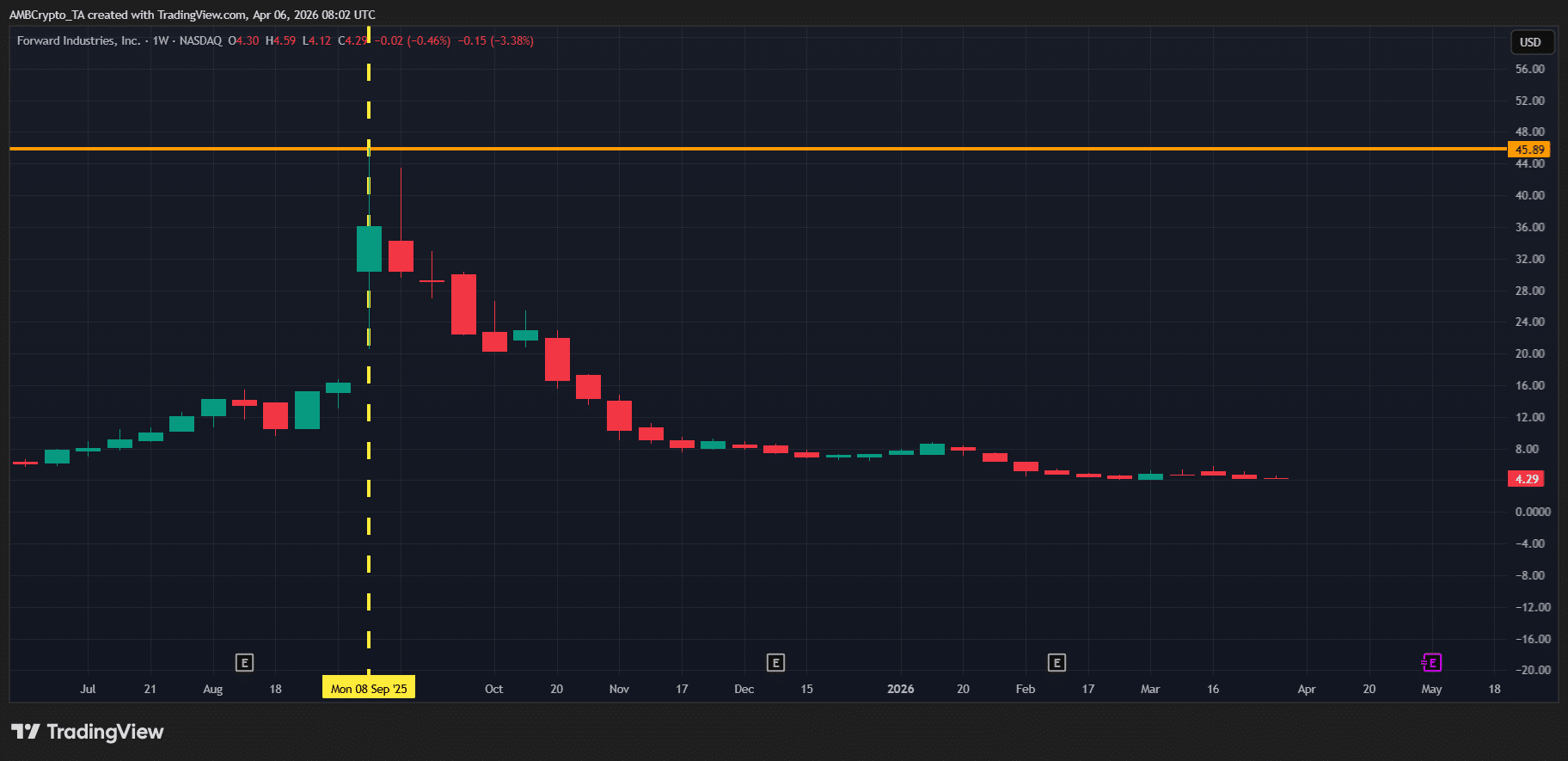
Nguồn: TradingView (FWDI/USD)

Trong bối cảnh này, dòng chảy RWA của Solana đóng vai trò như một chất xúc tác then chốt.

Ở cấp độ vĩ mô, Kho bạc Hoa Kỳ được mã hóa có thể tạo ra doanh thu cho Quỹ Tài sản Kỹ thuật số (DAT), sau đó có thể được sử dụng để tích trữ thêm SOL.

Với việc Solana đã nắm giữ vị thế vững chắc trong trái phiếu được mã hóa, đây là một chiến lược hữu hình có thể củng cố các quỹ và hỗ trợ tăng trưởng mạng lưới dài hạn.

Nhìn vào bức tranh tổng thể (sự tăng trưởng của thị trường RWA, số lượng người nắm giữ RWA ngày càng tăng của Solana và dòng vốn mạnh mẽ vào Kho bạc Hoa Kỳ), Solana có thể nổi lên như một giải pháp thay thế khả thi cho XAUT của Ethereum.

Nếu mạng lưới tiếp tục mở rộng hệ sinh thái RWA, nó có tiềm năng thiết lập vị thế là một trung tâm hàng đầu cho các tài sản được mã hóa, thu hút lượng vốn thể chế đáng kể trong quá trình này.


Tóm tắt cuối cùng

  • Solana đang nổi lên như một trung tâm lớn cho RWA trên chuỗi, với mức tăng 440% số lượng người nắm giữ so với cùng kỳ năm ngoái.
  • Dòng chảy mạnh vào Kho bạc Hoa Kỳ được mã hóa có thể biến Solana thành một giải pháp thay thế khả thi cho XAUT của Ethereum, mở ra con đường củng cố các DAT.


Связанные с этим вопросы

QSố lượng người nắm giữ RWA trên Solana đã tăng trưởng bao nhiêu phần trăm trong năm qua?

ASố lượng người nắm giữ RWA trên Solana đã tăng 440% so với cùng kỳ năm ngoái, đạt tổng cộng 218.000 người.

QTài sản thế giới thực (RWA) có tổng vốn hóa thị trường on-chain là bao nhiêu?

ATổng vốn hóa thị trường on-chain của RWA vừa đạt mức cao kỷ lục mới là 24 tỷ USD.

QXAUT hiện đang được giao dịch trên blockchain nào?

AXAUT hiện chỉ được giao dịch trên Ethereum (ETH).

QLoại tài sản RWA nào chiếm hơn 50% thị trường RWA?

ATài sản Kho bạc Hoa Kỳ chiếm hơn 50% thị trường RWA.

QSolana đang định vị mình như thế nào trong thị trường RWA?

ASolana đang định vị mình như một mạng lưới hàng đầu cho tài sản thế giới thực được token hóa, đặc biệt tập trung vào trái phiếu kho bạc Hoa Kỳ được token hóa, nhằm thu hút dòng vốn thể chế.

Похожее

a16z Crypto Partner: Cash Flow is the Moat

Title: a16z Crypto Partner: Cash Flow Is the Moat Summary: Historically, many of the best businesses were built by positioning themselves within the "flow of funds"—facilitating the creation and transfer of value within a network and taking a cut. The more value flows through, the larger the business grows. Cryptocurrency is the first modern technology natively built for this purpose. If a startup hasn't architected its product and business to benefit from these principles, it's missing a major opportunity. Thanks to stablecoins, capital and value now move at internet speed—globally settled, 24/7, with end-to-end programmability. Blockchains are inherently network businesses. Each transaction settles on a shared ledger, and every new participant strengthens the same underlying network. Network tokens amplify this effect. A well-designed token aligns all participants—users, developers, suppliers, validators, the protocol—around a single goal: growing the network. Participants are paid proportionally to their contributions, creating a transparent feedback loop between value flowing in the system and value accumulating to those building it. This model isn't new; crypto simply makes it more accessible and scalable for startups. The pattern is consistent: find where value flows and position yourself in the middle. Examples range from railroads (earning from freight) and Standard Oil to Google, Meta, and AWS (earning from attention, commerce, and compute flows, respectively). Financial markets make this even clearer. Visa's net income stems from its position in the $15.7 trillion payment flow. Major market makers profit from being in the flow of every order. This combination of fund flow and network effects creates one of the most durable business structures. Jeff Bezos's adage "your margin is my opportunity" applies perfectly here, especially to traditional finance—a massive pool of profit extraction. Crypto founders have the chance to build the next version: programmable, instant, global, and natively in the flow of funds. The frontier extends beyond finance to areas like compute/GPUs, memory chips, AI training data, energy, robotics, space, and rare earth metals—all domains where global value can flow at unprecedented scale on new, programmable infrastructure. Founders should ask: Are you currently in the flow of funds? Does your revenue scale 10x if the value of activity on your product grows 10x? Where in your target market is profit extraction highest relative to value created? The opportunity is there. Seize it, integrate into the new flow, and let the network effects accumulate.

链捕手5 мин. назад

a16z Crypto Partner: Cash Flow is the Moat

链捕手5 мин. назад

RWA First Stock's Major Acquisition: Why Buy a 'Traditional' Mortgage Company?

On June 10th, Figure Technology Solutions (Nasdaq: FIGR), a blockchain-native capital markets firm, announced a $717 million acquisition of Kiavi, a leading non-bank lender for residential real estate investors. The deal involves Figure acquiring Kiavi's technology and operations for approximately $538 million, while forming a joint venture with alternative asset manager Sixth Street to purchase Kiavi's existing loan portfolio. Sixth Street also provided a $3 billion forward purchase commitment. This acquisition marks a strategic shift for Figure, known as the "RWA (Real World Asset) first stock," allowing it to expand significantly into the larger market of first-lien mortgages. Kiavi specializes in non-qualified mortgage (Non-QM) loans, such as short-term fix-and-flip (RTL) and rental property (DSCR) loans—a segment traditionally underserved by major banks. The move is expected to increase Figure's first-lien loan origination to over $7 billion annually, aiming for these to constitute about 40% of its business by 2027. Both companies leverage AI for underwriting: Kiavi uses proprietary models to value renovated properties and automate document processing, dominating the fix-and-flip lending space. Figure plans to integrate these assets onto its blockchain platform, Provenance, using its new 'Adaptor' product to standardize and tokenize the loans for institutional investors on its Democratized Prime marketplace. While the integration poses challenges—including merging different asset types, interest rate sensitivity of Kiavi's loans, and post-IPO execution risks—Figure projects the deal to be accretive to earnings with a cash payback period under four years. The transaction is seen as a major step in scaling blockchain-based capital markets, moving RWA tokenization from concept validation toward large-scale operation.

Foresight News33 мин. назад

RWA First Stock's Major Acquisition: Why Buy a 'Traditional' Mortgage Company?

Foresight News33 мин. назад

Trend in US Stocks: A Post Triggers a 930-Point Rebound, Tonight Belongs to SpaceX

On Thursday (June 11, U.S. Eastern Time), Wall Street staged a textbook V-shaped reversal. The Dow Jones surged 929.97 points (+1.86%) to close above 50,000, while the Nasdaq and S&P 500 rose 2.54% and 1.75%, respectively. The rally occurred despite the hottest PPI report in years, with May data showing a 6.5% year-on-year surge, the highest since 2022. The market ignored the inflation data, focusing instead on reports that former President Trump called off a planned strike on Iran, hinting at a potential multi-party peace agreement draft. This sparked a sharp drop in oil prices, fueling hopes that inflation may have peaked. Sector rotations were stark: previously battered AI hardware and cyclical stocks led the gains, while defensive sectors that hit record highs the prior day were sold off. Chip stocks like Micron and Intel saw sharp rebounds. In contrast, software giant Oracle plunged nearly 10% despite beating earnings, with concerns over cloud revenue and cash flow. Adobe also fell after hours despite raising guidance, as its CFO announced departure. The rally's sustainability is questioned, driven largely by social media posts about unconfirmed geopolitical developments. Inflation risks remain, with pipeline pressures still high. Meanwhile, the market's risk appetite faces a major test with SpaceX's historic IPO. Priced at $135 per share, it aims to raise ~$75 billion with a $1.75 trillion valuation, becoming the largest U.S. IPO ever. It will join the Nasdaq 100 in 15 days, triggering massive index fund buying. However, critics cite extreme valuation (88x sales) and market liquidity concerns.

marsbit56 мин. назад

Trend in US Stocks: A Post Triggers a 930-Point Rebound, Tonight Belongs to SpaceX

marsbit56 мин. назад

The Trillion-Dollar Valuation Test: Are the Three Super IPOs a Tech Stock Frenzy or a Crypto Market Nightmare?

Trillion-Dollar Valuation Test: Are the Three Mega IPOs a Tech Stock Frenzy or a Crypto Market Nightmare? The capital market in 2026 is witnessing a highly anticipated wave of tech IPOs, centered on SpaceX, OpenAI, and Anthropic. Collectively valued at over $3.5 trillion, their potential listing represents one of the largest such waves in recent years. This raises concerns about market liquidity, valuation bubbles, and potential capital outflows from other assets like crypto. SpaceX's valuation narrative has shifted from rocket launches to becoming a global infrastructure play via its Starlink satellite network, which now drives most revenue. Despite ongoing losses, investors focus on its long-term growth potential. OpenAI and Anthropic represent the core productivity engines of generative AI. Their public listings would offer the first direct investment opportunity in large foundation model companies, potentially triggering a repricing within the AI sector. Market fears of a massive "capital drain" from these IPOs are likely overstated. Historical precedents like Alibaba and Saudi Aramco show that mega-listings primarily cause capital reallocation, not destruction, within the vast equities market. Systemic risk is rarely triggered by IPOs alone. For stock markets, short-term volatility and sector repricing are expected, especially for AI concept stocks. Long-term, these listings could reinforce the tech sector's importance. For crypto, direct competition for speculative capital exists, particularly affecting AI-themed tokens. However, crypto's trajectory remains more tied to its own cycles, macro liquidity, and Bitcoin ETF flows rather than a single IPO event. The real risk lies not in the listings themselves but in the sky-high growth expectations embedded in these valuations. If future revenue, profitability, or commercialization progress disappoints, significant valuation resets could follow, impacting high-growth tech stocks. Ultimately, the market's direction hinges on macroeconomic conditions and whether these companies can deliver on their ambitious promises.

链捕手1 ч. назад

The Trillion-Dollar Valuation Test: Are the Three Super IPOs a Tech Stock Frenzy or a Crypto Market Nightmare?

链捕手1 ч. назад

Торговля

Спот
Фьючерсы

Популярные статьи

Неделя обучения по популярным токенам 9: во время геополитических кризисов рост популярности защитных активов, таких как XAUT и XAG

Серебро (XAG) как важная часть "RWA/товарных фьючерсов" формирует вместе с XAUT/PAXG матрицу драгоценных металлов.

1.2k просмотров всегоОпубликовано 2026.03.03Обновлено 2026.03.03

Неделя обучения по популярным токенам 9: во время геополитических кризисов рост популярности защитных активов, таких как XAUT и XAG

Неделя обучения по популярным токенам 10: Обновление Alpenglow ожидается в первой половине 2026 года, долгосрочный прогноз по XAUT и XAG остается позитивным

Ожидается, что в первой половине 2026 года начнется развертывание масштабного обновления Alpenglow SOL.

1.3k просмотров всегоОпубликовано 2026.03.31Обновлено 2026.03.31

Неделя обучения по популярным токенам 10: Обновление Alpenglow ожидается в первой половине 2026 года, долгосрочный прогноз по XAUT и XAG остается позитивным

Обсуждения

Добро пожаловать в Сообщество HTX. Здесь вы сможете быть в курсе последних новостей о развитии платформы и получить доступ к профессиональной аналитической информации о рынке. Мнения пользователей о цене на XAUT (XAUT) представлены ниже.

活动图片