Ethena en difficulté alors que les revenus chutent de 32 % – La demande peut-elle sauver l'ENA à 0,089 $ ?

ambcryptoОпубликовано 2026-03-28Обновлено 2026-03-28

Введение

Le protocole Ethena (ENA) connaît une performance financière affaiblie au premier trimestre 2026, avec un revenu brut en baisse de 32% pour s'établir à 65,06 millions de dollars. La valeur totale bloquée (TVL) a également chuté, perdant environ 130 millions de dollars depuis début mars pour atteindre 6,66 milliards de dollars, indiquant des sorties de capitaux soutenues. Le nombre d'utilisateurs actifs quotidiens est tombé à environ 1 200, son plus bas niveau depuis décembre. Malgré ces fondamentaux en déclin, l'activité sur le marché au comptant montre une certaine résilience. Les données de flux nets des exchanges révèlent une pression d'achat accrue, avec des achats cumulés atteignant environ 3,41 millions de dollars sur trois jours. Cette demande soutenue pourrait limiter les baisses supplémentaires et favoriser une stabilisation des prix. Cependant, sans reprise de l'activité des utilisateurs et de la génération de revenus, toute appréciation du prix risque de rester limitée. La faible profitabilité, bien qu'en légère amélioration, semble insuffisante pour retenir les utilisateurs dans un environnement DeFi compétitif.

Le prix d’Ethena [ENA] semble désormais s'aligner sur ses performances financières en baisse. Au cours des dernières 24 heures, l'actif a enregistré un déclin à deux chiffres, tombant à 0,089 $ au moment de la rédaction.

Bien que les chiffres reflètent une pression croissante, une évaluation plus large des conditions du marché est nécessaire pour déterminer si cette baisse marque le début d'une correction plus profonde ou un ajustement temporaire.

L'élan d'Ethena faiblit sur les indicateurs clés

Les données on-chain montrent qu'ENA a sous-performé sur plusieurs fronts depuis le début du T1 2026, particulièrement en comparaison de ses performances des deux trimestres précédents.

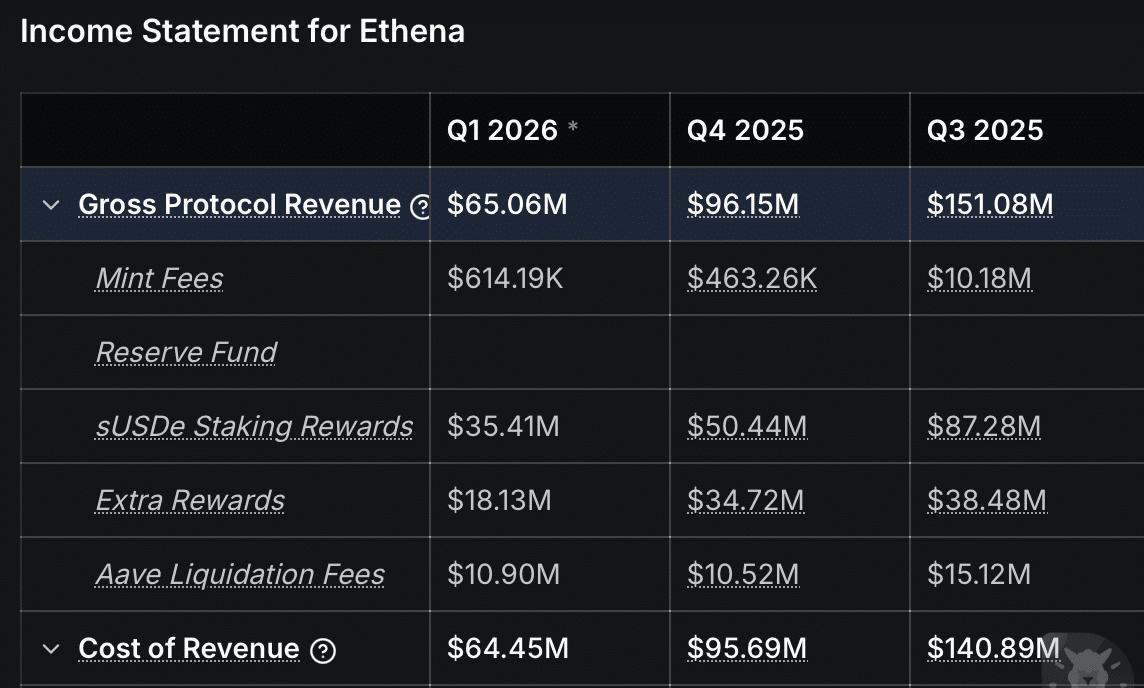
Un domaine clé de préoccupation est l'efficacité des revenus. Le Revenu Brut du Protocole est tombé à 65,06 millions de dollars, contre 96,15 millions de dollars au T4 2025, ce qui représente une baisse de 32 %. La chute devient encore plus prononcée lorsqu'on la compare au T3 2025.

Cette contraction indique une activité de minting plus faible et des récompenses de staking réduites, ce qui suggère tous deux un déclin de la participation on-chain.
Source : DeFiLlama

Dans un marché qui est resté relativement stable par rapport au cycle d'octobre-décembre 2025, cette sous-performance soulève des inquiétudes concernant un affaiblissement de la demande des utilisateurs plutôt qu'une pression externe.

Les conditions de liquidité renforcent cette tendance. La Valeur Totale Lockée (TVL), un indicateur central de la santé du protocole et de l'engagement des utilisateurs, a continué de baisser régulièrement.

Depuis le début du mois de mars 2026, la TVL a chuté d'environ 130 millions de dollars, pour s'établir à environ 6,66 milliards de dollars au moment de la rédaction. Rien que lors des dernières 24 heures, environ 16 millions de dollars ont été unstakés, signalant une sortie de capitaux soutenue du protocole.

Le profit seul peut-il maintenir l'intérêt des utilisateurs ?

Malgré le ralentissement général, Ethena a enregistré une légère amélioration de sa rentabilité brute.

Au T1 2026, le protocole a généré 614 190 $ de bénéfice brut, contre 463 200 $ au T4 2025. Bien que cela reflète une augmentation marginale, cela compense peu le déclin marqué par rapport aux niveaux de performance antérieurs.

Pour contextualiser, le T3 2025 avait enregistré 10,18 millions de dollars de bénéfice brut, soit environ 16,5 fois plus que les chiffres actuels. Cet écart met en lumière un déclin structurel du potentiel de gain, même si la rentabilité à court terme montre une légère amélioration.

L'implication est claire : une croissance modeste des profits à elle seule pourrait ne pas suffire à retenir les utilisateurs, surtout dans un environnement DeFi compétitif où le capital se tourne rapidement vers des opportunités à rendement plus élevé.

Les données d'activité des utilisateurs étayent ce point de vue. Selon Artemis, les Utilisateurs Actifs Quotidiens sont tombés à environ 1 200, le niveau le plus bas enregistré depuis décembre.

La demande au spot offre un contre-signal

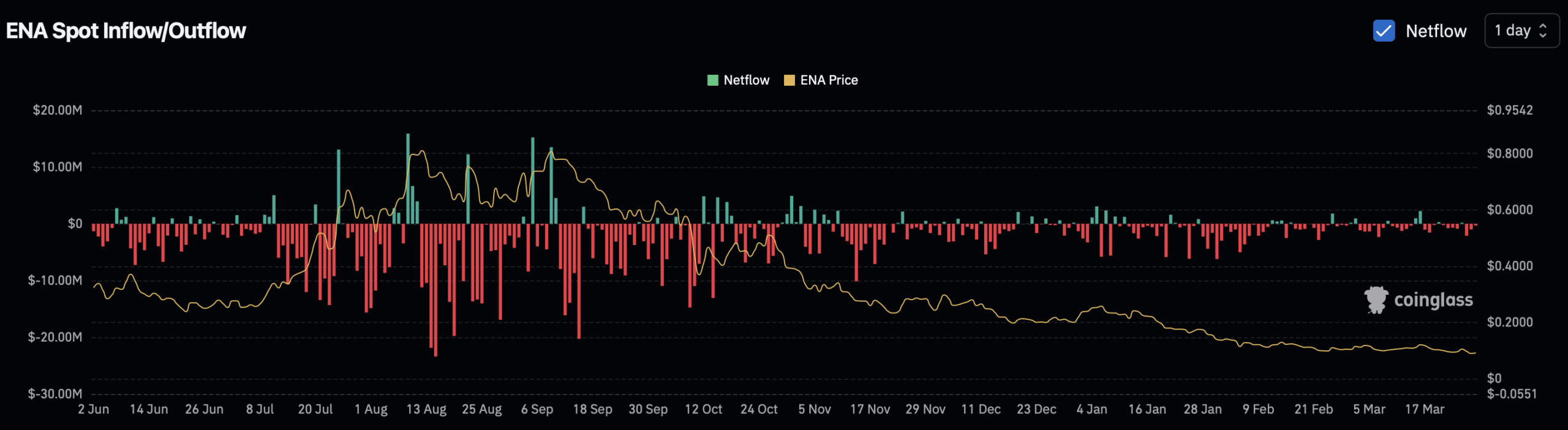
Malgré des fondamentaux qui s'affaiblissent et une liquidité en baisse, l'activité sur le marché au spot présente un tableau plus résilient. Les données de flux nets sur les exchanges indiquent que la pression d'achat a récemment augmenté. Au cours des dernières 24 heures, les entrées nettes dans les positions au spot ont atteint environ 303 000 $.

Plus notablement, ce n'est pas un événement isolé. Au cours des trois derniers jours, les achats cumulés ont grimpé à environ 3,41 millions de dollars, suggérant une accumulation constante.
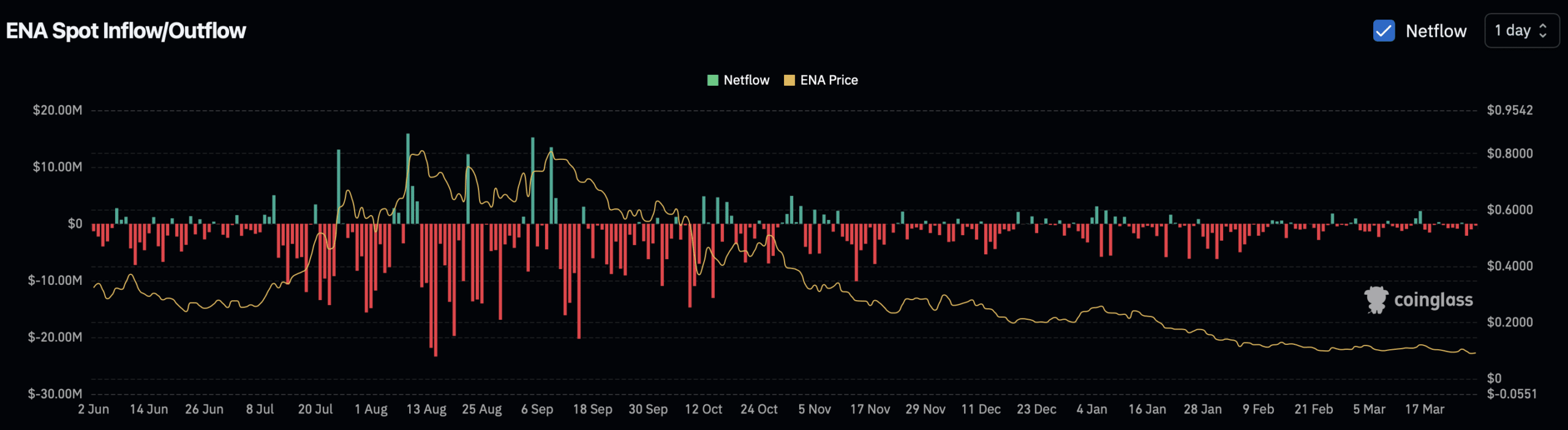
Source : CoinGlass

Une telle demande soutenue indique que les investisseurs continuent d'absorber la pression des vendeurs, même si les capitaux quittent la couche protocolaire.

Si cette tendance d'accumulation se maintient, elle pourrait limiter les baisses supplémentaires et soutenir une stabilisation des prix. Cependant, sans un rétablissement des fondamentaux de base, en particulier l'activité des utilisateurs et la génération de revenus, toute hausse pourrait rester contrainte dans une fourchette étroite.


Résumé final

  • La performance du protocole Ethena s'est détériorée au T1 2026, même si les conditions générales du marché sont restées relativement stables.
  • Les investisseurs au spot continuent d'accumuler, malgré les sorties de liquidités croissantes et la baisse de la TVL.


Связанные с этим вопросы

QQuels sont les principaux facteurs expliquant la baisse de 32% des revenus du protocole Ethena au premier trimestre 2026 ?

ALa baisse des revenus est principalement due à une activité de minting plus faible, des récompenses de jalonnement réduites et une participation on-chain en déclin, comme en témoigne la chute des revenus bruts du protocole de 96,15 millions de dollars au T4 2025 à 65,06 millions de dollars au T1 2026.

QComment la valeur totale verrouillée (TVL) d'Ethena a-t-elle évolué récemment et que cela indique-t-il ?

ALa TVL a continuellement diminué, perdant environ 130 millions de dollars depuis début mars 2026 pour atteindre environ 6,66 milliards de dollars. Seulement au cours des 24 dernières heures, près de 16 millions de dollars ont été retirés, signalant une sortie soutenue de capitaux et un affaiblissement de l'engagement des utilisateurs.

QMalgré les mauvaises performances, quel signe positif observe-t-on sur le marché au comptant pour ENA ?

ALe marché au comptant montre une demande résiliente avec des entrées nettes positives d'environ 303 000 dollars sur 24 heures et des achats cumulés d'environ 3,41 millions de dollars sur trois jours, indiquant une accumulation constante par les investisseurs.

QLa légère amélioration de la rentabilité brute est-elle suffisante pour inverser la tendance pour Ethena ?

ANon, la modeste amélioration (passant de 463 200 dollars de profit brut au T4 2025 à 614 190 dollars au T1 2026) est insuffisante pour compenser le déclin structurel par rapport aux performances passées (10,18 millions de dollars au T3 2025) et pour retenir les utilisateurs dans un environnement DeFi compétitif.

QQuel est le niveau actuel des utilisateurs actifs quotidiens sur Ethena et que révèle-t-il ?

ALe nombre d'utilisateurs actifs quotidiens est tombé à environ 1 200, son niveau le plus bas depuis décembre, ce qui confirme le déclin de l'activité et de l'intérêt des utilisateurs pour le protocole.

Похожее

Focus: Five Leading AI Stocks on Nasdaq

The report analyzes five Nasdaq-listed AI infrastructure stocks—Micron (MU), MaxLinear (MXL), AMD, Lumentum (LITE), and Vicor (VICR)—as distinct plays within the AI capital expenditure chain, rather than a single "AI trade." While all benefit from AI data center spending, they differ in their specific roles (e.g., memory, computing, optics, power, connectivity), financial resilience, and risk profiles. The author argues that the key question is not whether the AI narrative remains intact, but whether capital expenditure translates into real orders, earnings justify valuations, and portfolios can withstand high volatility. Historical data shows these stocks have significantly outperformed benchmarks but also experienced deeper drawdowns (~28% to -32%), highlighting their high-beta, high-volatility nature. An investment framework is proposed: core positions (e.g., MU, AMD) for stocks with stronger fundamental evidence; satellite positions (e.g., LITE, VICR) for high-potential, high-volatility names; and cautious observation (e.g., MXL) for smaller-cap ideas with unproven financials. The emphasis is on disciplined, phased buying during pullbacks—only when price corrections align with intact fundamentals and available risk budget—rather than emotional "buy-the-dip" strategies. Overall, AI infrastructure offers long-term potential, but success requires strict position sizing, role definition for each holding, and preparedness for significant volatility.

marsbit7 мин. назад

Focus: Five Leading AI Stocks on Nasdaq

marsbit7 мин. назад

Will UNI Reach $100 in Four Years? Will Standard Chartered's Prediction Come True?

TL;DR: - According to reports, Standard Chartered Bank has published a research report on Uniswap, setting a 2030 price target of $100 for the UNI token. - The bank's core logic is that the tokenization of assets will drive demand for open DeFi liquidity, and Uniswap could capture significant trading volume and fee revenue. - However, most institutional-grade tokenized products are permissioned, and the example of BlackRock's BUIDL shows that DeFi still faces significant access barriers. Standard Chartered's $100 target for UNI by 2030 is based on the hypothesis that tokenized assets will grow massively and a significant portion will flow into open DeFi markets, requiring decentralized exchange platforms like Uniswap for liquidity. The bank forecasts tokenized assets could reach $4 trillion by 2028, with up to 30% in DeFi by 2030. The key question is whether tokenized assets like treasuries and funds will trade in open, decentralized markets or remain within closed, permissioned institutional systems. This directly impacts Uniswap's potential growth. A real-world example is BlackRock's BUIDL fund, which, while using UniswapX for trading, is strictly limited to pre-approved, whitelisted institutional participants. This highlights the current trend: institutions may leverage DeFi infrastructure but maintain strict control over access and transfers. Furthermore, for UNI's value to rise significantly, Uniswap must establish a clear value-capture mechanism, such as the approved fee switch and token burn proposal. Regulatory and interoperability hurdles also persist, as noted by bodies like the Financial Stability Board. In summary, Standard Chartered's bold prediction hinges on the future flow of tokenized asset liquidity. While it signals institutional recognition of DeFi's potential, the path to $100 depends on overcoming current permissioned models and enabling truly open, cross-asset liquidity pools on platforms like Uniswap.

Foresight News10 мин. назад

Will UNI Reach $100 in Four Years? Will Standard Chartered's Prediction Come True?

Foresight News10 мин. назад

Odaily Editorial Team Tea Talk (June 17)

Odaily Editorial Team Casual Chat (June 17) This is an informal column sharing real-time thoughts from Odaily's editorial team on industry news, data, and events. The content is based on actual investment and observations, does not constitute investment advice, and aims to expand perspectives. Azuma shared recent operations: small-scale buys in crypto (mainly BTC) at relatively high levels, a small addition to HOOD stock, and participation in World Cup prediction markets. He also discussed Hyperliquid, noting that while its token HYPE has performed well, its high price may hinder the expansion of its HIP-3 ecosystem by making market creation cost-prohibitive, potentially limiting the platform to just one major market (trade.xyz). Suzz emphasized the importance of a calm mindset in investing, stating that markets offer perpetual opportunities. He warned against "hindsight bias," where past opportunities seem obvious, and stressed that the present always holds new chances for those with the right knowledge and temperament. Golem analyzed SpaceX's acquisition of AI tool Cursor's parent company, Anysphere, for $60 billion paid entirely in SpaceX stock. He speculated whether Musk's interests might work to keep SpaceX's trading volume and market cap high in the short term to reduce the actual equity cost of the deal, noting current high retail investor enthusiasm. Wenser shared a market outlook: cautiously bullish on BTC, monitoring SpaceX stock post-IPO for a potential rise, observing World Cup trends favoring strong teams, and noting the continued strength of Japanese and Korean stocks. He highlighted Anthropic's potential for a massive future IPO and the defensive investment logic in "picks and shovels" AI infrastructure. Qin Xiaofeng discussed trading HYPE around $56-$70, viewing the $50-$60 range as long-term support due to Hyperliquid's dominance in on-chain traditional asset trading and its substantial fee revenue used to buy back HYPE. On ETH, he noted a divide between disappointed crypto natives and bullish traditional investors like Tom Lee, personally viewing current ETH prices as undervalued.

Odaily星球日报22 мин. назад

Odaily Editorial Team Tea Talk (June 17)

Odaily星球日报22 мин. назад

Under the Shock of Oil Prices and Inflation, Which Country Will Be the First to Sell Off Its Gold Reserves?

The article draws a parallel between the 2003 North American blackout and the potential collapse of the global financial system, framing the US dollar and Treasury market as the world's economic "power grid." It argues that the closure of the Strait of Hormuz is creating a shockwave, starting with oil-importing emerging markets like Turkey, India, and Indonesia. As oil prices rise, these nations are forced to sell dollar-denominated assets—first US Treasuries, then potentially their gold reserves—to afford fuel. Turkey is highlighted as a key case, having sold nearly 90% of its Treasuries and begun tapping gold reserves when oil was between $70-$105/barrel. The article warns that if prices spike to $150-$160/barrel, global buffers like oil inventories and strategic reserves will be depleted. This could trigger a cascade: vulnerable nations, having exhausted assets, could face economic and political collapse (like Sri Lanka in 2022). Their forced asset sales would drive US Treasury yields higher, potentially past a critical threshold (around 5%), forcing the US to choose between a bond market crash or hyperinflation through massive money printing. Ultimately, the piece posits that the dollar's long-term decline is inevitable. The first domino to fall will likely be a fragile emerging market, signaling the start of a chain reaction that eventually threatens the core of the dollar system. The conclusion advises holding tangible assets like gold and energy, which cannot be printed, as a hedge against currency devaluation.

marsbit46 мин. назад

Under the Shock of Oil Prices and Inflation, Which Country Will Be the First to Sell Off Its Gold Reserves?

marsbit46 мин. назад

Торговля

Спот
Фьючерсы

Популярные статьи

Как купить ENA

Добро пожаловать на HTX.com! Мы сделали приобретение Ethena (ENA) простым и удобным. Следуйте нашему пошаговому руководству и отправляйтесь в свое крипто-путешествие.Шаг 1: Создайте аккаунт на HTXИспользуйте свой адрес электронной почты или номер телефона, чтобы зарегистрироваться и бесплатно создать аккаунт на HTX. Пройдите удобную регистрацию и откройте для себя весь функционал.Создать аккаунтШаг 2: Перейдите в Купить криптовалюту и выберите свой способ оплатыКредитная/Дебетовая Карта: Используйте свою карту Visa или Mastercard для мгновенной покупки Ethena (ENA).Баланс: Используйте средства с баланса вашего аккаунта HTX для простой торговли.Третьи Лица: Мы добавили популярные способы оплаты, такие как Google Pay и Apple Pay, для повышения удобства.P2P: Торгуйте напрямую с другими пользователями на HTX.Внебиржевая Торговля (OTC): Мы предлагаем индивидуальные услуги и конкурентоспособные обменные курсы для трейдеров.Шаг 3: Хранение Ethena (ENA)После приобретения вами Ethena (ENA) храните их в своем аккаунте на HTX. В качестве альтернативы вы можете отправить их куда-либо с помощью перевода в блокчейне или использовать для торговли с другими криптовалютами.Шаг 4: Торговля Ethena (ENA)С легкостью торгуйте Ethena (ENA) на спотовом рынке HTX. Просто зайдите в свой аккаунт, выберите торговую пару, совершайте сделки и следите за ними в режиме реального времени. Мы предлагаем удобный интерфейс как для начинающих, так и для опытных трейдеров.

545 просмотров всегоОпубликовано 2024.04.03Обновлено 2026.06.02

Как купить ENA

Обсуждения

Добро пожаловать в Сообщество HTX. Здесь вы сможете быть в курсе последних новостей о развитии платформы и получить доступ к профессиональной аналитической информации о рынке. Мнения пользователей о цене на ENA (ENA) представлены ниже.

活动图片