Can the Dual Currency Win Strategy Really Weather Bull and Bear Markets? A 6-Year Backtest Provides the Answer

marsbitОпубликовано 2026-02-27Обновлено 2026-02-27

Введение

"Can the Dual Currency Win (Wheel Strategy) truly weather bull and bear markets? A 6-year backtest (2020-2026) on Bitcoin and Ethereum provides the answer. The study compared two approaches: the 'Standard Rolling Strike' method, which dynamically sells covered calls at 105% of the current spot price, and the 'Fixed Anchor' method, which stubbornly sells calls at the original, higher cost basis after a drop, refusing to sell at a loss. Key findings reveal a significant performance gap. The Standard method, while sacrificing some upside, demonstrated superior risk-adjusted returns. For a 50/50 BTC/ETH portfolio, it achieved a +1347.32% total return with a -49.9% max drawdown and a Sharpe Ratio of 0.983, outperforming both Buy & Hold (+1665.52%, -77.8% drawdown, 0.85 Sharpe) on risk metrics and crushing the Fixed Anchor method (+592.77%, -61.8% drawdown, 0.766 Sharpe). The data shows the Standard strategy's strength lies in its dynamic adjustment mechanism, continuously resetting its strike price to balance income generation with participation in bullish trends. Conversely, the Fixed Anchor strategy's poor performance highlights the costly pitfall of the 'anchoring bias'—the human tendency to fixate on the entry price. This psychological trap cripples the ability to collect meaningful premium during bear markets and causes investors to miss subsequent bull runs when positions are called away at breakeven. The conclusion is clear: discipline and adaptability are far more valua...

Author: Michel Athayde

Can the Dual Currency Win Strategy Really Weather Bull and Bear Markets?

Using real market data from 2020-2026 for backtesting, we discovered:

Even with the same Dual Currency Win strategy, just by changing how the Calls are sold, the final profit difference can be nearly double.

The data tells us the problem isn't the strategy, it's human nature.

In the crypto market, the "Dual Currency Win" (Wheel Strategy) is often seen as a tool for collecting rent through bull and bear markets. But how do different underlying execution logics reshape long-term profit distribution?

To find the truth, we backtested Bitcoin and Ethereum over a complete bull-bear cycle from 2020-2026. In this sample, which includes crashes and an epic bull market, we compared two截然不同的双币赢玩法:

  • Standard Dual Currency Win (Rolling Strike): Follows the market. After taking delivery of the spot asset, each time a Covered Call is sold dynamically at 105% of the current price.

  • Break-even Type Dual Currency Win (Fixed Anchor): Anchors to cost. Once taking delivery at a high price, no matter how far the price falls, it stubbornly sells Calls at the "last delivery strike price," refusing to give up the chips until breaking even.

This is no longer a simple contest of "selling strategy vs. holding spot," but a deep test of "how trading psychology changes long-term profit distribution."

Core Data: Re-evaluating Risk and Return

(Note: Backtest span 2020-2026, Puts priced at 30% annualized, Calls at 25% annualized, 7-day cycles)

Investment Strategy Total Return Annualized (CAGR) Max Drawdown Sharpe Ratio
BTC HODL (Buy & Hold) +1133.73% 51.95% 0.83
BTC Standard (Rolling) +859.43% 45.72% -42.74% 0.929
BTC Break-even (Fixed) +558.81% 36.88% -61.19% 0.783
--- --- --- --- ---
ETH HODL (Buy & Hold) +2197.31% 68.52% -79.30% 0.87
ETH Standard (Rolling) +1835.21% 63.78% -54.27% 0.971
ETH Break-even (Fixed) +626.74% 39.13% -64.87% 0.724
--- --- --- --- ---
50/50 HODL Portfolio +1665.52% 61.30% <极速赛车开奖网em data-index-in-node="0" data-path-to-node="11,9,3,0">-77.80% 0.85
50/50 Standard Portfolio +1347.32% 56.05% -49.90% 0.983
50/50 Break-even Portfolio +592.77% 38.03% -61.80% 0.766

Faced with this real data, we need to re-examine two core propositions in trading.
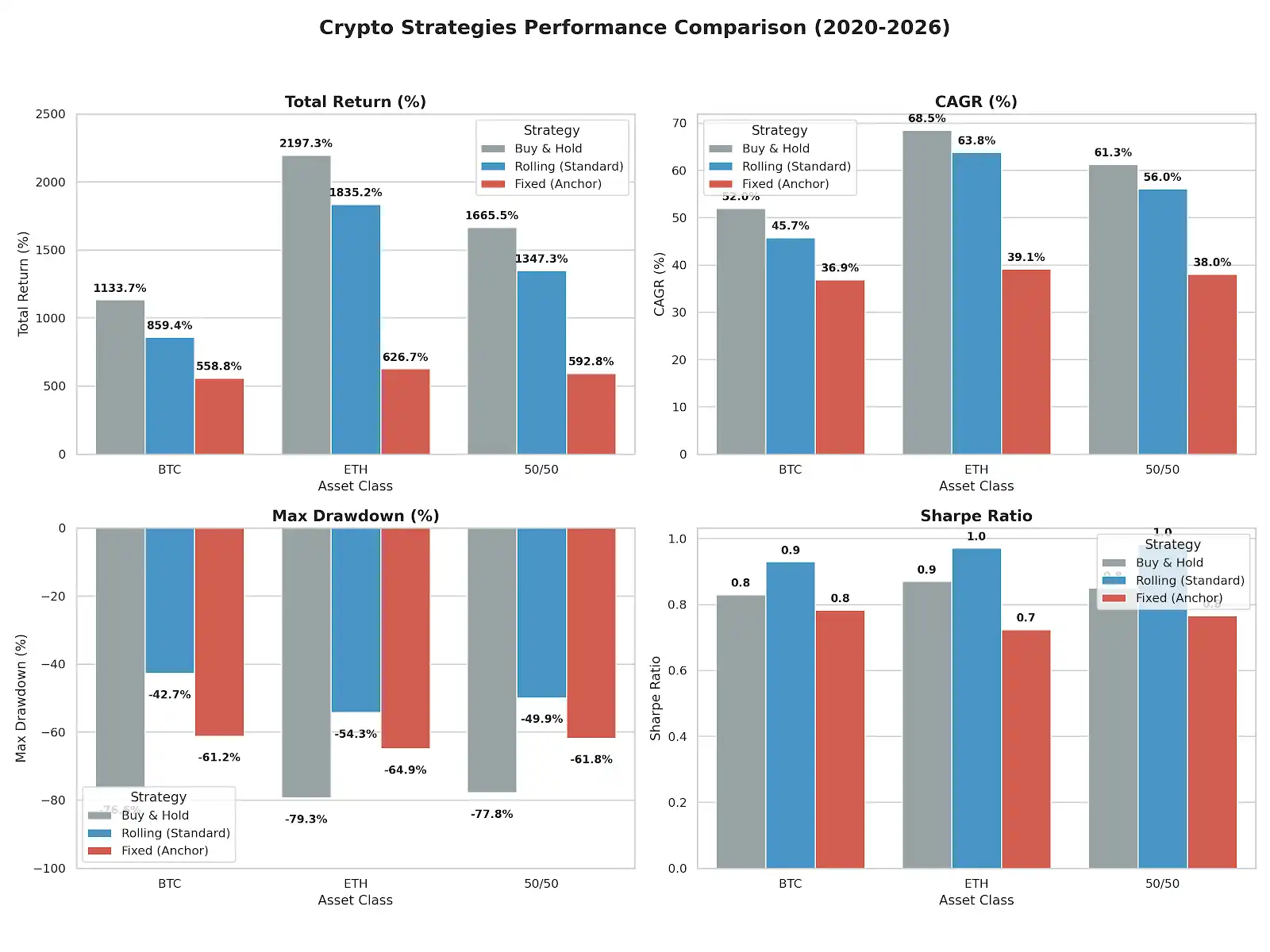
The Risk-Return Balancing Act of the Standard Dual Currency Win

Many mistakenly believed the standard strategy would severely underperform in bull markets, but the data proves that with just a 5% upside buffer (spot price * 1.05), it exhibits极强的 risk-return balancing ability over a full cycle.

In the 50/50 portfolio, its Sharpe Ratio (0.983) thoroughly crushed buy-and-hold (0.85) and drastically compressed the nearly -78% abysmal drawdown to -49.9%.

Its advantage doesn't come from predicting the market, but from the mechanism of "continuously dynamically raising the strike price."

With every price change, the standard version relentlessly adjusts its target. Rolling本质上是在牛市中不断“重置成本”,而 Fixed Anchor 却是在不断“确认错误”. The standard version sacrifices a极小部分 of potential暴利上限,换取来了平滑资金曲线的巨大战略纵深.

"Anchoring to Cost" is the Most Expensive Psychological Placebo

The most thought-provoking part of the data is the comprehensive failure of the "Break-even (Fixed Anchor)" type. It fell far short of the standard version in both return and drawdown control.

This exposes the most common weakness in human trading psychology: Anchoring Effect. If you took delivery at a high of 60k, and stubbornly hang a Call at 60k when the price drops to 30k, you not only lose the "bleeding stop" ability of option premiums during the long bear market, but also risk having your chips called away at 60k during a V-shaped market reversal, completely missing the subsequent main upward浪.

The break-even strategy seems conservative, but it's actually using time to fight the trend. And in a trend-driven market, time is often on the side of the trend. Obsessing over "not selling at a loss" is ironically the fastest way to perfectly miss out on major cycle红利.

Conclusion

Markets are full of volatility, but data doesn't lie.

In trending assets like Bitcoin and Ethereum, the real risk is not drawdown, but being limited on the upside by your own psychological anchor.

The standard Dual Currency Win tells us:

As long as you keep adjusting dynamically and rolling continuously, a selling strategy can also coexist with the trend.

And the break-even strategy reminds us:

The market won't change direction because of your cost basis.

Discipline is far more important than breaking even.

Связанные с этим вопросы

QWhat is the main finding of the 6-year backtest (2020-2026) comparing the two versions of the Wheel Strategy?

AThe backtest revealed that the standard 'Rolling Strike' version significantly outperformed the 'Fixed Anchor' version, with the performance gap being nearly double in some cases. The key difference lies not in the strategy itself, but in the human psychology of anchoring to a cost basis.

QHow does the 'Rolling Strike' (Standard) version of the Wheel Strategy manage risk and return compared to simply holding the asset (Buy & Hold)?

AThe 'Rolling Strike' version demonstrated superior risk-adjusted returns. For the 50/50 portfolio, it achieved a higher Sharpe Ratio (0.983 vs 0.85 for Buy & Hold) and significantly reduced the maximum drawdown (-49.9% vs -77.8% for Buy & Hold), while still capturing substantial upside.

QWhy did the 'Fixed Anchor' version of the strategy perform poorly in the backtest?

AThe 'Fixed Anchor' strategy performed poorly because it falls victim to the 'anchoring effect' in behavioral finance. By stubbornly selling calls at the original, higher cost basis during a bear market, it loses the ability to collect meaningful premium ('stop the bleeding') and risks having the asset called away at the break-even point, missing out on a subsequent major bull run.

QAccording to the article, what is the most significant risk when investing in trend assets like Bitcoin and Ethereum using such strategies?

AThe most significant risk is not the price drawdown itself, but the psychological limitation of one's upside potential by being anchored to a specific cost price, which can cause an investor to miss out on major market trends.

QWhat is the core lesson about discipline from the article's conclusion?

AThe core lesson is that maintaining discipline by dynamically adjusting and rolling positions (as in the standard version) is far more important than the psychological desire to simply 'break even' on a trade. The market will not change direction based on an individual's cost basis.

Похожее

Making Money While Laying Off: Where Did Silicon Valley's 170,000 Workers Go?

A significant wave of layoffs is sweeping through the U.S. tech industry, with over 170,000 jobs cut in 2025—surpassing levels seen during both the 2008 financial crisis and the 2020 pandemic. Unlike previous downturns driven by external economic shocks, the current restructuring is characterized by profitable companies proactively reducing headcount despite record revenues. The trend accelerated in early 2026, with more than 30,000 additional layoffs in the first six weeks alone. Major firms like Amazon, Block, Autodesk, and Salesforce announced significant cuts, often citing strategic shifts rather than financial distress. While AI and automation are frequently cited as causes, data shows that only about 28.5% of layoffs are directly attributable to AI adoption. The primary driver appears to be a correction after years of over-hiring during the low-interest, high-growth pandemic era. Companies are now prioritizing efficiency, smaller teams, and AI-integrated workflows in what analysts term a "structural reset"—meaning many eliminated roles may not return. The shift is creating a polarized job market: high demand for AI-specialized talent contrasts with shrinking opportunities in generalist roles like product operations and traditional engineering. Economists warn that continued tech sector contraction could slow U.S. GDP growth to near-recession levels. However, some data suggests the rate of layoffs may be moderating compared to 2024. Ultimately, the industry is undergoing a fundamental reorganization centered on redefining the role of human labor in an AI-driven ecosystem—a transition with no clear endpoint.

比推13 мин. назад

Making Money While Laying Off: Where Did Silicon Valley's 170,000 Workers Go?

比推13 мин. назад

The Stock Tokenization Revolution: A Panoramic Report on Market Dynamics, Product Architecture, and Regulatory Moats

Tokenized stocks are emerging as a breakthrough sector in the real-world asset (RWA) market, with a total value exceeding $800 million—a 30x increase since the start of the year—and monthly trading volume reaching $1.8 billion. The core value proposition is enabling global, 24/7 access to U.S. equities with near-instant settlement, bypassing geographic restrictions and delays inherent in traditional finance. Three primary architectures are competing for dominance: 1. Instant execution (e.g., Ondo, CyberAlpha): maximizes capital efficiency. 2. Inventory model (e.g., xStocks, Backed): uses Swiss debt structures for superior DeFi composability. 3. Direct ownership (e.g., Securitize): offers full legal rights but limited on-chain flexibility. The market is dominated by two players: Ondo (53% share) leverages liquidity engineering, while Backed/xStocks (23%) uses regulatory arbitrage via Swiss law. Regulatory licensing—not technology—is the key moat, with complex cross-jurisdictional compliance (U.S., EU, offshore) forming the highest barrier to entry. The sector faces a trilemma between liquidity/speed, regulatory safety, and DeFi composability, and is diverging into two paths: incremental integration with traditional systems (e.g., DTCC) and revolutionary on-chain issuance for full disintermediation. The convergence of the $150 trillion global equity market with blockchain infrastructure is already underway.

marsbit34 мин. назад

The Stock Tokenization Revolution: A Panoramic Report on Market Dynamics, Product Architecture, and Regulatory Moats

marsbit34 мин. назад

The Limits of Finance, The Channel Value of Global Markets

This article explores the evolving relationship between traditional finance and decentralized finance (DeFi), focusing on the growing institutional interest in on-chain vaults and real-world assets (RWA). While major asset managers like BlackRock and Apollo are investing heavily in DeFi tokens, the sector faces challenges, including liquidity crises and structural limitations. A central theme is the absence of a native DeFi risk-free interest rate. Despite multiple attempts—from algorithmic stablecoins to liquidity staking tokens—DeFi has largely adopted USDT and USDC for their scale, effectively making U.S. Treasury bonds the de facto benchmark. However, this dependency creates vulnerability, as DeFi cannot interact bidirectionally with traditional finance. The article argues that the next phase of DeFi will revolve around vaults—on-chain repositories that aggregate assets and yield. These vaults, managed by "curators," aim to offer fixed-rate products and credit systems but currently lack mechanisms for asset price inflation and clear risk management. The piece concludes that while vaults and curators are gaining traction, the true innovation lies in creating efficient "channels" or broker-like systems that enhance global capital flow. These could eventually replace centralized exchanges as the primary liquidity hubs, enabling a more integrated and efficient financial system without relying on traditional tokenomics.

marsbit34 мин. назад

The Limits of Finance, The Channel Value of Global Markets

marsbit34 мин. назад

Торговля

Спот
Фьючерсы
活动图片