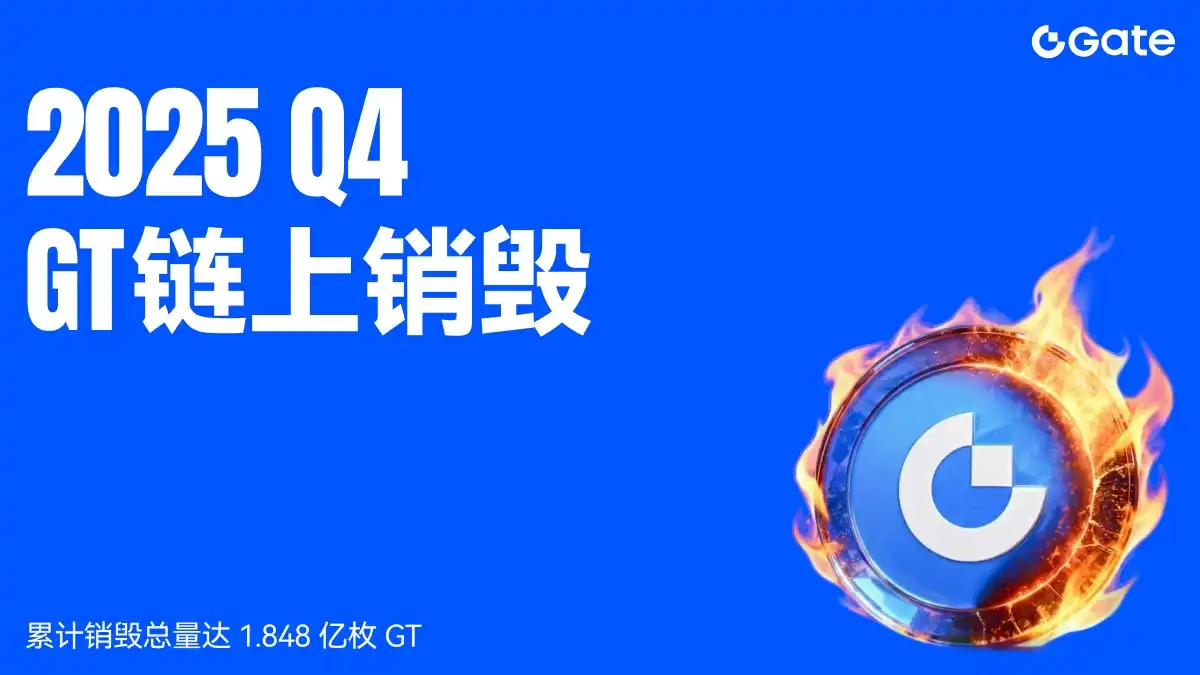
GateToken (GT) Menghancurkan 2,163,900 Koin pada Kuartal Keempat 2025, Membangun Struktur Ekonomi Token yang Lebih Kuat dalam Ekspansi Ekosistem

marsbitОпубликовано 2026-01-08Обновлено 2026-01-08

Введение

Token Gate (GT) telah membakar 2.163.900 GT pada kuartal keempat 2025, dengan nilai lebih dari $26,92 juta. Total GT yang telah dihancurkan hingga saat ini mencapai 184.819.426, senilai lebih dari $1,9 miliar. Sejak peluncuran mainnet GateChain pada 2019, total pasokan GT telah berkurang sekitar 61,61% melalui mekanisme pembakaran berkelanjutan. Sebagai aset inti ekosistem Gate, GT berfungsi sebagai token utilitas dan gas fee di GateChain. Dengan pengembangan ekosistem Web3 seperti Gate Perp DEX, Gate Fun, dan Gate Swap, penggunaan GT dalam transaksi dan interaksi on-chain terus meningkat. Gate terus memperkuat model ekonomi token melalui mekanisme deflasi yang berkelanjutan, sejalan dengan strategi "All in Web3" mereka untuk membangun infrastruktur yang matang dan berkelanjutan. Didirikan pada 2013, Gate adalah salah satu platform perdagangan crypto terkemuka dengan lebih dari 47 juta pengguna dan mendukung 4.200+ aset kripto.

Menurut pengumuman resmi, penghancuran on-chain GateToken (GT) untuk Q4 2025 telah selesai dilakukan. Sebanyak 2,163,900.48229 GT telah ditransfer ke alamat penghancuran, dengan nilai penghancuran melebihi $26.92 juta. Hingga saat ini, total GT yang telah dihancurkan mencapai 184,819,426 koin, dengan total nilai penghancuran melebihi $1.901 miliar (dihitung berdasarkan harga saat ini).

Detail transaksi on-chain dapat dilihat di: https://etherscan.io/tx/0x03773d485c05dc26a541f5d74e15097d02e010dea34c5cc4f6d3a127ac0126ce

GT (GateToken) adalah token platform utama Gate dan aset native GateChain. Sebagai Utility Token dan token pembayaran Gas Fee di GateChain, GT mendukung sistem transfer dasar GateChain. Sejak peluncuran mainnet GateChain pada 2019, GT telah menerapkan mekanisme penghancuran berkelanjutan, dengan total suplai token telah berkurang sekitar 61.61% dari jumlah awal 300 juta koin.

Seiring dengan Gate Layer dan produk ekosistem Web3-nya memasuki tahap operasi stabil dan pengembangan skala besar, posisi fundamental GT di seluruh ekosistem Gate terus diperkuat. Berpusat pada aplikasi inti seperti Gate Perp DEX, Gate Fun, Meme Go, dan Gate Swap, Gate telah membangun sistem aplikasi Web3 yang lengkap yang mencakup perdagangan, penerbitan, likuiditas, dan interaksi on-chain, dengan aktivitas on-chain dan kebutuhan penggunaan nyata yang terus meningkat. Sebagai satu-satunya token Gas di Gate Layer, GT telah terintegrasi secara mendalam dalam operasi jaringan, eksekusi transaksi, dan interaksi aplikasi, dengan konsumsi on-chain dan skenario penggunaan yang terus berkembang seiring dengan ekspansi ekosistem.

Gate selalu berkomitmen untuk menjalankan rencana penghancuran GT, secara stabil memajukan proses deflasi dalam kerangka hukum dan kepatuhan. Melalui mekanisme penghancuran yang jangka panjang, stabil, dan berkelanjutan, Gate terus memperkuat atribut kelangkaan dan dasar nilai GT, menciptakan siklus positif yang lebih erat antara model ekonomi token dengan kebutuhan penggunaan on-chain yang nyata dan pertumbuhan ekosistem.

Pada saat yang sama, Gate tetap berpegang pada strategi All in Web3, terus memperdalam pembangunan infrastruktur dasar, memperluas skenario aplikasi perdagangan terdesentralisasi dan multi-rantai, serta memberikan pengalaman Web3 yang lebih aman, efisien, dan kaya bagi pengguna. Melalui sinergi antara mekanisme deflasi dan pembangunan ekosistem, Gate, sebagai pembangun jangka panjang, mendorong infrastruktur Web3 menuju jalur perkembangan yang lebih matang dan berkelanjutan.

Tentang Gate

Gate didirikan pada 2013 oleh Dr. Han sebagai CEO, dan merupakan salah satu platform perdagangan cryptocurrency terkemuka di dunia. Platform ini melayani lebih dari 47 juta pengguna dan mendukung perdagangan lebih dari 4.200 aset kripto. Sebagai tolok ukur industri, Gate merupakan yang pertama mencapai Proof of Reserves 100%, dengan ekosistem yang mencakup layanan diversifikasi seperti Gate Wallet dan Gate Ventures.

Untuk informasi lebih lanjut, kunjungi: Website | X | Telegram | LinkedIn | Instagram | YouTube

Penyangkalan:

Konten ini tidak构成构成任何邀约、招揽、或建议。Sebelum membuat keputusan investasi apa pun, Anda harus mencari saran profesional independen. Harap diperhatikan bahwa Gate dapat membatasi atau melarang semua atau sebagian layanan dari wilayah yang dibatasi. Silakan baca Perjanjian Pengguna untuk informasi lebih lanjut, tautan: https://www.gate.com/zh/user-agreement 。


Связанные с этим вопросы

QBerapa jumlah GT yang dihancurkan oleh GateToken pada Q4 2025?

AGateToken menghancurkan total 2,163,900.48229 GT pada kuartal keempat tahun 2025.

QBerapa total nilai penghancuran GT hingga saat ini berdasarkan harga saat ini?

ATotal nilai penghancuran GT telah melebihi $1.901 miliar USD berdasarkan harga saat ini, dengan 184,819,426 GT yang telah dihancurkan secara kumulatif.

QApa peran utama GT (GateToken) dalam ekosistem GateChain?

AGT berfungsi sebagai Utility Token dan aset native GateChain, serta digunakan untuk membayar biaya gas dan mendukung sistem transfer dasar jaringan.

QBagaimana mekanisme penghancuran GT mempengaruhi model ekonomi token?

AMekanisme penghancuran yang konsisten memperkuat kelangkaan dan nilai dasar GT, menciptakan siklus positif dengan kebutuhan penggunaan on-chain dan pertumbuhan ekosistem.

QApa strategi utama Gate dalam pengembangan ekosistem Web3?

AGate menerapkan strategi All in Web3 dengan memperdalam infrastruktur dasar, memperluas skenario aplikasi on-chain terdesentralisasi, dan menyediakan pengalaman Web3 yang aman dan efisien.

Похожее

Dalio's Latest Warning: Don't Get Carried Away by AI, Real Returns on US Stocks in the Next 5-10 Years Could Be -5% to -10%

Ray Dalio, founder of Bridgewater Associates, warns investors against excessive concentration in AI stocks. He argues the current market, dominated by a few AI giants, mirrors historical patterns where revolutionary new technologies lead to high risk, volatility, and uncertainty. While acknowledging AI's transformative potential, Dalio emphasizes that most investors fail at this stage of the cycle by over-concentrating in a handful of leading companies. He cites inherent risks: companies cannot accurately forecast investment needs or external shocks (e.g., monetary policy, geopolitics, taxes), face potential disruption from future technologies and international competition (notably from China), and experience significant price swings. Dalio's core advice is diversification, calling it his "Holy Grail of Investing." He presents a mathematical case that a well-diversified portfolio of 15-20 uncorrelated, good bets offers a superior risk-adjusted return compared to a concentrated position. Dalio also offers a cautious outlook, suggesting U.S. stocks may deliver real returns of -5% to -10% over the next 5-10 years based on valuation and bubble indicators. He concludes that in the face of high uncertainty, the prudent strategy is not to avoid betting entirely, but to avoid large, concentrated bets where one lacks sufficient informational edge. Instead, investors should build a strategically balanced, diversified portfolio.

marsbit31 мин. назад

Dalio's Latest Warning: Don't Get Carried Away by AI, Real Returns on US Stocks in the Next 5-10 Years Could Be -5% to -10%

marsbit31 мин. назад

Rain Valuation Approaches $20 Billion: The Battle for U-Cards Extends to Rewards Systems

Rain, a stablecoin payments infrastructure company, is shifting the competitive focus for U Cards from simple issuance to user retention and repeated usage. On June 15, Rain launched "Rain Rewards," an embedded loyalty program capability within its card-issuing infrastructure. This allows partner businesses—like fintech platforms and neobanks—to configure branded loyalty points, earning rules, redemptions, and merchant promotions directly within their card products. The system, built from the 2025 acquisition of Uptop, ensures points are only issued upon final transaction settlement, preventing liabilities from refunds. Trials, such as with Avalanche Card, reportedly boosted spending by 25% among enrolled users. Founded by Farooq Malik and Charles Yoo-Naut, Rain evolved from a tool for managing Web3 company expenses into a full-stack enterprise platform. It is a Principal Member of Visa and Mastercard, enabling partners to issue stablecoin-backed cards and wallets while leveraging traditional payment networks. Notably, the popular U Card Plasma One is issued by Rain under Visa's authority. Rain also integrates with Visa's stablecoin settlement pilot, using USDC for network settlement. Rain's rapid funding reflects growing institutional interest in stablecoin payment infrastructure. It raised a $245 million Series A in March 2025, a $58 million Series B in August 2025, and a $250 million Series C in January of this year, reaching a $19.5 billion valuation. Annualized transaction volume exceeds $3 billion, serving over 200 partners including Western Union and Nuvei. Beyond cards, Rain is expanding into programmable payments. Its June 2026 "Agent Control Layer" allows businesses to set spending rules—like merchant categories, amounts, and frequency—for AI agents before transactions occur. This positions Rain not as a single product but as an operating system for stablecoin payments, handling everything from card issuance and wallet management to rewards, on/off-ramps, and automated compliance. The goal is to enable seamless, often invisible, real-world spending of on-chain assets.

Foresight News34 мин. назад

Rain Valuation Approaches $20 Billion: The Battle for U-Cards Extends to Rewards Systems

Foresight News34 мин. назад

Google TPU Shipments Revised Up by 50%

Recent industry research indicates a significant upward revision in the shipments of Google's TPU (Tensor Processing Unit) chips. Previous expectations for 2027 were set at around 10 million units, but new estimates now point to 15 million units, a 50% increase. This substantial boost directly translates to higher demand across the entire supporting supply chain. Google's TPU clusters utilize a standardized all-optical interconnect architecture. Consequently, key hardware components are deeply integrated and scaled in fixed ratios with the chips. The 15 million TPU target will drive corresponding demand increases for NPO optical engines (roughly a 1:1 match), 1.6T optical modules, OCS optical switches, high-end server power supplies, fiber optics & MPO connectors, and liquid cooling solutions. Among these, liquid cooling is highlighted as the sector experiencing the most significant transformation and offering the most stable potential for excess returns. As next-generation TPU chips reach power levels where traditional air cooling is insufficient, liquid cooling becomes essential. 2026 is forecasted as the first year of substantial adoption for Google's liquid cooling solutions. This shift, coupled with delivery and capacity bottlenecks faced by incumbent overseas manufacturers, is creating a prime window for domestic Chinese suppliers to enter and secure Google's core supply chain. The market size for Google-specific liquid cooling is projected to potentially triple from a baseline of hundreds of billions to around 300 billion units by 2028. The logic for the fiber optic sector is also being rewritten. Once considered a cyclical commodity tied to telecom operator procurement, fiber is now a strategic and scarce resource for AI Data Centers (AIDC). A severe supply-demand imbalance, driven by the long lead time for preform production (18-24 months) and surging demand from cloud giants, is supporting strong performance. Chinese fiber manufacturers are well-positioned to capture a significant share of global AIDC demand, with exports potentially reaching 200-300 million core kilometers in 2026. Overall, the investment focus within the AI computing industry is shifting from pure "chip performance speculation" towards the more certain incremental growth in computing infrastructure and its supporting ecosystem. The upward revision in Google TPU shipments, along with the potential for further doubling by 2028, is seen as solidifying performance visibility for the entire supporting supply chain over the next two years.

marsbit2 ч. назад

Google TPU Shipments Revised Up by 50%

marsbit2 ч. назад

What Wall Street Really Wants After the Crypto Story Recedes

The tide of speculative crypto narratives has receded, revealing Wall Street's true objective: building a controlled, yield-generating, and compliant financial pipeline on distributed ledgers. They are migrating core functions onto blockchains, not for decentralization, but for efficiency and new revenue streams. Key developments include BlackRock's BUIDL fund, a tokenized treasury fund acting as a foundational reserve asset, and the rise of Securitize, which is going public and partnering with the NYSE to build a 24/7 digital securities trading and settlement system. This signals a major shift of securities clearing to blockchain technology. To make volatile assets like Bitcoin palatable for institutional investors, firms like BlackRock and Goldman Sachs are creating "covered call" ETFs (e.g., BITA). These products systematically sell options on Bitcoin holdings, transforming price volatility into stable monthly income, effectively repackaging crypto as a yield-bearing asset. Stablecoins are being positioned not as speculative tools but as efficient payment rails. Companies like Stripe and Mastercard are integrating them for instant, low-cost merchant settlements and cross-border card payments, respectively. Critically, new legislation like the GENIUS Act shapes them as non-interest-bearing, heavily regulated extensions of the US dollar system. In summary, Wall Street is quietly constructing a parallel, blockchain-based financial infrastructure featuring tokenized traditional assets, structured crypto yields, and programmable dollar pipelines—all under its control and fully integrated with existing regulatory and credit frameworks.

marsbit2 ч. назад

What Wall Street Really Wants After the Crypto Story Recedes

marsbit2 ч. назад

Торговля

Спот
Фьючерсы

Популярные статьи

Как купить GT

Добро пожаловать на HTX.com! Мы сделали приобретение Gatechain (GT) простым и удобным. Следуйте нашему пошаговому руководству и отправляйтесь в свое крипто-путешествие.Шаг 1: Создайте аккаунт на HTXИспользуйте свой адрес электронной почты или номер телефона, чтобы зарегистрироваться и бесплатно создать аккаунт на HTX. Пройдите удобную регистрацию и откройте для себя весь функционал.Создать аккаунтШаг 2: Перейдите в Купить криптовалюту и выберите свой способ оплатыКредитная/Дебетовая Карта: Используйте свою карту Visa или Mastercard для мгновенной покупки Gatechain (GT).Баланс: Используйте средства с баланса вашего аккаунта HTX для простой торговли.Третьи Лица: Мы добавили популярные способы оплаты, такие как Google Pay и Apple Pay, для повышения удобства.P2P: Торгуйте напрямую с другими пользователями на HTX.Внебиржевая Торговля (OTC): Мы предлагаем индивидуальные услуги и конкурентоспособные обменные курсы для трейдеров.Шаг 3: Хранение Gatechain (GT)После приобретения вами Gatechain (GT) храните их в своем аккаунте на HTX. В качестве альтернативы вы можете отправить их куда-либо с помощью перевода в блокчейне или использовать для торговли с другими криптовалютами.Шаг 4: Торговля Gatechain (GT)С легкостью торгуйте Gatechain (GT) на спотовом рынке HTX. Просто зайдите в свой аккаунт, выберите торговую пару, совершайте сделки и следите за ними в режиме реального времени. Мы предлагаем удобный интерфейс как для начинающих, так и для опытных трейдеров.

311 просмотров всегоОпубликовано 2024.05.09Обновлено 2026.06.02

Как купить GT

Обсуждения

Добро пожаловать в Сообщество HTX. Здесь вы сможете быть в курсе последних новостей о развитии платформы и получить доступ к профессиональной аналитической информации о рынке. Мнения пользователей о цене на GT (GT) представлены ниже.

活动图片












