YouTube bật tính năng thanh toán bằng stablecoin PYUSD cho người sáng tạo tại Mỹ: Báo cáo

cointelegraphОпубликовано 2025-12-12Обновлено 2025-12-12

Введение

Theo báo cáo, YouTube hiện đã cho phép các nhà sáng tạo nội dung tại Hoa Kỳ nhận thanh toán bằng stablecoin PYUSD của PayPal. Tính năng này hiện chỉ khả dụng cho người dùng Mỹ, cho phép nhận tiền chi trả thông qua đồng ổn định này mà nền tảng không cần trực tiếp xử lý tiền mã hóa. PayPal và YouTube có quan hệ hợp tác lâu năm, việc tích hợp PYUSD được kỳ vọng thúc đẩy áp dụng stablecoin nhờ quy mô nền tảng lớn. PYUSD, ra mắt năm 2023, hiện có vốn hóa thị trường 3,9 tỷ USD và tăng trưởng mạnh từ đầu năm 2024, đặc biệt sau khi được tích hợp với các nền tảng cho vay và blockchain institutional vào tháng 9.

Gã khổng lồ chia sẻ video YouTube được báo cáo đã kích hoạt tính năng cho phép các nhà sáng tạo tại Mỹ nhận thanh toán bằng stablecoin PYUSD của PayPal.

Fortune đưa tin hôm thứ Năm rằng người đứng đầu mảng crypto của PayPal, May Zabaneh, cho biết tính năng này đã hoạt động, nhưng chỉ dành cho người dùng tại Mỹ. Công ty đã tích hợp khả năng cho người nhận chấp nhận thanh toán bằng PYUSD từ đầu năm nay, và cuối cùng YouTube đã chọn mở tùy chọn này cho các nhà sáng tạo của mình.

"Cái hay của những gì chúng tôi xây dựng là YouTube không cần phải động đến crypto và vì vậy chúng tôi có thể giúp loại bỏ sự phức tạp đó," bà nói.

PayPal có mối quan hệ lâu dài với YouTube, khi nền tảng này cho phép người dùng thanh toán thông qua các dịch vụ của mình trong nhiều năm, đồng thời sử dụng nó cho các khoản thanh toán AdSense của người sáng tạo.

YouTube có thể đang ấm lên với crypto, sau lịch sử cấm tiệt (shadowban) nội dung về crypto, khi các tài sản kỹ thuật số đang dần đi vào xu hướng chủ đạo. Động thái này cũng có thể là một lợi ích tiềm năng cho việc áp dụng stablecoin, xét theo quy mô nền tảng của YouTube.

Liên quan: Visa thí điểm chi trả bằng stablecoin được định giá bằng fiat cho các doanh nghiệp Mỹ

Thị trường stablecoin đã bùng nổ trong năm qua khi các doanh nghiệp, tổ chức và chính phủ chủ đạo chuyển sang tích hợp các tài sản này với tài chính truyền thống.

PYUSD được ra mắt vào giữa năm 2023 và hiện có vốn hóa thị trường là 3,9 tỷ USD theo dữ liệu từ CoinGecko. Giá trị thị trường của nó đã tăng vọt kể từ đầu năm, tăng từ khoảng 500 triệu USD vào tháng Một.
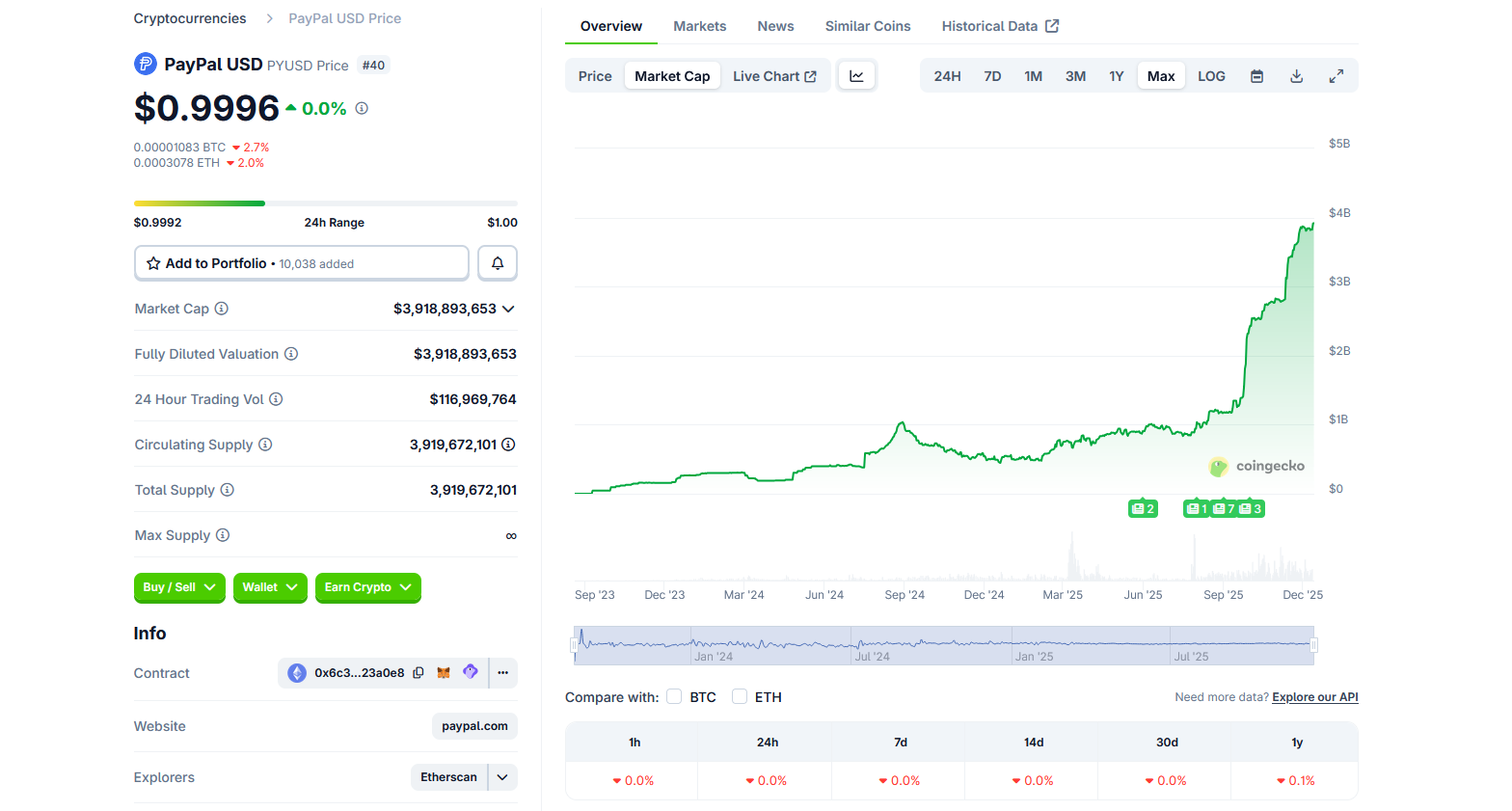
Vốn hóa thị trường PYUSD. Nguồn: CoinGecko

Một phần đáng kể trong sự tăng trưởng của PYUSD đến từ đầu tháng Chín, khi vốn hóa thị trường ở mức khoảng 1 tỷ USD. Trong tháng đó, PYUSD đã được tích hợp với thị trường cho vay của Spark và Stable của Bitfinex, một blockchain stablecoin cấp độ thể chế.
Tạp chí: Stablecoin sẽ chứng kiến sự tăng trưởng bùng nổ vào năm 2025 khi thế giới chấp nhận loại tài sản này


Связанные с этим вопросы

QYouTube đã bật tính năng thanh toán bằng stablecoin nào cho người sáng tạo nội dung tại Mỹ?

AYouTube đã bật tính năng thanh toán bằng stablecoin PYUSD của PayPal cho người sáng tạo nội dung tại Mỹ.

QAi là người đứng đầu bộ phận tiền mã hóa của PayPal đã xác nhận thông tin này?

AMay Zabaneh, người đứng đầu bộ phận tiền mã hóa của PayPal, là người đã xác nhận tính năng này đã được kích hoạt.

QLợi ích chính của việc tích hợp PYUSD theo đại diện PayPal là gì?

ATheo đại diện PayPal, lợi ích chính là YouTube không cần phải trực tiếp xử lý tiền mã hóa, giúp loại bỏ sự phức tạp cho nền tảng.

QVốn hóa thị trường hiện tại của PYUSD là bao nhiêu theo dữ liệu từ CoinGecko?

ATheo dữ liệu từ CoinGecko, vốn hóa thị trường hiện tại của PYUSD là 3,9 tỷ USD.

QSự kiện nào vào tháng 9 đã góp phần vào sự tăng trưởng đáng kể của PYUSD?

ASự tăng trưởng đáng kể của PYUSD từ tháng 9 đến từ việc nó được tích hợp với thị trường cho vay của Spark và Stable của Bitfinex, một blockchain stablecoin cấp tổ chức.

Похожее

Has the Crypto Market Bottomed? Here's What Institutions Think

The crypto market is in a period of significant debate, with leading institutions offering differing views on whether a bottom has been reached. Three prominent firms have published detailed analyses: * **Galaxy Digital** argues Bitcoin has **not yet bottomed**. Their analysis of 13 historical indicators across six dimensions (valuation, profit-taking, miner pressure, etc.) shows only four are fully met. They project a potential bottom range between $30k and $54k. * **NYDIG** states a bottom is **possible but not likely**. While metrics are close to historic bear market extremes, they note the absence of a classic panic-selling event. They also suggest increased institutional adoption may have structurally altered the market cycle, potentially leading to a shallower downturn. * **Standard Chartered Bank** asserts the **bottom has already occurred** at around $59k. They cite two key factors: potential US-Iran diplomatic progress and the anticipated SpaceX IPO, which they believe absorbed capital and caused ETF selling pressure that is now subsiding. They forecast a year-end price target of $100k. Despite the surface-level disagreement, the reports share critical common ground more valuable for long-term investors: 1. All three believe the market bottom will form **within this year**. 2. All agree the current price is **closer to the bottom than to previous highs**. 3. All maintain a **bullish long-term outlook** for Bitcoin and a new cycle. The core takeaway is that while the exact bottom price ($40k, $50k, or $60k) is debated, the consensus is that a bottom is imminent. For long-term holders, the primary focus should not be pinpointing the absolute low, but on the future potential for prices to reach $100k, $200k, or higher. The fundamental thesis for Bitcoin—sovereign debt accumulation, inflation, declining trust in centralized institutions, global digitization, and improved accessibility—remains intact and is arguably strengthening. The overall landscape is viewed as more favorable than in previous crypto winters.

marsbit5 мин. назад

Has the Crypto Market Bottomed? Here's What Institutions Think

marsbit5 мин. назад

The 'Chip' Challenge and Breakthroughs in China's Optical Industry Chain

China's Photonics Industry: Bottlenecks and Breakthroughs In the global AI race, computing chips dominate the narrative, but the underlying bottleneck increasingly defining the scale of AI clusters is light—or more specifically, optical connectivity. Optical modules, which translate electrical signals to light and vice versa, are crucial for connecting thousands of GPUs in AI data centers, preventing data congestion and ensuring efficient model training. High-speed modules (800G, 1.6T) are now standard, with performance hinging on advanced DSP (Digital Signal Processor) chips. This is where a critical dependency lies. Two US giants—Marvell and Broadcom—collectively dominate over 90% of the high-end DSP chip market. Chinese optical module leaders like Zhongji Innolight and Eoptolink rely on these chips to manufacture modules for overseas AI customers, primarily in North America. While this creates a supply chain vulnerability, complete decoupling is difficult. Marvell derives over half its revenue from Greater China, and the US firms depend on Chinese partners for chip packaging and optical components. The risk from laser chips (e.g., from Lumentum), another key component, is considered more manageable due to multiple global suppliers and faster progress in domestic alternatives from companies like YOFC and Accelink. To mitigate risks, China's industry is pursuing a multi-pronged strategy: diversifying supply chains and locking in long-term orders; fostering a domestic market ecosystem to adopt homegrown DSPs from firms like Huawei HiSilicon and CETC; accelerating R&D in high-speed DSPs and advanced packaging; and investing in next-gen technologies like silicon photonics and Co-Packaged Optics (CPO) to reduce reliance on discrete DSPs. The ultimate solution lies not in short-term博弈 but in persistent advancement of domestic high-end chip R&D and manufacturing. While challenges remain in performance, certification, and ecosystem building, China's vast domestic market and manufacturing base provide a crucial buffer, buying time for the industry to achieve greater technological independence.

marsbit19 мин. назад

The 'Chip' Challenge and Breakthroughs in China's Optical Industry Chain

marsbit19 мин. назад

Behind SpaceX's $2 Trillion Market Cap: Why Does Musk Always Have the Next Move Planned?

On June 12th, SpaceX debuted on the Nasdaq, reaching a valuation that briefly touched $2 trillion. This marked the culmination of a 24-year journey from its founding in 2002, driven by Elon Musk's frustration at the high cost of buying rockets. The company's path was defined by early failures, with its first three Falcon 1 launches ending in explosions before a successful 2008 flight opened the era of commercial spaceflight. Key to its model was a fixed-price NASA contract, incentivizing cost reduction. SpaceX mastered rocket reusability, first achieving a Falcon 9 landing in 2015, which drastically cut launch costs. This enabled its profitable Starlink satellite internet constellation, envisioned years before reusability was proven, to create an internal market for frequent launches. Similarly, the next-generation Starship rocket was in development long before its first flight, with its business case evolving from Mars colonization to supporting the emerging concept of in-orbit data centers for AI—a story now central to its valuation. The company's recent IPO, a reversal of its long-standing "no IPO" stance, is funding this ambitious "space-based compute" vision. While major tech players like Google, Blue Origin, and others are investing heavily, significant technical and cost hurdles remain. Ultimately, SpaceX's history is one of creating its own demand: first with Starlink and now with space-based AI compute, betting that its next rocket will enable its next giant market.

marsbit21 мин. назад

Behind SpaceX's $2 Trillion Market Cap: Why Does Musk Always Have the Next Move Planned?

marsbit21 мин. назад

When Crypto Meets the World Cup: CoinW and Modrić's Art of "Navigating Cycles"

When Encryption Meets the World Cup: CoinW and Modrić's "Transcending Cycles" Philosophy In the context of the 2026 FIFA World Cup and its massive global audience, the crypto exchange CoinW announced football legend Luka Modrić as its global brand ambassador. This move is framed not merely as a marketing tactic, but as a strategic experiment in user profile migration. It targets mature, financially stable football fans—particularly in Europe, Southeast Asia, and Latin America—who traditionally have low crypto awareness but value trusted, time-tested authority figures like Modrić. The article draws parallels between Modrić's enduring, disciplined career—marked by consistency and success at the highest level over two decades—and CoinW's own development path. Founded in 2017 during a volatile industry period, CoinW focused on building robust infrastructure and risk management. It weathered the 2022 industry crisis without major security incidents, subsequently earning recognition like "Europe's Most Trusted Exchange" and growing to over 20 million registered users. This "long-termism" is translated into user-centric products. CoinW Academy lowers the initial knowledge barrier. Its integrated ecosystem (CoinW, GemW, DeriW, PropW) and the recent launch of a TradFi section—offering perpetual contracts on traditional assets like stocks, gold, and oil—aim to create a unified platform for diverse assets. For the World Cup, CoinW launched the "We Are The Game" campaign, collaborating with Alchemy Pay to offer zero-fee deposits and local payment options, aiming to transform spectators into participants and lower entry barriers. Ultimately, CoinW's sports partnerships and product strategy are presented as a concerted effort to build trust and accessibility for the "silent majority" still outside crypto—shifting the industry narrative toward inclusivity and long-term value.

Foresight News27 мин. назад

When Crypto Meets the World Cup: CoinW and Modrić's Art of "Navigating Cycles"

Foresight News27 мин. назад

Торговля

Спот
Фьючерсы

Популярные статьи

Как купить US

Добро пожаловать на HTX.com! Мы сделали приобретение Talus Network (US) простым и удобным. Следуйте нашему пошаговому руководству и отправляйтесь в свое крипто-путешествие.Шаг 1: Создайте аккаунт на HTXИспользуйте свой адрес электронной почты или номер телефона, чтобы зарегистрироваться и бесплатно создать аккаунт на HTX. Пройдите удобную регистрацию и откройте для себя весь функционал.Создать аккаунтШаг 2: Перейдите в Купить криптовалюту и выберите свой способ оплатыКредитная/Дебетовая Карта: Используйте свою карту Visa или Mastercard для мгновенной покупки Talus Network (US).Баланс: Используйте средства с баланса вашего аккаунта HTX для простой торговли.Третьи Лица: Мы добавили популярные способы оплаты, такие как Google Pay и Apple Pay, для повышения удобства.P2P: Торгуйте напрямую с другими пользователями на HTX.Внебиржевая Торговля (OTC): Мы предлагаем индивидуальные услуги и конкурентоспособные обменные курсы для трейдеров.Шаг 3: Хранение Talus Network (US)После приобретения вами Talus Network (US) храните их в своем аккаунте на HTX. В качестве альтернативы вы можете отправить их куда-либо с помощью перевода в блокчейне или использовать для торговли с другими криптовалютами.Шаг 4: Торговля Talus Network (US)С легкостью торгуйте Talus Network (US) на спотовом рынке HTX. Просто зайдите в свой аккаунт, выберите торговую пару, совершайте сделки и следите за ними в режиме реального времени. Мы предлагаем удобный интерфейс как для начинающих, так и для опытных трейдеров.

514 просмотров всегоОпубликовано 2025.12.11Обновлено 2026.06.02

Как купить US

Обсуждения

Добро пожаловать в Сообщество HTX. Здесь вы сможете быть в курсе последних новостей о развитии платформы и получить доступ к профессиональной аналитической информации о рынке. Мнения пользователей о цене на US (US) представлены ниже.

活动图片