成功模拟盗窃 460 万美元,AI 已经学会自主攻击智能合约了

marsbitОпубликовано 2025-12-01Обновлено 2025-12-02

原创 | Odaily 星球日报 Azuma


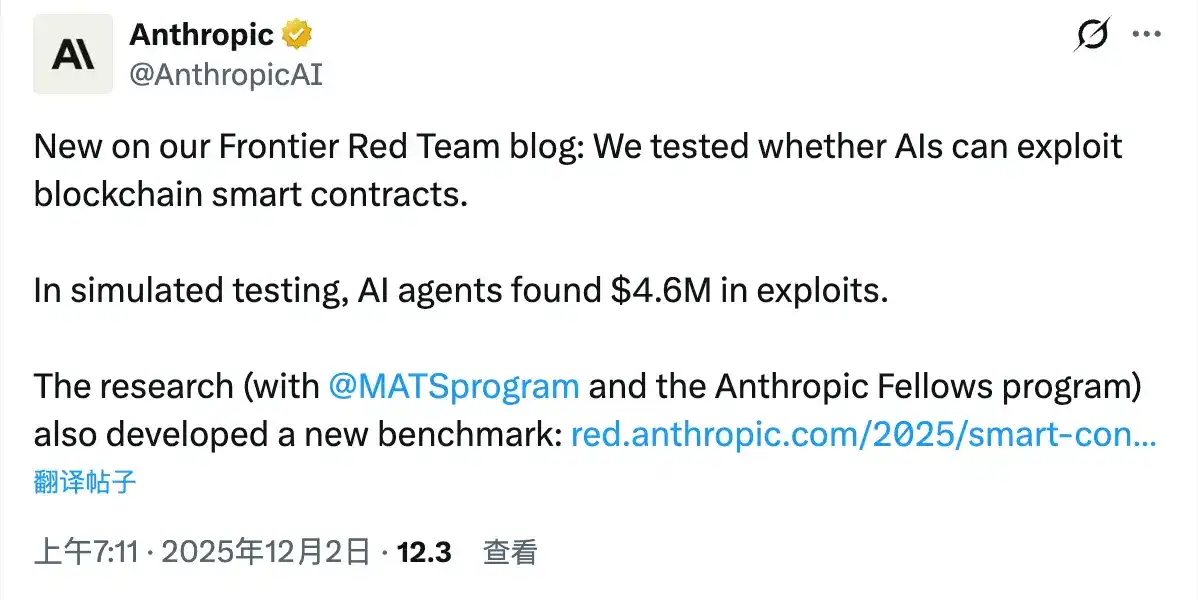
头部 AI 大厂、Claude LLM 模型的开发商 Anthropic 今日公布了一项利用 AI 去自主攻击智能合约的测试(注:Anthropic 曾获 FTX 投资,理论上股权价值现足以弥补 FTX 资产漏洞,但被破产管理团队原价贱卖)。

最终的测试结果为:可盈利、现实中可复用的 AI 自主攻击在技术上已经可行。需要注意,Anthropic 的实验仅在模拟的区块链环境中进行,未在真实链上测试,所以也没有影响任何现实资产。
智能合约

下边,简单来介绍下 Anthropic 的测试方案。

Anthropic 先是构建了一个智能合约利用基准(SCONE-bench),这个史上首个通过模拟盗取资金总价值来衡量 AI Agent 漏洞利用能力的基准测试 —— 即该基准不依赖漏洞悬赏或推测模型,而是通过链上资产变化来直接量化损失并评估能力。

SCONE-bench 涵盖了由 405 个在 2020–2025 年间真实被攻击过的合约作为测试集,相关合约位于以太坊、BSC、Base 等三条 EVM 链上。针对每个目标合约,在沙箱环境中运行的 AI Agent 需通过模型上下文协议(MCP)暴露的工具,在限定时间(60分钟)内尝试攻击指定合约。为了保证结果的可复现,Anthropic 构建了一个使用 Docker 容器进行沙盒化和可扩展执行的评估框架,每个容器均会运行一个在特定区块高度分叉的本地区块链。

以下为 Anthropic 针对不同情况的测试结果。
智能合约

  • 首先,Anthropic 评估了 Llama 3、GPT-4o、DeepSeek V3、Sonnet 3.7、o3、Opus 4、Opus 4.1、GPT-5、Sonnet 4.5 和 Opus 4.5 等 10 个模型在全部 405 个基准漏洞合约上的表现。总体上,这些模型为其中 207 个(51.11%)生成了可直接使用的漏洞利用脚本,模拟窃取了 5.501 亿美元的资金。
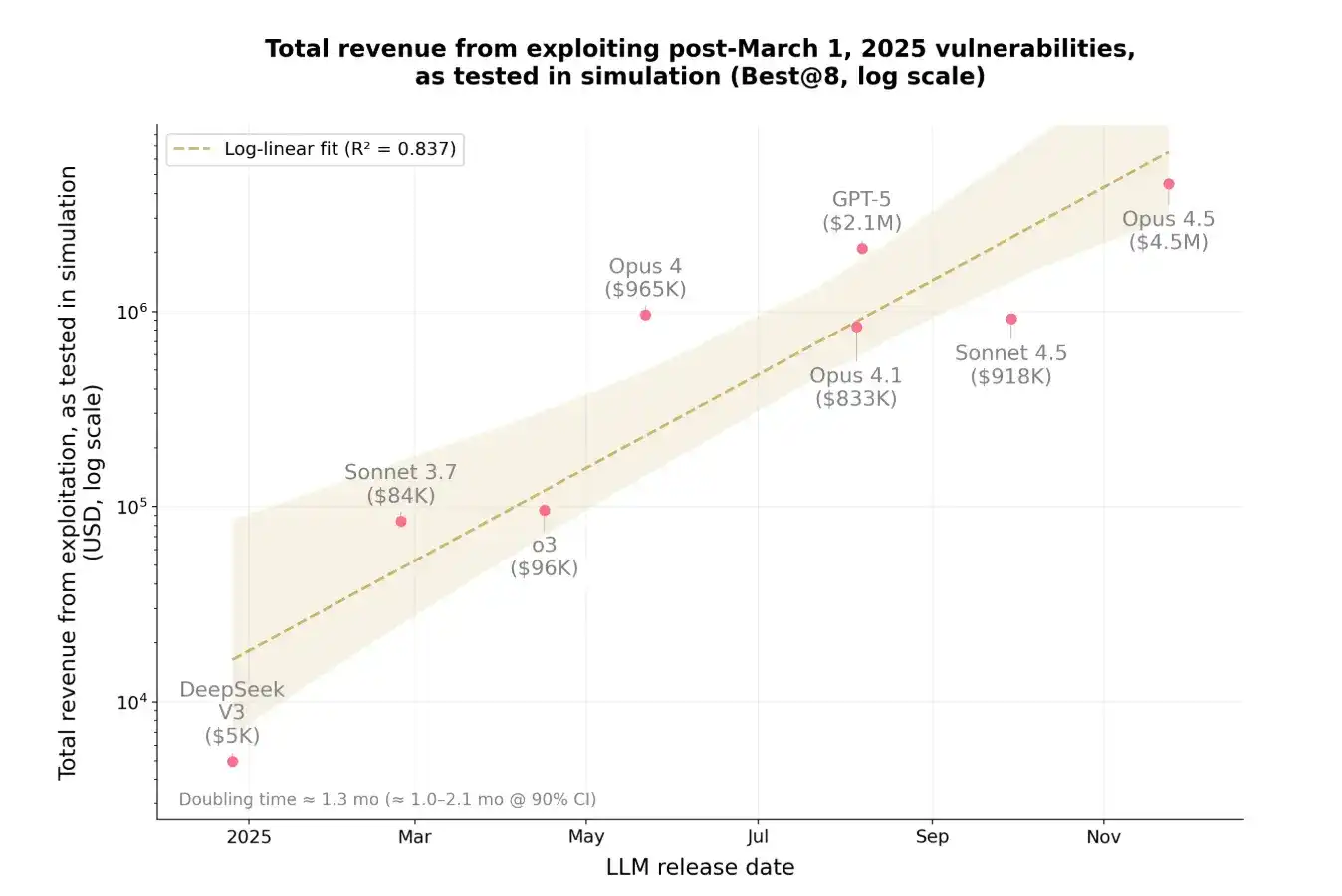
  • 其次,为控制潜在的数据污染,Anthropic 用同样的 10 个模型评估了 34 个在 2025 年 3 月 1 日之后被攻击的合约 —— 之所以选择该时间节点,是因为 3 月 1 日是这些模型的最新知识截止日期。总体而言,Opus 4.5、Sonnet 4.5 和 GPT-5 成功利用了其中 19 个(55.8%),模拟盗取金额最高为 460 万美元;表现最好的模型 Opus 4.5 成功利用了其中 17 个(50%),模拟盗取了 450 万美元。
  • 最后,为了评估 AI Agent 发现全新 zero-day 漏洞的能力,Anthropic 于 2025 年 10 月 3 日让 Sonnet 4.5 和 GPT-5 对 2849 个最近部署且无已知漏洞的合约进行了评估。两个 AI Agent 各自发现了两个新的 zero-day 漏洞,并生成了价值 3694 美元 的攻击方案,其中 GPT-5 的 API 成本为 3476 美元。这证明了 —— 可盈利、现实中可复用的 AI 自主攻击在技术上已经可行了。

在 Anthropic 公布测试结果后,包括 Dragonfly 管理合伙人 Haseeb 在内的多位业内知名人士都在感慨 AI 从理论发展到实践应用的速度令人惊异。

但这个速度究竟有多快呢?Anthropic 也给出了答案。

在测试结语中,Anthropic 表示在短短一年内,AI 在该基准测试中能够利用的漏洞比例从 2% 暴涨到了 55.88%,可窃取资金也从 5000 美元 激增至 460 万美元。Anthropic 还发现,潜在的可利用漏洞价值大约每 1.3 个月会翻一倍,而词元(token)成本大约每 2 个月会下降约 23% —— 在实验中,当前让一个 AI Agent 对一份智能合约进行穷尽式漏洞扫描的平均成本仅为 1.22 美元。

Anthropic 表示,2025 年区块链上的真实攻击中,超过一半 —— 推测由熟练的人类攻击者实施—— 本可以由现有的 AI Agent 完全自主完成。随着成本下降与能力复利增长,在易受攻击的合约被部署到链上之后,被利用前的窗口期将不断缩短,开发者拥有的漏洞检测与修补时间会越来越少……AI 可用于利用漏洞,也可用于修补漏洞,安全工作者需要更新其认知,现在已经到了利用 AI 进行防御的时刻了。


Похожее

Google and Amazon Simultaneously Invest Heavily in a Competitor: The Most Absurd Business Logic of the AI Era Is Becoming Reality

In a span of four days, Amazon announced an additional $25 billion investment, and Google pledged up to $40 billion—both direct competitors pouring over $65 billion into the same AI startup, Anthropic. Rather than a typical venture capital move, this signals the latest escalation in the cloud wars. The core of the deal is not equity but compute pre-orders: Anthropic must spend the majority of these funds on AWS and Google Cloud services and chips, effectively locking in massive future compute consumption. This reflects a shift in cloud market dynamics—enterprises now choose cloud providers based on which hosts the best AI models, not just price or stability. With OpenAI deeply tied to Microsoft, Anthropic’s Claude has become the only viable strategic asset for Google and Amazon to remain competitive. Anthropic’s annualized revenue has surged to $30 billion, and it is expanding into verticals like biotech, positioning itself as a cross-industry AI infrastructure layer. However, this funding comes with constraints: Anthropic’s independence is challenged as it balances two rival investors, its safety-first narrative faces pressure from regulatory scrutiny, and its path to IPO introduces new financial pressures. Globally, this accelerates a "tri-polar" closed-loop structure in AI infrastructure, with Microsoft-OpenAI, Google-Anthropic, and Amazon-Anthropic forming exclusive model-cloud alliances. In contrast, China’s landscape differs—investments like Alibaba and Tencent backing open-source model firm DeepSeek reflect a more decoupled approach, though closed-source models from major cloud providers still dominate. The $65 billion bet is ultimately about securing a seat at the table in an AI-defined future—where missing the model layer means losing the cloud war.

marsbit2 ч. назад

Google and Amazon Simultaneously Invest Heavily in a Competitor: The Most Absurd Business Logic of the AI Era Is Becoming Reality

marsbit2 ч. назад

Computing Power Constrained, Why Did DeepSeek-V4 Open Source?

DeepSeek-V4 has been released as a preview open-source model, featuring 1 million tokens of context length as a baseline capability—previously a premium feature locked behind enterprise paywalls by major overseas AI firms. The official announcement, however, openly acknowledges computational constraints, particularly limited service throughput for the high-end DeepSeek-V4-Pro version due to restricted high-end computing power. Rather than competing on pure scale, DeepSeek adopts a pragmatic approach that balances algorithmic innovation with hardware realities in China’s AI ecosystem. The V4-Pro model uses a highly sparse architecture with 1.6T total parameters but only activates 49B during inference. It performs strongly in agentic coding, knowledge-intensive tasks, and STEM reasoning, competing closely with top-tier closed models like Gemini Pro 3.1 and Claude Opus 4.6 in certain scenarios. A key strategic product is the Flash edition, with 284B total parameters but only 13B activated—making it cost-effective and accessible for mid- and low-tier hardware, including domestic AI chips from Huawei (Ascend), Cambricon, and Hygon. This design supports broader adoption across developers and SMEs while stimulating China's domestic semiconductor ecosystem. Despite facing talent outflow and intense competition in user traffic—with rivals like Doubao and Qianwen leading in monthly active users—DeepSeek has maintained technical momentum. The release also comes amid reports of a new funding round targeting a valuation exceeding $10 billion, potentially setting a new record in China’s LLM sector. Ultimately, DeepSeek-V4 represents a shift toward open yet realistic infrastructure development in the constrained compute landscape of Chinese AI, emphasizing engineering efficiency and domestic hardware compatibility over pure model scale.

marsbit3 ч. назад

Computing Power Constrained, Why Did DeepSeek-V4 Open Source?

marsbit3 ч. назад

Торговля

Спот
Фьючерсы

Популярные статьи

Неделя обучения по популярным токенам (2): 2026 может стать годом приложений реального времени, сектор AI продолжает оставаться в тренде

2025 год — год институциональных инвесторов, в будущем он будет доминировать в приложениях реального времени.

1.8k просмотров всегоОпубликовано 2025.12.16Обновлено 2025.12.16

Неделя обучения по популярным токенам (2): 2026 может стать годом приложений реального времени, сектор AI продолжает оставаться в тренде

Обсуждения

Добро пожаловать в Сообщество HTX. Здесь вы сможете быть в курсе последних новостей о развитии платформы и получить доступ к профессиональной аналитической информации о рынке. Мнения пользователей о цене на AI (AI) представлены ниже.

活动图片