Mastercard and Polygon Roll Out Email-Like Wallet IDs for Easier Crypto Transfers

bitcoinistОпубликовано 2025-11-20Обновлено 2025-11-20

Введение

Mastercard is taking a major step toward simplifying how everyday users interact with digital assets by leveraging the Ethereum and...

Trusted Editorial content, reviewed by leading industry experts and seasoned editors. Ad Disclosure

Mastercard is taking a major step toward simplifying how everyday users interact with digital assets by leveraging the Ethereum and Polygon network.

Related Reading: Hoskinson Vs. Cardano Foundation: From Berlin Parties To ‘Useful Idiots’

Through a new collaboration with Polygon Labs and payments infrastructure firm Mercuryo, the global payments giant is rolling out email-style wallet aliases designed to make crypto transfers feel as intuitive as sending a message online.

The upgrade expands Mastercard’s Crypto Credential program to self-custody wallets, replacing long, technical wallet addresses with human-readable IDs. For millions of users intimidated by complex hexadecimal strings, this shift could mark a turning point in mainstream crypto adoption.
Ethereum ETH Polygon Mastercard

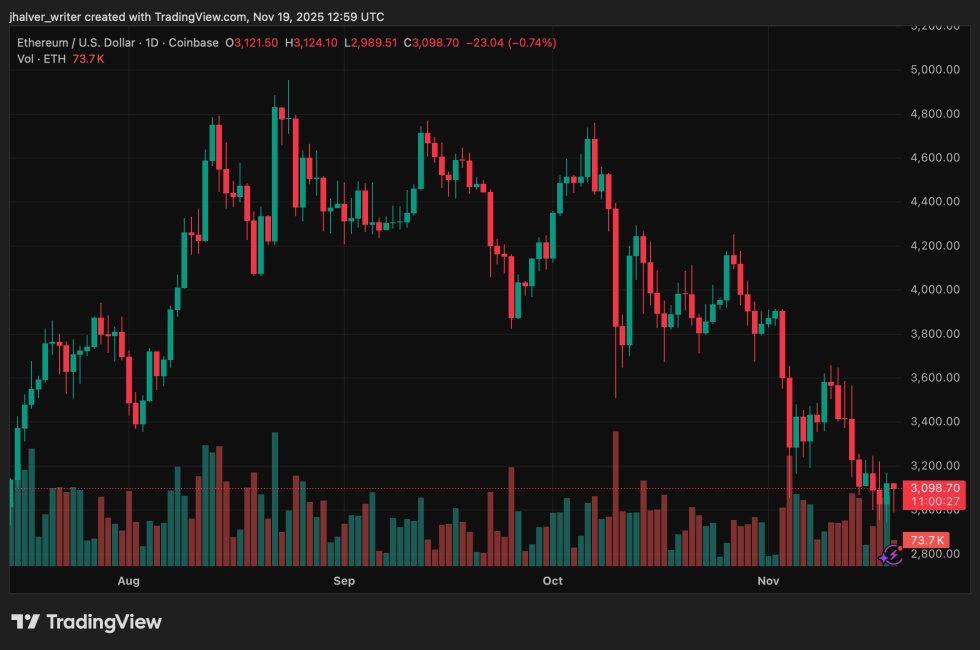
ETH's price trends to the downside on the daily chart. Source: ETHUSD on Tradingview

A New Identity Layer for Self-Custody Wallets

Under the new system, users can link wallets such as MetaMask to a verified alias issued through Mercuryo. After completing standard KYC checks, the user receives a simple username, similar to an email handle, that directs crypto to their self-custody wallet.

Polygon powers the underlying infrastructure, offering low-cost transactions and rapid settlement. Wallets can also mint a non-transferable “soulbound” credential on Polygon, publicly confirming that they belong to a verified user.

Mastercard states that this structure supports regulatory compliance, including Travel Rule requirements, without requiring users to relinquish control of their private keys.

Early access focuses on receiving funds through aliases, with outbound sending expected later. Mastercard notes that this framework is designed as a portable verification layer that can be moved across apps, wallets, and blockchains within the broader Crypto Credential network.

Why Mastercard Picked Polygon for the Rollout

Polygon’s selection as the first supported network reflects its growing reputation as a consumer-grade blockchain built for global-scale payments. Its upgrades, including the Rio and Heimdall v2 updates, have boosted throughput, improved finality, and reduced the risk of chain reorganizations.

With billions of dollars in stablecoin activity flowing through Polygon every month, analysts say the network offers the reliability and low operating costs that large institutions demand.

Polygon Labs CEO Marc Boiron called the initiative “the moment when self-custody becomes simple,” noting that alias-based transfers make blockchain interactions resemble familiar fintech experiences rather than technical workflows.

Shaping the Future of Identity-Driven Web3 Payments

For Mastercard, this rollout aligns with its broader strategy to bridge traditional finance and decentralized networks. The company has been expanding crypto services across 2024 and 2025, from debit card programs to on-chain settlement pilots.

By embedding identity, verification, and user-friendly interfaces into self-custody systems, Mastercard and Polygon are helping shape the next generation of digital payments.

Related Reading: What Happens To The Ethereum Price If It Replicates Bitcoin Supercycle?

If adopted widely, alias-based transfers could redefine how users engage with Web3, lowering barriers and accelerating mainstream participation in blockchain-based finance.

Cover image from ChatGPT, ETHUSD chart from Tradingview

Editorial Process for bitcoinist is centered on delivering thoroughly researched, accurate, and unbiased content. We uphold strict sourcing standards, and each page undergoes diligent review by our team of top technology experts and seasoned editors. This process ensures the integrity, relevance, and value of our content for our readers.

Похожее

Casper Network Publishes the Casper Manifest, a Multi-Year Roadmap to Power Regulated Real-World Assets and the Machine Economy

The Casper Association has published "The Casper Manifest," a multi-year technical roadmap for Casper Network. Introduced at the Digital Finance Forum in Bermuda, the roadmap outlines nine coordinated initiatives designed to position the layer-1 blockchain as the infrastructure for regulated real-world asset (RWA) tokenization and the machine-to-machine economy. Key initiatives focus on: 1. **Developer Access:** Adding full Ethereum Virtual Machine (EVM) compatibility alongside its existing WebAssembly (Wasm) execution layer. 2. **User Experience:** Implementing gasless transactions, batch operations, and smart accounts with biometric authentication. 3. **Institutional Compliance & Privacy:** Building compliant security tokens aligned with the ERC-3643 standard and a multi-phase roadmap for confidential transactions with built-in audit tools. 4. **Machine Economy:** Implementing the X402 open payment standard to enable AI agents and machines to make autonomous, programmatic micropayments. 5. **Token Infrastructure:** Creating a Native Token Registry to give all tokens protocol-level status with fixed, predictable costs. 6. **Quantum Safety:** Developing hybrid accounts with both classical and quantum-resistant keys. The first initiative, X402 micropayments, is expected within weeks. Subsequent releases through 2026 and 2027 will include EVM compatibility, compliant security tokens, the Native Token Registry, gasless transactions, and quantum-safe features. The goal is to create a blockchain that is frictionless for users, trusted by institutions, and native for machines.

TheNewsCrypto16 мин. назад

Casper Network Publishes the Casper Manifest, a Multi-Year Roadmap to Power Regulated Real-World Assets and the Machine Economy

TheNewsCrypto16 мин. назад

TechFlow Intelligence: Trump-Linked Companies Transfer $12 Million in Assets Before China Visit, 'The Big Short' Protagonist Warns of Stock Market Bubble Again

The article reports multiple developments across tech, crypto, and finance. In AI, Mozilla used AI for large-scale code review, Google confirmed hackers used AI to find zero-day exploits, and OpenAI deployed GPT-5.5 to find errors in math benchmarks. A court ruled Anthropic's scanning and destroying books for AI training as fair use, while its Claude platform launched on AWS. Google's new video model 'Omni' was leaked. In crypto/Web3, Trump-linked companies transferred $12M in crypto assets before a China visit. BlackRock chose Ethereum for tokenized funds, and a hacker stole $174k via a malicious NFT that tricked an AI. Jack Dorsey's first tweet NFT plummeted from $2.9M to under $5. In chips/hardware, TSMC approved an additional $20B for its Arizona plant. Apple's Tim Cook and Elon Musk will accompany Trump to China, while Nvidia's Jensen Huang is notably absent. For markets, Michael Burry warned of parabolic stock rises and suggested near-total sell-offs, with online discussions comparing current sentiment to the 1999 bubble. Other notes include WTI oil surpassing $100, a 20% price hike for Beijing-Shanghai high-speed rail, and new products like Unitree's $26.9k humanoid robot. The underlying theme suggests AI is becoming infrastructure, creating pressure on old systems while a new order is not yet ready, leaving investors anxious.

marsbit44 мин. назад

TechFlow Intelligence: Trump-Linked Companies Transfer $12 Million in Assets Before China Visit, 'The Big Short' Protagonist Warns of Stock Market Bubble Again

marsbit44 мин. назад

Торговля

Спот
Фьючерсы
活动图片