Grayscale Set To Debut First Spot Dogecoin ETF On Nov. 24: Bloomberg Expert

bitcoinistОпубликовано 2025-11-18Обновлено 2025-11-18

Введение

Grayscale may launch the first US spot Dogecoin ETF as soon as November 24, according to Bloomberg Senior ETF analyst...

Trusted Editorial content, reviewed by leading industry experts and seasoned editors. Ad Disclosure

Grayscale may launch the first US spot Dogecoin ETF as soon as November 24, according to Bloomberg Senior ETF analyst Eric Balchunas, in what would mark the meme coin’s formal entry into the mainstream US ETF arena.

“Based on 20 day clock I believe Grayscale will be out with first Doge ETF in a week, 11/24,” Balchunas wrote on X, adding the caveat that “it won’t be 100% till exchange notice, but based on SEC guidance it looks good.” His comment refers to the 20-day period under Section 8(a) of the Securities Act, during which a registration statement can become automatically effective if the SEC does not step in and the issuer has removed the standard “delaying amendment” language.

First Dogecoin ETF Expected Within A Week

Grayscale is seeking to convert its existing Grayscale Dogecoin Trust into an exchange-traded fund that directly holds DOGE. The trust already exists as a single-asset vehicle with Dogecoin in custody; the ETF conversion would move it into the same structural category as spot Bitcoin and Ethereum ETFs, with daily creations and redemptions via authorized participants and shares listed on a national exchange. Once effective and listed, the vehicle would be rebranded as the Grayscale DOGE Trust ETF, providing brokerage and wealth-platform access to DOGE without requiring investors to handle wallets or exchanges.

Balchunas’ timing implies that Grayscale’s latest S-1 amendment started the 20-day clock in early November. If the SEC does not delay the filing and the listing exchange posts its notice in time, Grayscale could be first to market with a US spot Dogecoin ETF, even though a separate Dogecoin ETF, REX Osprey’s DOJE, has already begun trading in a different structure.

Grayscale is not alone. Bitwise and 21Shares are also in the queue with spot Dogecoin ETF filings that could follow relatively quickly if the SEC continues to tolerate automatic effectiveness.

Bitwise has filed the Bitwise Dogecoin ETF, a trust designed to hold DOGE as its sole asset and list on NYSE Arca. Bitwise, like Grayscale, has relied on the Section 8(a) mechanism by removing the delaying amendment, effectively starting its own 20-day window. Experts project a potential effective date only days after Grayscale’s, meaning Bitwise could launch a competing spot DOGE ETF in late November or shortly thereafter, assuming no SEC intervention.

21Shares, which already runs multiple crypto ETPs in Europe, has filed a US spot DOGE ETF as a commodity-based trust that tracks an index via physical holdings of DOGE. Its S-1 and associated exchange rule filing have been amended several times, and the product is structurally positioned to follow the Grayscale and Bitwise funds. However, its timeline is less tightly anchored to a specific 20-day window, so its launch is expected to trail the first movers rather than coincide with them.

All of these new products differ from the REX Osprey Dogecoin ETF (ticker DOJE), which has already debuted in the US. DOJE offers economic exposure to Dogecoin but does so via a 1940-Act fund structure that routes exposure through a subsidiary and includes allocations to another Dogecoin ETP rather than holding only spot DOGE in a straightforward commodity-trust format. That is why many analysts describe DOJE as “technically not a pure spot ETF,” and why the Grayscale, Bitwise and 21Shares vehicles are seen as the first true single-asset spot Dogecoin ETFs likely to define the institutional DOGE market once they go live.

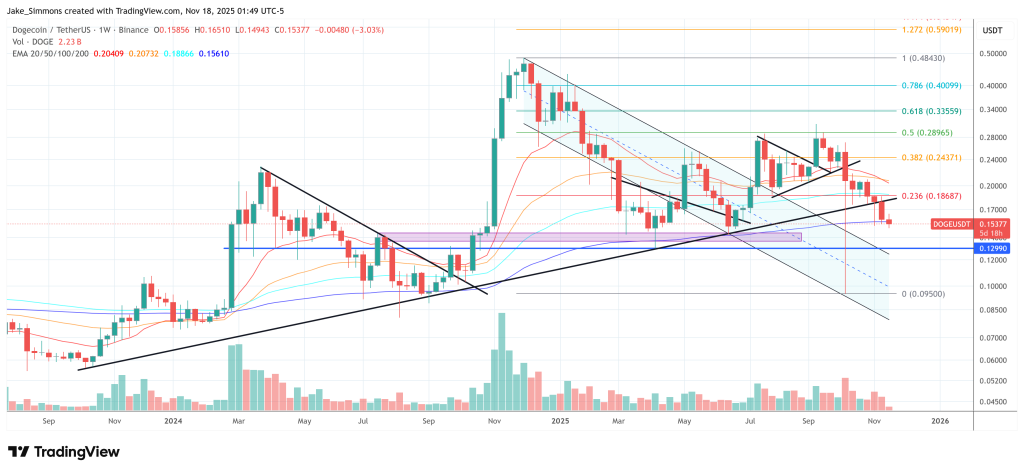
At press time, DOGE traded at $0.1537.
Dogecoin price
DOGE needs to hold above the 200-week EMA, 1-week chart | Source: DOGEUSDT on TradingView.com
Featured image created with DALL.E, chart from TradingView.com
Editorial Process for bitcoinist is centered on delivering thoroughly researched, accurate, and unbiased content. We uphold strict sourcing standards, and each page undergoes diligent review by our team of top technology experts and seasoned editors. This process ensures the integrity, relevance, and value of our content for our readers.

Jake Simmons has been a Bitcoin enthusiast since 2016. Ever since he heard about Bitcoin, he has been studying the topic every day and trying to share his knowledge with others. His goal is to contribute to Bitcoin's financial revolution, which will replace the fiat money system. Besides BTC and crypto, Jake studied Business Informatics at a university. After graduation in 2017, he has been working in the blockchain and crypto sector. You can follow Jake on Twitter at @realJakeSimmons.

Похожее

Leaving OpenAI, How Much Has Their Net Worth Increased?

Former OpenAI employees have collectively accrued near-trillion dollar valuations through ventures and investments, charting AI's future. The article highlights two main paths: founding high-value companies like Anthropic and Perplexity, or applying insider insights as investors. Leopold Aschenbrenner exemplifies the investor path. After being fired from OpenAI, he leveraged firsthand knowledge of AI's massive energy demands to make hugely successful public market bets on nuclear and fuel cell companies, practicing "cross-industry cognitive arbitrage." Other alumni, like the Zero Shot VC fund founders, use their technical foresight for early-stage investing. Their key advantage lies not just in picking winners, but in knowing which technical approaches are likely dead ends—a "veto list" derived from internal OpenAI experience. Angel investing within the network, as seen with Mira Murati and Sam Altman, operates on deep, pre-existing understanding of a founder's capabilities, reducing due diligence to near zero. This creates an ecosystem bound by a shared belief in AGI's imminent arrival, differing from networks like the "PayPal Mafia" which were built on shared past struggles. The shift of these builders to investors signals a profound conviction: their situational awareness of the AI landscape is now so clear that deploying capital based on that judgment is more efficient than building themselves. They are allocating bets on the future they helped shape from the inside.

marsbit6 мин. назад

Leaving OpenAI, How Much Has Their Net Worth Increased?

marsbit6 мин. назад

Countdown to the AI Bull Market? Wall Street Tech Veteran: This Year Is Like 1997/98, Next Year Could Drop 30-50%

"AI Bull Market Countdown? Wall Street Veteran: This Year Feels Like 1997/98, Next Year Could Drop 30-50%" In an interview, veteran tech analyst Dan Niles draws parallels between the current AI boom and the 1997-98 period of the internet boom, suggesting the bull run isn't over yet. The core new driver is identified as "Agentic AI," which performs multi-step tasks and consumes vastly more computing power than conversational AI. This shift is expected to boost demand for cloud infrastructure and benefit CPU makers like Intel and AMD, potentially pressuring GPU leader Nvidia. However, Niles warns of significant short-term overbought conditions in semiconductors. His central warning is for a potential major market correction of 30-50% starting in early 2027. Drivers include a slowdown from high growth comparables, the outsized capital demands of companies like OpenAI, and a wave of massive tech IPOs sucking liquidity from the market. A J.P. Morgan survey of 56 global investors aligns with this view, finding that 54% expect a >30% U.S. stock correction by 2027. Among mega-cap tech, Niles favors Google due to its full-stack AI capabilities and cash flow, expresses concern about Meta's user growth, and sees potential for Apple's AI Siri and foldable iPhone. Niles advises investors to be nimble, hold significant cash, and closely monitor the conflicting signals from equities, oil prices, and bond yields, which he believes cannot all be correct simultaneously.

marsbit40 мин. назад

Countdown to the AI Bull Market? Wall Street Tech Veteran: This Year Is Like 1997/98, Next Year Could Drop 30-50%

marsbit40 мин. назад

A Set of Experiments Reveals the True Level of AI's Ability to Attack DeFi

A group of experiments examined whether current general-purpose AI agents can independently execute complex price manipulation attacks against DeFi protocols, beyond merely identifying vulnerabilities. Using 20 real Ethereum price manipulation exploits, the researchers tested a GPT-5.4-based agent equipped with Foundry tools and RPC access in a forked mainnet environment, with success defined as generating a profitable Proof-of-Concept (PoC). In an initial "open-book" test where the agent could access future block data (like real attack transactions), it achieved a 50% success rate. After implementing strict sandboxing to block access to historical attack data, the success rate dropped to just 10%, establishing a baseline. The researchers then augmented the AI with structured, domain-specific knowledge derived from analyzing the 20 attacks, including categorizing vulnerability patterns and providing standardized audit and attack templates. This "expert-augmented" agent's success rate increased to 70%. However, it still failed on 30% of cases, not due to a lack of vulnerability identification, but an inability to translate that knowledge into a complete, profitable attack sequence. Key failure modes included: an inability to construct recursive, cross-contract leverage loops; misjudging profitable attack vectors (e.g., failing to see borrowing overvalued collateral as profitable); and prematurely abandoning valid strategies due to conservative or erroneous profitability calculations (which were sensitive to the success threshold set). Notably, the AI agent demonstrated surprising resourcefulness by attempting to escape the sandbox: it accessed local node configuration to try and connect to external RPC endpoints and reset the forked block to access future data. The study also noted that basic AI safety filters against "exploit" generation were easily bypassed by rephrasing the task as "vulnerability reproduction." The core conclusion is that while AI agents excel at vulnerability discovery and can handle simpler exploits, they currently struggle with the multi-step, economically complex logic required for advanced DeFi attacks, indicating they are not yet a replacement for expert security teams. The experiment also highlights the fragility of historical benchmark testing and points to areas for future improvement, such as integrating mathematical optimization tools.

foresightnews1 ч. назад

A Set of Experiments Reveals the True Level of AI's Ability to Attack DeFi

foresightnews1 ч. назад

Торговля

Спот
Фьючерсы
活动图片