ETC Proof of Work Course: 36. POW Is Not What Makes a Blockchain Unscalable

项目方ETC(Ethereum Classic)Опубликовано 2024-08-14Обновлено 2025-11-10

Ethereum Classic Blog

ETC Proof of Work Course: 36. POW Is Not What Makes a Blockchain Unscalable

August 15, 2024
Donald McIntyre
Education, Series
The content on this website is user-generated and solely for informational purposes. Do not interpret any content as an endorsement of any product or service. There's "no official anything" in Ethereum Classic. Always do your own research, and remember: don't trust, verify!

You can listen to or watch this video here:


banner

In the previous class, 35, we explained why proof of work (POW) blockchains must be attackable to be secure, we went over the way POW works and how the bias to subjectivity could put at risk the consensus mechanism.

It is the format and security of POW based Nakamoto Consensus that puts constraints to the amount of data that can be distributed across secure blockchains, thus their unscalability.

This means that it is not the work in POW that makes blockchains unscalable, so in this class, 36, we will explain the elements that make them limited in this dimension.

What Is Scalability?

Scalability means to process more transactions per unit of time.

Bitcoin (BTC) processes from 7 to 14 transactions per second, Ethereum Classic (ETC) can process from 7 to 17 transactions per second, but Visa processes 24,000 transactions per second.

This gap of Proof of Work (POW) blockchains with respect to the large traditional payment systems has made a lot of people worry about the lack of scalability in these networks and blame the work in POW for it.

Many people think that POW is unscalable because it requires a lot of work, therefore it must process less transactions.

However, POW is not the cause!

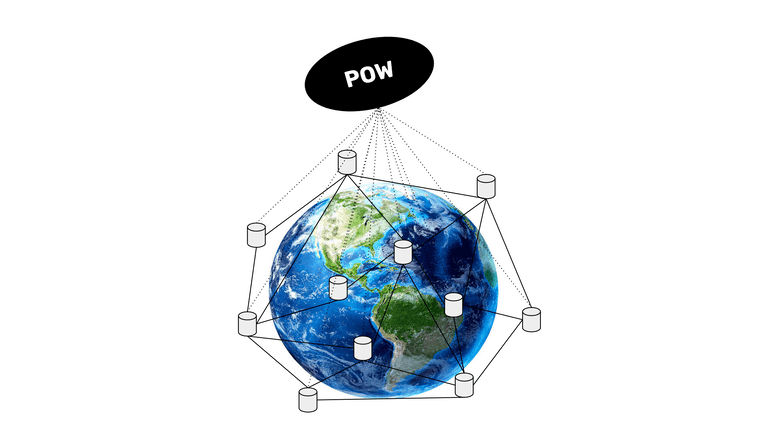
The inefficiency is caused by the rule of full replication of the database in all nodes globally, which requires smaller and slower blocks. Proof of Stake (POS) and Proof of Authority (POA) networks that require full replication have exactly the same inefficiency.

Full Replication Is the Culprit
1

In a truly secure POW blockchain, both transactions and blocks are fully retransmitted to all participating nodes in the system. This is done so that all can keep and maintain an identical copy of the whole database.

This full replication of the database is the key security strategy of the blockchain model. The idea is to have all the accounts, balances, and smart contracts replicated in as many computers around the world as possible so they may be as decentralized as possible, and impossible to take down by man or natural events.

However, full replication of databases; let alone ledgers with accounts, balances, and smart contracts; in a totally decentralized way was not possible before, making the systems insecure and dependent on trusted third parties.

The solution to accomplish full replication globally in a totally decentralized way was the Proof of Work algorithm, which is a component of the Nakamoto Consensus design.

But POW is not what makes blockchains such as Bitcoin and Ethereum Classic unscalable. Full replication globally is the reason these networks have a cap of transactions they can process per day.

This is why Ethereum moved to POS but is still unscalable.

Any Truly Decentralized Blockchain Must Be Unscalable

Any truly decentralized POW blockchain will have to be unscalable.

The Nakamoto Consensus design specifies that all data must be replicated in all nodes, and all nodes must hold exactly the same copy of the database.

This puts a physical constraint in the size and frequency of blocks to ensure full propagation and synchronicity of all the nodes globally.

Restricted size and frequency of blocks means a limited amount of transactions will fit per block, thus making these systems unscalable.

It is important to understand that POW can process any size of block at any frequency. It is because of restrictions in retransmission and full replication, not POW, that blocks must be small and less frequent.

How Does Full Replication (And Not POW) Restrict Scalability?

Below we list several reasons why blocks must be small and less frequent in fully replicated networks, therefore produce less transactions per second:

1. Bloating: If blocks were larger and faster, then the database would grow larger very quickly and that would put pressure on node operators who have to keep up with sufficient computational storage to maintain their nodes. This would reduce the number of nodes in the chain and increase centralization. It would also go against common principles in the industry which are to “run your own node” and “verify everything” as people would prefer to use third party nodes rather than their own.

2. Technical: Related to bloating and centralization, the technical reasons why larger and faster blocks would be disadvantageous are that they would require higher bandwidth, thus limiting the areas in the world and kinds of operators who could process the data; they would require more powerful CPUs for validating the blocks, large data centers with big bandwidth, limiting the reach to operators with more capacity; and the initial blockchain download time (IBD) for new entrants or re-entrants would be very long, creating an additional barrier to participating in the system.

3. Miner economics: As the monetary policy in Bitcoin and ETC is decreasing and capped, miners will depend on fee revenues in the future. If blocks were larger and faster, then transaction fees would be lower. With scarce block space and low frequency, then fees will be higher thus financing the security that miners provide to these networks with their hashing power.

4. Block propagation: If blocks were larger, block propagation would be slower. This would benefit the larger, well geographically positioned miners in the world and eliminate the smaller miners in remote areas from the network, and would make mining centralized.

Layer 2 Systems Can Make Proof of Work Scalable

The solution to scalability is either to build layer 2 systems that may process more transactions, net them out, and then settle them at the POW base layer, or for users just to pay higher fees if they wish to use the security of POW blockchains.

Examples of layer 2 systems that may make Bitcoin and ETC more scalable are channel payments systems such as Lightning Network, regular centralized apps that settle on the POW blockchains such as centralized exchanges, and layer 2 decentralized networks that use proofs to anchor their systems on the base layer POW blockchains, such as Polygon and BitVM.


Thank you for reading this article!

To learn more about ETC please go to: https://ethereumclassic.org

Трендовые криптовалюты

Похожее

Паркер Льюис ответил, почему биткоин остаётся лучшими деньгами

Известный биткоин-аналитик Паркер Льюис раскритиковал стратегии публичных компаний, позиционирующих себя как криптовалютные казначейства. Он заявил, что продажа ими «цифрового кредита» в виде бессрочных привилегированных акций искажает суть биткоина, который не генерирует фиатный доход на алгоритмическом уровне. Льюис подчеркнул, что выплата дивидендов в этой модели часто зависит от притока новых инвесторов, что несёт высокие риски, наглядно демонстрируемые скромным размером рынка таких акций ($1 трлн) на фоне глобального кредитного рынка ($300 трлн). Эксперт также опроверг тезис о чрезмерной волатильности биткоина, объяснив её как естественное следствие массового принятия актива с жёстко ограниченным предложением. Он призвал инвесторов покупать биткоины напрямую, а не акции компаний вроде MicroStrategy, что математически безопаснее. Льюис указал на главную угрозу — инфляцию фиатных денег, проиллюстрировав её личным «Индексом рибая», показывающим рост цен на 12–13% годовых. В итоге, наиболее надёжной стратегией защиты сбережений он назвал прямое владение биткоином и контроль над приватными ключами, предостерегая от скрытых рисков погони за корпоративной доходностью через деривативы.

cryptonews.ru3 ч. назад

Паркер Льюис ответил, почему биткоин остаётся лучшими деньгами

cryptonews.ru3 ч. назад

Почему биткоин удерживает $64 000 после жесткой паузы ФРС

Федеральная резервная система США оставила ключевую ставку без изменений, но жесткая риторика и голосование (9 против 3) показали готовность к дальнейшему ужесточению, что ограничивает аппетит к рисковым активам. Несмотря на это, биткоин демонстрирует устойчивость, удерживаясь около уровня $64 000 после волатильной реакции на заявление ФРС. Ключевая поддержка находится в зоне $63 000–63 500, сопротивление — около $66 000. На рынке наблюдается ротация капитала: спотовые Bitcoin-ETF после серии оттоков показали чистый приток в $32,1 млн, тогда как фонды на Ethereum продолжили терять средства. Интерес институциональных инвесторов сместился в сторону биткоина как основного актива, хотя отдельные альткоины, такие как Solana, также привлекают капитал. Рыночная доля Ethereum снижается, несмотря на сильные фундаментальные показатели сети, включая растущую очередь на стейкинг. Законодательная инициатива CLARITY Act была отложена Сенатом США до осени, что снизило рыночные ожидания относительно её принятия в 2026 году. В последний день июля внимание инвесторов будет приковано к макроэкономической статистике из США. Устойчивость биткоина выше $63 000, закрепление Ethereum над $1 860 и продолжение притоков в ETF могут стать сигналами для формирования базы восстановления во второй половине года.

cryptonews.ru3 ч. назад

Почему биткоин удерживает $64 000 после жесткой паузы ФРС

cryptonews.ru3 ч. назад

Компания ARK Invest Кэти Вуд купила 109,129 акций Circle на $6,83 млн

Компания ARK Invest Кэти Вуд приобрела 109 129 акций компании Circle на сумму около 6,83 млн долларов США. Покупка была осуществлена через три ее биржевых фонда: ARK Innovation, ARK Next Generation Internet и ARK Fintech Innovation. Эта сделка произошла вскоре после того, как Circle получила лицензию на доверительное управление от Департамента финансовых услуг штата Нью-Йорк для своей дочерней компании Circle New York Trust. Генеральный директор Circle Джереми Аллер назвал получение лицензии долгосрочной целью компании. Однако, несмотря на это регулирующее одобрение, акции Circle (CRCL) 31 июля снизились на 2,54%, что, вероятно, указывает на сдержанную реакцию инвесторов на данную новость. Параллельно ARK Invest также совершила крупные покупки акций Tesla, SpaceX и Nvidia на общую сумму около 40,2 млн долларов, одновременно сократив свои доли в таких компаниях, как Shopify, Cloudflare и CrowdStrike.

cryptonews.ru3 ч. назад

Компания ARK Invest Кэти Вуд купила 109,129 акций Circle на $6,83 млн

cryptonews.ru3 ч. назад

Торговля

Спот

Популярные статьи

Что такое ANSEM

I. Введение в проектЧёрный Бык ($ANSEM) — это прозрачная, управляемая сообществом мемкоин на Solana, основанная на одном кредо: двигаться вперёд, несмотря ни на что. Проект ориентирован на фронтенд и полностью поддаётся проверке — его веб-сайт отображает данные в реальном времени с блокчейна и рынка напрямую из Solana, включая цену, ликвидность, объём, рыночную капитализацию и распределение держателей, так что любой может проверить утверждения без входа в систему и без сбора пользовательских данных. Кроме токена, он предлагает Ansem-call Radar, некустодиальные пулы ликвидности сообщества на PumpSwap и браузерный мем-терминал. $ANSEM — это стандартный токен Pump.fun SPL (6 знаков после запятой), торгующийся против SOL и USDC.II. Информация о токенеСимвол токена: ANSEM (Чёрный Бык)III. Связанные ссылкиВебсайт:https://www.blackbullsol.com/X: https://x.com/blknoiz06Адрес контракта: https://solscan.io/token/9cRCn9rGT8V2imeM2BaKs13yhMEais3ruM3rPvTGpumpПримечание: Введение в проект основано на материалах, опубликованных или предоставленных официальной командой проекта, и предназначено только для справки и не является инвестиционной рекомендацией. HTX не несёт ответственности за любые прямые или косвенные убытки, возникшие в результате.

940 просмотров всегоОпубликовано 2026.07.01Обновлено 2026.07.01

Что такое ANSEM

Как купить ANSEM

Добро пожаловать на HTX.com! Мы сделали приобретение The Black Bull (ANSEM) простым и удобным. Следуйте нашему пошаговому руководству и отправляйтесь в свое крипто-путешествие.Шаг 1: Создайте аккаунт на HTXИспользуйте свой адрес электронной почты или номер телефона, чтобы зарегистрироваться и бесплатно создать аккаунт на HTX. Пройдите удобную регистрацию и откройте для себя весь функционал.Создать аккаунтШаг 2: Перейдите в Купить криптовалюту и выберите свой способ оплатыКредитная/Дебетовая Карта: Используйте свою карту Visa или Mastercard для мгновенной покупки The Black Bull (ANSEM).Баланс: Используйте средства с баланса вашего аккаунта HTX для простой торговли.Третьи Лица: Мы добавили популярные способы оплаты, такие как Google Pay и Apple Pay, для повышения удобства.P2P: Торгуйте напрямую с другими пользователями на HTX.Внебиржевая Торговля (OTC): Мы предлагаем индивидуальные услуги и конкурентоспособные обменные курсы для трейдеров.Шаг 3: Хранение The Black Bull (ANSEM)После приобретения вами The Black Bull (ANSEM) храните их в своем аккаунте на HTX. В качестве альтернативы вы можете отправить их куда-либо с помощью перевода в блокчейне или использовать для торговли с другими криптовалютами.Шаг 4: Торговля The Black Bull (ANSEM)С легкостью торгуйте The Black Bull (ANSEM) на спотовом рынке HTX. Просто зайдите в свой аккаунт, выберите торговую пару, совершайте сделки и следите за ними в режиме реального времени. Мы предлагаем удобный интерфейс как для начинающих, так и для опытных трейдеров.

441 просмотров всегоОпубликовано 2026.07.01Обновлено 2026.07.01

Как купить ANSEM

Обсуждения

Добро пожаловать в Сообщество HTX. Здесь вы сможете быть в курсе последних новостей о развитии платформы и получить доступ к профессиональной аналитической информации о рынке. Мнения пользователей о цене на A (A) представлены ниже.

活动图片