Bitcoin Hyper’s ($HYPER) $24.6M Presale Surges as FOMO Draws in Investors

bitcoinistОпубликовано 2025-10-23Обновлено 2025-10-23

Введение

Quick Facts: 1️⃣ Bitcoin Hyper’s presale reaches $24.6M as investors feel the FOMO moving into Q4. 2️⃣ As Bitcoin’s upcoming...

Trusted Editorial content, reviewed by leading industry experts and seasoned editors. Ad Disclosure

Quick Facts:

1️⃣ Bitcoin Hyper’s presale reaches $24.6M as investors feel the FOMO moving into Q4.
2️⃣ As Bitcoin’s upcoming Layer-2 solution, Hyper promises faster and cheaper transactions for a more performant and scalable Bitcoin ecosystem.
3️⃣ $HYPER has a projected release window of between Q4 2025 and Q1 2026, depending on market conditions and demand.
4️⃣ Whales are making a presale splash, signaling strong investor interest.

Bitcoin Hyper’s presale has reached $24.6M+ and it’s growing fast, following a FOMO-driven surge in investors.

But what’s drawing everyone to Bitcoin Hyper ($HYPER)?

Bitcoin Hyper is the Layer-2 that promises to upgrade the Bitcoin ecosystem to Solana-grade numbers, removing the fee-based priority system, and allowing for faster and cheaper transactions.

In turn, this will make the network more scalable, which is likely to bring in more institutional and retail users, and catapult the ecosystem into the mainstream.

This would be a much-needed change to a network choked by its performance cap of seven transactions per second (TPS) – the reason why Bitcoin currently ranks a dismal 23rd in terms of blockchain performance.

Bitcoin’s current 23rd ranking on the list of the fastest blockchains by TPS.
Source: Chainspect

So, how exactly will Hyper change Bitcoin’s biggest pain points?

Bitcoin’s Problem and Why TPS Matters

The TPS cap is responsible for several problems within the Bitcoin environment, the most obvious one being the long confirmation queues, increasing finality times to hours during high-traffic periods.

Naturally, the free market found a workaround in the form of the fee-based priority system. Essentially, since users compete for limited block space, miners started prioritizing larger transactions with higher fees, leaving the smaller and cheaper ones at the bottom.

During high-traffic windows, small transactions can take hours to go through, which explains why the network hasn’t yet penetrated the mainstream.

According to data from Ethereum Foundation, Ethereum is the largest ecosystem for active developers in 2025. Solana is second and Bitcoin comes third. And it’s not even close, as Ethereum outweighs Bitcoin by a factor of 3:1.

The top 10 ecosystems by active developers in 2025, with Bitcoin in the third spot.
Source: Ethereum Foundation

Chainspect’s data looks even grimmer, with Solana leading the list and Bitcoin sitting at the 11th spot in terms of crypto dev activity in 2025.

The conclusion is obvious: the limited TPS bottlenecks the network, such that Bitcoin transactions take longer and are, therefore, more expensive than they need to be.

The Lightning Network was one of the first serious attempts at correcting the problem, focusing primarily on transaction speed, which would’ve inadvertently reduced costs as well.

Unfortunately, it failed to achieve its goals. The reasons were multiple, including bugs, routing failures due to insufficient liquidity and channel imbalances, and even security problems.

Then there’s the fact that the network’s fees are route-dependent, which often leads to errors like failed payments or, even worse, overpayments.

Other Layer-2s failed for reasons of their own.

  • The Liquid Network, for instance, did increase transaction speed, but relied on a more centralized model, which increased risks of censorship.
  • Fractal Bitcoin failed due to requiring miners to devote their hashing power to Fractal instead of Bitcoin, essentially encouraging them to leave the Bitcoin network.
  • SatoshiVM promised massive scalability and improved security, but its Bool Network bridge was managed and upgradeable by a single account, which introduced massive centralization and posed extreme security risks.

It was time for something new – and that’s how Bitcoin Hyper came to be.

How Bitcoin Hyper Works

Bitcoin Hyper ($HYPER) aims to make Bitcoin faster, cheaper, more scalable, and more performant across the board.

To that end, the project will rely on tools like Solana Virtual Machine (SVM) and the Canonical Bridge to speed up execution and transaction times – and keep costs low.

The SVM will address the same problem Rootstock attempts to: Bitcoin’s lagging smart contract execution. Unlike Rootstock, though, the SVM has already proven its capabilities in the Solana ecosystem, showcasing a TPS in the thousands.

The SVM is a direct competitor to the Ethereum Virtual Machine (EVM), built specifically for high throughput and increased agility, allowing for the ultra-fast execution of DeFi apps and smart contracts.

The Canonical Bridge, on the other hand, will address Bitcoin’s capped TPS by bridging the Hyper and Bitcoin ecosystems. This will allow the Canonical Bridge to mint your Bitcoins directly onto the Hyper layer, as soon as the Bitcoin Relay Program confirms the transaction details.
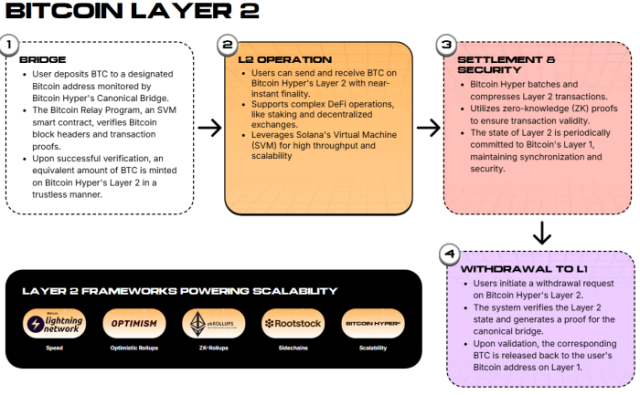
How Hyper’s Canonical Bridge works.

Your wrapped bitcoins will be available for use within the Hyper layer, or until you decide to withdraw them back to Bitcoin’s Layer-1.

Together with SVM, the Canonical Bridge eliminates the fee-based priority system, reduces transaction times to seconds, and lowers transaction costs considerably.

If implemented successfully, Bitcoin Hyper could transform Bitcoin into an ultra-performant network with near-instant finality and vastly increased scalability.

This would catapult the ecosystem at the forefront of the adoption scale and welcome larger institutional investors.

Until that happens, though, Hyper first needs to complete its presale – and things are looking good.

Should You Invest in Bitcoin Hyper’s Presale?

The Bitcoin Hyper’s ($HYPER) presale reached $24.6M+ in just a few months after its launch, making it one of the best crypto presales of 2025.

🐳 That’s thanks – in part – to a significant amount of whale activity. We’re talking the likes of $379.9K, $274K, and $180.6K whale buys, among many others, including yesterday’s $11.3K. That right there shows strong investor interest in this project’s utility-packed proposal.

$HYPER is selling at the presale price of $0.013155 right now and comes with a dynamic staking APY of 48%. Our step-by-step guide to buying Bitcoin Hyper can help get you started if you’re thinking of joining the presale.
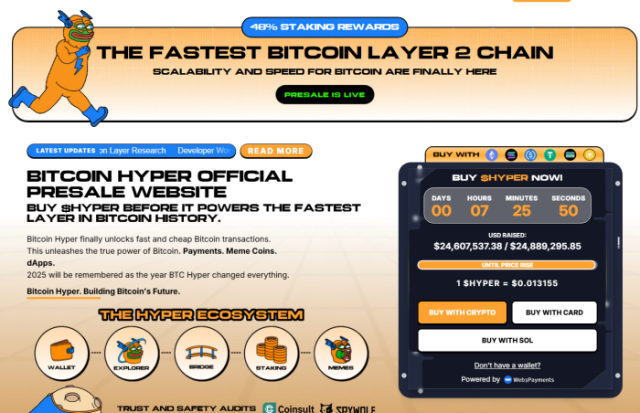
Bitcoin Hyper’s presale data

On that note, if you want to invest, now may be the right time, given that the market is preparing for a bullish November.

Moreover, $HYPER targets a release window between Q4 2025 and Q1 2026, depending on the ‘prevailing market conditions and demand’.

Based on the presale’s momentum, long-term potential, and investor participation, we expect $HYPER to rally once the post-launch cash-in fever has died out.

💰 Our price prediction for $HYPER is a potential $1.50 by 2030, which would reward you with an 11,302% ROI if you bought your tokens at today’s price.

Bear in mind, though, that presale prices go up in stages, while the staking APY lowers as more holders stake their tokens. And with the next price increase expected by tomorrow, the clock is ticking.

Join the $HYPER presale before the next price hike.

Disclaimer: This isn’t financial advice. Always do your own research and invest wisely.

Authored by Bogdan Patru, Bitcoinist – https://bitcoinist.com/bitcoin-hyper-presale-24m-surges

Editorial Process for bitcoinist is centered on delivering thoroughly researched, accurate, and unbiased content. We uphold strict sourcing standards, and each page undergoes diligent review by our team of top technology experts and seasoned editors. This process ensures the integrity, relevance, and value of our content for our readers.

As a crypto writer, Bogdan’s responsibilities are split between researching and writing articles and entertaining the team with his humor bordering on the politically incorrect, an aspiring Bill Burr, if you will. Thanks to his 12+ years of writing experience in just as many fields, including tech, cybersecurity, modelling, fitness, crypto, and other topics-that-shall-not-be-named, he's become a genuine asset to the team. While his position as a senior writer at PrivacyAffairs thought him valuable lessons about the power of self-management, his entire writing career was and is an exercise in self-improvement. Now, he's ready to sink his teeth into crypto and teach people how to take control of their own money on the blockchain. With fiat as an eternally devaluing currency, Bitcoin and altcoins seem like the best-fitting alternative for Bogdan. Bogdan’s biggest professional accomplishment, aside from securing a position as a main writer for Bitcoinist, was his 5-year run as a writing manager at Blackwood Productions, where he coordinated a team of four writers. During that time, he learned the value of teamwork and that of creating a working environment that breeds efficiency, positivity, and friendship.

Похожее

Bitroot Public Chain Invited to Attend Tencent Cloud Singapore AI Conference, Discussing the Future Alongside Solana

On May 19, Bitroot, an emerging Layer 1 blockchain, participated in the Tencent Cloud AI Summit in Singapore alongside key industry players like Solana Foundation. The event explored the intersection of AI infrastructure, enterprise applications, AI Agents, and Web3. Bitroot's invitation, despite being pre-mainnet, highlights industry interest in its focus on high-performance, AI-native architecture tailored for future AI Agent execution and verifiable on-chain automation. Bitroot CEO Juan Jose emphasized that AI competition is shifting from model performance to data, real-world application scenarios, and trust infrastructure. He argued that for AI Agents to evolve from assistants to autonomous executors managing transactions and assets, they require low-latency, low-cost, and high-throughput blockchain environments. Bitroot aims to address this through its EVM-compatible design, optimistic parallel execution, and a consensus mechanism targeting high scalability. Currently in its Testnet 5.0 phase, Bitroot reports metrics like over 50,000 peak TPS and sub-0.3 second average block time. Its narrative positions it within a growing landscape where next-generation Layer 1s like Monad and Aptos also compete on performance, while Bitroot differentiates by integrating AI computational capabilities natively across its stack. The summit underscored that the fusion of AI and Web3 is moving from concept to infrastructure competition, where networks balancing performance, security, and verifiability will be crucial for enabling scalable AI-driven applications.

marsbit54 мин. назад

Bitroot Public Chain Invited to Attend Tencent Cloud Singapore AI Conference, Discussing the Future Alongside Solana

marsbit54 мин. назад

Hedge Fund Q1 Interpretation: Everyone Is Selling Software, Buying Chips

Hedge Funds and Mutual Funds Aligned in Q1: Dumping Software, Buying Chips A clear consensus emerged among major U.S. hedge funds and mutual funds in Q1: they were simultaneously selling software stocks and pouring capital into the semiconductor sector. This aggressive rotation pushed semiconductor exposure in hedge fund long portfolios to a record high. Hedge funds delivered a 7% return year-to-date, while only 30% of large-cap active mutual funds outperformed their benchmarks. The average short interest for S&P 500 constituents rose to 3% of market cap, the highest since 2011. Within technology, the structural shift was stark. Hedge funds' semiconductor weighting hit an all-time high, while software fell to its lowest since 2019. Excluding Microsoft, mutual funds' relative overexposure to semis vs. software was the largest since 2012. Microsoft was among the most net-sold stocks by both groups. Hedge funds net purchased semiconductor names like LRCX and AMAT. Strategies diverged on leverage and cash. Hedge funds increased their net exposure to near a one-year high after an initial cut. Mutual funds raised their cash allocation, though it remains historically low at 1.4%. Sector alignment was high in Industrials (both overweight) but divergent in Tech: hedge funds increased their Tech net tilt by a record 853 basis points, while mutual funds reduced theirs. Clear splits also appeared in Financials and Consumer Discretionary. Four stocks appeared on both Goldman's hedge fund VIP and mutual fund overweight lists: BA, MA, MRVL, and V. This "shared favorites" basket has returned 10% YTD, outperforming the equal-weight S&P 500. Notably, all "Magnificent Seven" stocks are on the hedge fund VIP list but are uniformly underweighted by mutual funds.

marsbit1 ч. назад

Hedge Fund Q1 Interpretation: Everyone Is Selling Software, Buying Chips

marsbit1 ч. назад

The Evolution Path of Physical Bitcoin

The Evolution of Physical Bitcoin Bitcoin's digital nature is its core strength, enabling self-custody and rapid global transfers. However, its intangibility also hinders mainstream adoption. For over a decade, creators have attempted to materialize Bitcoin while preserving its cash-like properties, yielding notable results. Casascius Coins, launched in 2011, were the first and most iconic physical Bitcoin. Creator Mike Caldwell generated private keys offline, printed them on coins, and sealed them with tamper-evident holograms. This model relied on user trust in the centralized issuer. Production ceased in 2013 due to regulatory pressure from FinCEN. RavenBit Coins emerged in 2014 aiming to decentralize minting by letting users generate and apply their own keys. However, this led to trust issues with numerous untrusted minters and insecure key generation methods. In 2016, Coinkite introduced Opendimes—a breakthrough in bearer asset technology. These USB-shaped devices generate and store keys internally. Funds can be received by checking the public key, but spending requires physically breaking the device to extract the private key. While innovative and open-source, its cost (~$20) and form factor limit its use for small, everyday transactions. Satochip's Satodime, a card-shaped device using similar secure chip technology, followed. It supports NFC interaction and comes in various forms. While potentially cheaper in bulk (~13€), it remains a high-security hardware wallet, not a low-cost cash substitute. A fundamental cost barrier exists. For physical Bitcoin to achieve widespread commercial use, hardware costs must drop below $1 to match the production cost of fiat banknotes. Current secure chips capable of running Bitcoin's cryptographic algorithms (like secp256k1) are too expensive. Chips like NXP's NTAG X DNA (~$3) show cost-reduction potential but lack native Bitcoin curve support. Projects like OfflineCash embed chips in banknote-like paper, but face challenges with durability, the need for custom Bitcoin-enabled chips, and the inherent requirement for users to verify balances online—which conflicts with Bitcoin's trustless ideal. Coinkite's Tapsigner, a ~$20 card with a proprietary Bitcoin NFC chip, is seen as a more practical step forward. It functions as a reloadable hardware wallet for contactless payments, solving the "change" problem and focusing on real-world retail integration, a direction also pursued by companies like Cash App and Square. In summary, the journey to physical Bitcoin has progressed from trusted centralized mints (Casascius) to user-generated keys (RavenBit) and finally to self-contained secure hardware (Opendimes, Satodime, Tapsigner). The core challenge remains developing a sufficiently low-cost, durable, and truly trustless physical bearer asset that can function like cash in daily transactions. Current solutions are either too expensive or introduce new trust assumptions, keeping the ideal of ubiquitous physical Bitcoin just out of reach for now.

marsbit1 ч. назад

The Evolution Path of Physical Bitcoin

marsbit1 ч. назад

Торговля

Спот
Фьючерсы

Популярные статьи

Как купить S

Добро пожаловать на HTX.com! Мы сделали приобретение Sonic (S) простым и удобным. Следуйте нашему пошаговому руководству и отправляйтесь в свое крипто-путешествие.Шаг 1: Создайте аккаунт на HTXИспользуйте свой адрес электронной почты или номер телефона, чтобы зарегистрироваться и бесплатно создать аккаунт на HTX. Пройдите удобную регистрацию и откройте для себя весь функционал.Создать аккаунтШаг 2: Перейдите в Купить криптовалюту и выберите свой способ оплатыКредитная/Дебетовая Карта: Используйте свою карту Visa или Mastercard для мгновенной покупки Sonic (S).Баланс: Используйте средства с баланса вашего аккаунта HTX для простой торговли.Третьи Лица: Мы добавили популярные способы оплаты, такие как Google Pay и Apple Pay, для повышения удобства.P2P: Торгуйте напрямую с другими пользователями на HTX.Внебиржевая Торговля (OTC): Мы предлагаем индивидуальные услуги и конкурентоспособные обменные курсы для трейдеров.Шаг 3: Хранение Sonic (S)После приобретения вами Sonic (S) храните их в своем аккаунте на HTX. В качестве альтернативы вы можете отправить их куда-либо с помощью перевода в блокчейне или использовать для торговли с другими криптовалютами.Шаг 4: Торговля Sonic (S)С легкостью торгуйте Sonic (S) на спотовом рынке HTX. Просто зайдите в свой аккаунт, выберите торговую пару, совершайте сделки и следите за ними в режиме реального времени. Мы предлагаем удобный интерфейс как для начинающих, так и для опытных трейдеров.

1.4k просмотров всегоОпубликовано 2025.01.15Обновлено 2025.03.21

Как купить S

Sonic: Обновления под руководством Андре Кронье – новая звезда Layer-1 на фоне спада рынка

Он решает проблемы масштабируемости, совместимости между блокчейнами и стимулов для разработчиков с помощью технологических инноваций.

2.3k просмотров всегоОпубликовано 2025.04.09Обновлено 2025.04.09

Sonic: Обновления под руководством Андре Кронье – новая звезда Layer-1 на фоне спада рынка

HTX Learn: Пройдите обучение по "Sonic" и разделите 1000 USDT

HTX Learn — ваш проводник в мир перспективных проектов, и мы запускаем специальное мероприятие "Учитесь и Зарабатывайте", посвящённое этим проектам. Наше новое направление .

1.8k просмотров всегоОпубликовано 2025.04.10Обновлено 2025.04.10

HTX Learn: Пройдите обучение по "Sonic" и разделите 1000 USDT

Обсуждения

Добро пожаловать в Сообщество HTX. Здесь вы сможете быть в курсе последних новостей о развитии платформы и получить доступ к профессиональной аналитической информации о рынке. Мнения пользователей о цене на S (S) представлены ниже.

活动图片