PEPE Price Prediction: Analyst Says Market Is Ready After Crash, Here’s The Target

bitcoinistОпубликовано 2025-10-13Обновлено 2025-10-13

Введение

The PEPE price was one of the worst-hit altcoins in the weekend liquidation event, as the price plummeted more than 60%...

Trusted Editorial content, reviewed by leading industry experts and seasoned editors. Ad Disclosure

The PEPE price was one of the worst-hit altcoins in the weekend liquidation event, as the price plummeted more than 60% in a matter of minutes. This led to a cascade of liquidations as traders scrambled to save their positions. Now, though, with the liquidation event out of the way and the market looking to be bouncing back, things are beginning to look up for the PEPE price, which one analyst believes is primed for a monster rally from here.

PEPE Price Is Set To Soar

Crypto analyst MMBTtrader took to the TradingView website to share their view of what could be happening with the PEPE price. According to the analyst, the PEPE price decline was expected, but not as fast as it played out. Nevertheless, it plays into the bigger picture and the reset that the meme coin needed.

MMBTtrader explains that the path for the PEPE price is now clear as it is ready to rally. They point out that the red long candle that sent the altcoin spiraling could’ve been the result of market manipulation. This is a thought that many in the space share, especially with many altcoins basically crashing up to 80% in a single candle.

However, the crypto analyst believes that a move like this is only the precursor of something big that is coming for the market. With liquidations rising by over $19 billion on Friday, it marked the single largest liquidation event in the history of crypto, and many believe this is a needed reset for the market.

The crypto analyst explains that the move was indeed needed to hunt and kick out leverage traders, regardless of their positions. In the aftermath of it all, most long traders were affected, regardless of how high or how low their leverage was. Data from the Coinglass website shows that some crypto exchanges recorded up to 96% of all liquidations for that day being long traders.

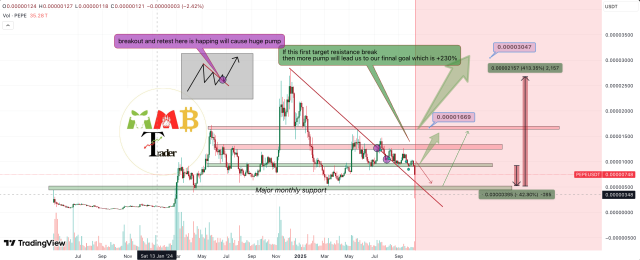
Looking at the chart shared by the crypto analyst, the PEPE price has bounced back above major monthly support. This support sits at the $0.000005 level, and since bulls have so far held above it, it could be the take-off point for the next upward rally.
PEPE Price
Source: TradingView.com

If this level holds, then there are multiple levels of interest for the PEPE price. The first stop in the bounce would be the $0.00001 level, where most of the resistance has lain over the last few months. Once broken, though, this would set the stage for the rally as it moves up rapidly.

The next stage of the rally would be the $0.000013 level as bears begin to put up a fight. By this level, though, the PEPE price would be almost 100% up. Then the next major level would be the $0.000016, the point to be broken.

If all of the resistances along the way are evenly surpassed, then the crypto analyst sees the PEPE price reaching new all-time highs. The target from here would be the $0.00003047 level, which the analyst refers to as the final goal, completing a 230% move.

PEPE price chart from TradingView.com
Price returns after brief rally | Source: PEPEUSDT on TradingView.com
Featured image from Dall.E, chart from TradingView.com
Editorial Process for bitcoinist is centered on delivering thoroughly researched, accurate, and unbiased content. We uphold strict sourcing standards, and each page undergoes diligent review by our team of top technology experts and seasoned editors. This process ensures the integrity, relevance, and value of our content for our readers.

Scott Matherson is a leading crypto writer at Bitcoinist, who possesses a sharp analytical mind and a deep understanding of the digital currency landscape. Scott has earned a reputation for delivering thought-provoking and well-researched articles that resonate with both newcomers and seasoned crypto enthusiasts. Outside of his writing, Scott is passionate about promoting crypto literacy and often works to educate the public on the potential of blockchain.

Похожее

Kalshi and Coinbase Receive CFTC Approval, Ushering in the Most Regulation-Friendly Era for the Crypto Industry?

The U.S. Commodity Futures Trading Commission (CFTC) took two landmark actions on May 29. It approved Kalshi's application to list a Bitcoin perpetual futures contract and issued a no-action letter to Coinbase Financial Markets. This allows Coinbase to offer certain perpetual futures products to U.S. customers through a subsidiary, with digital assets permitted as collateral. These moves, coupled with a new CFTC policy statement, provide a clearer regulatory pathway for perpetual contracts in the U.S., moving them from a regulatory gray area. CFTC Chair Mike Selig stated this is a key step for U.S. crypto leadership but noted the policy is not yet permanent. The article explains that CFTC's previous reluctance stemmed from legal ambiguities, as perpetual contracts lack an expiration date. However, such contracts dominate global crypto derivatives, accounting for ~78% of centralized exchange volume in 2025, forcing U.S. regulators to adapt to competition from offshore platforms like Hyperliquid. The approvals offer two compliance paths: Kalshi's direct listing and Coinbase's model using foreign futures. This is expected to attract institutional capital back to regulated U.S. venues, stimulate the launch of more products like ETH perpetuals, and enhance U.S. competitiveness in the global crypto derivatives market. The author suggests this may signal a "regulatorily friendly" era for crypto.

marsbit17 мин. назад

Kalshi and Coinbase Receive CFTC Approval, Ushering in the Most Regulation-Friendly Era for the Crypto Industry?

marsbit17 мин. назад

Sharplink CEO: Ethereum's Future Is Playing Out Now

This article presents a perspective from Joseph Chalom, CEO of Sharplink and a former BlackRock executive. He argues that current controversies surrounding the Ethereum Foundation (EF) and ETH's price miss the bigger picture for institutional adoption. Chalom asserts that Ethereum is decisively winning in the three key attributes institutions value most: trust, security, and liquidity. He cites its dominance in stablecoin settlement, tokenized real-world assets (RWA), and high-value DeFi as evidence. This success is attributed to the EF's consistent, long-term protocol development over a decade, including major upgrades like The Merge and a robust future roadmap. He defends Ethereum's decentralization as a core strength, not a weakness, stating institutions require a neutral infrastructure not controlled by any single entity. Comparing ETH to Amazon, Chalom suggests critics focusing on short-term price are missing its potential to become the foundational settlement layer for the entire global financial system. The article encourages a contrarian "be greedy when others are fearful" investment approach, drawing parallels to Warren Buffett's strategy and BlackRock's continued investment during crypto winters. Chalom concludes that while the EF correctly focuses on core protocol attributes (CROPS: Censorship Resistance, Capture Resistance, Open Source, Privacy, Security), a leadership gap exists in market-facing narrative and institutional adoption. He calls for ecosystem participants, including his own firm Sharplink, to become more vocal advocates to support Ethereum's impending "supercycle" of institutional adoption.

链捕手38 мин. назад

Sharplink CEO: Ethereum's Future Is Playing Out Now

链捕手38 мин. назад

Deconstructing the Investment Methodology of the 'Stock God Serenity' in One Article

"Serenity's Bottleneck Investment Methodology: A Deep Dive" This article dissects the "bottleneck point investment" strategy of the pseudonymous investor Serenity, known for exceptional returns (YTD 4502.45%). The core methodology involves identifying a major technological trend (e.g., AI compute expansion), mapping its supply chain, and investing early in the most irreplaceable, supply-constrained upstream component before the market fully values it. The framework is broken down into a five-factor model: 1. **Deterministic Demand**: Anchored in a large, validated trend. 2. **Constrained Supply**: The component must be difficult to replicate or scale quickly. 3. **Low Market Attention**: Opportunities exist where coverage is sparse. 4. **Value Capture**: The company must have pricing power, high margins, and customer lock-in. 5. **Catalyst**: A near-term event to trigger price discovery (earnings, customer ramp, etc.). The article provides illustrative examples like $AXTI (InP substrates for photonics), $RPI (edge hardware for AI agents), and $AAOI/$LITE (components for cloud ASICs). To apply this method, a six-step process is outlined: identify the macro trend, map the supply chain, pinpoint the true bottleneck, gather evidence (client wins, certifications), assess risks ("anti-thesis table"), and size the position according to research depth. Crucially, the article notes significant limitations: risk of overfitting inferences from sparse data, valuation challenges for pre-revenue companies, liquidity/reflexivity risks due to Serenity's own market influence, and survivor bias amplified by a strong AI bull market. The key takeaway is to emulate the rigorous research process—finding the trend, the bottleneck, the evidence—rather than blindly copying specific stock picks, emphasizing the discipline of "walking through the narrow gate."

marsbit1 ч. назад

Deconstructing the Investment Methodology of the 'Stock God Serenity' in One Article

marsbit1 ч. назад

One Article Deconstructs the Investment Methodology of 'Stock God Serenity'

This article deconstructs the "bottleneck point" investment methodology of the renowned investor known as "Serenity" (aleabitoreddit). Characterized by a YTD return of over 4500%, the strategy involves identifying a major, confirmed trend (e.g., AI data center expansion), mapping its supply chain, and then pinpointing a critical, hard-to-replace upstream bottleneck that the market has yet to fully price in. The core framework is a five-factor model: 1) **Certain Demand** from a clear megatrend; 2) **Constrained Supply** with high barriers to entry and slow replication; 3) **Low Market Attention**, where the company is overlooked; 4) **Value Capture** potential through pricing power and market share; and 5) a near-term **Catalyst** to trigger re-evaluation. Case studies include **$AXTI** (InP substrates for photonics), **$RPI** (edge hardware for AI agents), and companies like **$AAOI** and **$LITE** tied to hyperscaler-specific ASIC demand (e.g., Microsoft Maia, Amazon Trainium). The article provides a six-step guide for applying this approach: 1) Identify a validated macro trend; 2) Map the entire supply chain; 3) Find the true bottleneck; 4) Gather concrete evidence (e.g., filings, customer contracts); 5) Perform rigorous risk assessment ("anti-thesis"); 6) Match position size to depth of research. Key limitations are also noted: the risk of narrative overfitting, difficulty in valuing early-stage companies, Serenity's own market-moving influence creating reflexivity, and potential survivorship bias due to the AI bull market. The essence of the method is not to copy picks but to adopt the research process: find the trend, locate the bottleneck, verify with evidence, assess valuation, await a catalyst, and then invest with discipline. The philosophy is summarized as "walking through the narrow gate"—seeking non-consensus, structurally vital points within booming industries before they become widely recognized.

链捕手1 ч. назад

One Article Deconstructs the Investment Methodology of 'Stock God Serenity'

链捕手1 ч. назад

Торговля

Спот
Фьючерсы
活动图片