EU Plans Transfer Of Crypto, Stocks Oversight Power To Address Market Fragmentation – ESMA Chair

bitcoinistОпубликовано 2025-10-07Обновлено 2025-10-07

Введение

The European Union (EU) is reportedly planning to shift oversight power of key financial market areas, including crypto, from national...

Trusted Editorial content, reviewed by leading industry experts and seasoned editors. Ad Disclosure

The European Union (EU) is reportedly planning to shift oversight power of key financial market areas, including crypto, from national authorities to a centralized supervisory authority to help boost the bloc’s capital markets and harmonize regulation.

EU Eyes Centralized Crypto Market Oversight

On Monday, Verena Ross, chair of the European Securities and Markets Authority (ESMA), affirmed that the regulation of stock exchanges, crypto companies, and clearing houses in the EU will likely be transferred to the bloc’s market watchdog.

Ross told the Financial Times that the European Commission is preparing new rules that would shift the supervision of several areas of EU financial markets from national authorities to ESMA, to push for “a capital market in Europe that is more integrated and globally competitive.”

Last month, the EU commissioner for financial services, Maria Luís Albuquerque, shared they were “considering a proposal to transfer supervisory powers to Esma for the most significant cross-border entities,” including crypto companies.

“All of this would imply changes to the governance and decision-making processes of Esma, and we have various models to consider based on other existing models of centralised supervision,” said Albuquerque.

The change aims to address the continued fragmentation in markets to “create more of a single market for capital in Europe,” the ESMA chair stated, arguing that “while we are doing a lot of work to try to make sure the implementation of MiCA is aligned, it clearly takes a lot of effort from us and the national supervisors to achieve that.”

“It also means that people had to build up specific new resources and expertise 27 times in different national supervisors, which could have been done more efficiently once at a European level,” she added.

Single Supervisor Proposal Faces Backlash

Notably, the EU first proposed making ESMA the main supervisory agency of Crypto Asset Service Providers (CASP) during the development of its Markets in Crypto-Assets Regulation (MiCA).

The plan received backlash from smaller EU nations, such as Luxembourg, Ireland, and Malta, which criticized the watchdog’s ability to oversee the fast-growing crypto market and feared it could undermine their flourishing financial sectors.

As a result, the supervision of these markets was left in the hands of the 27 national authorities, which Ross considers has created inefficiencies. She explained that the Paris-based authority has “tried for quite some time with the capital markets union and other initiatives to build a more effective capital market,” but “the reality has been that it is not easy to do given we have very different market structures.”

In July, ESMA raised concerns about Malta’s process for approving pan-EU licenses for crypto companies, arguing that “some risk areas were not adequately assessed during the authorisation process.”

As reported by Bitcoinist, the bloc watchdog’s Peer Review Committee (PRC) conducted a review of Malta’s Financial Services Authority (MFSA) CASP authorization process, finding the national regulator only “partially met expectations,” despite having adequate staffing and technical infrastructure.

At the time, ESMA stressed that the concerns extended beyond Malta and urged all EU competent authorities to align their oversight mechanisms to ensure consistency under MiCA’s regulatory regime.

Last year, former European Central Bank President Mario Draghi identified transforming ESMA into a single common regulator for all the bloc’s securities markets, similar to the US Securities and Exchange Commission (SEC), as a “key pillar” to boost European capital markets.

Since then, the European watchdog has been granted greater powers. The regulator will oversee new providers of consolidated tapes for equity and bond prices, and agencies that provide environmental, social, and governance ratings starting in 2026.

However, Claude Marx, Director General of Luxembourg’s financial watchdog, considers that a single financial regulator would turn into a “monster.” “It is a fantasy that the European Commission wants to push a single supervisor,” Marx stated in June.

“The European Commission has always stated they do not have an idée fixe to have a European SEC,” he argued, adding that there remain several barriers to providing financial services across European borders.
crypto, bitcoin, btc, btcusdt

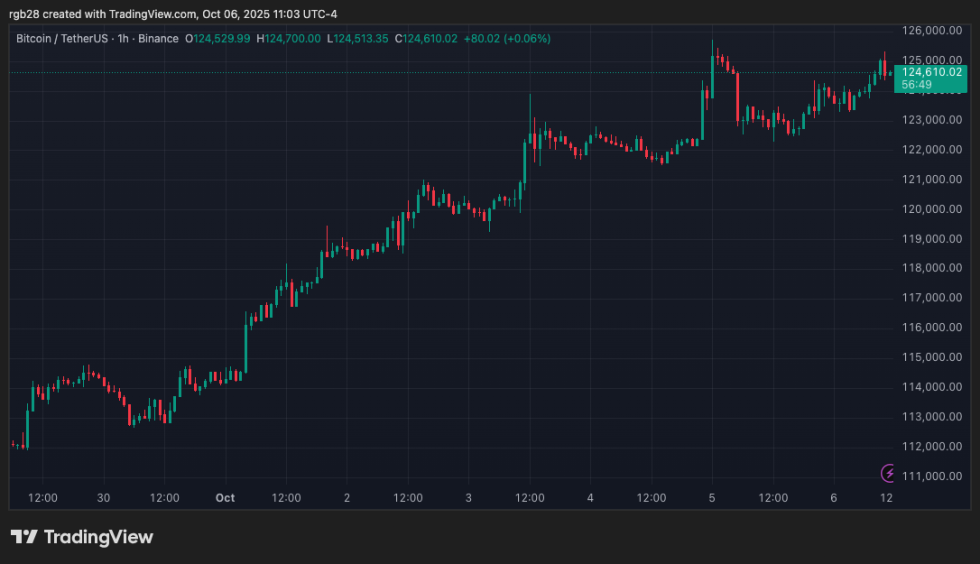
Bitcoin (BTC) trades at $124,610 in the one-week chart. Source: BTCUSDT on TradingView
Featured Image from Unsplash.com, Chart from TradingView.com
Editorial Process for bitcoinist is centered on delivering thoroughly researched, accurate, and unbiased content. We uphold strict sourcing standards, and each page undergoes diligent review by our team of top technology experts and seasoned editors. This process ensures the integrity, relevance, and value of our content for our readers.

Rubmar is a crypto enthusiast who likes learning and improving constantly. She enjoys reporting on the latest news and developments in the crypto industry. Rubmar also enjoys scrapbooking, crafting, simulation games, and watching football.

Похожее

Bitwise: Crypto Becomes a Contrarian Investment, Three Logics to Understand the Current Market

**Summary** Matt Hougan, Bitwise's CIO, analyzes the current crypto market through three key lenses, arguing it has shifted from a momentum-driven to a contrarian investment. **1) Crypto Becomes a Contrarian Play:** The market is weak, with major assets like Bitcoin and Ethereum down significantly. Capital has moved to hot sectors like AI, leaving crypto as an "unloved" asset class. This transforms crypto investing from trend-following to a test of patience and fundamental analysis. Investors now favor projects with solid fundamentals (e.g., Hyperliquid) over speculative ones. **2) Regulatory Overhang:** The uncertain fate of the U.S. CLARITY Act, a major crypto regulatory framework, is a key headwind. With its passage in 2024 seen as far from guaranteed (estimates range from 30-55%), institutional capital remains on the sidelines, choosing less risky alternatives like AI stocks. The market needs clarity—whether the bill passes or fails—more than any specific outcome to move decisively. **3) Capital Rotates to New Fundamentals:** This cycle differs from past bear markets where money fled to Bitcoin. Now, capital seeks smaller assets with strong use cases. While major cryptos fell in May 2024, tokens like Hyperliquid (+72%), Zcash (+50%), and XLM (+44%) rallied on their specific fundamentals. This rotation confirms the new contrarian, fundamentals-driven logic and signals the bear market may be in its later stages. **Conclusion:** Short-term pressure persists due to regulatory uncertainty and competition from AI narratives. Investing in crypto now requires a contrarian mindset—acting against the crowd and focusing on fundamental value. Patience and targeting high-quality projects based on their merits are essential for capturing long-term gains.

marsbit9 мин. назад

Bitwise: Crypto Becomes a Contrarian Investment, Three Logics to Understand the Current Market

marsbit9 мин. назад

ChatGPT Might Be Disappearing Soon

OpenAI announced at its "Intelligence at Work" event that its coding assistant, Codex, will be fully integrated into the ChatGPT app within weeks. This move marks a strategic shift from a conversational AI (Chat) towards a unified "agentic" platform capable of execution. Codex, originally launched to compete with Anthropic's Claude Code, has grown rapidly to 5 million weekly active users, with 20% being non-developers like analysts and designers. Its enterprise revenue now constitutes 40% of OpenAI's total. The integration is the first step in creating a super-app combining ChatGPT (interface), Codex (execution engine), and the Atlas browser (web access). OpenAI also unveiled new Codex features: specialized Agent plugins for six professional roles, an "Annotations" tool for direct document editing, and a "Sites" function to turn work into shareable web apps. Internally, this reflects a power shift; the Codex team now leads core product strategy. While the ChatGPT brand remains for its vast user base, the platform's future is focused on autonomous agents that perform tasks, not just chat. The article notes that competition with Claude Code pushed OpenAI's development, with Codex competing on cost-effectiveness and accessibility rather than raw coding quality. It concludes that the essence of "ChatGPT" is evolving from a chatbot into an AI agent platform, with the name potentially becoming a legacy symbol of its original function.

marsbit20 мин. назад

ChatGPT Might Be Disappearing Soon

marsbit20 мин. назад

WWDC26 Ultimate Preview: The All-New Siri is the Main Course, iOS 27 is Another Year of Refinements

Apple has confirmed WWDC26 will begin on June 8, with the keynote at 10 AM PT (1 AM Beijing Time, June 9). This year's focus is expected to shift significantly from routine OS updates to Apple's progress in AI, particularly a major overhaul of Siri. Reports indicate the highlight will be a new Siri, reportedly powered by Google's Gemini technology. This upgraded assistant is expected to appear as a lightweight bubble from the Dynamic Island and be accessible via a unified "Search or Ask" system-wide entry point. It aims to deeply integrate with iOS 27, iPadOS 27, and macOS 27, accessing personal data like messages, photos, and documents, with a potential standalone Siri app also in development. For iOS 27, leaks suggest incremental improvements rather than major redesigns. Key updates may include a redesigned, more customizable Camera app, enhanced photo editing tools within the Photos app, and potential early system optimizations for a future foldable iPhone. The update is also rumored to prioritize bug fixes, stability, and performance optimization. iPadOS 27 is anticipated to focus on improving productivity features like window management, file systems, and external display support to better utilize the iPad's hardware. macOS 27 is seen as a core platform for Apple Intelligence, likely receiving an optimized Siri, new AI features, and continued refinement of the "Liquid Glass" design language. Notably, macOS 27 may finally drop support for Intel-based Macs. The overarching theme for WWDC26 is whether Apple can effectively integrate AI across its ecosystem. The success of the new Siri and Apple Intelligence will be judged on their ability to move beyond standalone features and become a cohesive, context-aware system layer that understands user workflows across iPhone, iPad, Mac, and other devices, while maintaining Apple's emphasis on privacy and stability. The conference represents Apple's critical attempt to catch up and redefine the AI assistant experience after a perceived slow start in the generative AI era.

marsbit45 мин. назад

WWDC26 Ultimate Preview: The All-New Siri is the Main Course, iOS 27 is Another Year of Refinements

marsbit45 мин. назад

Торговля

Спот
Фьючерсы
活动图片





