Bitcoin Price Pulls Back From $125K Record High: Analysts See Path Toward $170K in Q4

bitcoinistОпубликовано 2025-10-06Обновлено 2025-10-07

Введение

The Bitcoin price set a fresh all-time high near $125,700 before easing back as traders locked in gains and reassessed...

Trusted Editorial content, reviewed by leading industry experts and seasoned editors. Ad Disclosure

The Bitcoin price set a fresh all-time high near $125,700 before easing back as traders locked in gains and reassessed near-term risks. Despite the dip, market structure remains bullish. Spot ETF demand is accelerating, exchange balances are at multi-year lows, and macro tailwinds continue to favor “digital gold.”

With “Uptober” seasonality intact, several strategists now map a route toward $150K–$170K in Q4 if inflows persist.
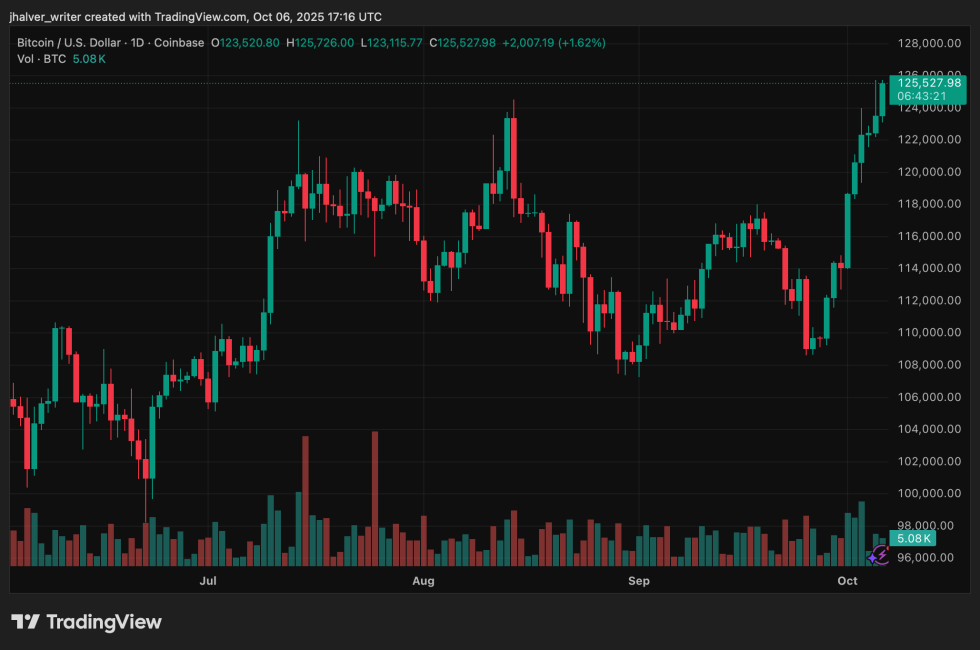
Bitcoin price btc btucsd

BTC's price trends to the upside on the daily chart. Source: BTCUSD on Tradingview

Why Bitcoin Rallied to a Record

The latest breakout was supported by a perfect storm of demand and scarcity. U.S. spot Bitcoin ETFs drew $3Billion plus of net inflows in early October, led by heavyweight issuers, while on-chain data show exchange reserves sliding to 6–7-year lows (roughly 2.45–2.83M BTC).

That supply squeeze, Bitcoin moving to self-custody, treasuries, and ETF vaults, reduces sell pressure at the same time large buyers add exposure.

Macro helped too. A weaker dollar, government-shutdown uncertainty, and shifting rate-cut odds boosted safe-haven bids, with Bitcoin tracking alongside gold’s strength. Historically strong Q4 performance (the “Uptober” effect) layered on a behavioral tailwind as trend followers chased the breakout.

Key Levels to Watch in Q4

After hitting a fresh ATH, Bitcoin has entered a consolidation phase above its key support zones, setting the stage for Q4’s next major move. The $121,000–$118,000 range now acts as the primary demand pocket, with deeper support at $115,000 and $108,000, levels tied to the origin of the recent impulse rally.

On the upside, traders are watching $135,000 as the immediate resistance and potential price magnet, while a strong weekly close above the psychological $150,000 mark could open the path toward the $165,000–$170,000 corridor.

Overall market internals remain healthy: spot-driven accumulation is outpacing leveraged speculation, liquidations were minimal at the highs, and funding rates have stayed balanced.

These factors suggest a controlled advance rather than a blow-off top, meaning any dip into the $118,000–$121,000 zone accompanied by declining volume is likely to be seen as a re-accumulation opportunity by seasoned investors.

Will $170K Happen This Quarter?

The bullish case hinges on sustained ETF inflows and ongoing exchange supply shrinkage.

If net creations remain robust and long-term holders keep coins off-market, price discovery can extend toward $150K to $165K then $170K. Seasonality supports the view that Bitcoin has historically outperformed in Q4 when September closes green.

Risks to monitor include a sharp ETF outflow week, a US-dollar rebound, or regulatory shocks, all of which could force a retest of sub-$118K supports. However, as long as BTC holds $120K on a closing basis and the spot bid persists, analysts argue the path of least resistance remains higher.

Cover image from ChatGPT, BTCUSD chart from Tradingview

Editorial Process for bitcoinist is centered on delivering thoroughly researched, accurate, and unbiased content. We uphold strict sourcing standards, and each page undergoes diligent review by our team of top technology experts and seasoned editors. This process ensures the integrity, relevance, and value of our content for our readers.

Похожее

Claude Code Introduces Dynamic Workflows: Enabling AI to Form Teams and Collaborate

Claude Code introduces dynamic workflows, enabling AI to coordinate teams of specialized agents for complex tasks. This transforms Claude from a code assistant into a programmable workbench. Workflows address key limitations of single-agent systems: agentic laziness (premature task completion), self-preferential bias (favoring own outputs), and goal drift (losing sight of original objectives). The system allows Claude to dynamically create execution frameworks using JavaScript. It can split tasks, dispatch parallel agents for isolated work (e.g., in separate worktrees), implement adversarial validation, run tournaments, and synthesize results. This multi-agent approach is valuable for tasks requiring deep research, factual verification, code migration, root cause analysis, large-scale triage, and qualitative sorting. Key patterns include: classify-and-route, fan-out-and-synthesize, adversarial verification, generate-and-filter, tournaments, and loop-until-done. While token usage is higher, workflows excel where tasks resemble programming—needing problem decomposition, isolated context, hypothesis testing, and handling many details. They extend Claude Code's utility beyond technical work to areas like business plan review, resume screening, and naming brainstorm. The feature is not a universal solution but points to a future where AI tool competitiveness depends on organizing reliable, reusable, and auditable execution flows for complex goals.

marsbit8 мин. назад

Claude Code Introduces Dynamic Workflows: Enabling AI to Form Teams and Collaborate

marsbit8 мин. назад

Hyperliquid, Wall Street's 24/7 Trading Convenience Store

Hyperliquid: The 24/7 Trading "Convenience Store" for Wall Street Hyperliquid, a decentralized cryptocurrency exchange, has become a go-to platform for Wall Street traders seeking to trade around the clock, especially during traditional market closures. Founded by Jeff Yan, a former quantitative trader, after the FTX collapse, the platform emphasizes user self-custody of assets. It offers a wide range of perpetual contracts—leveraged derivatives with no expiry—on assets from Bitcoin and crude oil to the S&P 500 and even pre-IPO companies like SpaceX. A notable example involves a hedge fund trader who capitalized on geopolitical news over a weekend, securing a 243% return on oil derivatives before markets reopened. The platform, run by just 11 employees, generated approximately $800 million in revenue last year, and its native token HYPE has seen significant growth. Its rise highlights the merging of traditional finance and crypto. While U.S. users are currently restricted, recent CFTC rule changes could open access. The platform is known for its transparency, having processed $10 billion in liquidations during a market crash while competitors faltered. Regulators warn of the high risks and complexity of perpetual contracts for retail investors. Key to its appeal is a strong community culture, direct engagement with founders, and a simple interface. Despite rules against VPN use, it attracts global users with its permissionless approach. Hyperliquid plans to expand into prediction markets and options, aiming to eventually host all financial activity.

marsbit9 мин. назад

Hyperliquid, Wall Street's 24/7 Trading Convenience Store

marsbit9 мин. назад

Who Funds the Agents?

**Summary: Who Funds AI Agents?** OpenAI recently shut down a feature allowing AI agents to shop for users, highlighting the challenge of creating a secure and regulated environment for agent-driven transactions. While payment infrastructure exists, a crucial governance layer—defining spending limits, fraud detection, tax handling, and return policies—is largely missing. The potential is enormous: AI agents already processed $73M across 176M transactions last year, with McKinsey forecasting this could grow to $3-5T in global consumer commerce by 2030. The core competition isn't just about processing payments, which can be very cheap (especially with crypto-based settlement), but about controlling the rules that govern agent spending. Key players like Stripe and Coinbase are racing to dominate this governance layer. Stripe's acquisition of wallet provider Privy allows it to set spending policies, identity checks, and human-in-the-loop approvals directly at the wallet level. Similarly, Coinbase's stack, including its x402 protocol and AgentKit, embeds governance rules. This vertical integration across settlement, wallet, and governance layers is becoming the dominant strategy. Control over the governance layer is where significant future value lies. If agents handle trillions in transactions, even a small fee for managing compliance, fraud prevention, and policy enforcement could generate billions in annual revenue. The companies that successfully integrate across the payment stack will capture value from idle agent balances, transaction fees, and governance services, positioning themselves as the foundational banks of the AI agent economy.

marsbit36 мин. назад

Who Funds the Agents?

marsbit36 мин. назад

Торговля

Спот
Фьючерсы
活动图片





