BONK预测:若想反弹,必须攻克这两个关键挑战!

ambcryptoОпубликовано 2025-08-25Обновлено 2025-08-25

Введение

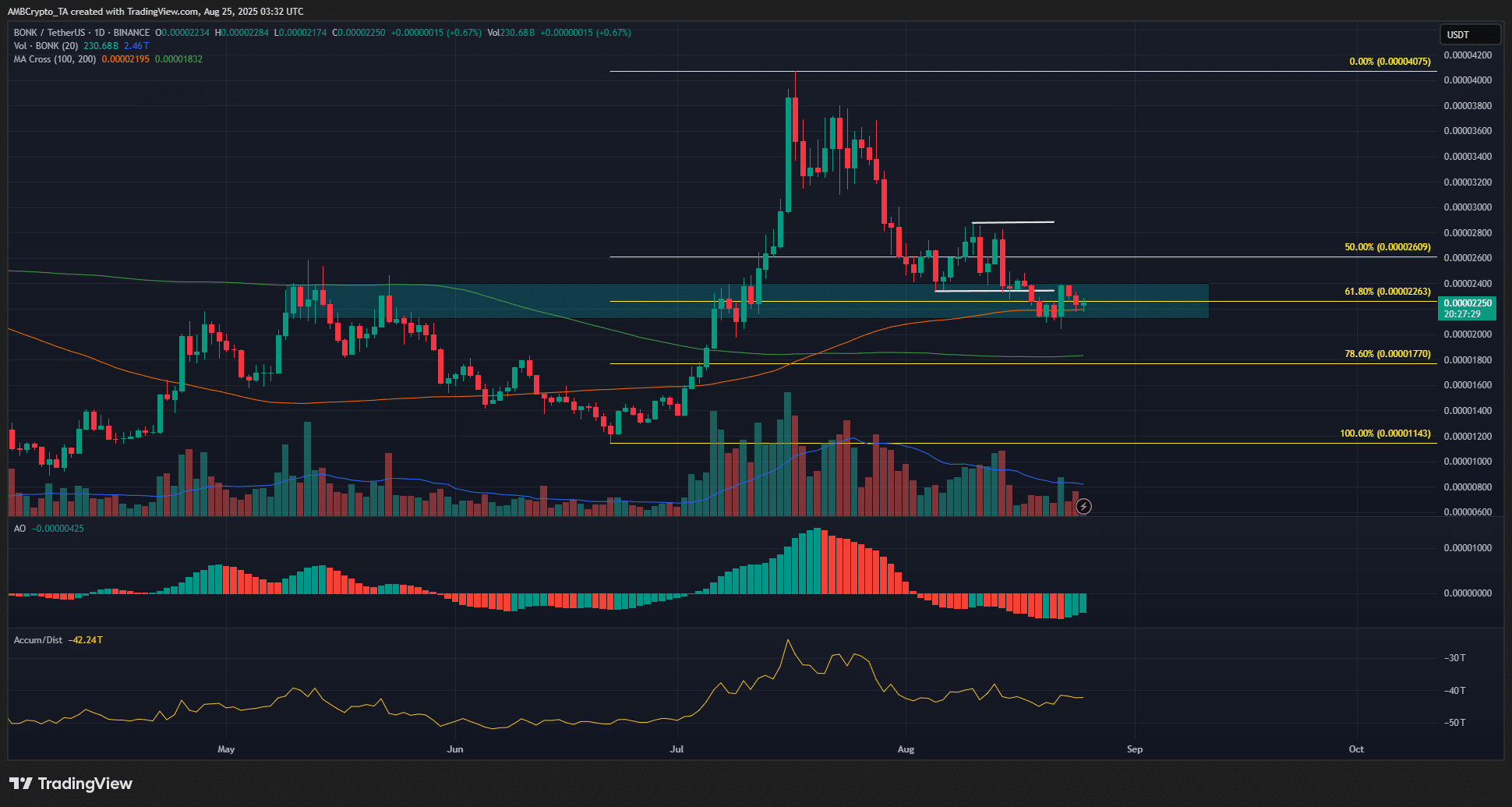
BONK 的 100 天移动平均线、斐波那契水平和看涨突破块在 0.0000225 美元区域汇聚。

截至本文撰写时, Bonk [BONK]的交易价格正处于 7 月份启动上涨至 0.00004 美元的支撑位。事实上,自上个月触及该高点以来,该 memecoin 已回落 44%。

短期比特币 [BTC] 看跌偏见表明 BONK 交易者应警惕进一​​步的损失。

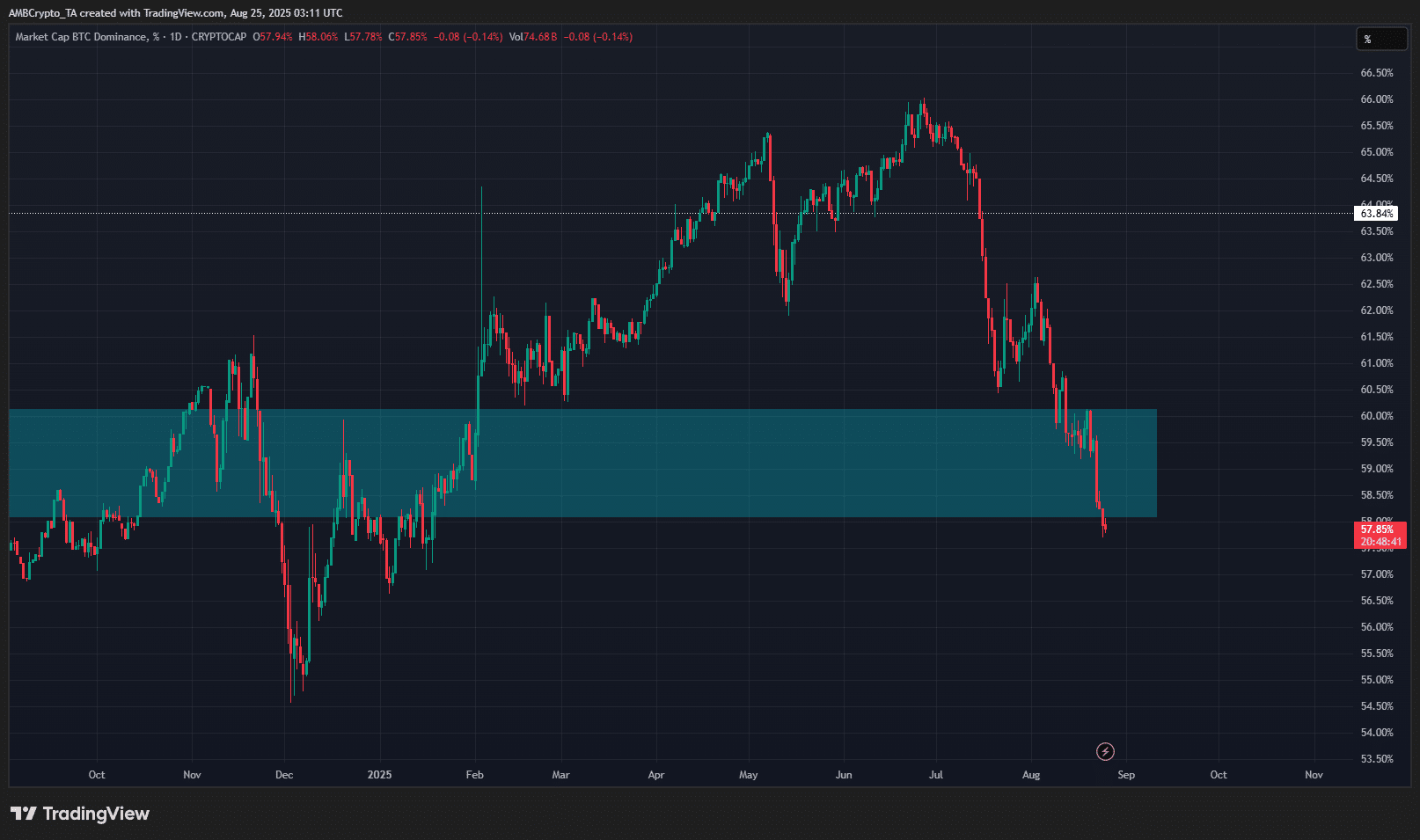
近几周,比特币的主导地位持续下降。截至发稿时,其价格已跌破2020年9月以来的支撑位(青色)。BTC.D的持续下跌趋势将利好山寨币市场,包括模因币(memecoin)板块。

这意味着山寨币的市值扩张速度可能快于比特币——这是资金流入山寨币的迹象。自3月以来,模因币的市值一直在缓慢增长。尽管目前市值已达714.1亿美元,但距离2024年底达到的1150亿美元仍有相当大的差距。

接下来您对 BONK 有什么期待?

在单日图上,内部结构看跌。之前的波动点以白色标记,且 BONK 在 8 月份创下新低。因此,未来几天的走势看跌。动量震荡指标在零线下方运行,突显了市场的看跌势头。

然而,自5月份以来,memecoin的交易价格一直处于看涨突破区域。0.0000225美元区域在7月份的反弹中曾充当阻力位。这意味着再次测试该区域可能会获得支撑。

绘制的斐波那契回撤位显示,61.8% 的回撤水平位于 0.000226 美元。100 日移动平均线也位于该区域内。这些因素的结合意味着 BONK 正处于关键的长期支撑位。

交易者和投资者应警惕看涨反转。不过,一个值得关注的点可能是最近几天交易量的下降,A/D指标也反映了这一点。BONK需要改变这种状况才能确立上涨趋势。

Похожее

Six Complaints from an Ethereum Developer

A disgruntled early Ethereum developer and token holder presents six core criticisms of the project's trajectory, contrasting it with Solana's rise. 1. **Premature Complacency**: The Ethereum Foundation shifted from a "building" to an "infrastructure" mindset too soon, adopting a passive, "retired chairman" posture before securing market dominance, reflected in ETH's ~65% decline against BTC post-Merge. 2. **Misguided Messaging**: The Merge was marketed primarily on ESG (99.95% energy reduction) rather than user benefits like speed or yield, appealing to internal ideals instead of market demands. 3. **Delayed Execution**: Proof-of-Stake, on the roadmap since 2015, took seven years to launch, ceding critical narrative and development windows. Competitors like Solana built entire ecosystems in that time. 4. **Poor Native Staking UX**: Years after the Merge, there is still no first-party, user-friendly staking application, forcing reliance on centralized services like Lido and undermining ETH's "sound money" narrative. 5. **Managed Decline**: The rollup-centric roadmap deliberately weakens the base layer's fee capture, outsourcing value and profitability to L2s like Arbitrum and Base, which issue their own tokens and fragment capital. 6. **Ideology Over Product**: Ethereum culture prioritizes philosophical purity ("credible neutrality," "public goods") over competitive product delivery that meets user demands (e.g., financialization), while Solana's ecosystem focuses on coordinated execution. The diagnosis is accumulated execution debt, not a coordination failure. Ethereum possessed a structural advantage in 2021 but spent years in governance debates, while Solana efficiently executed. The current market cap reflects these specific strategic failures, not abstract theory.

marsbit7 мин. назад

Six Complaints from an Ethereum Developer

marsbit7 мин. назад

Six Complaints from an Ethereum Developer

Six Grievances from an Ethereum Developer The author, an early investor and developer still building on Ethereum, expresses deep frustration with its trajectory and declining ETH/BTC price since the merge. The core argument is that Ethereum's current market position stems from concrete failures in execution and strategy, not abstract coordination problems. The first grievance targets a shift in the Ethereum Foundation's mentality from builders to "infrastructure," adopting a premature posture of a retired victor. Second, marketing the Merge around ESG (99.95% energy reduction) is seen as talking to its own conscience rather than the market, which prioritizes user experience and yield. Third, the seven-year delay in delivering Proof-of-Stake (PoS) ceded critical narrative and development time to competitors like Solana. Fourth, three years post-merge, there is still no user-friendly first-party staking application, forcing reliance on centralized services like Lido and undermining ETH's monetary narrative. Fifth, the rollup-centric roadmap has strategically surrendered base-layer fee capture to L2s, fragmenting value within the ecosystem while Solana demonstrates an integrated L1's value accrual. Finally, the author criticizes an institutional culture that prioritizes philosophical ideals (credible neutrality, pluralism) over competitive product delivery focused on what users actually want. The diagnosis is "accumulated execution debt." Ethereum possessed a structural advantage in 2021 but spent years in governance debates, while Solana's ecosystem coordinated efficiently to deliver and capture the next wave of value. The conclusion is that Ethereum's market cap reflects its abandonment of the fight for asset appreciation.

链捕手17 мин. назад

Six Complaints from an Ethereum Developer

链捕手17 мин. назад

Token Budget Wars: Enterprise AI Enters the 'Accounting Era'

Token Budget Wars: Enterprise AI Enters the "Accounting Era" Enterprise AI is shifting from the question of "whether to adopt" to "how to account for it." As AI inference costs evolve from experimental budgets into ongoing operational expenses, CEOs and CFOs are demanding proof of value: what tangible results does each dollar spent on tokens deliver? The core of "Token Budget Wars" is not simply about reducing AI bills, but about intelligently allocating compute resources. It involves determining which business processes warrant more computational power, which tasks can use cheaper models, which can be outsourced or handled manually, and which are merely inefficient consumption. A key insight is that AI usage (token consumption) does not equal value. While SaaS usage indicated software adoption, AI token usage only indicates the "meter is running." The same workflow can cost vastly different amounts due to factors like prompt quality, context, model choice, and retries. The critical metric for scaling is "marginal token utility"—the business value created per additional dollar of inference cost. However, this is difficult to measure due to challenges like the long tail of retries, context inflation (where costs can scale quadratically with context length), and inefficient model routing (defaulting to the most powerful model for all tasks). The competition for token allocation is intensifying because, in the AI era, influence is tied to how much intelligence one can command, not just team size. AI spending is essentially competing with labor costs, whether for replacing external BPOs, internal staff, or generating new revenue. BPO contracts provide a clearer benchmark as they are priced per completed unit. The missing layer is attribution from tokens to business outcomes. Companies need a system that connects inference spending to completed work and results, capturing the agent's decision trajectory—what it saw, retrieved, tried, and why it succeeded or failed. This recorded rationale becomes a valuable asset. Ultimately, those who master token-to-outcome attribution will control the allocation of AI resources within enterprises, deciding which workflows get more compute, which are capped, or which revert to humans. The first phase of enterprise AI proved models could do the work. The next phase will determine how much of that work is worth paying for.

marsbit43 мин. назад

Token Budget Wars: Enterprise AI Enters the 'Accounting Era'

marsbit43 мин. назад

US Debt Exceeds $39 Trillion, Surpassing GDP for First Time: The 'Gray Rhino' Every Investor Must Face by 2026

The U.S. national debt has exceeded $39 trillion, with the debt-to-GDP ratio surpassing 100% in 2026 for the first time since WWII. The annual interest payment is projected to reach $1.039 trillion. Driven by structural factors like tax cuts, rising entitlement spending (Social Security, Medicare), and compounding interest, the deficit persists. The Congressional Budget Office warns the current fiscal path is unsustainable, projecting debt could reach 175% of GDP by 2056. While the U.S. is unlikely to default as it issues its own currency, the consequences include persistent inflation pressure, higher long-term interest rates (e.g., 30-year Treasury yields at 5.2%), and potential crowding out of private investment. A fiscal crisis could manifest as a sudden, sharp spike in borrowing costs if market confidence erodes. Major credit rating agencies have downgraded U.S. debt, reflecting these concerns. For investors, this signals the end of the era of permanently low interest rates. Equity investors should favor companies with strong current earnings over high-growth stocks reliant on low discount rates. Bond investors face headwinds for long-term Treasuries due to increased supply, making shorter-duration bonds and investment-grade corporates relatively attractive. Gold and real assets can provide a hedge against currency debasement risks. Three broad scenarios are possible: gradual stabilization through fiscal reform (unlikely given political gridlock), a slow-burn of high debt and interest rates dragging on growth (the most probable baseline), or a sudden loss of market confidence triggering a crisis. Key indicators to watch include CBO report updates, Treasury auction demand, and the 30-year Treasury yield. The core takeaway for investors is the need to adjust portfolios for a world of sustained higher government borrowing costs and interest rates.

marsbit1 ч. назад

US Debt Exceeds $39 Trillion, Surpassing GDP for First Time: The 'Gray Rhino' Every Investor Must Face by 2026

marsbit1 ч. назад

Торговля

Спот
Фьючерсы

Популярные статьи

Как купить BONK

Добро пожаловать на HTX.com! Мы сделали приобретение Bonk (BONK) простым и удобным. Следуйте нашему пошаговому руководству и отправляйтесь в свое крипто-путешествие.Шаг 1: Создайте аккаунт на HTXИспользуйте свой адрес электронной почты или номер телефона, чтобы зарегистрироваться и бесплатно создать аккаунт на HTX. Пройдите удобную регистрацию и откройте для себя весь функционал.Создать аккаунтШаг 2: Перейдите в Купить криптовалюту и выберите свой способ оплатыКредитная/Дебетовая Карта: Используйте свою карту Visa или Mastercard для мгновенной покупки Bonk (BONK).Баланс: Используйте средства с баланса вашего аккаунта HTX для простой торговли.Третьи Лица: Мы добавили популярные способы оплаты, такие как Google Pay и Apple Pay, для повышения удобства.P2P: Торгуйте напрямую с другими пользователями на HTX.Внебиржевая Торговля (OTC): Мы предлагаем индивидуальные услуги и конкурентоспособные обменные курсы для трейдеров.Шаг 3: Хранение Bonk (BONK)После приобретения вами Bonk (BONK) храните их в своем аккаунте на HTX. В качестве альтернативы вы можете отправить их куда-либо с помощью перевода в блокчейне или использовать для торговли с другими криптовалютами.Шаг 4: Торговля Bonk (BONK)С легкостью торгуйте Bonk (BONK) на спотовом рынке HTX. Просто зайдите в свой аккаунт, выберите торговую пару, совершайте сделки и следите за ними в режиме реального времени. Мы предлагаем удобный интерфейс как для начинающих, так и для опытных трейдеров.

931 просмотров всегоОпубликовано 2024.03.29Обновлено 2025.03.21

Как купить BONK

Обсуждения

Добро пожаловать в Сообщество HTX. Здесь вы сможете быть в курсе последних новостей о развитии платформы и получить доступ к профессиональной аналитической информации о рынке. Мнения пользователей о цене на BONK (BONK) представлены ниже.

活动图片