兵临城下:Qubic 对门罗币发起 51% 攻击,社区 72 小时自救

marsbitОпубликовано 2025-08-11Обновлено 2025-08-12

在加密世界日新月异的叙事洪流中,有些名字似乎已淡出聚光灯的中心。门罗币(Monero)便是其中之一。作为2014年便已问世的“活化石”级项目,它不像DeFi协议那样许诺惊人的收益率,也不像NFT或Meme币那样能轻易点燃社交媒体的狂热。多年来,门罗币如同一位沉默的匠人,始终专注于其最初的使命——打造一套真正无法追踪、无法链接的数字现金系统。它的发展不追求朝夕之功,而在于对隐私技术的持续打磨和对网络韧性的不断加固。

然而,这份执着也让整个隐私赛道行走于刀锋之上。随着全球监管的收紧,隐私币种成了合规的“头号公敌”。各大主流交易所纷纷将其下架,以规避潜在的法律风险。在外界看来,隐私赛道面临的挑战主要来自监管机构的外部压力。然而,谁也未曾料到,一场更具颠覆性的危机,竟会从加密世界的内部爆发,其矛头直指这个赛道中最具代表性的旗手。

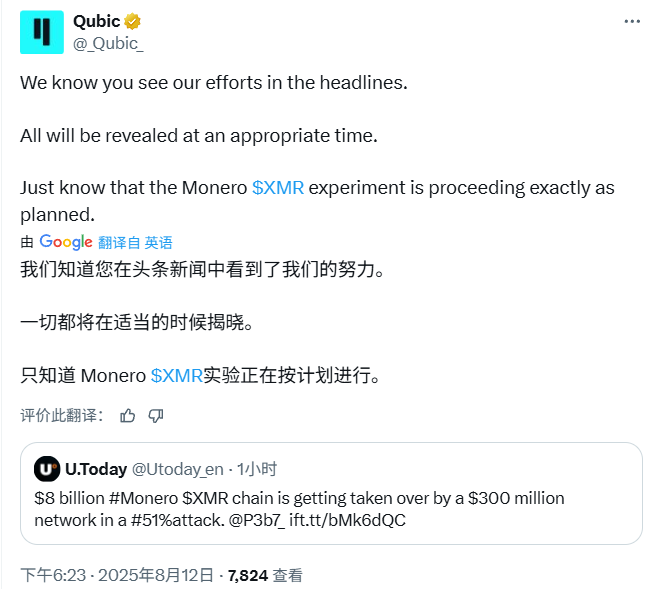
2025年8月12日,新兴的Layer 1项目Qubic在社交媒体上发布了一则简短但信息量巨大的声明:“门罗币(XMR)实验正按计划顺利进行,一切都会在适当的时候揭晓。” 这条推文如同一声惊雷,将门罗币正遭受的、近乎致命的网络算力危机公之于众,并毫不避讳地将自己与这场风暴关联起来。这究竟是一次鲁莽的炫技,一场蓄意的攻击,还是一场旨在揭示行业沉疴的“社会实验”?要解开这个谜团,我们必须将目光投向风暴的策划者。
门罗币

这场风暴的背后,是一位在加密行业留下过深刻印记的人物——Sergey Ivancheglyo(社区人称CfB)。他的名字总是与颠覆式创新捆绑在一起。从早期为NXT项目开创性地引入纯粹的PoS(权益证明)共识,到后来作为IOTA的核心力量,将“有向无环图”(DAG)这一突破性技术推向公众视野,Ivancheglyo的职业生涯本身就是一部挑战现有范式的历史。他与IOTA基金会的分道扬镳,以及后续围绕此事的公开争论,更凸显了他倾向于在传统组织框架之外,以更纯粹、更不受约束的方式实现其技术愿景的行事风格。Qubic,便是他这种风格的延续——一个旨在从根本上重新定义PoW(工作量证明)价值的最新尝试。


“有用”的算力与“经济攻击”

Qubic的核心理念是“有用工作量证明”(Useful Proof of Work, uPoW)。传统PoW,如比特币所使用的,矿工通过解决无实际意义的哈希谜题来维护网络安全,这被认为是一种巨大的能源浪费。而Qubic则试图让这些算力变得“有用”,将其引导至AI训练、科学计算等领域。他们的系统允许矿工在执行这些AI任务的同时,通过一种名为“外包计算”的机制,将其部分算力指向其他PoW网络进行挖矿,门罗币便是他们的第一个目标。

这套机制的精妙之处在于它创造了一种强大的经济激励。Qubic矿工在获得其原生代币QUBIC奖励的同时,还能额外获得门罗币挖矿的收益。更具颠覆性的是,Qubic官方将挖来的XMR在公开市场上出售,用所得资金回购并销毁QUBIC代币,制造通缩压力,从而推高QUBIC的价格。一个危险的飞轮就此形成:更高的QUBIC价格吸引更多矿工加入,更多的矿工意味着更强的算力,更强的算力能挖到更多的XMR,卖掉XMR又能进一步推高QUBIC价格。

这并非传统的算力攻击,而是一种“经济攻击”。Qubic并非试图通过双花攻击直接窃取资金,而是利用更优越的经济模型,像一个巨大的磁铁,将原本分散的门罗币算力吸附到自己周围。正如Protos媒体分析的那样,这是一种“温水煮青蛙”式的威胁,它腐蚀的是门罗币去中心化的根基。


兵临城下:门罗币社区的反击

当Qubic的算力在门罗币网络中的占比从7月中旬的25%一路飙升,并在8月12日触及48-50%的临界点时,门罗币社区感受到了切实的寒意。慢雾(SlowMist)创始人余弦在社交媒体上证实:“从技术上讲,Qubic对门罗币的51%攻击已经成功。”尽管Qubic并未发起双花,但网络的安全天平已被彻底打破。

51%攻击对PoW链来说是悬顶的达摩克利斯之剑。历史上,以太坊经典(ETC)在2019年因此被双花盗取了价值110万美元的资产,而比特黄金(BTG)更是在2018年的一次攻击中损失高达1800万美元。The Block引用分析师的估算称,一个恶意行为者仅需花费“每天7000到10000美元”,就可能租用到足够的算力来控制门罗币网络。Qubic的“实验”无疑是将这一理论上的风险活生生地展现在了世人面前。

面对兵临城下的局面,这个以“隐私”和“抗审查”为图腾的社区爆发出惊人的凝聚力。一场自下而上的“算力保卫战”迅速打响。社区成员在Reddit等社交平台上奔走相告,呼吁所有忠诚的矿工将算力从未知矿池撤出,转移到p2pool(一种去中心化矿池)或supportxmr.com等信誉良好的防御性矿池中。

这场反击的核心,是削弱Qubic经济模型的根基。主流挖矿软件XMRig的开发者Sergei Chernykh虽然否认了对Qubic发动DDoS攻击的指控,但他明确表示,社区正在探索“完全合法的反制措施”。这背后,是一场关于网络灵魂的争夺。


“请不要反抗”:哲学、狂妄与未来

在Qubic官方发布的“第172周期回顾”博文中,他们以一种近乎上帝视角的口吻,复盘了这场“实验”的全过程,甚至记录了他们如何开启“自私挖矿”模式以应对社区的反击。而其创始人Ivancheglyo在社区中的一句回应,更是将事件的戏剧性推向高潮:“Please, do not resist.”(请不要反抗。)

门罗币

这句话充满了挑衅,但也揭示了Qubic行为背后更深层次的哲学思考。在Ivancheglyo和他的支持者看来,如果一个PoW网络能轻易被一个更优越的经济系统在算力上压制,那么问题出在这个网络本身的设计上,它在“进化论”意义上是不适应的。Qubic的“实验”,便是一场检验PoW网络“免疫力”的压力测试。他们认为自己并非破坏者,而是揭示真相的“吹哨人”,迫使行业正视PoW机制在经济激励层面可能存在的脆弱性。

这无疑触及了加密世界的核心议题:去中心化的本质究竟是什么?是算力在物理上的绝对分散,还是一个能够抵御外部经济侵蚀的、更具韧性的共识模型?门罗币的RandomX算法,旨在抵抗ASIC矿机,以实现CPU挖矿的公平化,其初衷正是为了维护去中心化。但Qubic的出现证明,即使在硬件层面做到了极致的去中心化,基于经济激励的算力中心化依然是一个无法回避的威胁。

此次事件的影响是深远的。它为所有PoW项目敲响了警钟,尤其是那些市值较小、算力安全壁垒不高的项目。单纯依靠技术上的精巧设计可能不足以应对来自外部的、更高效经济体的“降维打击”。未来的公链竞争,或许不仅仅是技术和生态的竞争,更是经济模型和激励机制的博弈。

最终,在门罗币社区的顽强抵抗和舆论的巨大压力下,Qubic的算力占比有所回落。这场没有硝烟的战争暂时告一段落。但Qubic所提出的问题,依然悬而未决。它像一面镜子,照出了PoW世界深处的光荣与隐忧。这场由一个天才开发者发起的、充满争议的“实验”,或许不会是最后一次。当下一个更强大的“Qubic”出现时,又有谁能保证自己不会成为下一个“门罗币”?这场关于算力、主权和生存的博弈,才刚刚开始。


Похожее

Xiaomi MiMo's 99% Price Cut is Not Marketing! Luo Fuli Posts on X to Refute Critics

The price of Xiaomi's MiMo-V2.5 series API has been permanently reduced by up to 99%, specifically for the "Input (Cache Hit)" cost, which covers users re-reading historical context in long conversations. MiMo's head, Luo Fuli, published a detailed technical blog to clarify that this drastic price cut stems from genuine engineering breakthroughs, not a marketing stunt or a simple price war. The core of the achievement lies in six key engineering optimizations. First, the model architecture adopts a Hybrid Sliding Window Attention (SWA), reducing the memory footprint (KVCache) to 1/7th of a traditional model. Second, a dual-pool memory management system actually utilizes these savings, allowing a single GPU to handle over 5 times more concurrent users. Third, an upgraded prefix caching mechanism achieves a cache hit rate of 93-95% for repeated reads, meaning most such requests bypass GPU computation entirely. Fourth, a self-developed distributed cache (GCache) utilizes idle SSD space on existing GPU servers, eliminating additional storage costs. Fifth, an intelligent scheduling system (LLM-Router) efficiently routes requests to maximize cache reuse and performance. Sixth, Multi-Token Prediction (MTP) accelerates the model's text generation ("output") side. Together, these systemic optimizations dramatically lower the real computational cost per request, enabling the 99% price reduction for cached inputs while reportedly maintaining positive gross margins. Luo Fuli's disclosure aims to shift the narrative from "price war" to a demonstration of substantive AI engineering progress.

marsbit1 ч. назад

Xiaomi MiMo's 99% Price Cut is Not Marketing! Luo Fuli Posts on X to Refute Critics

marsbit1 ч. назад

$26 Billion: An 'All-Chinese Team' Backs the World's Highest-Valued AI Programming Company

Cognition AI, the company behind the AI programmer "Devin," has raised over $1 billion in new funding at a valuation of $26 billion, just eight months after reaching a $10.2 billion valuation. The round was led by Lux Capital, General Catalyst, and 8VC. Founded by three young Chinese entrepreneurs with strong competitive programming backgrounds, Cognition initially gained fame with Devin, marketed as the world's first AI software engineer capable of handling tasks from start to finish. While its early demos were impressive, real-world usage revealed reliability and cost-effectiveness issues, leading to a significant price cut for Devin in 2025. A pivotal moment came when Cognition acquired the assets of AI IDE company Windsurf after a failed acquisition by OpenAI. This move gave Cognition a crucial developer-facing tool, allowing it to pursue a two-pronged strategy: Devin for autonomous task execution and Windsurf for integrated, collaborative coding within an IDE. This shift helped the company move away from the controversial "AI replacement" narrative towards a model of augmenting human engineers, particularly for repetitive or maintenance tasks. This strategic pivot is backed by strong commercial metrics. The company reports a 10x increase in enterprise usage this year, with an annual revenue run-rate of $492 million and a 50% month-over-month growth in enterprise Devin usage over the past six months. Its client list now includes major corporations like Goldman Sachs and Mercedes-Benz, as well as government agencies like NASA and the U.S. Army. Investors are betting on Cognition becoming a foundational piece of next-generation software engineering infrastructure, positioning it at the center of a hybrid future where AI agents and human developers work in tandem.

marsbit1 ч. назад

$26 Billion: An 'All-Chinese Team' Backs the World's Highest-Valued AI Programming Company

marsbit1 ч. назад

The Hottest 00s Generation on Wall Street

"Wall Street's Hottest '00s Phenom: The 25-Year-Old Fund Manager Who Bet on AI's 'Boring' Backbone" At just 25, Leopold Aschenbrenner, once fired by OpenAI, now runs a hedge fund worth $13.7 billion. His strategy? Betting against the consensus. While others chased AI chips, he invested early in the physical infrastructure powering the AI boom: electricity, data centers, and energy. Expelled from OpenAI's safety team in 2024, Aschenbrenner foresaw the coming bottleneck. He argued that AI progress would be limited not by algorithms, but by power, chip capacity, and space. Acting on this, he founded Situational Awareness LP to go long on these "old economy" assets. His bets have paid off spectacularly. His fund's assets soared from $255 million in late 2024 to $13.7 billion by Q1 2026. His portfolio is a direct reflection of his thesis: major long positions in fuel cell company Bloom Energy and data center/bitcoin mining firms like CleanSpark and Riot Platforms, which control critical land and power resources. Conversely, he holds massive put options against overheated semiconductor giants like NVIDIA and AMD. A notable exception was his bullish bet on storage company SanDisk, which surged ~160% in Q2. Aschenbrenner's vision is materializing. Tech giants like Amazon, Alphabet, and Meta are ramping up colossal capital expenditure on data centers. Global data center power consumption is projected to skyrocket, with AI accounting for over half by 2030. The demand for enabling technologies like optical fiber and modules is also exploding. His story underscores a fundamental truth of the AI era: the ethereal intelligence of algorithms rests on a very physical, heavy, and power-hungry foundation. The future is being built not just in code, but in concrete, copper, and kilowatts.

marsbit4 ч. назад

The Hottest 00s Generation on Wall Street

marsbit4 ч. назад

Review of Cathie Wood's Masterstroke Operation on Circle

A Recap of Cathie Wood's Masterful Trading in Circle's IPO This article analyzes the strategic moves made by ARK Invest's Cathie Wood around the IPO of Circle (CRCL). Despite her typical long-term, narrative-driven investment style, Wood executed a textbook "buy low, sell high" trade. Wood secured a core position of approximately 4.49 million shares at the $31 IPO price. The stock debuted at $69, surged to a high of $299 in June 2025 fueled by stablecoin regulatory news (the GENIUS Act), and then entered a prolonged decline. During this rally, ARK systematically sold around 1.7 million shares at an average price near $210, driven partly by internal fund rebalancing rules triggered by the stock's soaring weight. This move locked in substantial profits. As the stock later fell due to lockup expirations, new share issuance, and interest rate concerns—even dipping below $50—Wood began repurchasing shares. Starting in November 2025 around $86, she continued buying on the way down, eventually rebuilding her position to roughly the original size by Q1 2026. Key takeaways include: 1) Having a strong, independent long-term thesis (viewing Circle as critical digital dollar infrastructure). 2) Trading in tranches instead of trying to time exact tops or bottoms. 3) Maintaining strict position-sizing discipline, using rules to force profit-taking and preserve buying power. For most retail investors, chasing the dramatic "pop" at open is dangerous, as the subsequent 83% drawdown showed. Wood's success hinged on pre-IPO access, a clear investment thesis, and disciplined execution.

marsbit5 ч. назад

Review of Cathie Wood's Masterstroke Operation on Circle

marsbit5 ч. назад

Sharplink CEO: Ethereum's Future is Unfolding Now

In an article titled "Sharplink CEO: Ethereum's Future is Unfolding," Joseph Chalom, a former BlackRock executive and current Sharplink CEO, argues that the current debates surrounding the Ethereum Foundation (EF) and ETH price miss the bigger picture. He asserts that Ethereum's long-term institutional adoption is secured by its foundational strengths: trust, security, and liquidity. Chalom highlights Ethereum's dominance in settling stablecoin value, tokenizing real-world assets (RWA), and facilitating high-value DeFi transactions as evidence of its winning position. He defends the Ethereum Foundation's focus on rigorous protocol development and a decade-long track record of major upgrades (The Merge, EIP-1559, Dencun, etc.), viewing its upcoming technical roadmap as the most ambitious in the industry. Contrary to critics, Chalom posits that Ethereum's decentralization and reliable neutrality are core strengths for institutional adoption, not weaknesses, as they prevent control by any single entity. Drawing a parallel to Amazon's early days, he suggests that ETH's intrinsic value is tied to the expansion of its network, which is poised for a step-change in transaction volume across stablecoins, RWAs, DeFi, and agentic finance. Chalom advocates for a "be greedy when others are fearful" approach, citing historical examples from Warren Buffett and his own experience at BlackRock during the crypto winter. He concludes that while the EF should remain focused on core protocol attributes (CROPS: Censorship Resistance, Capture Resistance, Open Source, Privacy, Security), there is a leadership gap in market outreach. Chalom calls for ecosystem participants, including Sharplink and other key players, to become more vocal advocates to support the coming institutional adoption supercycle, asserting that "Ethereum's future is unfolding now."

marsbit5 ч. назад

Sharplink CEO: Ethereum's Future is Unfolding Now

marsbit5 ч. назад

Торговля

Спот
Фьючерсы
活动图片