Fantasy.top出走背后:Blast生态已日暮西山?

Odaily星球日报Опубликовано 2025-07-15Обновлено 2025-07-15

Введение

明星项目出走,Blast生态「失色」:一场早有预兆的告别。

原文作者:KarenZ,Foresight News

北京时间 7 月 15 日凌晨,Blast 生态去中心化卡牌游戏 Fantasy.top 宣布将迁移至 Base 生态,并将支持用户将其资产迁移至 Base 网络。

消息一出,社区的反应不是惋惜,而是一种「终于」的感慨——仿佛早已写好的结局被翻到了最后一页。

Fantasy.top:Blast 生态的「扛旗者」

Fantasy.top 是一款基于 Blast 网络的去中心化社交卡牌游戏,通过将加密领域 KOL 社交媒体表现转化为 NFT 卡牌,结合游戏化机制吸引了大量用户。自 2024 年 5 月 1 日上线主网以来,Fantasy.top 迅速成为 Blast 生态的明星项目。

据 DeFiLlama 统计,过去 24 小时内,Fantasy.top 贡献了 Blast 生态 83% 的协议收入(约 10, 566 美元);过去一周占比 78% ,过去一个月占比 56% 。另据 Nansen 数据,过去 6 个月,Fantasy.top 是 Blast 网络上用户交易笔数第三高的应用。

Fantasy.top 的存在,是 Blast 生态维持「活跃度」的重要支柱。而如今它的迁移,无疑让本就冷清的 Blast 雪上加霜。

不止 Fantasy.top:Blast 生态的「出走潮」

事实上,Fantasy.top 并非首个从 Blast 逃离的项目。从整体数据以及众多出走案例中,我们能清晰看到 Blast 生态中项目和用户的流失,以及 Blast 走向颓势的态势。

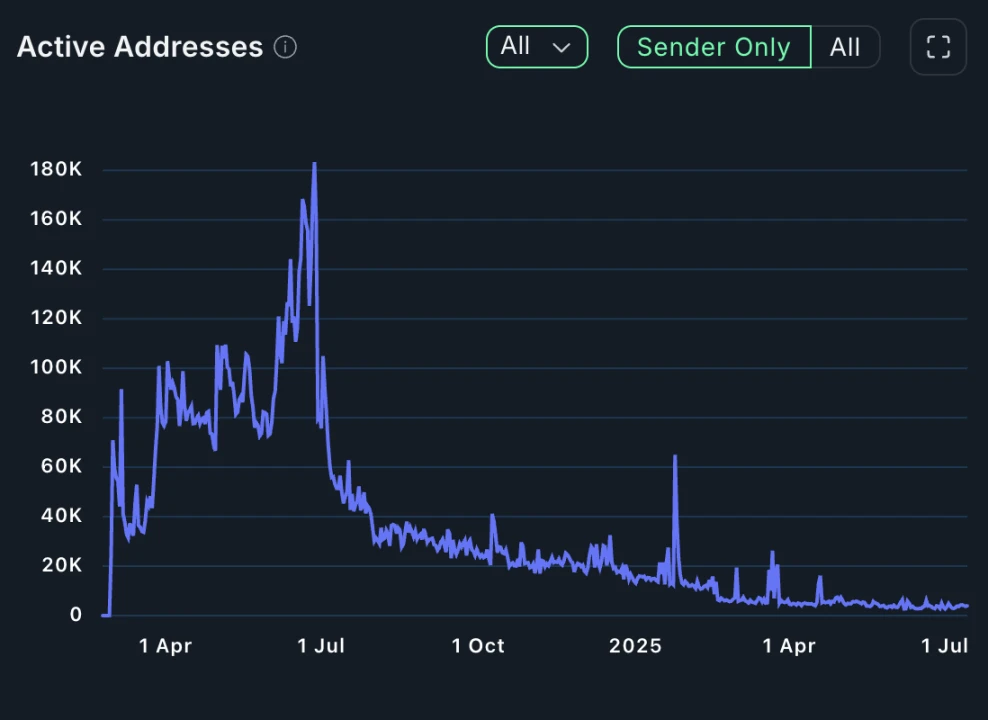
数据方面,据 DeFiLlama,Blast 生态 DeFi 总锁仓额目前仅为 8700 万美元,而在巅峰时期的 22 亿美元缩水超 95% 。另据 Nansen 数据,Blast 网络单日活跃地址在 2024 年 6 月底曾达到 18 万以上,但自此之后直线下降,近几个月仅维持在 2000-5000 区间。另外,每日合约部署量降至两位数或百位数出头,代币部署数量更是跌至个位数,这也说明了开发者的热情消退。
Fantasy.top出走背后:Blast生态已日暮西山?

来源:Nansen

典型项目迁移案例

  • pump.fun: 2024 年 1 月在 Solana 上线,一个多月后曾上线 Blast,但未获太多关注,数月后便停止在 Blast 的运营。

  • 彩票应用 Megapot(菠菜应用,请勿使用)也从 2025 年 3 月份从 Blast 迁移到 Base 生态。

  • Ethos Network:原本计划在 Blast 上线,最终选择直接在 Base 启动。Ethos Network 目前是 Base 生态的热门声誉协议。

  • Blast BIG BANG 获奖项目 Baseline:后期也迁移到到 Base 生态。

这些案例共同指向一个结论:Blast 在吸引和留存项目方面正遭遇严峻挑战。尽管作为「原生收益型以太坊 Layer 2 」曾被寄予厚望,但其生态发展显然未能兑现早期承诺。

Blast 生态近期风波

近期,Blast 生态的负面信号或风波进一步加剧了市场对其的担忧:

2025 年 5 月份,Blast 宣布将不再续签与 Safe 的服务协议,不过支持通过 BrahmaFi 的前端或自托管前端访问多签钱包。Pacman 解释称,原因有很多,其中之一是已经有很多支持 Blast 的替代方案。但这一决策被外界解读为生态基础设施的收缩。

次月,Blast 生态 DEX Thruster 宣布决定逐步停止 Thruster 的运营。Thruster 官方解释称,这是对 Thruster 现状、预期、周边生态系统以及未来前景全面评估后的结果。这也从侧面反映出开发者对 Blast 生态的信心不足。

受上述事件影响,Blast 生态 SocialFi 项目 EarlyFans 此前还表示,「鉴于 Blast 不再续签与 Safe 的服务协议以及 Thruster 的停止运营,将资产保留在 Blast 网络上的风险越来越大,并从 Thruster 撤回了 EARLY 代币的 LP(价值 7 万美元)。」当然,最终,EarlyFans 转入「维护模式」,转向开发完全原生的移动端应用 8020 。

一系列连锁反应表明,Blast 生态的信任基础正在瓦解。当基础设施合作断裂、核心应用停摆,开发者和用户自然会选择更稳定的网络。

Blast 为何从聚光灯走向式微?

Blast 从巅峰跌落的背后,是多重因素的叠加作用:

一、NFT 的大幅降温:Blast 和 Blur 深度绑定,NFT 市场的降温,对 Blast 产生了巨大冲击。

二、积分经济与真实需求的错配 :Blast 用「存入即挖矿」、「积分换空投」快速堆高 TVL,但大量地址只为薅积分而来,协议层缺少让用户留下来的理由。

三、代币价格:BLAST 和 BLUR 价格距离历史高点跌逾 90% ,严重打击了投资者与开发者的信心。在加密市场中,代币价格往往与生态活跃度形成正向循环,而价格的持续低迷进一步削弱了 Blast 的吸引力。

四、生态多样性匮乏:Blast 的 DApp 生态在多样性远不及 Base 等竞争对手。多数用户仅为赚取空投积分而跨链,实际参与应用互动的意愿极低,导致网络活跃度持续下滑。

五、叙事透支与竞争:「原生收益」曾是 Blast 的核心卖点,但当市场对其叙事失去新鲜感,而生态又未能拿出突破性应用时,被竞争对手超越成为必然。

小结

Fantasy.top 的离开,无疑是 Blast 生态吸引力衰减的注脚。当积分激励不再万能、叙事失去新鲜感,开发者自然会流向更稳定、流动性更强、用户更真实的网络。

回顾 Blast 的兴衰,其创始人虽凭借早期营销吸引了一批优秀开发者,却未能构建起支撑生态持续发展的基础设施与用户粘性。这也再次印证了加密世界的残酷法则:依赖短期投机与流量套路或许能赢得一时关注,但只有真正解决用户需求、构建健康生态,才能在激烈竞争中立足。

从 Blast 到 Base 的迁移潮,不仅是单个项目的选择,更是 Layer 2 赛道「去泡沫化」的必然。

Похожее

Xpeng and NIO Compete on Computing Power, Li Auto Shifts Architecture

On June 15, 2026, Li Auto unveiled details of its self-developed chip, Mahe M100, for its new L9 Livis model. CTO Xie Yan stated the goal was not just a faster chip, but a fundamentally different one, targeting the chip architecture itself. While competitors like NIO, Xpeng, and Huawei highlight TOPS (computing power) figures for their self-developed chips, Li Auto’s Mahe M100 focuses on redesigning the underlying architecture. It employs a "dynamic data flow architecture" to address memory bandwidth bottlenecks in large model inference, claiming up to 3x the effective computing power of Nvidia's Thor U for its specific workloads and a 40% reduction in latency. The chip's design was peer-reviewed and accepted at ISCA 2026. However, this performance is highly optimized for Li Auto's own VLA2.1 algorithm, meaning it may not generalize as well to other tasks. Li Auto aims to achieve full-stack in-house development with Mahe M100, covering chip, compiler, OS, AI algorithms, and domain controller—a level of vertical integration few competitors match. Beyond the chip, CEO Li Xiang introduced a new strategic narrative: the "embodied intelligent vehicle," defined as an integration of an EV, a professional driver, an AI computer, and a life assistant. This shifts competition from features like large screens to systemic AI capabilities. A key commitment was that Li Auto's Mahe VLA autonomous driving model will match Tesla's FSD V14 by Q4 2026, with specific OTA milestones set for July, September, and December. Financially, Li Auto faces pressure with declining revenue and vehicle gross margins since Q4 2025, while maintaining high R&D investment (approx. ¥12B in 2026, 50% AI-related). Its 2026 sales target is 550,000 vehicles, up from 406,000 in 2025. The new L9 Livis garnered over 10,000 pre-orders in two weeks. The effectiveness of these strategic moves—new products, OTAs, and the novel chip architecture—will begin to show in Q3 2026 financial results, with the year-end FSD V14 benchmark being the ultimate test.

marsbit53 мин. назад

Xpeng and NIO Compete on Computing Power, Li Auto Shifts Architecture

marsbit53 мин. назад

The Year of AI Applications: Saying 'Yes' While Ignoring Risks? A Comprehensive Open Source Log of Software Development's Journey

The Year of AI Applications: Blindly Saying "Yes" While Ignoring Risks? A Software Development Log Goes Fully Open Source. AI-generated code harbors risks hidden within seemingly correct programs, potentially leading to data leaks or asset loss. The open-source project "Narwhal AI Code Risks," from Peking University's Narwhal-Lab, compiles real-world cases, early warning signs, and typical risk pathways. Its goal is to help developers identify potential hazards early and avoid repeating past mistakes. In 2026, code is generated faster than ever but deployed with less scrutiny. The danger often lies not in glaring errors, but in code that appears normal—syntactically correct, passing all checks—yet introduces subtle but critical flaws like non-existent dependencies, excessive permissions, or exposed databases. A stark example is the Moonwell cbETH oracle incident. A configuration file error, where a cryptocurrency price was set to ~$1.12 instead of ~$2,200, slipped through 28 checks and a pull request signed by both AI (Claude, Copilot) and human developers. This "semantic deviation" resulted in a loss of $1.78 million. The risk is that AI can produce functionally valid code that is semantically wrong for the business context. As AI moves beyond simple code completion to modifying configurations, installing dependencies, and operating via autonomous agents, it traverses longer, less traceable paths within software engineering, blurring traditional boundaries and oversight points. The Narwhal AI Code Risks project structures information into three layers: `/cases` for documented real-world incidents, `/inferred` for early warning signals, and `/scenarios` for clear, generalized risk patterns not yet tied to specific events. This aims to create a lasting, public record to prevent collective amnesia about past AI-coding pitfalls. Risks are categorized into seven areas: Software Supply Chain (e.g., recommending fake packages), Code-Level Vulnerabilities (e.g., reintroducing path traversal bugs), Cloud & Infrastructure Misconfiguration (e.g., overly permissive settings), Agent Risks (from autonomous tool execution), Vertical Domain Risks (e.g., in finance, healthcare), Intellectual Property & Compliance issues, and Human Factors (like over-reliance on AI output). The project's core value is transforming isolated incidents into reusable knowledge—a foundational resource for developers to spot similar issues, for security researchers to build upon, for toolmakers to create detection rules, and for the community to contribute new findings. As AI integration accelerates, this open-source "logbook" serves as a crucial navigational aid, charting past errors to help future projects steer clear of the same traps.

marsbit53 мин. назад

The Year of AI Applications: Saying 'Yes' While Ignoring Risks? A Comprehensive Open Source Log of Software Development's Journey

marsbit53 мин. назад

The Foundation of SpaceX's Trillion-Dollar Valuation: Who is Dividing Up Musk's Annual Tens of Billions in Capital Expenditure?

SpaceX's trillion-dollar valuation is built on its three core businesses: Starlink (profitable, 60% of revenue), rockets (driving down launch costs), and AI (a major investment area). This creates a financial cycle: Starlink funds rocket development, which enables low-cost launches for AI hardware, generating future revenue. This cycle fuels annual capital expenditures of tens of billions, flowing to a vast supply chain. Suppliers are categorized by their replaceability. The first group includes irreplaceable players like NVIDIA (GPU/CUDA ecosystem), Eutelsat (critical radio spectrum), Filtronic (specialized amplifiers), Materion (strategic beryllium), and STMicroelectronics (antenna chips). The second group consists of hard-to-replace suppliers due to high switching costs, such as Honeywell (flight control), Carpenter Technology (specialty alloys), Hexcel (carbon fiber), Broadcom (data exchange), and Linde (industrial gases). The third group comprises high-volume, cost-critical suppliers for mass-produced items like Starlink terminals. Key names include Wistron NeWeb (primary manufacturer) and several A-share companies like Shenzhen Sunway (connectors), Pies New Materials (forgings), Western Superconducting (alloys), and Yingliu (castings). Other niche players include Trimble (timing), Astronics (power distribution), and CTS (thermal management). The article argues that investing in these suppliers, rather than SpaceX stock directly, offers an alternative opportunity. The rationale is threefold: procurement is just beginning to scale, SpaceX's IPO brings new transparency to its supply chain, and the situation mirrors early stages of past "super terminal" ecosystems like Apple or Tesla. While risks exist (commodity cycles, geopolitical factors, technology shifts), the core thesis is that SpaceX's massive, ongoing procurement will translate into reliable revenue for its key suppliers, regardless of its own stock price volatility.

marsbit1 ч. назад

The Foundation of SpaceX's Trillion-Dollar Valuation: Who is Dividing Up Musk's Annual Tens of Billions in Capital Expenditure?

marsbit1 ч. назад

SpaceX's Trillion-Dollar Valuation Base: Who's Sharing in Musk's Annual Tens of Billions in Capital Expenditure?

**Title: The Foundation of SpaceX's Trillion-Dollar Valuation: Who Benefits from Musk's Annual $100 Billion Capital Expenditure?** This article argues that investors seeking to benefit from SpaceX's growth might find greater opportunities in its supply chain rather than directly investing in the company itself, drawing parallels to historical successes with Apple, Tesla, and NVIDIA suppliers. **SpaceX's Business Model & Cash Flow:** SpaceX generates revenue from three main areas: 1. **Starlink:** Its profitable core, earning $11.3B in 2023 (60% of revenue), funding other ventures. 2. **Rockets (Falcon/Starship):** Requires $3B+ in annual R&D but achieves the world's lowest launch costs. 3. **AI:** Currently unprofitable (-$6B+ in 2023), investing heavily in ground-based supercomputers (220,000 GPUs) and future orbital data centers. The cycle is: Starlink profits → fund cheaper rockets → low-cost launches deploy AI hardware → AI compute rentals generate future revenue. This cycle drives annual procurement spending of tens of billions of dollars. **The Supply Chain Beneficiaries:** Suppliers are categorized by their replaceability: **1. Nearly Irreplaceable (High Barriers to Entry):** * **NVIDIA:** Powers the Colossus supercomputer; its CUDA ecosystem creates immense switching costs. * **Eutelsat (SATS):** Controls critical radio spectrum for satellite communications; holds a ~3% stake in SpaceX. * **Filtronic (FTC):** Supplies millimeter-wave signal amplifiers for Starlink satellites; SpaceX constitutes 83% of its revenue. * **Materion (MTRN):** Global leader in beryllium production, a strategic material used in Starship structures. * **STMicroelectronics (STM):** Supplies phased-array antenna chips for Starlink satellites. **2. Replaceable, but Switching Cost is Prohibitively High:** * **Honeywell (HON):** Provides flight control and inertial navigation systems with decades of certification. * **Carpenter Technology (CRS):** Manufactures ultra-pure specialty steel alloys for Raptor engines. * **Hexcel (HXL):** Supplies custom carbon fiber composites developed over a decade with SpaceX. * **Broadcom (AVGO):** Manages high-speed data switching. * **Linde Group:** Supplies industrial gases (liquid oxygen/nitrogen) from facilities built near SpaceX launch sites. **3. High-Volume, Cost-Critical Manufacturing:** Focuses on mass-producing components like Starlink user terminals (target: 30 million units). * **Key Players:** Wistron NeWeb (6285, primary terminal manufacturer), several Chinese A-share companies (e.g., Sunway Communication, PAX New Materials, Western Metal Materials, Yingliu Co.), and smaller US firms like Trimble (TRMB, timing systems). **Why Now?** Three factors make the supply chain opportunity timely: 1. **Volume Ramp-Up:** SpaceX plans 100 launches in 2026, aims for 30 million Starlink terminals, and will deploy AI data centers, meaning procurement will accelerate. 2. **Increased Transparency:** The IPO provides public financial data, allowing investors to track supplier order growth. 3. **Historical Precedent:** The current phase is likened to Tesla's early mass-production stage (circa 2018), suggesting a long growth runway for suppliers. **Conclusion:** The article posits that while investing in SpaceX stock is betting on Elon Musk's ambitious vision at a high valuation, investing in its established suppliers is a bet on the tangible, recurring revenue from its massive procurement budget, which is largely decoupled from day-to-day stock price volatility.

链捕手1 ч. назад

SpaceX's Trillion-Dollar Valuation Base: Who's Sharing in Musk's Annual Tens of Billions in Capital Expenditure?

链捕手1 ч. назад

Торговля

Спот
Фьючерсы

Популярные статьи

Как купить BLAST

Добро пожаловать на HTX.com! Мы сделали приобретение Blast (BLAST) простым и удобным. Следуйте нашему пошаговому руководству и отправляйтесь в свое крипто-путешествие.Шаг 1: Создайте аккаунт на HTXИспользуйте свой адрес электронной почты или номер телефона, чтобы зарегистрироваться и бесплатно создать аккаунт на HTX. Пройдите удобную регистрацию и откройте для себя весь функционал.Создать аккаунтШаг 2: Перейдите в Купить криптовалюту и выберите свой способ оплатыКредитная/Дебетовая Карта: Используйте свою карту Visa или Mastercard для мгновенной покупки Blast (BLAST).Баланс: Используйте средства с баланса вашего аккаунта HTX для простой торговли.Третьи Лица: Мы добавили популярные способы оплаты, такие как Google Pay и Apple Pay, для повышения удобства.P2P: Торгуйте напрямую с другими пользователями на HTX.Внебиржевая Торговля (OTC): Мы предлагаем индивидуальные услуги и конкурентоспособные обменные курсы для трейдеров.Шаг 3: Хранение Blast (BLAST)После приобретения вами Blast (BLAST) храните их в своем аккаунте на HTX. В качестве альтернативы вы можете отправить их куда-либо с помощью перевода в блокчейне или использовать для торговли с другими криптовалютами.Шаг 4: Торговля Blast (BLAST)С легкостью торгуйте Blast (BLAST) на спотовом рынке HTX. Просто зайдите в свой аккаунт, выберите торговую пару, совершайте сделки и следите за ними в режиме реального времени. Мы предлагаем удобный интерфейс как для начинающих, так и для опытных трейдеров.

361 просмотров всегоОпубликовано 2024.06.24Обновлено 2026.06.02

Как купить BLAST

Обсуждения

Добро пожаловать в Сообщество HTX. Здесь вы сможете быть в курсе последних новостей о развитии платформы и получить доступ к профессиональной аналитической информации о рынке. Мнения пользователей о цене на BLAST (BLAST) представлены ниже.

活动图片