Bitcoin breaks ATH – Identifying why BTC’s rally is just getting started!

AmbcryptoОпубликовано 2025-07-12Обновлено 2026-05-22

Введение

The signs of market exhaustion and widespread profit-taking were not here for Bitcoin despite the swift short-term rally.

Key Takeaways

Bitcoin hit $118.8K on the 11th of July, but on-chain data showed low retail activity, moderate MVRV Ratio, reduced Short-Term Holder profits, and declining Miner Position Index. All of these signal the rally isn’t over yet.

Bitcoin [BTC] was trading at $117,783, after clocking a fresh all-time high of $118,856 earlier that day, as bullish sentiment started to drive the market upward.

Google Trends showed that the Bitcoin topic was still not popular in the United States, and was far away from the peaks of 2020, or even November 2024.

No retail frenzy in sight
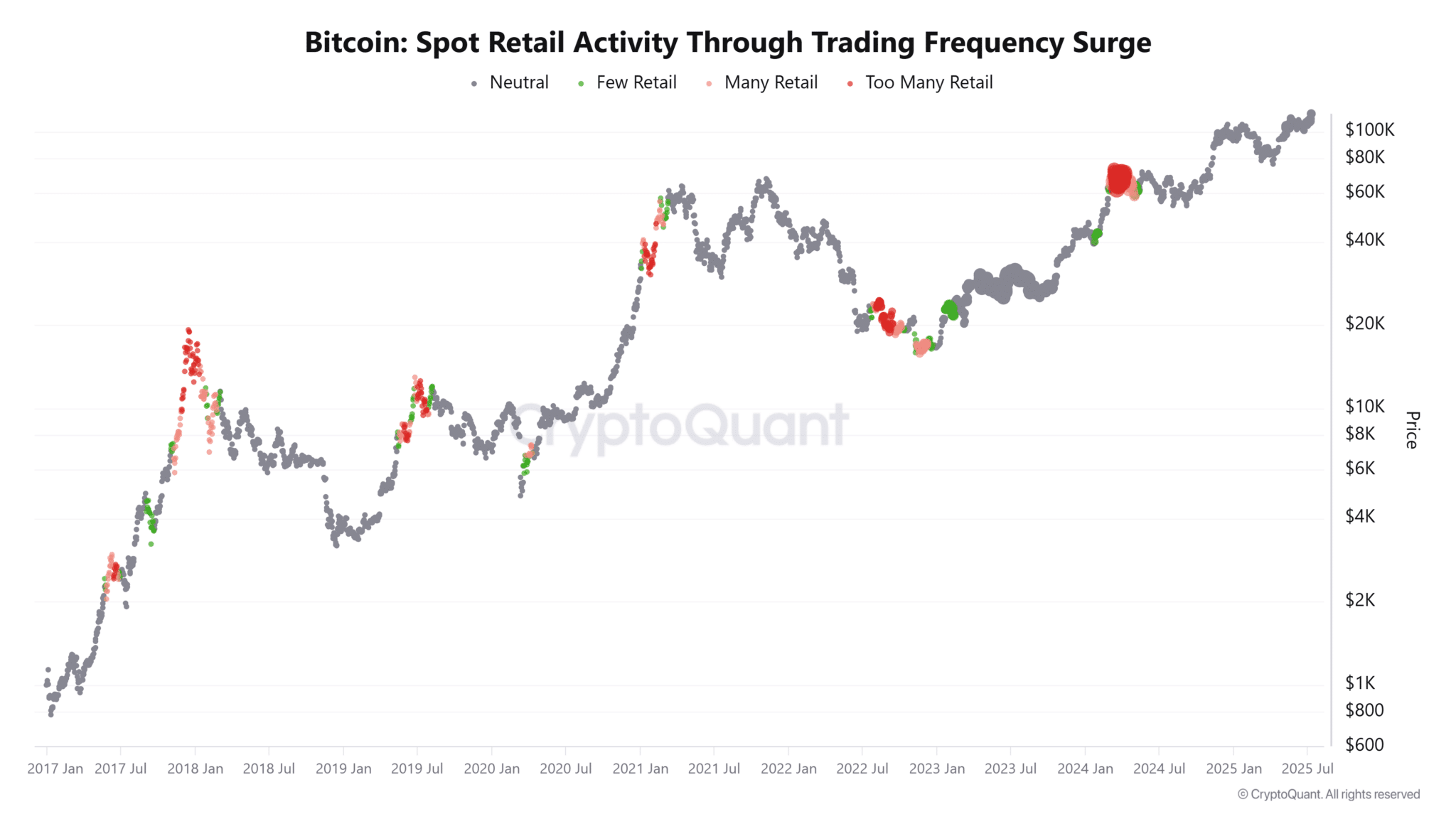
The trend of a lack of retail euphoria was visible in the Spot Retail Activity.

Using the trading frequency and position size to understand whether retail participation was increasing, this metric is a useful tool in understanding whether smaller market participants were flooding in.

According to CryptoQuant, this metric hasn’t seen a retail surge since March 2024. That mirrors earlier cycles too: in February 2021, retail jumped in, and BTC soon met rejection near $60k.

Further evidence that the Bitcoin market has not overheated
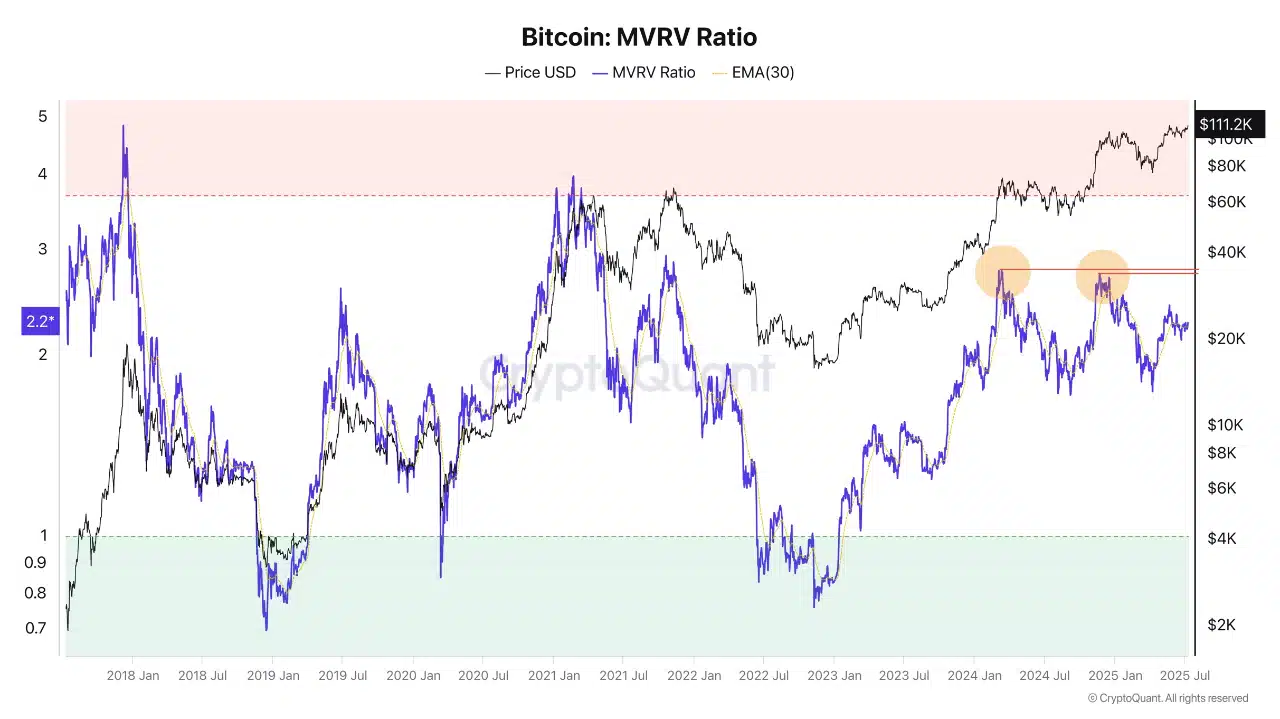
In a post on CryptoQuant Insights, analyst Avocado_onchain demonstrated how the market sentiment and dynamics were strikingly different from the previous market peaks.

The MVRV Ratio exceeded 2.7 in March and December 2024. On the 11th of July, though, the reading hovered around 2.2—a signal of healthier market conditions.
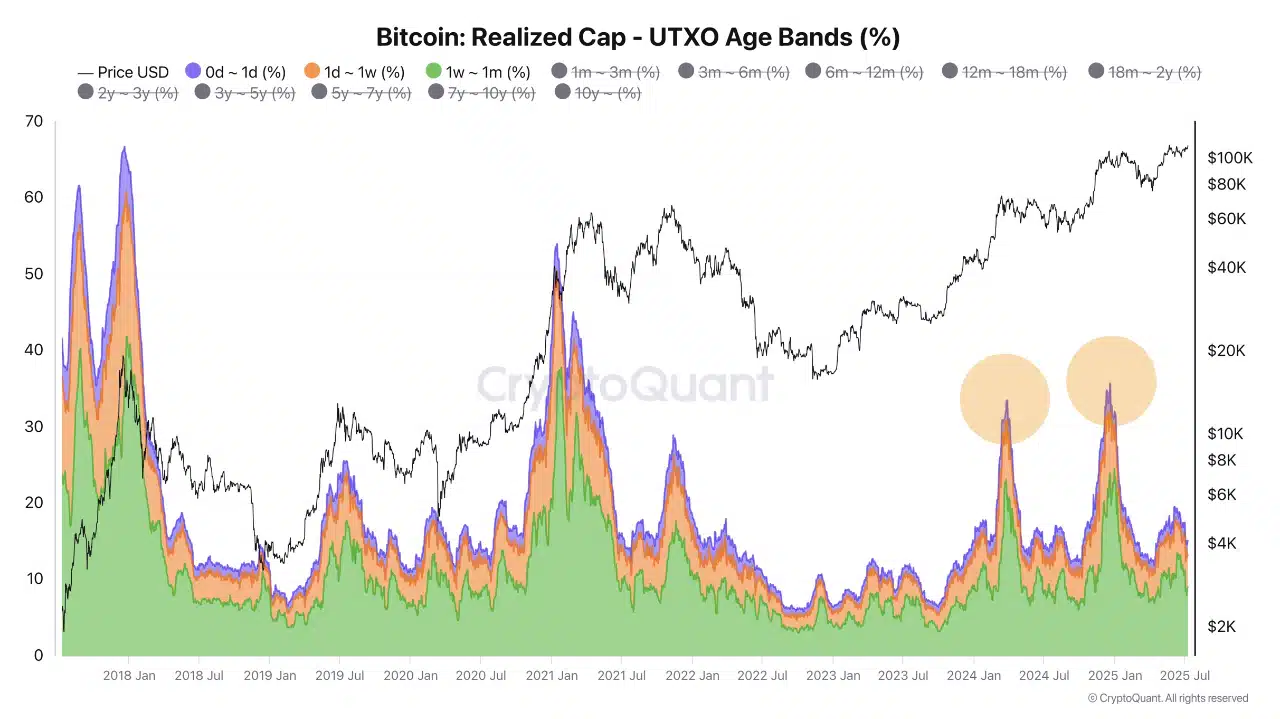
Another important cue came from the UTXO Age Bands, which analyze how long each Bitcoin remains unspent.

Data showed that 15% of the BTC supply belonged to Short-Term Holders (STH)—wallets holding coins for under a month. For context, this figure sat near 30% at prior cycle peaks.
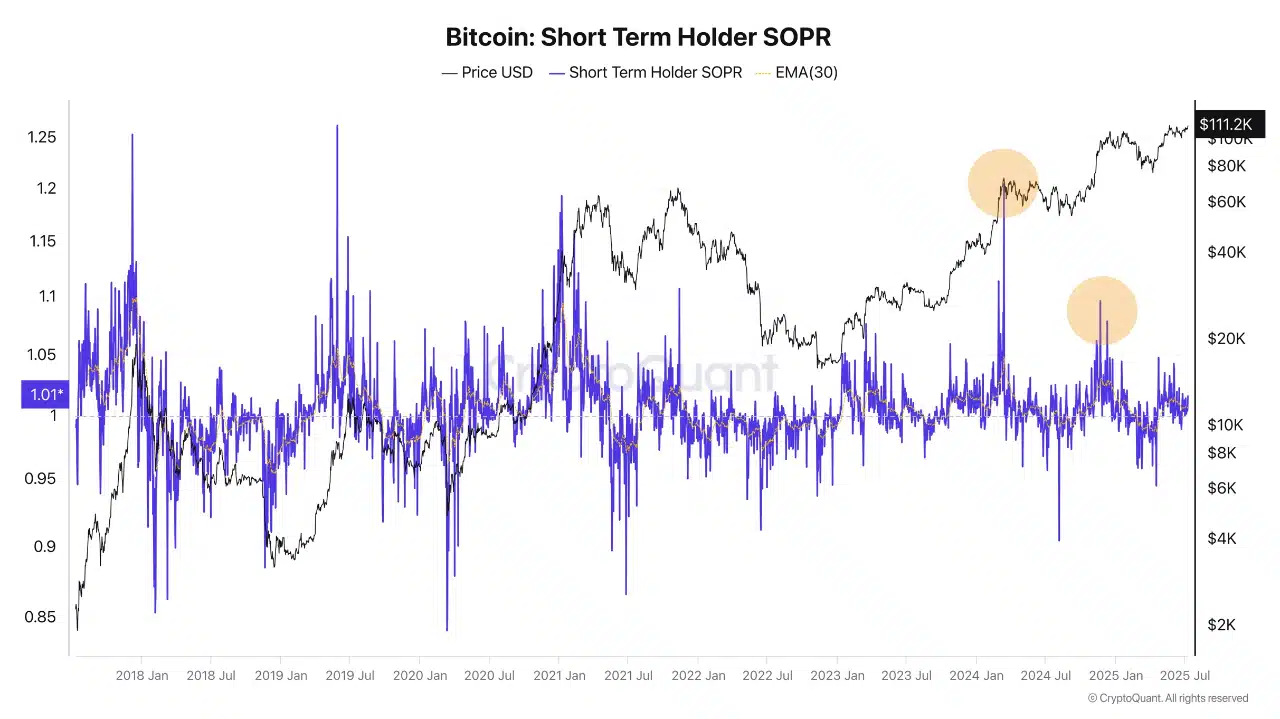
Moreover, the STH SOPR showed that holders were not sitting on large profits. This was another clue of minimal sell pressure from profit-taking activity from STH Bitcoin wallets.

Miners keep stacking – another reason bulls aren’t done
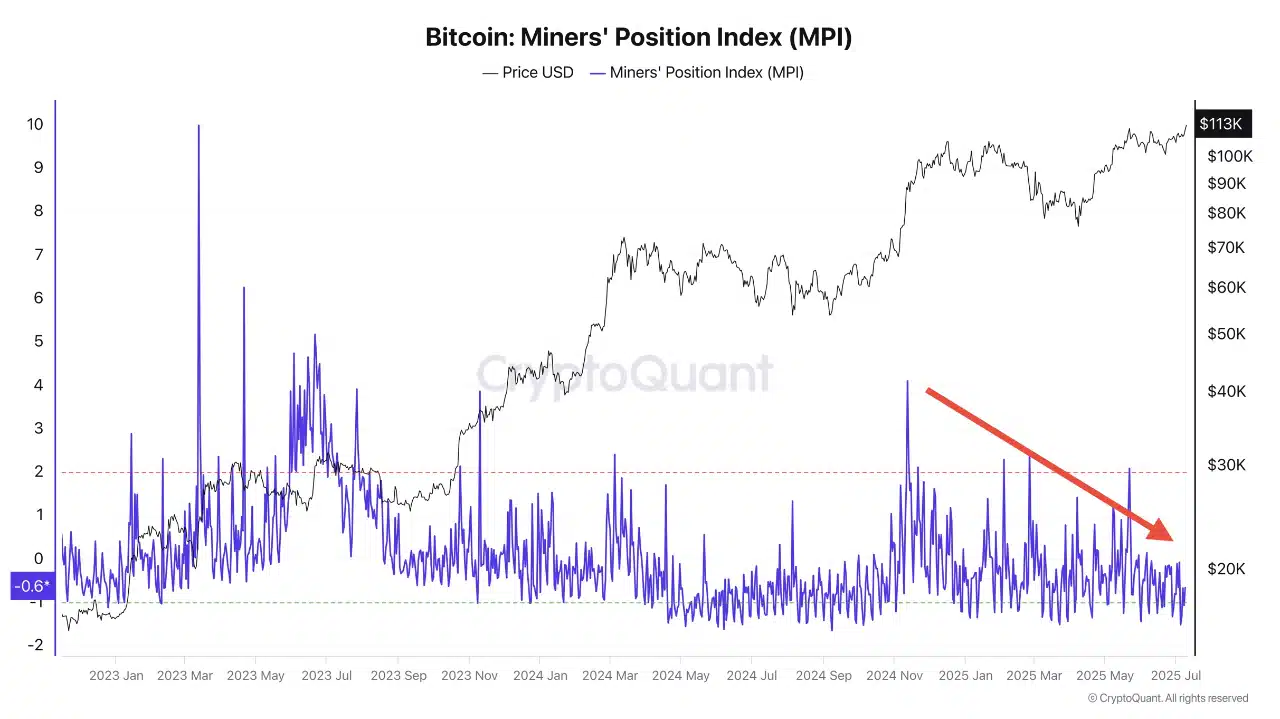
Finally, the Miner Position Index was also trending downward since November 2024. This showed reduced selling pressure from miners.

Mining companies have tended to accumulate Bitcoin instead of selling it, showing that they expected prices to continue to grow.

Overall, the signs of market exhaustion and widespread profit-taking were not here. There was hope that Bitcoin’s price would trend higher in the coming months, and the bull run was not yet over.


Похожее

Bitcoin Becomes a National Strategic Asset? U.S. Congressman Proposes Annual Purchase of 200,000 BTC, Locked for 20 Years Without Sale

U.S. Representative Nick Begich (R-Alaska) introduced the "American Reserve Modernization Act" (ARMA) on May 21, aiming to codify a strategic Bitcoin reserve into law. Building on a prior executive order, the bill seeks to establish a permanent national Bitcoin reserve managed by the Treasury Department. The proposed legislation would authorize the Treasury to acquire up to 200,000 Bitcoin annually for five years, targeting a total reserve of 1 million Bitcoin, roughly 5% of the total supply. All acquired Bitcoin would be locked and held for at least 20 years. Representative Begich likened Bitcoin's role in crypto to gold's in precious metals, calling it the dominant store of value in its asset class. The U.S. government currently holds approximately 328,000 Bitcoin, largely from law enforcement seizures, but lacks a coherent management strategy for these assets. Co-sponsors emphasized the urgency of addressing this gap. This move coincides with a wave of crypto-friendly legislation in Washington, including recent bipartisan committee approval of a major digital asset market structure bill. Concurrently, the Treasury has intensified crackdowns on illicit crypto finance, seizing hundreds of millions in assets, further highlighting the need for a comprehensive digital asset strategy. The White House has indicated that operational details for the strategic Bitcoin reserve are forthcoming, with key legal hurdles reportedly cleared.

marsbit12 мин. назад

Bitcoin Becomes a National Strategic Asset? U.S. Congressman Proposes Annual Purchase of 200,000 BTC, Locked for 20 Years Without Sale

marsbit12 мин. назад

Secures Over $60 Million in Funding from Dragonfly, Sequoia, and Others. An In-Depth Look at the On-Chain Derivatives Protocol Variational | CryptoSeed

Variational, a decentralized derivatives trading platform, has raised over $61.8 million in total funding, including a recent $50 million Series A led by Dragonfly Capital. Investors include Sequoia Capital, Coinbase Ventures, Bain Capital Crypto, and Hack VC. The platform, with over $810 million in Open Interest (ranking 4th among on-chain derivatives protocols), is founded by Lucas Schuermann and Edward Yu. Both are Columbia University graduates and former partners at quant fund Qu Capital. They later held senior roles at Genesis Trading, handling billions in trading volume. The broader team includes talent from Google, Meta, and top trading firms like Jane Street. Operating on Arbitrum, Variational distinguishes itself by aggregating external liquidity from CEXs, DEXs, and traditional market makers using an RFQ (Request-for-Quote) model, positioning itself more as a broker than an exchange like Hyperliquid. Its dual product line features Omni for retail users (offering up to 50x leverage on ~450+ crypto and TradFi pairs) and Pro for institutional OTC trading. Currently in a pre-TGE phase, Variational has launched an "Omni Points" system, with 50% of its upcoming $VAR token supply allocated for community incentives through trading-based rewards and referrals until Q3 2026.

链捕手56 мин. назад

Secures Over $60 Million in Funding from Dragonfly, Sequoia, and Others. An In-Depth Look at the On-Chain Derivatives Protocol Variational | CryptoSeed

链捕手56 мин. назад

Blockchain Capital Partner: The Structure of On-Chain Two-Tier Capital Is Still in the Early Stages of Value Discovery

Spencer Bogart, a general partner at Blockchain Capital, argues that the on-chain economy possesses unique features like programmability, composability, and global distribution, fostering an open and fast-paced innovation ecosystem. However, these very features create challenges for large, fiduciarily-responsible institutional capital, which requires robust risk assessment frameworks often difficult in a permissionless and adversarial environment. The proposed solution is the emergence of a two-tiered capital structure. The first, permissionless layer remains the crucible for innovation, where protocols are built, tested, and hardened with real capital. The second, "institutional" layer consists of chains (L1s, L2s, etc.) that, while based on similar code, incorporate risk-management features like the ability to pause or freeze transactions in extreme scenarios, making them suitable for large-scale institutional deployment. The synergy between these layers is key. Protocols proven resilient in the open, permissionless environment can then scale to the institutional layer, accessing deeper capital pools. This creates a lifecycle: build and launch permissionlessly, test and prove robustness publicly, then expand to an institutional-grade chain for scaled adoption. This architecture allows the open, experimental side to continue driving innovation with crypto-native capital, while the institutional layer provides the liquidity, stability, and trust required for mainstream adoption. The major challenge identified is the "cold start" problem: aligning where institutional capital prefers to go with where the most proven applications and network effects currently reside. How this dynamic resolves—whether through protocol migration, new protocol builds, or institutional adaptation—will be crucial to watch. Overall, this evolving structure aims to combine the strengths of open innovation and institutional depth within a shared on-chain ecosystem.

链捕手1 ч. назад

Blockchain Capital Partner: The Structure of On-Chain Two-Tier Capital Is Still in the Early Stages of Value Discovery

链捕手1 ч. назад

Торговля

Спот
Фьючерсы

Популярные статьи

Тест по Bitcoin Биткоина

HTX Learn: Изучите Bitcoin halving и Заработаете Токены USDT

3.0k просмотров всегоОпубликовано 2024.04.16Обновлено 2024.04.16

Тест по Bitcoin  Биткоина

Что такое $BITCOIN

ЦИФРОВОЕ ЗОЛОТО ($BITCOIN): Комплексный анализ Введение в ЦИФРОВОЕ ЗОЛОТО ($BITCOIN) ЦИФРОВОЕ ЗОЛОТО ($BITCOIN) — это проект на основе блокчейна, работающий в сети Solana, который стремится объединить характеристики традиционных драгоценных металлов с инновациями децентрализованных технологий. Хотя он носит имя Биткойн, часто называемого “цифровым золотом” из-за его восприятия как средства хранения ценности, ЦИФРОВОЕ ЗОЛОТО является отдельным токеном, предназначенным для создания уникальной экосистемы в ландшафте Web3. Его цель — позиционировать себя как жизнеспособный альтернативный цифровой актив, хотя детали его применения и функциональности все еще развиваются. Что такое ЦИФРОВОЕ ЗОЛОТО ($BITCOIN)? ЦИФРОВОЕ ЗОЛОТО ($BITCOIN) — это токен криптовалюты, специально разработанный для использования в блокчейне Solana. В отличие от Биткойна, который выполняет широко признанную роль хранения ценности, этот токен, похоже, сосредоточен на более широких приложениях и характеристиках. Примечательные аспекты включают: Инфраструктура блокчейна: Токен построен на блокчейне Solana, известном своей способностью обрабатывать высокоскоростные и недорогие транзакции. Динамика предложения: ЦИФРОВОЕ ЗОЛОТО имеет максимальное предложение, ограниченное 100 квадриллионами токенов (100P $BITCOIN), хотя детали о его обращающемся предложении в настоящее время не раскрыты. Утилита: Хотя точные функциональные возможности не описаны, есть указания на то, что токен может быть использован для различных приложений, потенциально связанных с децентрализованными приложениями (dApps) или стратегиями токенизации активов. Кто создатель ЦИФРОВОГО ЗОЛОТА ($BITCOIN)? На данный момент личность создателей и команды разработчиков, стоящих за ЦИФРОВЫМ ЗОЛОТОМ ($BITCOIN), остается неизвестной. Эта ситуация типична для многих инновационных проектов в области блокчейна, особенно тех, которые связаны с децентрализованными финансами и феноменом мем-криптовалют. Хотя такая анонимность может способствовать культуре, ориентированной на сообщество, она усиливает опасения по поводу управления и ответственности. Кто инвесторы ЦИФРОВОГО ЗОЛОТА ($BITCOIN)? Доступная информация указывает на то, что у ЦИФРОВОГО ЗОЛОТА ($BITCOIN) нет известных институциональных спонсоров или значительных венчурных капиталовложений. Проект, похоже, функционирует по модели пирингового взаимодействия, сосредоточенной на поддержке и принятии сообществом, а не на традиционных путях финансирования. Его активность и ликвидность в основном сосредоточены на децентрализованных биржах (DEX), таких как PumpSwap, а не на устоявшихся централизованных торговых платформах, что еще больше подчеркивает его подход, ориентированный на grassroots. Как работает ЦИФРОВОЕ ЗОЛОТО ($BITCOIN) Операционные механизмы ЦИФРОВОГО ЗОЛОТА ($BITCOIN) можно подробно описать на основе его дизайна блокчейна и характеристик сети: Механизм консенсуса: Используя уникальный механизм доказательства истории (PoH) Solana в сочетании с моделью доказательства доли (PoS), проект обеспечивает эффективную валидацию транзакций, что способствует высокой производительности сети. Токеномика: Хотя конкретные дефляционные механизмы не были подробно описаны, большое максимальное предложение токенов подразумевает, что оно может быть предназначено для микротранзакций или нишевых случаев использования, которые еще предстоит определить. Интероперабельность: Существует потенциал для интеграции с более широкой экосистемой Solana, включая различные платформы децентрализованных финансов (DeFi). Однако детали относительно конкретных интеграций остаются неуточненными. Хронология ключевых событий Вот хронология, которая подчеркивает значимые вехи, касающиеся ЦИФРОВОГО ЗОЛОТА ($BITCOIN): 2023: Первоначальное развертывание токена происходит в блокчейне Solana, отмеченное его адресом контракта. 2024: ЦИФРОВОЕ ЗОЛОТО приобретает видимость, когда оно становится доступным для торговли на децентрализованных биржах, таких как PumpSwap, позволяя пользователям обменивать его на SOL. 2025: Проект наблюдает спорадическую торговую активность и потенциальный интерес к инициативам, возглавляемым сообществом, хотя на данный момент не зафиксировано никаких значительных партнерств или технических достижений. Критический анализ Сильные стороны Масштабируемость: Основная инфраструктура Solana поддерживает высокие объемы транзакций, что может повысить полезность $BITCOIN в различных сценариях транзакций. Доступность: Потенциально низкая цена торговли за токен может привлечь розничных инвесторов, способствуя более широкому участию благодаря возможностям дробного владения. Риски Отсутствие прозрачности: Отсутствие публично известных спонсоров, разработчиков или процесса аудита может вызвать скептицизм относительно устойчивости и надежности проекта. Волатильность рынка: Торговая активность сильно зависит от спекулятивного поведения, что может привести к значительной волатильности цен и неопределенности для инвесторов. Заключение ЦИФРОВОЕ ЗОЛОТО ($BITCOIN) является интригующим, но неоднозначным проектом в быстро развивающейся экосистеме Solana. Хотя он пытается использовать нарратив “цифрового золота”, его отход от установленной роли Биткойна как средства хранения ценности подчеркивает необходимость более четкого различения его предполагаемой утилиты и структуры управления. Будущее принятие и усвоение, вероятно, будут зависеть от решения текущей непрозрачности и более четкого определения его операционных и экономических стратегий. Примечание: Этот отчет охватывает синтезированную информацию, доступную на октябрь 2023 года, и с тех пор могут произойти события.

99 просмотров всегоОпубликовано 2025.05.13Обновлено 2025.05.13

Что такое $BITCOIN

Fractal Bitcoin: масштабирование Биткоина с помощью рекурсивной системы

Fractal Bitcoin — масштабное Layer-1-решнение, созданное на базе кода Биткоина, позволяющего достигать бесконечного масштабирования с помощью рекурсивного подхода.

2.3k просмотров всегоОпубликовано 2025.06.30Обновлено 2025.06.30

Fractal Bitcoin: масштабирование Биткоина с помощью рекурсивной системы

Обсуждения

Добро пожаловать в Сообщество HTX. Здесь вы сможете быть в курсе последних новостей о развитии платформы и получить доступ к профессиональной аналитической информации о рынке. Мнения пользователей о цене на BTC (BTC) представлены ниже.

活动图片