SHIB adds $1.4b to its market cap but can it reclaim its near-term supply zone

AmbcryptoОпубликовано 2022-06-22Обновлено 2022-06-22

Введение

SHIB not only managed to climb to a new price level, but also it also climbed up the crypto rankings by market cap to secure the #14 spot. Its strong uptrend was characterized by a significant increase in its 24-hour trading volume by more than 200%.

Shiba Inu community was in celebratory mode on 21 June after the dog-themed memecoin pumped back above the $0.00000965 price level. Most of the hype was because it managed to drop a zero, a move that has historically been considered a great win for the community.

SHIB not only managed to climb to a new price level, but also it also climbed up the crypto rankings by market cap to secure the #14 spot. Its strong uptrend was characterized by a significant increase in its 24-hour trading volume by more than 200%.

Can SHIB maintain the upside?

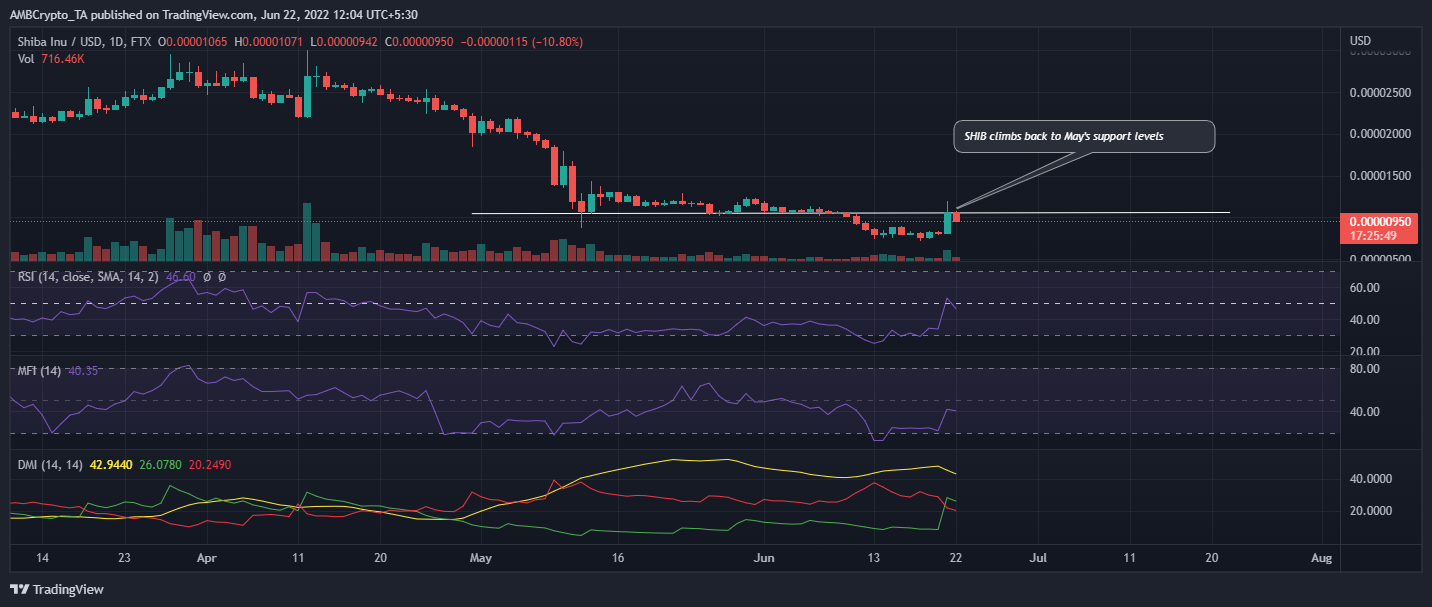
Shiba Inu traded at $0.0000119 on 21 June after a 45% rally. The strong uptrend had pushed its price back to May’s support levels. This coincided with an RSI run-up to the 50% level, which resulted in a significant increase in friction.

The same level which acted as support turned into resistance, resulting in a significant pullback at press-time.
Source: TradingView, SHIB/USD

SHIB’s bulls launched their assault at a time when the bearish trend exhibited a significant loss of momentum. This was highlighted by the drop in the -DI since 13 June. The uptick in the +DI was delayed until 20 June. Shiba Inu had already registered a significant downtrend after reversing from the support-turned-resistance line.

It also dropped below the $0.00001 price level and was down to $0.0000095 at press time. Moreover, it also dropped ranks in the crypto market from #14 to #16 largest by market cap.

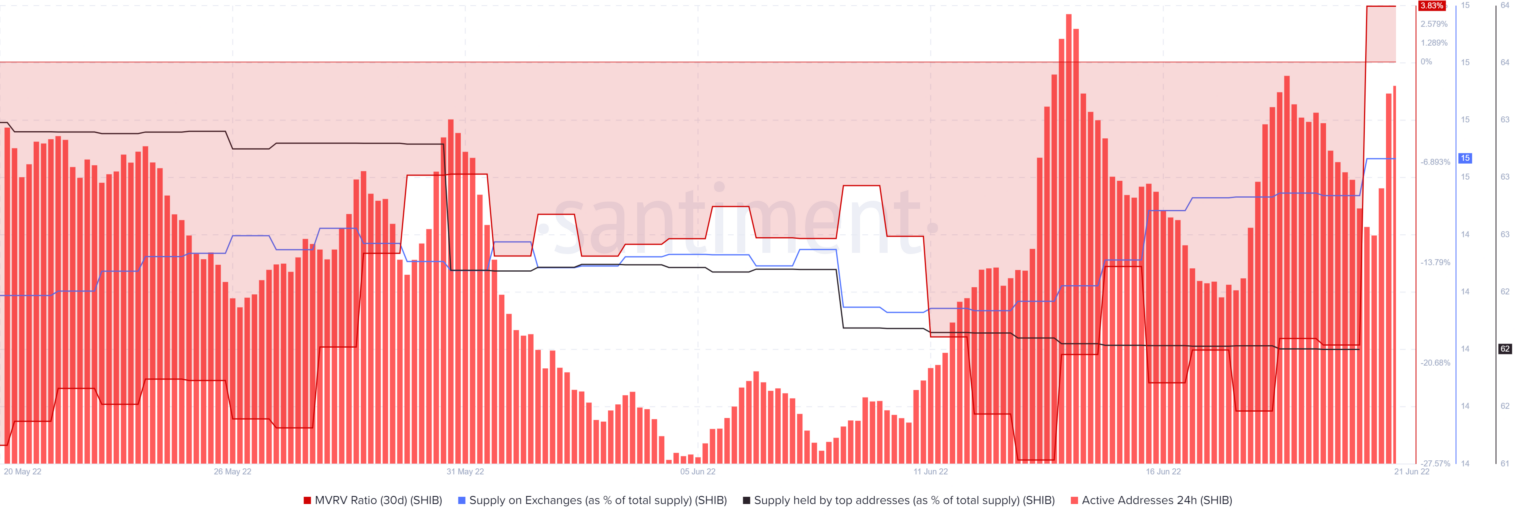
SHIB’s price uptick on 21 June (Tuesday) coincided with an increase in the number of daily active addresses by almost 1,000 addresses. While this highlights increased demand, on-chain metrics paint a different picture.

The supply on exchanges metric shows an increase from 14 June to 21 June. Meanwhile, the supply held by top addresses shows a continuous downtrend during the same time.
Source: Santiment

This confirms that there was not enough volume to sustain a continuous uptrend at least for a few days. The MVRV ratio has, however, improved from -27.3% on 13 June to 3.83% on 21 June, meaning most addresses that bought the recent dip are in profit.

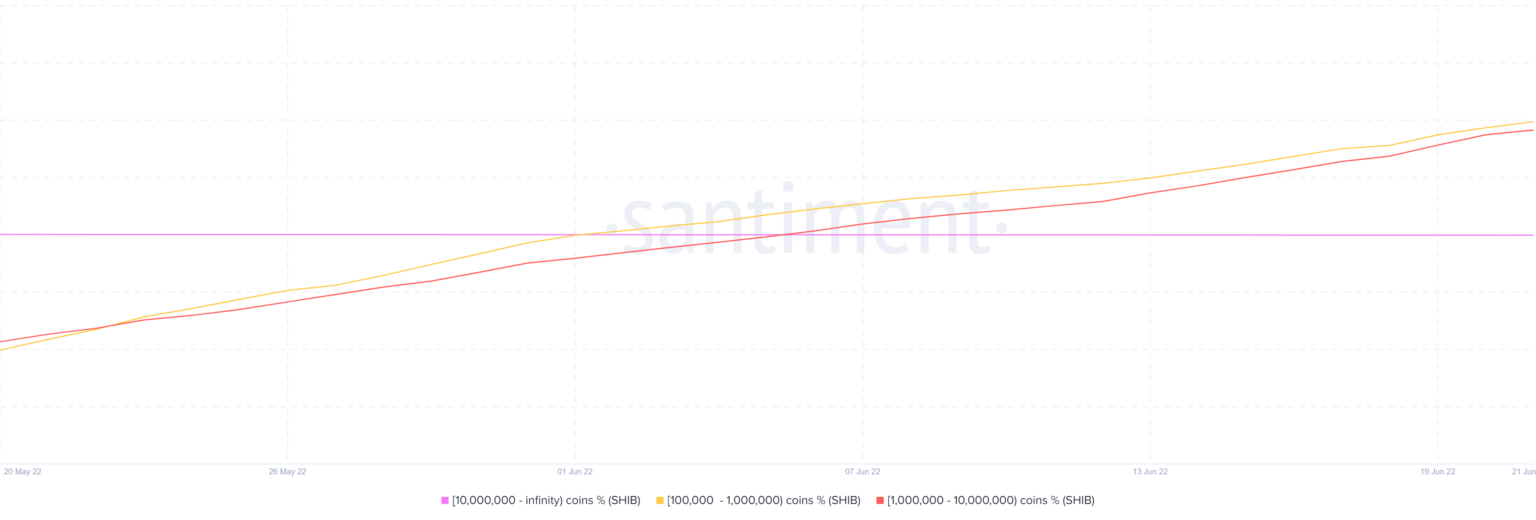
Shiba Inu’s supply distribution by balance of addresses shows a consistent increase in balances. Addresses holding between 100,000 and 10 million coins have been steadily accumulating in the last 30 days.
Source: Santiment

The last time Shiba Inu crossed above the $0.00001 price level, was in 2021 and it was backed by strong buying pressure. This time the volume was limited by the prevailing market conditions which have forced investors to tread cautiously.


Похожее

$9.4 Billion: The Largest Robotics Funding This Year Has Emerged

Munich-based humanoid robotics company Neura has completed a $1.4 billion (approximately RMB 94.9 billion) Series C funding round, valuing the company at around $7 billion and positioning it among the global leaders in the sector. The investment round is notable not just for its size—reportedly the largest in robotics this year—but also for its strategic backers, which include tech giants like NVIDIA and Amazon, alongside established industrial players such as German engineering firms Bosch and Schaeffler. This mix of investors signals a significant shift in the industry's focus from technological demonstrations and general-purpose narratives toward practical, industrial deployment and commercialization. Neura's approach centers on developing humanoid robots for defined, high-value industrial tasks rather than pursuing a general-purpose model. Its early validation comes from a partnership with BMW, where its robots are being tested on actual production lines. The involvement of Bosch and Schaeffler, companies deeply embedded in global manufacturing, underscores a growing belief that humanoid robots are transitioning from labs to viable factory-floor solutions. The article highlights two converging trends driving investment: advancements in AI and large language models, which enhance robots' perception and decision-making in unstructured environments, and mounting pressure from labor shortages and rising costs in major manufacturing regions. The funding landscape is now bifurcating between companies like Figure AI, focusing on versatile general-purpose robots, and firms like Neura, targeting specific vertical industrial applications with clearer, shorter paths to ROI. While technical hurdles remain, the core challenges for widespread adoption are increasingly seen as engineering and commercial in nature: managing the high integration and customization costs for different factory environments and establishing robust, localized maintenance and service networks. The record investment in Neura, particularly from industrial capital, indicates the industry's growing confidence in moving from proving feasibility to solving the practical problems of scalability, reliability, and building sustainable business models around humanoid robots in real-world settings like automotive manufacturing and hazardous labor environments.

marsbit13 ч. назад

$9.4 Billion: The Largest Robotics Funding This Year Has Emerged

marsbit13 ч. назад

Торговля

Спот
Фьючерсы
活动图片