MATIC’s last 80 days have this to say about the crypto’s fortunes

AmbcryptoОпубликовано 2022-06-21Обновлено 2022-06-21

Введение

Traders and investors holding on to Polygon may have spotted a 10% uptick in price over the last 24 hours. In doing so, they may have assumed that a bullish run was underway. Unfortunately, they would be wrong.

Traders and investors holding on to Polygon [MATIC] may have spotted a 10% uptick in price over the last 24 hours. In doing so, they may have assumed that a bullish run was underway. Unfortunately, they would be wrong.

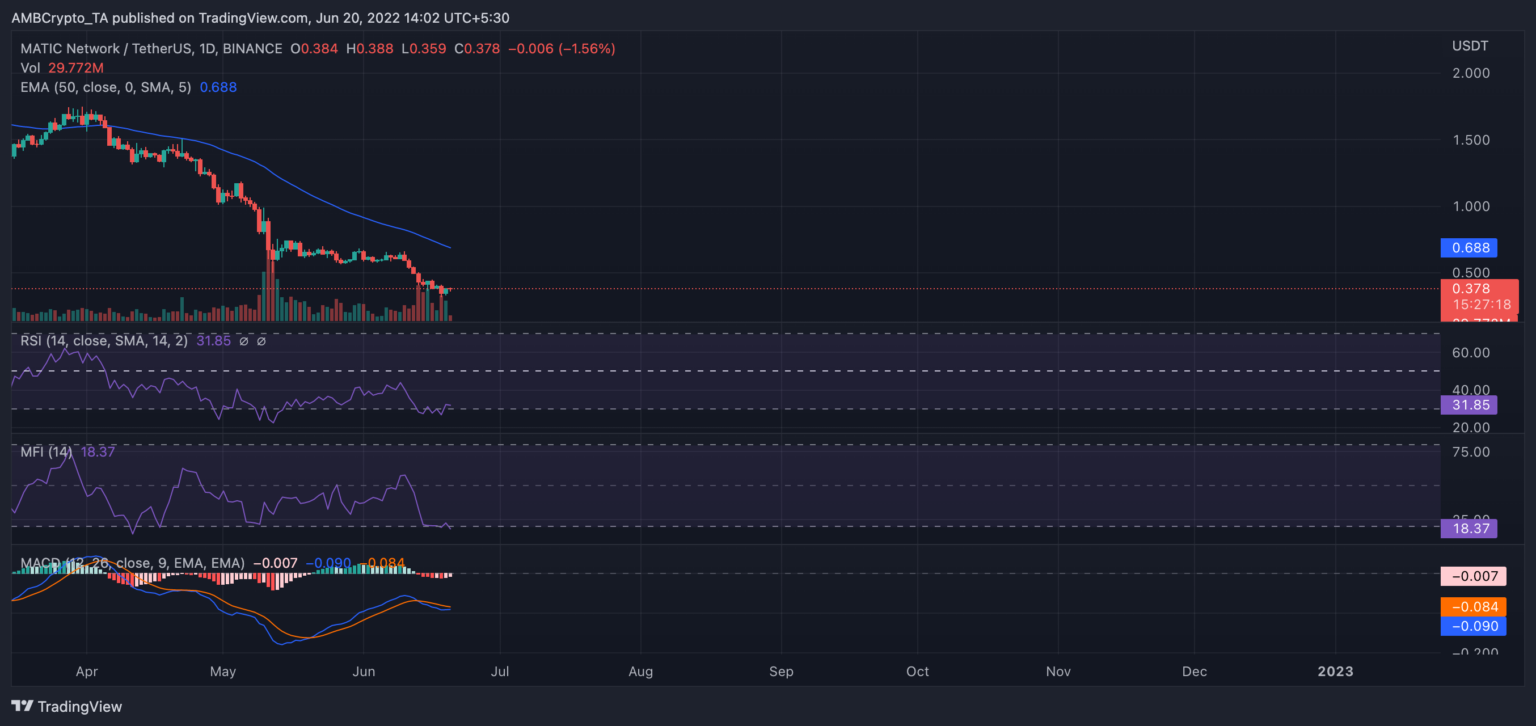
With an index price of $0.3637, the crypto has dropped back to its April 2021 levels. With the MACD poised for a bearish run, the three month-long decline in price might be far from over.

A tale of 80 days…

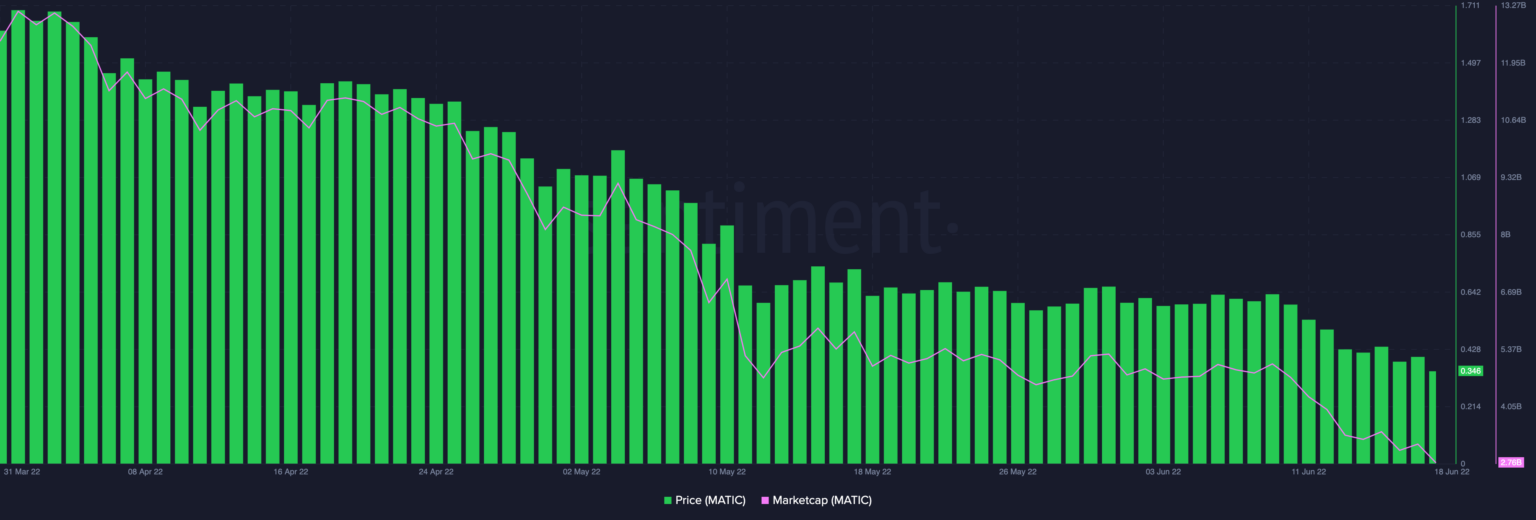
Before the plague hit, MATIC started the month at an index price of $1.62. Over the last 80 days, the altcoin has lost 77% of its value to mark a spot at $0.372.

Over the last 24 hours, the alt’s price registered a 10% uptick. Within the 80-day period, the market capitalization also declined from $12.45 billion to $2.98 billion, at the time of writing.
Source: Santiment

Struggling to keep the bears at bay, the Relative Strength Index (RSI) and the Money Flow Index (MFI) have been stationed below 50 for three months. Within that period, the RSI went as low as 22 on 12 May. The MFI also touched a low of 13 on 11 April. At press time, the RSI and MFI were deeply oversold at 31 and 18, respectively.

While the latest uptick in the price of MATIC might give investors a false sense of recovery, it is trite to point out that recovery is still far from sight. Looking at the 50 EMA showed the EMA line resting comfortably above the price.

This is indicative of a bearish bias. Also, implying a renewed bear run, the MACD line on 12 June intersected the trendline in a downward curve.
Source: TradingView

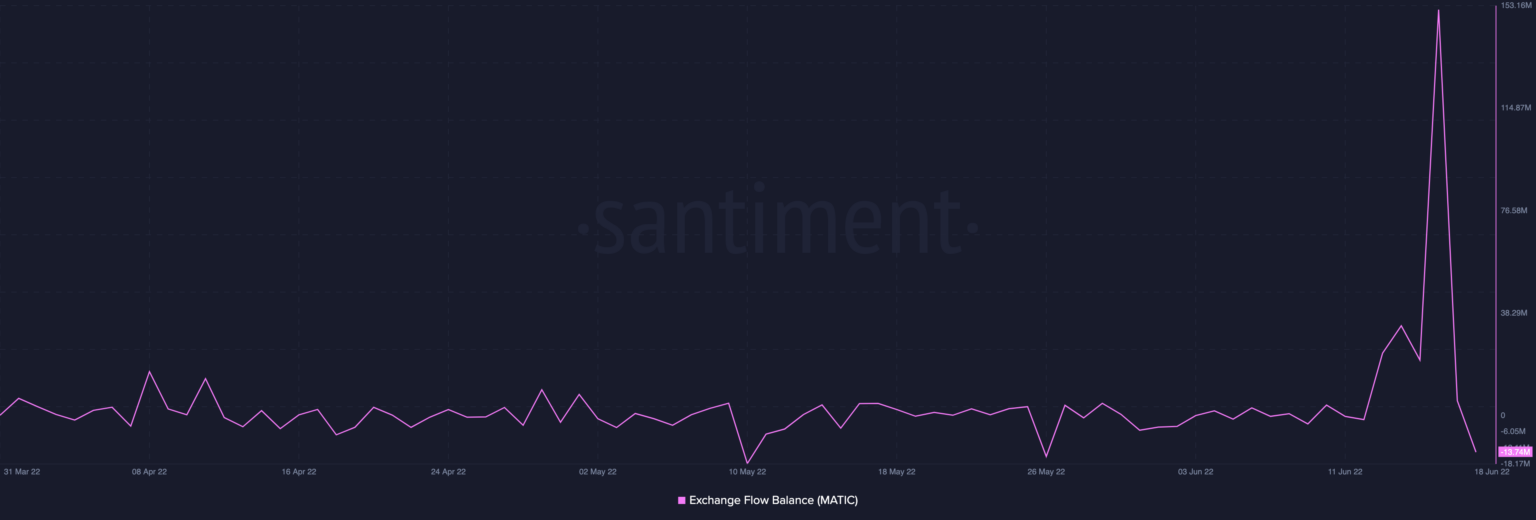
The position of the exchange flow balance metric for MATIC lent credence to its bearish outlook. With a reading of -13.74 million at press time, a price drop down seemed imminent.
Source: Santiment

On-chain analysis

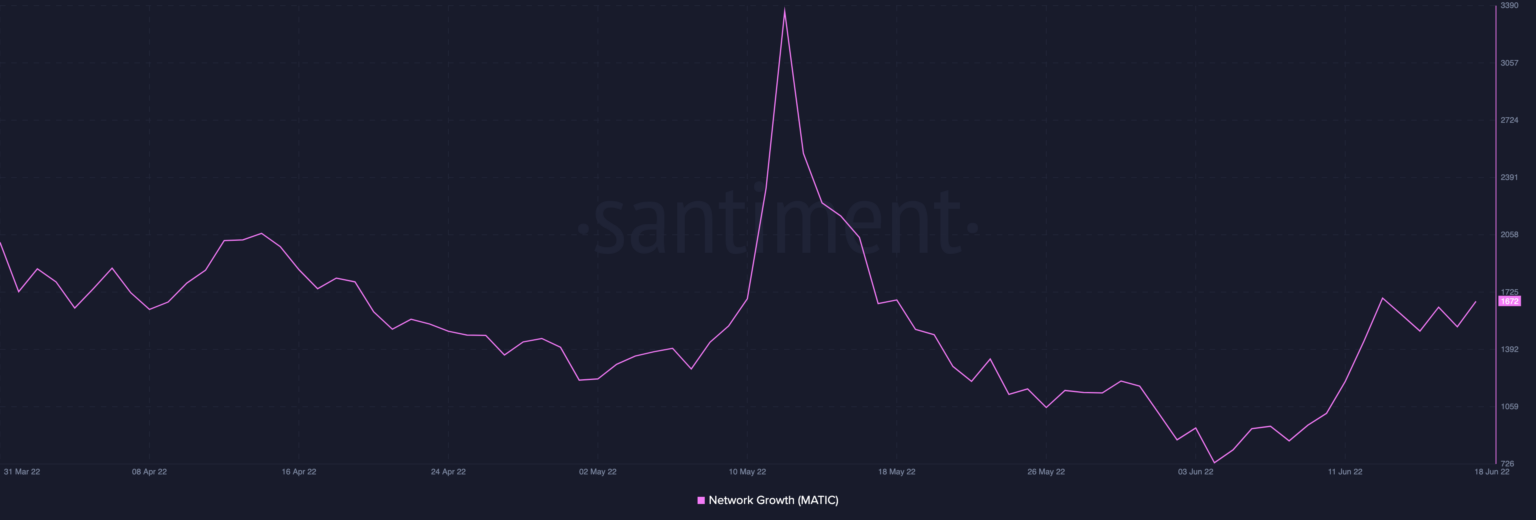
A review of MATIC’s on-chain performance over the last three months revealed a decline in the number of new addresses created on the network daily.

After registering a high of 3357 on 12 May, the network’s growth took on a downtrend. At the time of writing, it had recorded a 50% drop to be pegged at 1,672 new addresses.
Source: Santiment

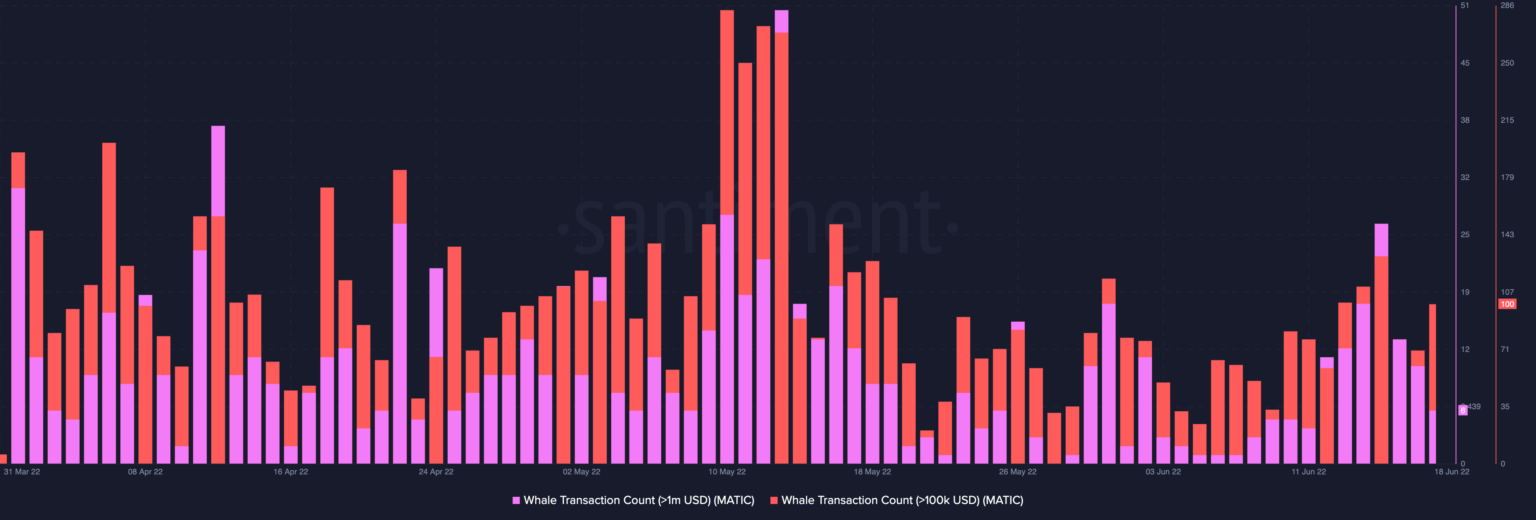
Whale accumulation of the altcoin has embarked on a steady decline since mid-May. After recording a total count of 1,079 transactions between 10 and 13 of May, the count for whale transactions above $100k has since taken a beating.

Since 13 May, a 62% decline has been registered. For transactions above $1 million, an 88% drop in count has been recorded since the high on 13 May.
Source: Santiment

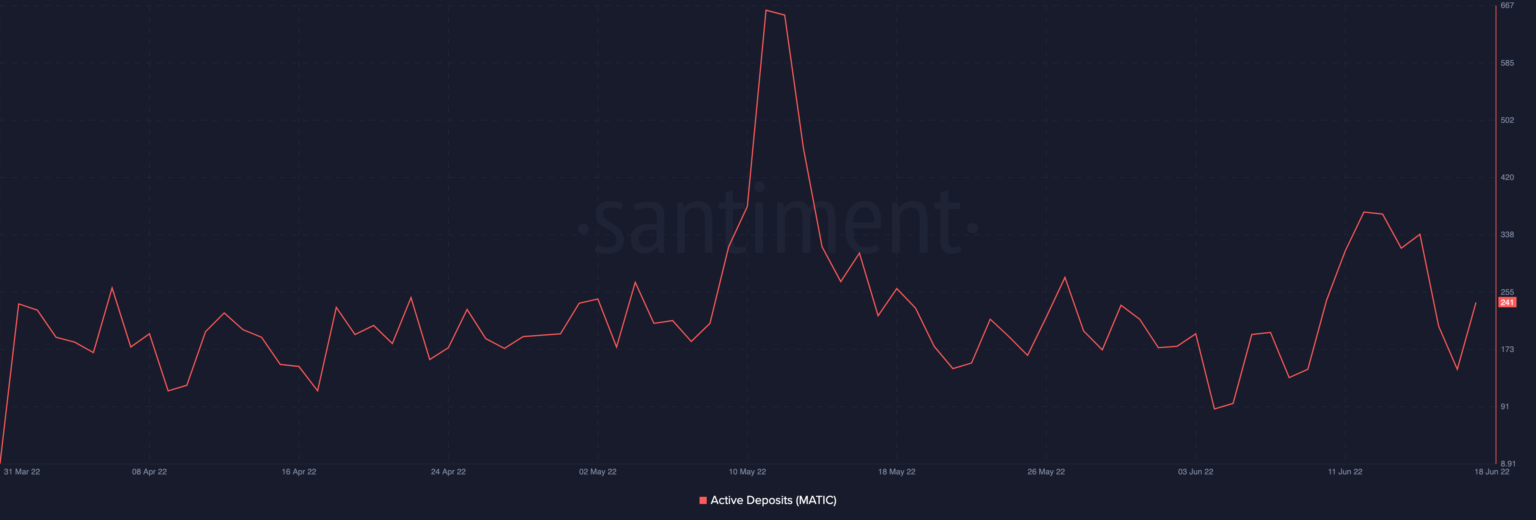
In addition to this, active deposits on the network have dropped steadily since 11 May after a high of 661.
Source: Santiment

So far this year, the Polygon Network has introduced some updates to its ecosystem. These updates include the Green Manifesto and its Carbon Neutral project. However, with a sustained decline in price, more has to be done by the network in order to retain its investors.


Похожее

$9.4 Billion: The Largest Robotics Funding This Year Has Emerged

Munich-based humanoid robotics company Neura has completed a $1.4 billion (approximately RMB 94.9 billion) Series C funding round, valuing the company at around $7 billion and positioning it among the global leaders in the sector. The investment round is notable not just for its size—reportedly the largest in robotics this year—but also for its strategic backers, which include tech giants like NVIDIA and Amazon, alongside established industrial players such as German engineering firms Bosch and Schaeffler. This mix of investors signals a significant shift in the industry's focus from technological demonstrations and general-purpose narratives toward practical, industrial deployment and commercialization. Neura's approach centers on developing humanoid robots for defined, high-value industrial tasks rather than pursuing a general-purpose model. Its early validation comes from a partnership with BMW, where its robots are being tested on actual production lines. The involvement of Bosch and Schaeffler, companies deeply embedded in global manufacturing, underscores a growing belief that humanoid robots are transitioning from labs to viable factory-floor solutions. The article highlights two converging trends driving investment: advancements in AI and large language models, which enhance robots' perception and decision-making in unstructured environments, and mounting pressure from labor shortages and rising costs in major manufacturing regions. The funding landscape is now bifurcating between companies like Figure AI, focusing on versatile general-purpose robots, and firms like Neura, targeting specific vertical industrial applications with clearer, shorter paths to ROI. While technical hurdles remain, the core challenges for widespread adoption are increasingly seen as engineering and commercial in nature: managing the high integration and customization costs for different factory environments and establishing robust, localized maintenance and service networks. The record investment in Neura, particularly from industrial capital, indicates the industry's growing confidence in moving from proving feasibility to solving the practical problems of scalability, reliability, and building sustainable business models around humanoid robots in real-world settings like automotive manufacturing and hazardous labor environments.

marsbit13 ч. назад

$9.4 Billion: The Largest Robotics Funding This Year Has Emerged

marsbit13 ч. назад

Торговля

Спот
Фьючерсы
活动图片